- The paper introduces DataClaw, an autonomous data agent that integrates with IM platforms to automate complex data workflows using natural language.
- The paper details a ReAct-based reasoning engine and a multi-tiered memory system that ensure persistent context, auditability, and dynamic skill extensibility.
- The paper demonstrates practical performance with approximately 45-second task latency and support for 50+ concurrent instances, underscoring its advanced data governance capabilities.
DataClaw: An Autonomous Data Agent with Instant Messaging Integration
Motivation and Context
Data-centric tasks—such as form-filling, spreadsheet analytics, and report visualization—are typically fragmented across disparate tools with high cognitive overhead, especially for non-technical users. The paper "DataClaw: An Autonomous Data Agent with Instant Messaging Integration" (2604.24067) addresses this challenge by proposing an agent that operates natively within IM platforms, automating multi-stage data workflows via natural language input. The design is motivated by the limitations of both traditional BI software, which entails excessive manual orchestration, and stateless chat-based analytical assistants, which lack persistent memory and local data governance control.
System Architecture
DataClaw adopts a three-tier architecture encompassing user interaction, agent core, and memory-content execution layers. The agent leverages familiar IM platforms (Telegram, WhatsApp) or a browser console as entry points, normalizing user experience across communication channels. The gateway receives requests, which are processed by the agent core using a ReAct-based reasoning engine. The agent’s internal operations are transparent and auditable through a console interface.
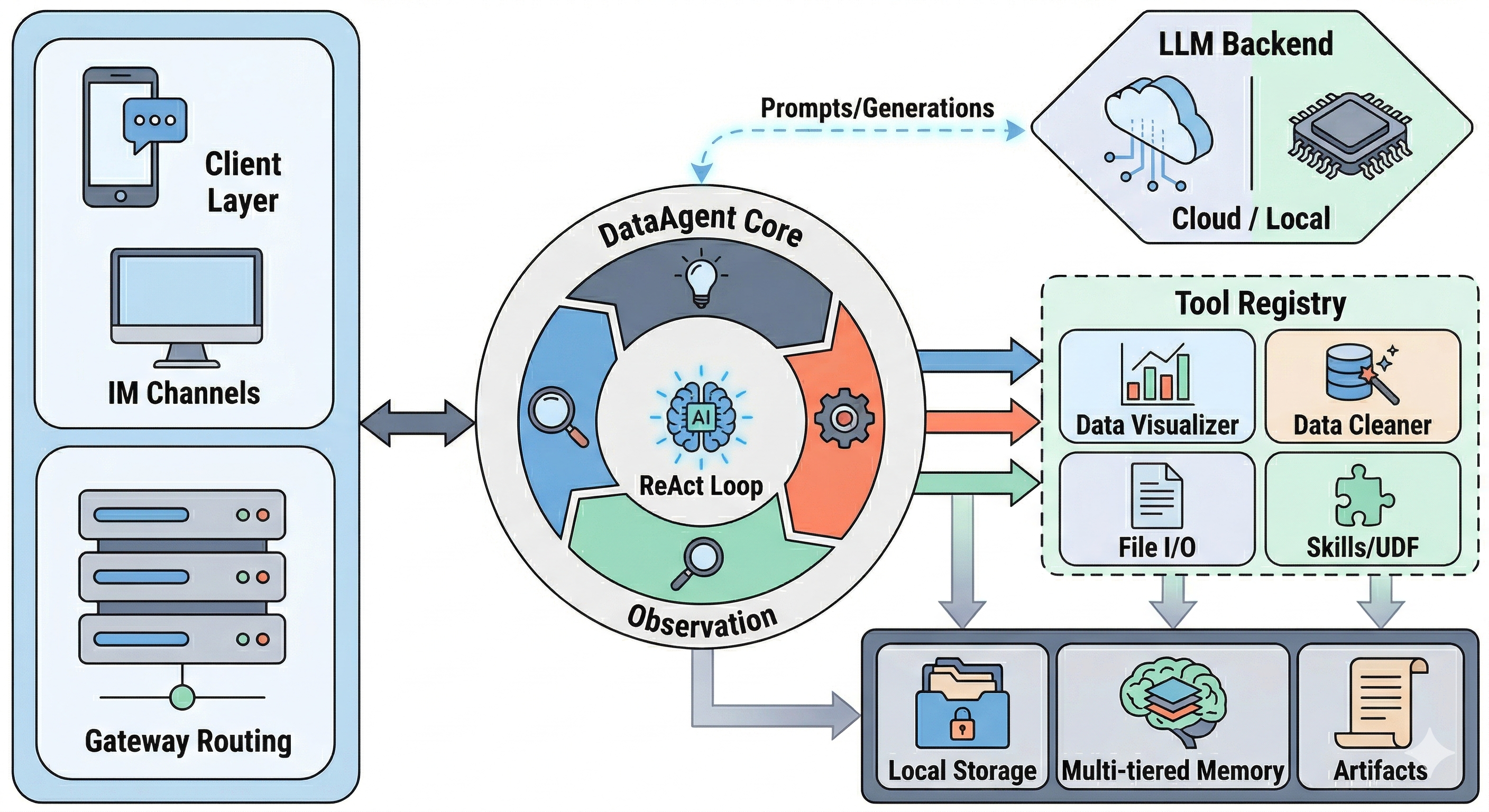
Figure 1: DataClaw's modular architecture delineates IM integration, ReAct reasoning engine, pluggable skills, and multi-tiered memory system.
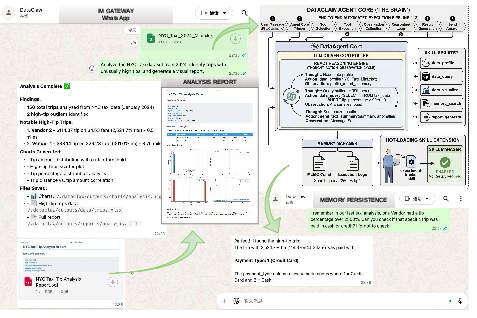
Figure 2: DataClaw seamlessly integrates into IM platforms, streaming solved analytical results and agent reasoning into the IM thread and backend console.
Core Components
ReAct-Based Reasoning Engine
DataClaw’s reasoning core employs the ReAct paradigm, which iteratively interleaves thought, action, and observation cycles. Each analytical goal is decomposed into granular steps, with intermediate artifacts and execution traces accessible in real time. The agent’s iteration limit and context window are configurable, with memory_search tools invoked for context retrieval. This mechanism enables adaptive replanning during execution, addressing issues such as schema mismatches and ambiguous queries through iterative refinement.
Multi-Tiered Memory System
A rolling DataMemory tracks session context, mitigating token overflow through automatic memory compaction and semantic summarization. Persistent files (MEMORY.md, AGENTS.md) ensure cross-session knowledge and global configuration retention. SOULS.md accumulates user preferences, facilitating agent personalization. This architecture avoids cold starts, allowing DataClaw to maintain a persistent knowledge base that is robust to session resets and long-running analytical dialogues.
DataClaw exposes a pluggable skill mechanism, enabling runtime extensibility. Users can onboard new skills via SKILL.md with trigger keywords, few-shot examples, and optional Python modules. Built-in tools encompass canonical data operations (PDF parsing, Excel editing, data cleaning, visualization). The hot-loading feature allows domain-specific adaptation without system restart.
Asynchronous Event Streaming Channel
DataClaw integrates SSE-based asynchronous streaming, reporting intermediate states (thinking, tool_call, tool_result) at selectable verbosity levels. Users may customize event streaming granularity, ensuring transparency and reducing wait anxiety during task execution.
User Experience and Demonstration
The demonstration reveals DataClaw’s full workflow—natural language requests trigger autonomous data analysis, culminating in chart generation and report compilation within IM threads. Attendees engage with the agent using everyday devices; the backend console visualizes granular reasoning traces and operations.
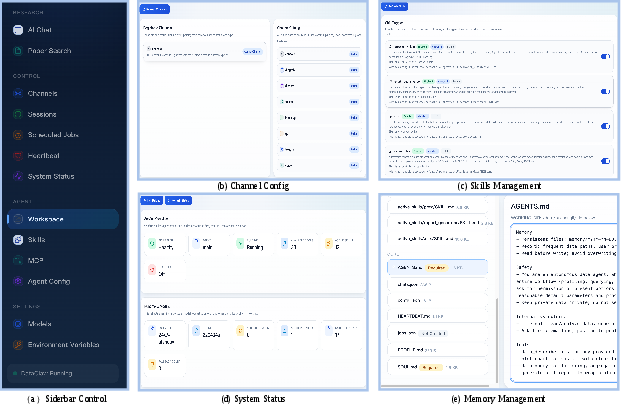
Figure 3: The console UI exposes sidebar controls, channel config, skills management, system status/logs, and memory management for operational transparency.
Explicit continuity is showcased as users query prior session findings, confirming DataClaw’s cross-session retrieval capabilities. Skill extensibility is demonstrated by dynamically adding experiment-tracker workflows, which are instantly registered and operational. The system’s operational latency is approximately 45 seconds per multi-tool task, supporting more than 50 concurrent agent instances across diverse LLM backends. Memory compaction is triggered at an 80% context threshold, configurable per deployment.
Implications and Future Developments
DataClaw’s integration of autonomous reasoning, native IM support, memory persistence, and plug-and-play extensibility constitutes a significant advance in practical agent-centric analytics. By keeping all artifacts and computation local, it aligns with rigorous data governance protocols, enabling deployment even in privacy-sensitive environments. The system architecture enables auditability and intervention, critical for trust and transparency in automated data workflows.
Future developments may further expand DataClaw's skill ecosystem, enhance memory compaction strategies, and improve multi-agent orchestration to allow collaborative analytical sessions. The approach sets a precedent for integrating advanced autonomous agents into ubiquitous communication platforms, substantially lowering the technical barrier for data analytics in everyday scenarios. The agent-autonomy/memory architecture is extensible to other domains where continuous context and workflow auditing are essential, including scientific research, enterprise operations, and personalized assistants.
Conclusion
DataClaw establishes an autonomous data agent paradigm capable of planning and executing complete analytical workflows directly within IM platforms. The ReAct-based reasoning engine, multi-tiered memory, and pluggable skills confer transparency, extensibility, and continuity, while enabling advanced data governance through local-only execution. The demonstrator validates both practical throughput and extensibility, supporting claims that agent autonomy and rigorous data governance are not mutually exclusive (2604.24067). DataClaw’s implementation provides a robust foundation for future research and production deployments of user-facing data agents.