NeuroClaw Technical Report
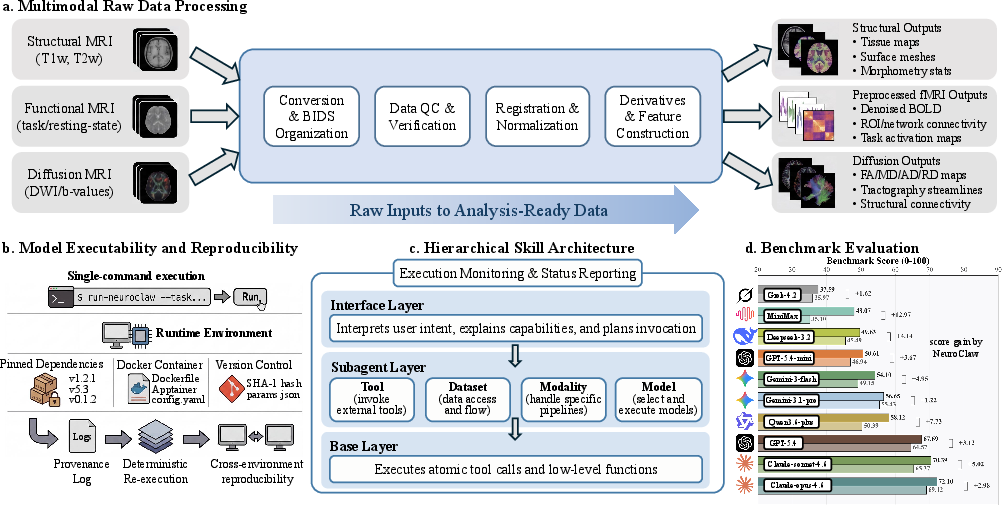
Abstract: Agentic artificial intelligence systems promise to accelerate scientific workflows, but neuroimaging poses unique challenges: heterogeneous modalities (sMRI, fMRI, dMRI, EEG), long multi-stage pipelines, and persistent reproducibility risks. To address this gap, we present NeuroClaw, a domain-specialized multi-agent research assistant for executable and reproducible neuroimaging research. NeuroClaw operates directly on raw neuroimaging data across formats and modalities, grounding decisions in dataset semantics and BIDS metadata so users need not prepare curated inputs or bespoke model code. The platform combines harness engineering with end-to-end environment management, including pinned Python environments, Docker support, automated installers for common neuroimaging tools, and GPU configuration. In practice, this layer emphasizes checkpointing, post-execution verification, structured audit traces, and controlled runtime setup, making toolchains more transparent while improving reproducibility and auditability. A three-tier skill/agent hierarchy separates user-facing interaction, high-level orchestration, and low-level tool skills to decompose complex workflows into safe, reusable units. Alongside the NeuroClaw framework, we introduce NeuroBench, a system-level benchmark for executability, artifact validity, and reproducibility readiness. Across multiple multimodal LLMs, NeuroClaw-enabled runs yield consistent and substantial score improvements compared with direct agent invocation. Project homepage: https://cuhk-aim-group.github.io/NeuroClaw/index.html
Paper Prompts
Sign up for free to create and run prompts on this paper using GPT-5.
Top Community Prompts
Explain it Like I'm 14
What is this paper about?
This paper introduces NeuroClaw, a smart assistant made of multiple AI “helpers” that can run brain imaging studies from start to finish—and do it in a way that’s reliable and easy to repeat. It also presents NeuroBench, a set of tests to check whether such AI assistants really work in real-world brain research.
Brain imaging (like MRI or EEG) creates lots of complex data. Different tools, long pipelines, and tiny mistakes can break the whole process. NeuroClaw is designed to handle raw data, set up the software environment, run the steps safely, check the results, and keep a clear record so others can repeat the work.
What questions were the authors trying to answer?
The paper focuses on three simple questions:
- Can we build an AI assistant that runs brain imaging workflows end-to-end (from raw data to results) without needing lots of manual setup?
- Can that assistant make the work reproducible, meaning someone else can run the same steps later and get the same results?
- How do we fairly test if the assistant actually works across different kinds of brain data and tools?
How did they approach it?
The authors built two things: the NeuroClaw system and the NeuroBench benchmark. Here’s how they work, explained in everyday language.
1) NeuroClaw: an AI “team” that plans, runs, checks, and logs
- Works from raw data: NeuroClaw understands common brain data types:
- sMRI (structural MRI): detailed “photos” of brain anatomy.
- fMRI (functional MRI): “videos” of brain activity over time.
- dMRI (diffusion MRI): shows the brain’s wiring (connections).
- EEG: records electrical signals from the scalp.
- Understands BIDS: Think of BIDS as a standard filing system and naming rules for brain data. NeuroClaw reads and uses this to avoid mix-ups.
- Sets up the “kitchen” correctly: Research needs the right “ingredients” (software versions) and “appliances” (GPUs, Docker containers). NeuroClaw pins versions, installs tools (like FSL, FreeSurfer, fMRIPrep), and configures everything so steps won’t break later.
- Uses a safety harness: Like saving at checkpoints in a video game, NeuroClaw:
- Saves progress at each stage
- Verifies outputs (e.g., checks for missing files or nonsense values)
- Logs what happened (so others can audit or rerun it)
- Organized like a sports team:
- Interface layer (the “coach”): understands your goal and plans the workflow.
- Sub-agent layer (the “captains”): manages specific areas—tools, data types, datasets, or models.
- Base-execution layer (the “players”): does small, precise tasks (like format conversion or running a single command).
- All tasks are linked in a one-way dependency graph, so steps happen in the right order without looping back incorrectly.
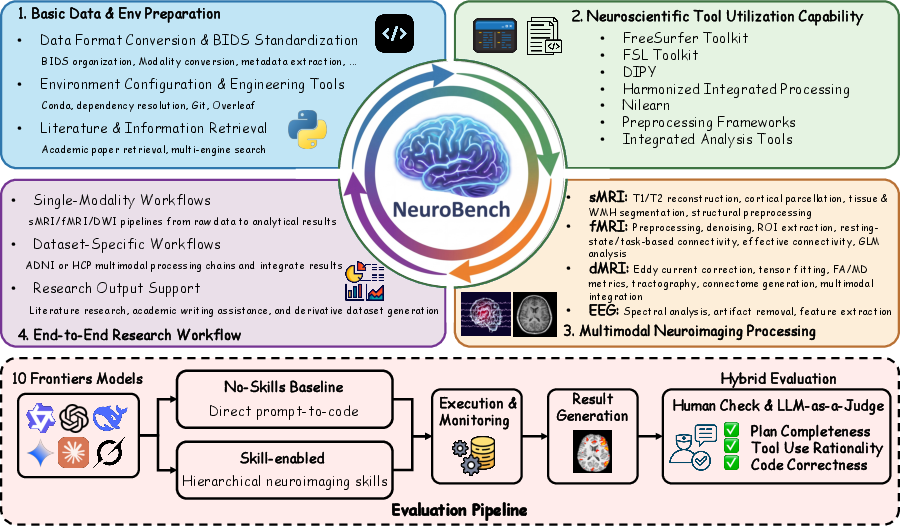
2) NeuroBench: a fair test for real-world use
- 100 expert-designed tasks: From basic data checks to full pipelines (like FreeSurfer, fMRIPrep, QSIPrep), and from single-modality tasks to multi-step, multimodal research loops.
- Clear instructions and expected outputs: Each task specifies inputs, what to produce, how to name things, and how to check if the results are valid.
- Scores what matters: It evaluates:
- Planning completeness (did you think through the steps?)
- Tool usage (did you choose sensible tools and settings?)
- Command/code correctness (did your commands actually work?)
- Compares “with NeuroClaw skills” vs. “no skills”: The same AI models run tasks both ways to see if NeuroClaw really helps.
What did they find?
The main takeaways:
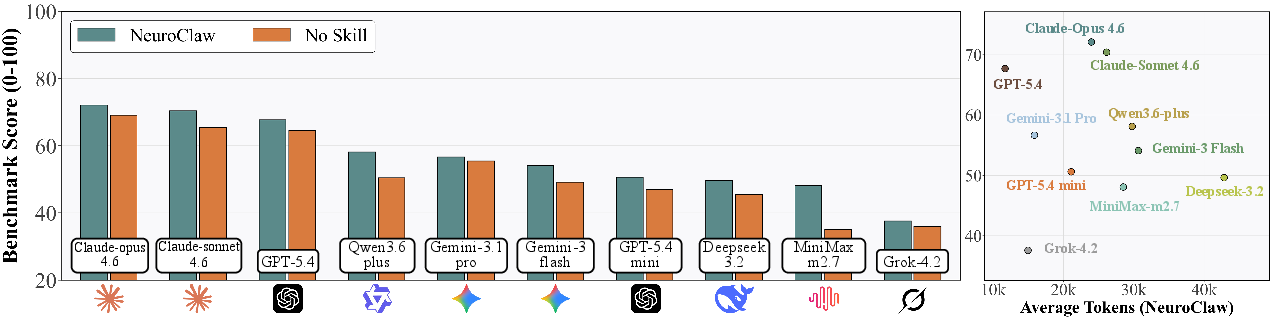
- NeuroClaw makes AI models more reliable at running brain imaging workflows. Across many different LLMs, using NeuroClaw’s skills consistently improved scores on NeuroBench compared to not using them.
- It works across multiple data types and datasets. NeuroClaw handles sMRI, fMRI, dMRI, and EEG, and supports well-known datasets like HCP, ADNI, and UK Biobank.
- It improves reproducibility and transparency. Because it locks software versions, uses Docker when needed, adds checkpoints, and logs everything, it becomes much easier to rerun and verify results.
- The “safety harness” matters. Post-run checks (like detecting missing files or invalid numbers) and audit trails help catch subtle problems early, so bad results don’t sneak into later stages.
- There’s a real-world trade-off. Using more careful planning and checks can use more compute and time, but it usually leads to better, more trustworthy results.
Why is this important?
- For research labs: NeuroClaw can reduce setup headaches, make pipelines more dependable, and cut down on errors that are hard to find.
- For method developers: NeuroBench provides a realistic way to test whether your AI or pipeline actually runs as promised—on real tasks, with clear pass/fail rules.
- For reviewers and journals: The framework’s logs and standardized outputs make it easier to assess whether results are reproducible and scientifically usable.
Limits and future directions
- Not for clinical decisions (yet): This is about research infrastructure, not medical diagnosis. Clinical use needs more testing and oversight.
- Ethical care is needed: Brain data is sensitive. The authors emphasize privacy, traceability, and accountability.
- More challenges to come: Future versions plan to test tougher scenarios—messy or unfamiliar data, live tool runs on real datasets, and multi-agent teamwork under more diverse conditions.
In short, NeuroClaw is like a careful lab teammate: it plans the experiment, sets up the software kitchen properly, cooks step by step with checkpoints, checks the dish at each stage, labels and stores everything clearly, and writes down exactly what it did—so you or anyone else can make the same dish again. NeuroBench then grades how well that teammate performs across many realistic recipes.
Knowledge Gaps
Knowledge gaps, limitations, and open questions
Below is a consolidated list of concrete gaps and unresolved questions that future work could address:
- Real execution vs. judged plans: NeuroBench primarily uses an LLM judge and specification conformance; large-scale evaluations with actual end-to-end tool invocation, failure rates, and recovery outcomes are not reported.
- Quantitative reproducibility: No cross-run, cross-OS/container, or cross-hardware reproducibility metrics (e.g., bitwise hashes, metric variance, ICCs for derived phenotypes) are provided.
- Determinism controls: Effects of seeds, CUDA/cuDNN deterministic settings, and GPU/driver versions on reproducibility are unmeasured.
- Dataset and modality coverage: Benchmark emphasizes ADNI, HCP Young Adult, and UK Biobank; clinical breadth (e.g., pediatric, psychiatric, multi-center disease cohorts), PET/MEG, multi-echo fMRI, and advanced dMRI reconstructions are underrepresented.
- Toolchain breadth and licensing: Handling of tools with licenses or external runtimes (e.g., FreeSurfer license files, SPM/MATLAB) is not detailed; automated license management and compliance workflows are unspecified.
- HPC and enterprise integration: Docker is supported, but HPC-native runtimes (Apptainer/Singularity), schedulers (SLURM/LSF), and multi-tenant cluster policies are not covered.
- Provenance standards: Audit logs are JSONL-based, but mapping to community standards (W3C PROV, RO-Crate), and integration with DataLad, BIDS Derivatives, or Boutiques is not implemented or evaluated.
- Security and supply chain: Threat modeling, sandbox boundaries, least-privilege execution, dependency provenance, and container/image signing or SBOM-based verification are not described.
- Data governance and privacy: Built-in de-identification (DICOM anonymization), defacing, PHI/PII detection, consent/IRB workflows, and HIPAA/GDPR-aligned controls are not specified.
- Robustness to messy inputs: Systematic tests for corrupted DICOMs, missing slices, inconsistent headers, non-standard vendor tags, partial BIDS compliance, and mixed-stage inputs are deferred to future work.
- QC validity and thresholds: Post-execution verification logic lacks explicit, domain-validated thresholds (e.g., MRIQC metrics, FD/DVARS cutoffs) and an analysis of false-positive/negative rates in QC.
- Impact on scientific results: No evidence that NeuroClaw improves downstream scientific validity (e.g., test–retest reliability, effect sizes, brain–behavior associations) relative to standard pipelines.
- Comparative baselines: Missing comparisons against established workflow managers (Nipype, BIDS Apps, Snakebids, Nextflow/Toil) to quantify what the agentic layer adds in executability and robustness.
- Component ablations: No ablation study isolating contributions of pinned environments, checkpointing, DAG design, and artifact verification to the observed gains.
- Efficiency and cost: Runtime, throughput, GPU/CPU utilization, and cloud cost overheads of the agentic layer versus conventional pipelines are not reported.
- Scalability and concurrency: Behavior on very large cohorts (e.g., 10k–100k subjects), parallel scheduling, caching strategies, and resource contention are uncharacterized.
- Skill lifecycle and versioning: Formal interfaces, unit tests, CI/CD, backward-compatibility guarantees, and deprecation/versioning policies for skills are not specified.
- Skill drift detection: Automated monitoring for skill or toolchain drift (e.g., parameter changes, output schema shifts) and guardrails for regression prevention are not documented.
- Stage detection accuracy: While stage-aware planning is claimed, there is no quantitative evaluation of how accurately the system infers pipeline stage and resumes partially processed datasets.
- Multi-agent coordination: The paper does not empirically study multi-agent collaboration patterns, contention/deadlock handling, or benefits over single-agent controllers.
- Human-in-the-loop checkpoints: Where expert approval is required (e.g., QC outliers, parameter overrides) and how interactive gating is operationalized remain unspecified.
- Error explainability: Methods for failure categorization, root-cause analysis, automatic remediation suggestions, and user-facing transparency are not evaluated.
- Robustness to tool updates: Strategies for pinning, testing, and migrating across breaking changes in neuroimaging tools (e.g., fMRIPrep/QSIPrep versions) are not empirically validated.
- Interoperability with existing assets: Policies for ingesting prior derivatives, mixing pipelines, and guaranteeing compatibility across different preprocessing histories are not assessed.
- Benchmark scoring reliability: Reliance on a single LLM judge introduces potential bias; inter-rater reliability with human experts and sensitivity to verbosity/formatting are unreported.
- Penalty for cautious reasoning: The rubric may penalize environment checks and dependency verification; alternative scoring that values operational safety is not explored.
- Privacy-preserving modes: Local-only execution, encrypted storage, audit trail protection, and secure deletion/retention policies are not detailed.
- Economic and storage footprint: Storage growth from checkpoints/artifacts, retention policies, and trade-offs between auditability and cost are unquantified.
- Generalization beyond imaging: Extensibility to connectomics, neuromodulation, real-time fMRI/neurofeedback, and integration with behavioral or genetic data is not demonstrated.
- Open-source reproducibility: Exact code, container digests, seed/config bundles, and scripts necessary to reproduce reported benchmark numbers are not enumerated.
Practical Applications
Immediate Applications
The paper’s framework and benchmark enable several deployable use cases today across sectors. Below is a concise set of actionable applications, each with sector linkage, potential tools/products/workflows, and key dependencies or assumptions.
Healthcare and Clinical Research
- Cohort-wide, standardized preprocessing with audit trails
- What: Run BIDS-aware, multimodal pipelines (sMRI/fMRI/dMRI/EEG) using fMRIPrep, QSIPrep, FreeSurfer, FSL with automated installers, pinned environments, and Docker.
- Sector: Healthcare, Medtech, CROs, Pharma R&D.
- Tools/products/workflows: “Lab-in-a-Box” Docker images; one-command setup scripts; reproducibility harness with checkpointing and JSONL audit logs; cohort skills for ADNI/HCP/UKB.
- Dependencies/assumptions: Data-use agreements (e.g., ADNI, UK Biobank); FreeSurfer license; BIDS availability or DICOM-to-NIfTI+BIDS conversion; sufficient CPU/GPU/HPC resources; institutional Docker support.
- Multi-site trial harmonization and drift detection
- What: Use structured verification (expected artifacts, NaN/Inf screens, checksum checks) to identify site/scanner drift and metadata inconsistencies.
- Sector: CROs, Clinical trials, Hospital research IT.
- Tools/products/workflows: Reproducibility dashboards; QC summary generators; provenance diff tools.
- Dependencies/assumptions: Access to per-site logs and artifacts; consistent BIDS conventions across sites; secure data transfer policies.
- Rapid data readiness and QC at study intake
- What: Base skills for BIDS validation, metadata extraction, and format conversion to gate data ingestion before analysis.
- Sector: Hospital IT, Research cores.
- Tools/products/workflows: “BIDS Gatekeeper” service in data lakes/LIMS; CI checks on ingestion.
- Dependencies/assumptions: Integration with PACS/LIMS; consistent metadata capture; storage for intermediate artifacts.
Academia and Education
- Course-ready, reproducible neuroimaging labs
- What: End-to-end assignments from raw DICOM to GLM/ROI tables using checkpointed, version-pinned environments.
- Sector: Education (undergrad/grad neuroscience, BME, CS).
- Tools/products/workflows: Teaching containers; fixed manifests; auto-grading scripts leveraging harness verification.
- Dependencies/assumptions: Access to small open datasets (e.g., OpenNeuro/HCP sample); campus compute quotas; instructor familiarity with Docker/BIDS.
- Executable supplements and method reproducibility
- What: Authors submit manifests, audit logs, and rerun instructions aligned with the harness; reviewers verify artifact validity.
- Sector: Academic publishing.
- Tools/products/workflows: “Executable supplement” templates; reviewer rerun checklists.
- Dependencies/assumptions: Journal policy support; time allocation for verification; sample data for privacy.
Software and MLOps
- CI/CD for neuroimaging pipelines
- What: Integrate the harness into GitHub Actions/GitLab CI to run smoke tests on sample data and catch environment regressions.
- Sector: Software, DevOps, Research IT.
- Tools/products/workflows: CI templates; cached Docker images with pinned neuroimaging stacks; failure triage via audit logs.
- Dependencies/assumptions: CI runners with container support; caching/storage for test artifacts.
- Agent plug-ins for tool-grounded execution
- What: LLM vendors and lab assistants call NeuroClaw skills to improve tool usage and reduce environment errors.
- Sector: AI platforms, ISVs.
- Tools/products/workflows: Skill APIs/SDKs; “NeuroClaw connector” for model endpoints.
- Dependencies/assumptions: Stable API access; prompt/tool-use governance; cost controls for tokens/compute.
Publishing, Funding, and Policy
- Submission-time reproducibility checks
- What: Journals require a minimal harness run on provided sample data to verify executable pipelines and artifact conformity.
- Sector: Publishing, Funding agencies.
- Tools/products/workflows: Lightweight NeuroBench-derived checklists; acceptance thresholds for BIDS compliance/QC.
- Dependencies/assumptions: Editorial buy-in; scalable reviewer infrastructure; non-sensitive sample datasets.
Citizen Science and Maker Communities (Non-clinical)
- One-click analysis of public datasets
- What: Community processing of OpenNeuro/HCP samples with standardized pipelines and QC reports.
- Sector: Daily life (citizen science clubs, hackathons).
- Tools/products/workflows: Prebuilt Docker images; “QC-first” runbooks; result viewers for audit logs.
- Dependencies/assumptions: Non-clinical use; modest local compute; data literacy; adherence to dataset licenses.
Long-Term Applications
These opportunities require further validation, integration, scaling, or regulatory development before deployment.
Healthcare Delivery and Regulated Clinical Use
- PACS/EHR-integrated, regulatory-grade neuroimaging pipelines
- What: Closed-loop preprocessing/QC with traceable audit trails integrated into hospital systems for clinical workflows.
- Sector: Healthcare providers, Medtech vendors.
- Tools/products/workflows: FDA/CE-ready “NeuroClaw Clinical” modules; HL7/FHIR integrations; real-time QC alerts.
- Dependencies/assumptions: Prospective clinical validation; cybersecurity reviews; uptime/latency guarantees; regulatory approvals.
- Real-time acquisition feedback at the scanner
- What: On-scanner or edge agent checks BIDS/metadata completeness and basic QC, prompting immediate rescans when needed.
- Sector: Imaging centers, OEMs.
- Tools/products/workflows: Edge-optimized harness; DICOM routers; technologist dashboards.
- Dependencies/assumptions: Vendor cooperation; deterministic runtimes; limited on-prem compute.
Research Automation and Discovery
- Autonomous hypothesis–experiment–verification loops
- What: Agents propose analyses, execute tool-grounded pipelines, evaluate reliability, and iterate across modalities.
- Sector: Academia, Pharma R&D.
- Tools/products/workflows: Multi-agent “AI lab technician”; experiment memory and DAG-aware orchestration at scale.
- Dependencies/assumptions: Stronger safety/guardrails; sandboxed execution; human-in-the-loop oversight; cost-effective compute.
- Multimodal neuromarker discovery at scale
- What: Systematic integration of sMRI/fMRI/dMRI/EEG with harmonized artifacts for robust biomarker pipelines.
- Sector: Translational research, Precision medicine.
- Tools/products/workflows: Cross-modal feature stores; reliability scoring services; automated harmonization modules.
- Dependencies/assumptions: Access to large, diverse datasets; standardization of cross-site metadata; bias audits.
Enterprise Software and AgentOps
- Enterprise “AgentOps” for scientific computing
- What: Cross-domain extension of the harness (beyond neuroimaging) with auditability, version pinning, and environment control.
- Sector: Software, Cloud providers.
- Tools/products/workflows: Managed “NeuroClaw-as-a-Service”; audit-log explorer UIs; reproducibility scorecards.
- Dependencies/assumptions: Cloud compliance (HIPAA/GDPR); cost models; multi-tenant isolation.
- Federated and privacy-preserving execution
- What: Reproducible workflows executed across sites without centralizing raw data (e.g., secure enclaves, federated orchestration).
- Sector: Healthcare networks, Consortia.
- Tools/products/workflows: Federated harness runners; encrypted provenance; site-local QC engines.
- Dependencies/assumptions: Secure compute (TEEs), networking agreements, privacy-preserving analytics maturity.
Standards, Policy, and Governance
- Benchmark-driven standards for agentic scientific tools
- What: NeuroBench-like evaluations embedded in journal and funder policies to certify executability and reproducibility.
- Sector: Policy, Publishing, Funding bodies.
- Tools/products/workflows: Community-maintained task suites; accreditation processes for agentic systems.
- Dependencies/assumptions: Field-wide consensus; longitudinal maintenance; mitigation of LLM-judge biases via expert panels.
Education at Scale
- Virtual neuroimaging labs with automated assessment
- What: Massive courses/labs where the harness grades pipeline correctness, QC quality, and report completeness.
- Sector: Education (MOOCs, universities).
- Tools/products/workflows: Cloud lab environments; structured rubrics mapping to harness checks.
- Dependencies/assumptions: Scalable compute credits; dataset hosting; academic licensing for tools.
Products and Commercial Offerings
- Turnkey research platforms and marketplaces
- What: Skill libraries and dataset-specific “playbooks” sold as enterprise offerings; plugin ecosystems for LLMs.
- Sector: ISVs, Cloud marketplaces.
- Tools/products/workflows: Skill packs (ADNI/HCP/UKB); model-agnostic connectors; support SLAs.
- Dependencies/assumptions: IP/licensing clarity for tools and datasets; model provider partnerships; customer success resources.
Glossary
- ADNI: A large longitudinal neuroimaging cohort (Alzheimer’s Disease Neuroimaging Initiative) widely used for method development and validation. "for cohorts such as ADNI, HCP Young Adult, and UK Biobank."
- Advanced Normalization Tools (ANTs): A toolkit for high-accuracy medical image registration and normalization. "ANTs alignment"
- BIDS (Brain Imaging Data Structure): A community standard for organizing neuroimaging data and metadata to ensure consistency and reproducibility. "BIDS organization"
- confound regression: The removal of nuisance signals (e.g., motion, physiological noise) from fMRI time series to reduce spurious correlations. "confound regression"
- connectome: A graph-like representation of brain connectivity (structural or functional) derived from imaging data. "connectome construction"
- cortical surface reconstruction: Computational estimation of the brain’s cortical surfaces from structural MRI for morphometry and mapping. "cortical surface reconstruction"
- DICOM: The standard medical imaging file format and metadata protocol used by scanners and hospitals. "DICOM-to-NIfTI transformation"
- diffusion MRI (dMRI): An MRI technique sensitive to water diffusion, used to infer white-matter pathways and microstructure. "For diffusion MRI (dMRI), the framework manages preprocessing, tensor fitting, microstructural metric computation, tractography, and connectome construction."
- diffusion-weighted imaging (DWI): The acquisition protocol underpinning dMRI that measures diffusion-weighted signal along multiple directions. "DWI"
- EEG: Electroencephalography; measures electrical activity of the brain via scalp electrodes. "EEG"
- fMRI (functional MRI): MRI that measures blood-oxygen-level-dependent (BOLD) signal changes to infer brain activity. "For functional MRI (fMRI), it supports preprocessing and denoising pipelines, confound regression, ROI time-series extraction, connectivity analysis, and first- to group-level GLM reporting."
- fMRIPrep: A standardized, tool-integrating preprocessing pipeline for robust and reproducible fMRI preparation. "such as FSL, FreeSurfer, and fMRIPrep"
- FreeSurfer: A software suite for cortical surface reconstruction, segmentation, and morphometric analysis. "such as FSL, FreeSurfer, and fMRIPrep"
- FSL: A comprehensive library of analysis tools for functional, structural, and diffusion MRI. "such as FSL, FreeSurfer, and fMRIPrep"
- GLM (General Linear Model): A statistical framework used in fMRI to model relationships between designed task events (or regressors) and observed signals. "first- to group-level GLM reporting"
- HCP Young Adult: A flagship Human Connectome Project cohort with high-quality multimodal MRI data for healthy young adults. "for cohorts such as ADNI, HCP Young Adult, and UK Biobank."
- ICA-FIX: A denoising approach that combines Independent Component Analysis with a trained classifier (FIX) to remove artifacts in fMRI. "ICA-FIX denoising"
- MEG: Magnetoencephalography; measures magnetic fields produced by neural activity for high temporal-resolution brain mapping. "MEG"
- microstructural metrics: Diffusion-derived measures that characterize tissue properties (e.g., anisotropy) at the microscopic scale. "microstructural metric computation"
- neuromarker: An imaging-derived biomarker intended to quantify or predict neurological status or outcomes. "multi-modal neuromarker computation"
- NIfTI: A widely used neuroimaging file format that stores volumetric data and headers consistently across tools. "DICOM-to-NIfTI conversion"
- provenance logging: Recording detailed lineage of data, parameters, software, and environment to enable auditability and reproducibility. "provenance logging"
- QSIPrep: A standardized preprocessing and reconstruction pipeline for diffusion MRI data. "QSIPrep"
- quality control (QC): Procedures and metrics to verify data integrity and processing success. "quality control"
- registration (image registration): Spatial alignment of images (within- or across-modality) into a common coordinate space. "structural-to-functional registration"
- resting-state fMRI: fMRI acquired while subjects are not performing a task, used to study intrinsic functional connectivity. "resting-state fMRI"
- ROI (Region of Interest): A predefined anatomical or functional region used for extracting signals and computing statistics. "ROI time-series extraction"
- scanner harmonization: Techniques to mitigate site/scanner differences so that data are comparable across acquisitions. "scanner harmonization"
- seed-based connectivity: Functional connectivity analysis that correlates time series from a seed region with other brain regions. "seed-based connectivity"
- skull stripping: Removing non-brain tissues from structural MRI to isolate the brain for further analysis. "skull stripping"
- sMRI (structural MRI): MRI focused on brain anatomy (e.g., T1/T2-weighted), used for segmentation and morphometry. "For structural MRI (sMRI), it handles DICOM-to-NIfTI conversion, BIDS organization, skull stripping, tissue segmentation, cortical surface reconstruction, and ROI-based statistical extraction."
- tensor fitting: Estimation of diffusion tensor models from DWI to quantify directional diffusivity and anisotropy. "tensor fitting"
- test-retest reliability: The consistency of measurements across repeated sessions, critical for robust scientific inference. "Test-retest reliability"
- tractography: Reconstruction of white-matter fiber pathways from diffusion MRI data. "tractography"
- UK Biobank: A very large population cohort with extensive health records and imaging, used for population-scale analyses. "UK Biobank"
Collections
Sign up for free to add this paper to one or more collections.