- The paper presents a physics-integrated autoregressive framework using propagation-aligned next-token prediction to construct unified 2D and 3D radio maps.
- It employs a VQ-VAE-based tokenizer with 3D rotary position encoding to maintain vertical continuity and align environment-aware features with radio signal propagation.
- Experiments show significantly reduced NMSE, real-time inference efficiency, and robust zero-shot generalization across varied urban ecosystems.
PILOT: A Physics-Integrated Autoregressive Framework for Unified 2D and 3D Radio Map Construction
Introduction and Motivation
Accurate pathloss radio map construction is critical to the development of 6G systems, wireless digital twins, and UAV-based communications, particularly as network coverage expands into three-dimensional (3D) urban environments. In these settings, radio propagation is substantially influenced by environmental factors such as blockage, reflection, and diffraction, rendering classical ray tracing computationally prohibitive for 3D volumes. Existing learning-based approaches predominantly focus on 2D maps, formulate the problem as direct regression, and generally lack a mechanism to explicitly embed the physics of radio propagation, such as the causal structure induced by transmission paths.
PILOT addresses these limitations by proposing a unified generation framework for 2D and 3D radio map construction based on physics-integrated, autoregressive sequence modeling. Central to PILOT are propagation-aligned next-token prediction, environment-aware conditioning, and extensible support for both slice-based 2D and volumetric 3D representations, enabling strong accuracy, real-time inference, and robust zero-shot generalization across frequencies and geometries.
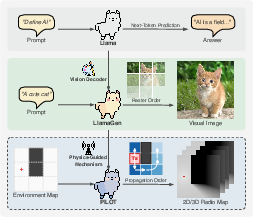
Figure 1: Overview of the PILOT framework.
Technical Contributions
Physics-Guided Autoregressive Generation
PILOT reformulates the radio map construction task as an autoregressive sequence-generation problem, where each radio map “token” (a quantized patch of the map) is sequentially predicted. Rather than relying on spatially arbitrary or raster scan orders, PILOT introduces a wavefront propagation order that guides token generation outward from the transmitter along low-blockage, physically plausible paths. This order is computed via a Dijkstra-style expansion over the urban building map, incorporating both Euclidean distance and blockage penalties, thereby closely mirroring multi-hop, cost-weighted signal propagation.
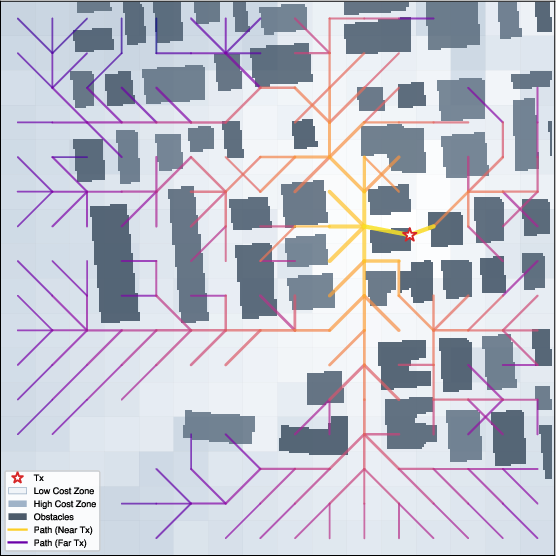
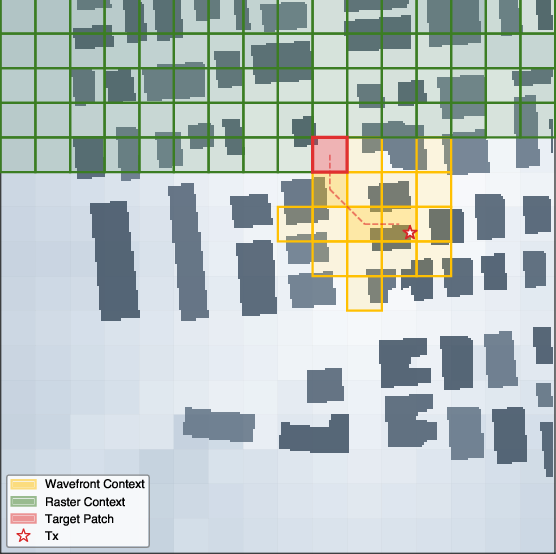
Figure 2: (a) Wavefront propagation paths in an urban scene, showing routing around blocked regions. (b) Comparison between raster-order (green) and wavefront-order (yellow) prefixes for a target patch (red), illustrating greater propagation relevance in the latter.
This sequence construction ensures that at each prediction step, the autoregressive model conditions its forecasts on the most propagation-relevant context, significantly reducing prediction uncertainty in complex, shadowed regions.
Unified 2D/3D Map Tokenization and Generation
A key architectural innovation in PILOT is the design of its tokenizer, a VQ-VAE-based discretizer that operates identically for both 2D slices and 3D volumes by stacking height slices along the channel axis, eliminating the need for volumetric convolution. A gradient regularization term enforces vertical continuity, thus preserving inter-slice correlation for 3D map construction and ensuring field-structure consistency across spatial dimensions.
Environment-Aware Representation and Position Embedding
Each generation step in PILOT is jointly conditioned on both the spatial environment and propagation state. The model incorporates building geometry, transmitter configuration, and a frequency-aware pathloss anchor map (encoding free-space pathloss with shadowing) to align environmental context with the map region under prediction. Spatial coordinates are embedded using 3D rotary position encoding (3D-RoPE) to ensure seamless extensibility across 2D and 3D tasks.
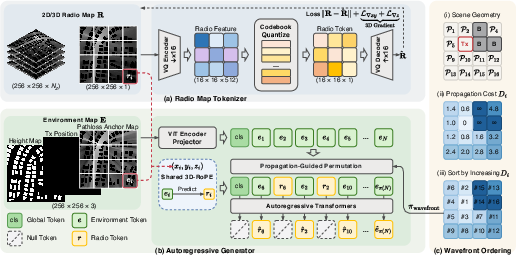
Figure 3: Overall framework of the proposed PILOT, featuring environment-aware tokenization, propagation-guided ordering, and 3D spatial registration via 3D-RoPE.
Experimental Results
On the RadioMapSeer benchmark, PILOT achieves an NMSE of 0.0316, outperforming all reference models, including RadioMamba (0.0349 NMSE) and RadioUNet (0.1041 NMSE). The model generates sharper shadow boundaries and more accurate diffraction corridors.
In zero-shot cross-domain transfer to RadioMap3DSeer (featuring differing frequency, geometry, and pathloss range), PILOT reduces NMSE by 7.9% over the strongest baseline (RME-GAN), demonstrating robust generalization in the absence of domain-specific retraining and superior adaptation to altered map distributions.
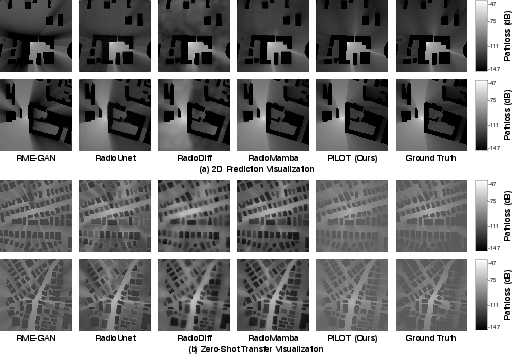
Figure 4: Predicted radio maps: (a) 2D generation on RadioMapSeer; (b) Zero-shot transfer performance on RadioMap3DSeer under frequency and geometry shift.
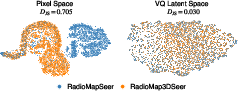
Figure 5: t-SNE visualization of RadioMapSeer and RadioMap3DSeer distributions in pixel (left) and VQ latent (right) space, illustrating tighter cross-domain alignment after tokenization.
3D Volumetric Generation and Inference Efficiency
On the UrbanRadio3D dataset at receiver heights 1–4 m, PILOT (volumetric mode) achieves a 78% reduction in NMSE compared to the 1000-step RadioDiff-3D diffusion model (0.0120 vs 0.0534), with inference times reduced from ~122 s to just 0.05 s per map—approximately 2500× faster.
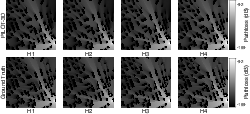
Figure 6: 3D radio maps on UrbanRadio3D at receiver heights 1–4 m generated by PILOT.
Sequence Order and Predictive Entropy
The wavefront order, by construction, yields lower per-step predictive entropy and reduces error accumulation on long, shadowed propagation paths compared to geometric scan orders. Conditional entropy measurements across benchmarks confirm that propagation-aligned ordering prioritizes low-uncertainty tokens and contains predecessor chains necessary for accurate causality in radio field generation.
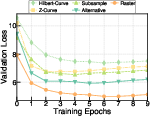
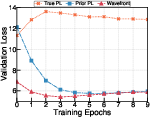
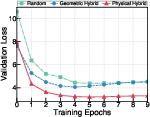
Figure 7: Validation cross-entropy by generation order: (a) Geometric; (b) Physics-guided; (c) Hybrid strategies. Physical hybrid order yields fastest convergence.
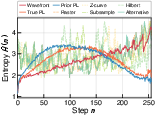
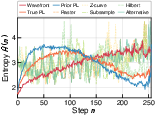
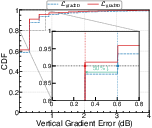
Figure 8: (a–b) Predictive entropy curves for different sequence orders, demonstrating lowest uncertainty for wavefront and physical hybrids; (c) CDF for vertical error, reflecting improved 3D continuity.
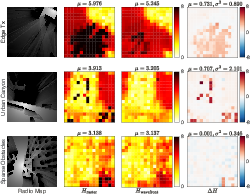
Figure 9: Spatial entropy maps highlighting largest uncertainty reduction in complex, multi-obstacle regimes under wavefront sequence generation.
Implications and Theoretical Insights
PILOT’s results empirically substantiate the theoretical proposition that sequence order in autoregressive field generation is not merely a permutation choice but is fundamentally coupled to underlying physical processes. The wavefront ordering, via blockage-weighted cost assignment, guarantees that each predicted token is causally conditioned on its relevant propagation predecessors. This property, verified by both reduced predictive entropy and cross-domain robustness, has implications for any autoregressive modeling tasks where causal structure can be distilled from physical principles or domain knowledge.
Practically, PILOT’s sampling-free, physically grounded generation process enables real-time deployment for dynamic network planning, wireless digital twins, and UAV coverage analysis, eliminating the need for on-site sampling or frequent retraining across diverse domains.
Future Directions
Extending PILOT to multi-transmitter, time-varying environments, and real-world datasets with non-ideal measurements are immediate directions. Incorporating differentiable ray-tracing components or integrating reinforcement learning for adaptive environment interaction could further enhance the model’s alignment with radio physics and spatial-temporal generalization. The hybridization of physics-informed graph-based orders with large-scale pretraining, as realized here, offers a paradigm for future generative models in complex scientific domains.
Conclusion
PILOT establishes a unified, physics-integrated autoregressive paradigm for 2D and 3D radio map construction, anchored by a propagation-aligned wavefront generation order, environment-aware tokenization, and transferable pretraining. It achieves strong performance on standard and cross-domain benchmarks with superior computational efficiency, strong vertical continuity, and practical zero-shot transfer. These findings underline the value of embedding physics-based priors into scalable, autoregressive token generation for spatial field modeling.