- The paper introduces a physics-aware hierarchical graph attention network that combines query-conditioned local aggregation with global context refinement for precise radio map estimation.
- It achieves state-of-the-art performance by learning structured residuals over a classical interpolator, significantly reducing RMSE and MAE under sparse measurement constraints.
- The model’s modular design, including a post-hoc gated regime, improves robustness and interpretability for accurate transmitter-resolved radio strength predictions.
Physics-Aware Query-Conditioned Hierarchical Graph Attention for Radio Map Estimation
Introduction and Problem Context
Radio map estimation (RME) is central to wireless network planning, enabling site-specific optimization, resource management, and CSI-feedback reduction. The principal challenge involves inferring fine-grained, transmitter-resolved received signal strength (RSS) at arbitrary query points from sparse, spatially irregular observations—a setting characterized by severe measurement constraints and non-uniform propagation regimes. Traditional methodologies divide into (1) model-based interpolators (e.g., kriging, inverse-distance weighting), (2) data-driven deep learning approaches, and (3) hybrid models leveraging both priors and learned residuals. The first group encodes geometric/propagation constraints but often fails amid strong local discontinuities or propagation transitions. In contrast, the second excels at capturing nonlinearities but is sample-inefficient and environment-sensitive. Hybrid methods attempt to combine these merits, yet most focus on dense map grid completion, neglecting more deployment-relevant pointwise query or local-update scenarios, especially for multi-transmitter environments.
This work introduces a physics-aware query-conditioned hierarchical graph attention network (HGAT) for transmitter-resolved, query-centric radio map estimation. This architecture uniquely structures inference via local, query-dependent graph construction over references and subsequent global regularization among target queries, with all pipeline elements built solely from observables: RSS, positions, relative geometry, and—where available—LOS/NLOS link annotations.
Physics-Aware HGAT Architecture
The core HGAT mechanism operates in two hierarchical stages per query–transmitter pair:
- Local Evidence Aggregation: For each transmitter b and target location, a bounded, spatially uniform reference set is subsampled. Around each query (t,b), a localized kNN graph over Kref nearby references is induced. Each reference is represented as a composite “page” embedding, incorporating geometric features (distances, bearings among query, reference, and transmitter locations), observed RSS, and transmitter coordinates. This enables the model to contextualize spatial evidence with respect to the actual propagation regime confronting the target.
- Global Context Refinement: The local query embedding is refined through a same-transmitter global graph defined by neighboring query targets, facilitating representation-level message exchange to enforce mutual consistency and structural regularity reflecting real-world correlated propagation effects.
The encoder architecture is GATv2-based, using enhanced attention mechanisms per (Brody et al., 2021), where attention computes relevance over composite page vectors rather than simple adjacent node states, accommodating the complex geometric and measurement-specific relationships prevalent in radio propagation.
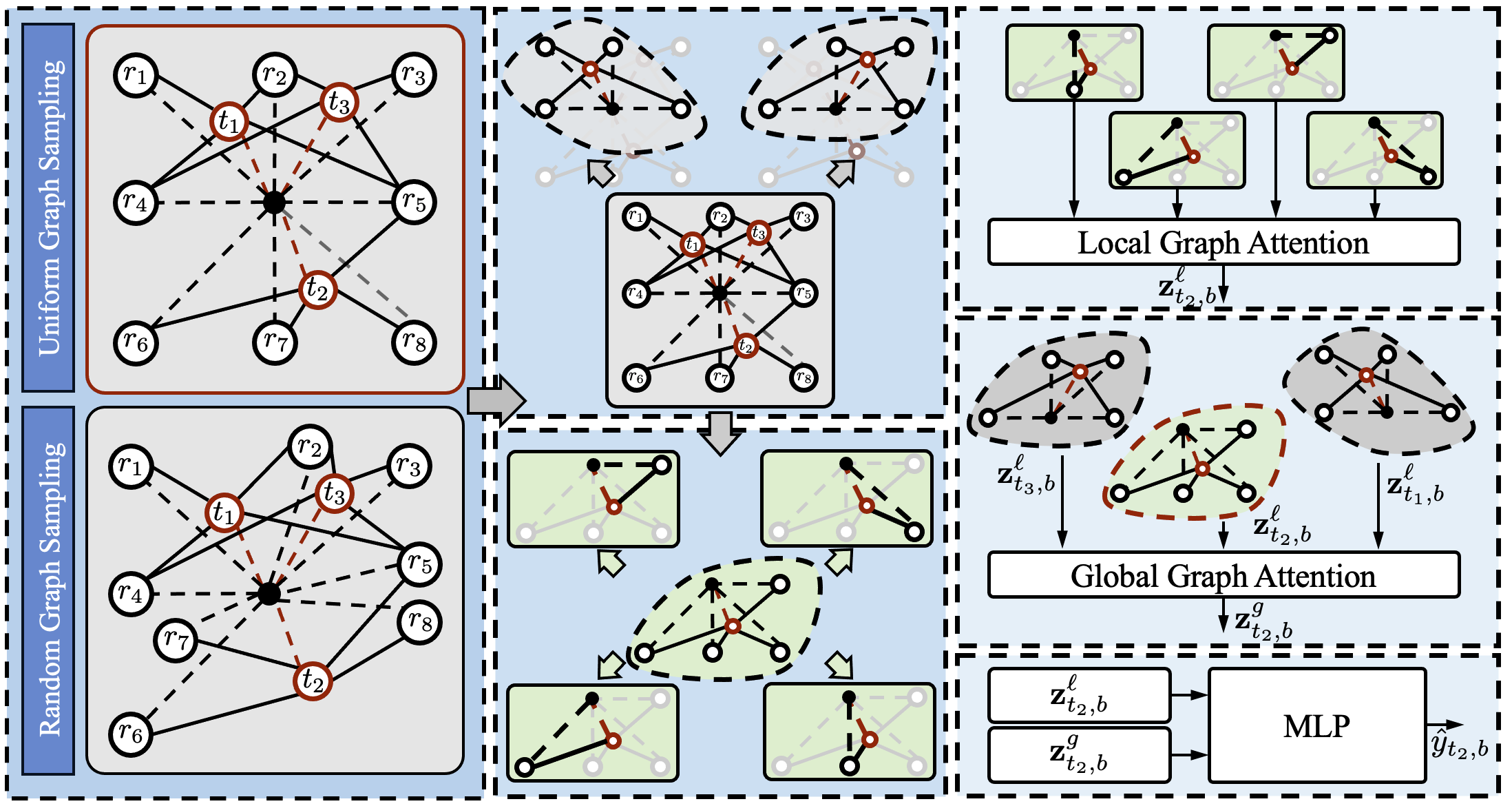
Figure 1: The HGAT encoder architecture with sequential local aggregation of reference evidence and global context refinement among query targets.
Estimation Regimes and Prior Residual Structure
The HGAT design supports three inference regimes, each addressing different operational and interpretability requirements:
- Direct Estimation: The model predicts the absolute RSS at each (t,b) based solely on learned hierarchical embeddings.
- Prior-Conditioned Residual Correction: Given a classical interpolator (here, ordinary kriging), HGAT predicts only the structured residual (local mismatch) between the interpolator and ground truth. At inference, the residual is added to the explicit prior, allowing for modular error decomposition.
- Post-Hoc Gated Regime: Recognizing that learned corrections may be regionally unreliable, a lightweight gate modulates the application of the residual, depending on contextual cues (e.g., magnitude and local variation descriptors of the prior and residual). The gate is calibrated in a post-hoc fashion, freezing the encoder/residual and optimizing to minimize overall recomposition error.
Empirical analysis on DeepMIMO data evidences that prior errors are not spatially i.i.d.: reflection-induced hotspots and field discontinuities yield coherent residual structure (see below).
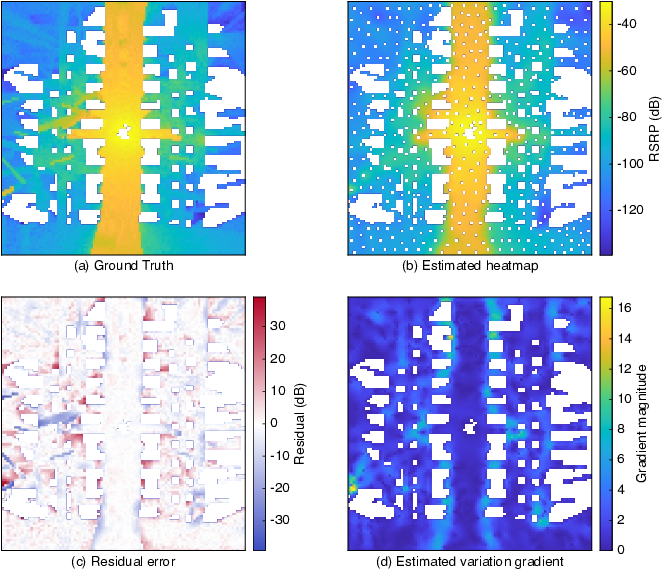
Figure 2: Structured prior residuals following ordinary kriging, revealing coherent spatial error aligned with local propagation transitions and sharp gradients.
Experimental Setup and Evaluation
All methods are benchmarked on DeepMIMO Denver datasets under a measurement-only contract—excluding any environment/map privileged features—with three transmitter sites (seen/held-out partitioning). Each method receives identical sparse reference and supervision budgets for fair comparison. Baselines include 5GNN (GCN), DCAE, STORM, RadioGAT, RobUNet, and both ordinary and universal kriging.
HGAT achieves the strongest results among all learning-based methods, outperforming or closely matching kriging on both seen (training) and held-out (generalization) sites:
- Seen Sites: For Sites 1 and 3, HGAT attains RMSE/MAE as low as (6.20,3.92) and (5.99,3.99) dB, outperforming other deep models by wide margins in both metrics.
- Held-Out Sites: On Site 2, HGAT achieves (6.62,4.44) dB, with consistent robustness under regional generalization. Kriging, as a strong conventional baseline, remains competitive, indicating that physics-anchored priors are difficult to beat with data-driven methods under sparse observations—highlighting the need for hybridization.
Example output heatmaps below demonstrate that HGAT preserves narrow high-power corridors and sharp transitions more effectively than alternatives, which tend to over-smooth or leak power into adjacent blocks.
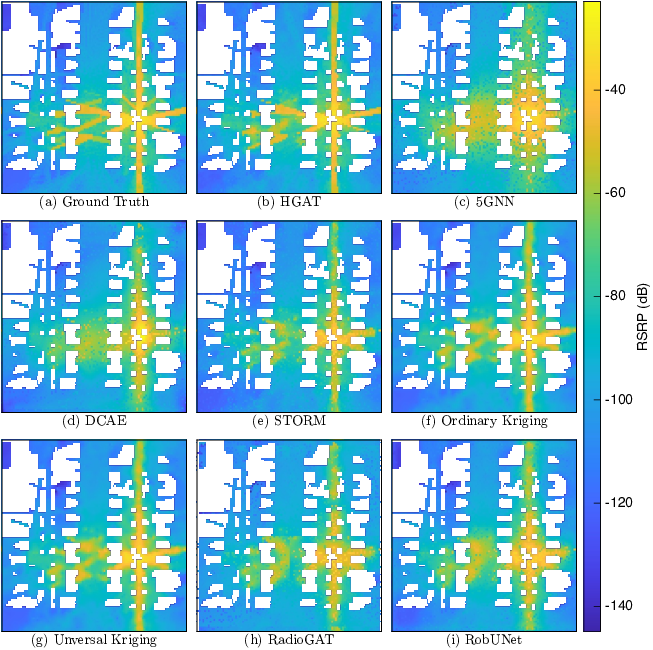
Figure 3: Comparison of predicted RSS on a seen site, illustrating HGAT’s ability to capture narrow propagation features and attenuation edges.
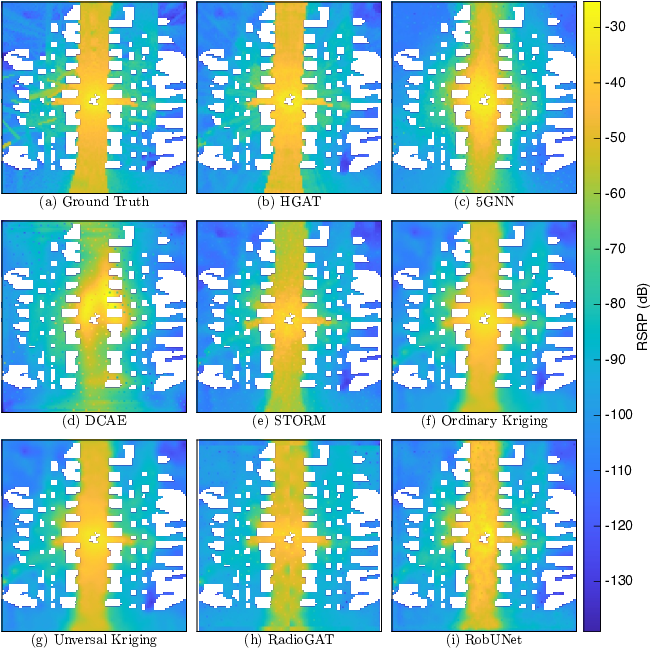
Figure 4: Held-out site result, with HGAT maintaining sharp corridor structure and accurate transition localization.
Residual and Gated Regime Results
Incorporating kriging as an explict prior, HGAT’s residual regime systematically reduces RMSE/MAE relative to the prior, with further post-hoc gating resolving trade-offs between high-magnitude error reduction (RMSE) and average error (MAE), especially on held-out data. Numerical improvements are significant—e.g., on Site 3, the residual regime achieves a RMSE of $5.41$ dB (vs. $5.87$ for kriging), further lowered by gating to $5.37$ dB.
Qualitative analyses expose where most error reduction is achieved: high-gradient and reflection regions, which are inadequately captured by globally smooth interpolators but corrected by HGAT’s structured residuals.
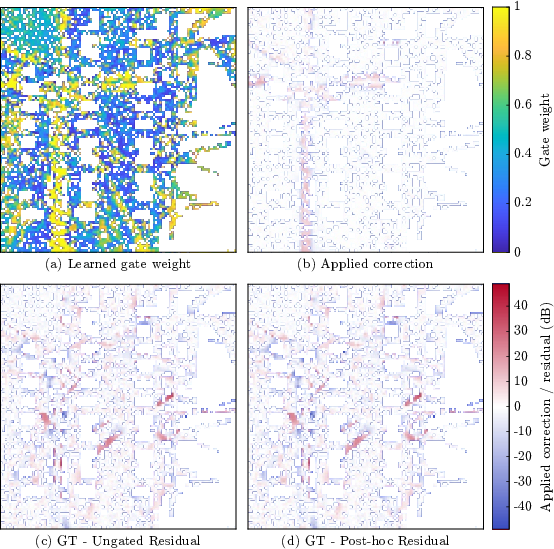
Figure 5: Residual learning: Left shows ordinary kriging estimation; middle shows HGAT-corrected estimates; rights show the difference/improvement in absolute error, highlighting gains at sharp transitions.
Figure 6: Diagnostic of post-hoc gating: Point-wise learned attenuation factor suppresses unreliable corrections, optimizing reliability with minimal additional supervision.
Theoretical and Practical Implications
This approach formalizes query-conditioned, point-wise hierarchical aggregation as an effective alternative to dense grid completion, better suited for real deployments where only selected locations or localized updates are needed. The explicit separation of prior and learned correction enhances interpretability, robustness, and modularity—a notable advance considering that classical priors already encode substantial physical insight.
The use of GATv2-style attention over composite geometric and measurement descriptors (rather than fixed neighborhood convolution or vanilla GCNs) is validated as essential for capturing fine-grained, target-specific dependencies in spatially heterogeneous wireless channels.
The results reinforce important design principles for radio cartography:
- Explicitly incorporating physics-based priors (even strong interpolators like kriging) is non-negotiable for maximizing accuracy under sparse sampling.
- Structured residual learning, informed by local propagation conditions and query-specific evidence, systematically improves upon model-based baselines without overfitting.
- Post-hoc gating is effective to mitigate calibration risk—especially crucial when deploying in unsupervised or new environments.
Future Directions
Open directions include: extension to multi-band/joint transmitter modeling, integration with active measurement selection policies (e.g., Bayesian uncertainty-driven scheduling), and adaptation to highly non-stationary or evolving environments. Further, investigation into more expressive geometric encoding (multiresolution hash, circular harmonic embeddings) or attention mechanisms (multi-head or adaptive hierarchies) can refine the inductive bias of pointwise estimators.
Conclusion
This work demonstrates that a physics-aware, hierarchical GAT with query-conditioned local and global stages achieves state-of-the-art performance for transmitter-resolved, measurement-only radio map estimation—particularly when coupled with explicit priors and structured residual correction. The modular regime design, strong empirical gains, and comprehensive analysis collectively advance practical RME for real-world, sparse, and adaptive wireless deployments.
Reference: "Physics-Aware Query-Conditioned Graph Attention Networks for Radio Map Estimation" (2604.17414)