- The paper introduces RadTwin, which enables real-time, scene-agnostic channel prediction through explicit geometric conditioning and LOS-masked attention.
- It employs a voxel-based point cloud representation and transformer decoder to synthesize spatial spectra, achieving 31.6% higher SSIM and 91.96% lower LPIPS than NeRF2.
- RadTwin demonstrates data efficiency and robust scalability across dynamic indoor settings, validated on synthetic datasets with varying furniture configurations.
RadTwin: Generalizable Wireless Digital Twin for Dynamic Environments
Introduction and Motivation
RadTwin addresses the longstanding challenge of modeling radio propagation within dynamic indoor environments for the realization of wireless digital twins (DNTs). The paper critiques established approaches such as deterministic EM ray tracing and neural radiance fields (NeRF), highlighting their limitations in dynamic scene adaptation. Ray tracing requires highly specific geometric and material attributes, while NeRF encodes geometry implicitly in network weights, demanding costly retraining upon any environmental change. RadTwin proposes to circumvent these restrictions via explicit geometric conditioning, thus enabling real-time, scene-agnostic channel prediction in continuously evolving indoor spaces.
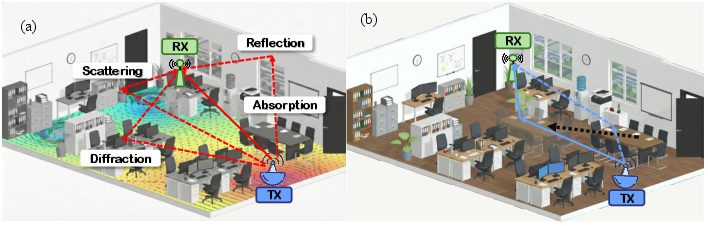
Figure 1: Impact of dynamic scene changes on radio propagation, illustrating multipath phenomena and the effect of furniture movement on the radiance field.
Radio Radiance Fields and Spatial Spectrum Synthesis
RadTwin leverages the radio radiance field (RRF) formalism, which analogizes wireless channel modeling to optical radiance fields; it maps environment geometry and angular queries to spatial spectrum power distributions. The spatial spectrum Ψ(θ,φ) (Equation 3) provides a comprehensive characterization of multipath propagation, capturing dominant arrival directions and the magnitude of path loss per direction. This representation underpins both the interpretability and the predictive capacity of DNTs for applications such as coverage prediction, beam tracking, and interference management.
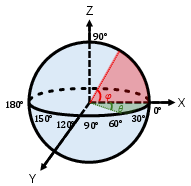
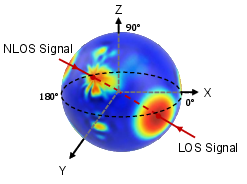
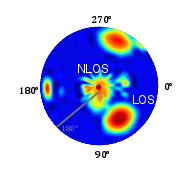
Figure 2: Angular parametrization for spatial spectrum, showing azimuth and elevation mappings used in direction-based spectrum queries.
RadTwin Framework and Architecture
RadTwin introduces an end-to-end pipeline with three major components:
- Scenario Representation Network: Utilizes a point cloud-based voxelization strategy, extracting local and global geometric features with positional encoding to capture fine spatial dependencies.
- Electromagnetic Ray Tracing Module: Implements a physics-informed LOS voxel mapping, using ray-box intersection tests to determine which surfaces are visible from any RX query direction. This yields sparse attention masks encoding geometric relevance.
- Neural Propagation Decoder: Aggregates voxel features via a Transformer decoder employing masked cross-attention restricted by LOS masks, efficiently synthesizing spatial spectra.
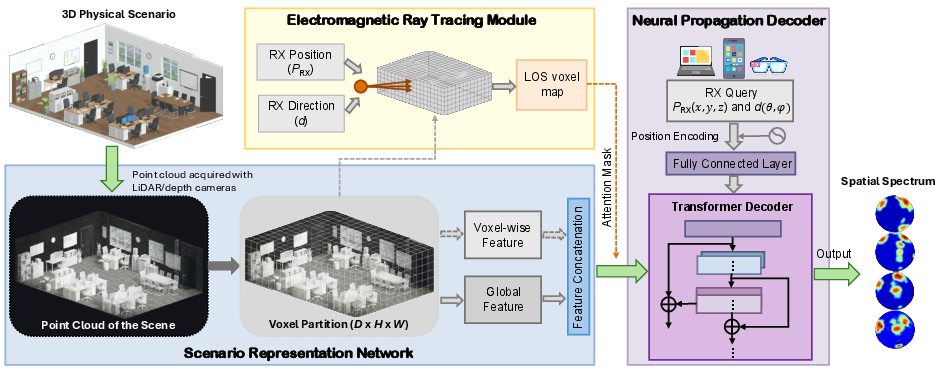
Figure 3: Overview of the RadTwin framework, detailing the flow from scenario representation to electromagnetically guided attention and Transformer-based decoding.
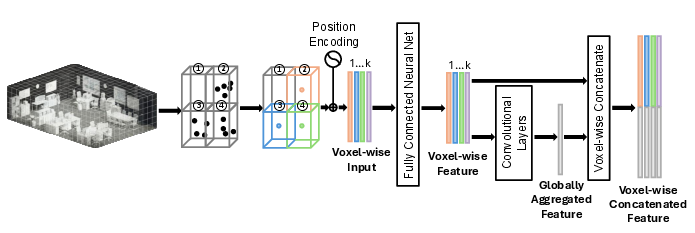
Figure 4: Architecture of Scenario Representation Network, highlighting voxel grid partitioning, positional encoding, and hierarchical feature aggregation.
This explicit conditioning enables scene-agnostic generalization: the model is trained once and then adapts to new environmental configurations without any retraining.
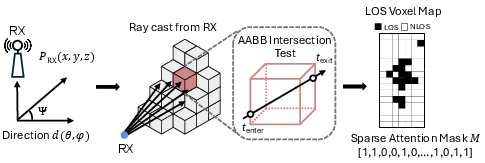
Figure 5: Electromagnetic Ray Tracing Module, illustrating the LOS voxel identification process and angular aggregation for sparse attention.
Dataset and Implementation Details
A synthetic dataset was constructed in Blender spanning small, medium, and large office scenes, systematically varying furniture layouts. Wireless channel data were generated using Sionna RT, with uniform sampling of RX positions and sweeping all angular directions per RX. RadTwin processes point clouds of scene surfaces; the voxel resolution is fixed at 0.5×0.5×0.5\,m3, retaining efficiency in both spatial representation and neural processing.
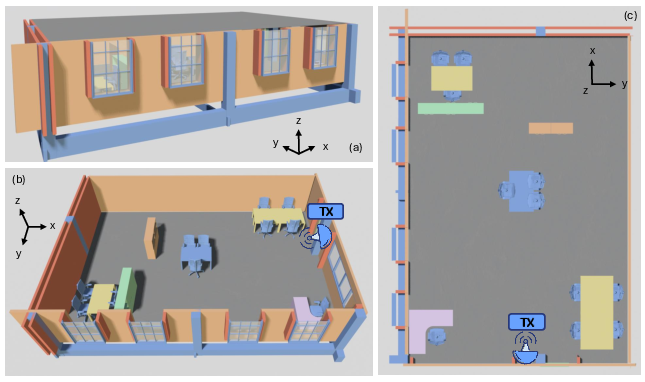
Figure 6: Visualization of a small indoor office scene used for dataset generation (exterior, interior, and top view).
Strong numerical sensitivity to geometric perturbations was demonstrated: moving a single bookshelf by 3.5\,m induced path loss deviations exceeding 99\,dB at certain directions, underlining the necessity for precise geometric encoding in channel modeling.
Spatial Spectrum Prediction Accuracy
RadTwin was benchmarked against NeRF2 and MLP baselines. Visual and quantitative comparisons reveal that RadTwin consistently predicts spatial spectra with higher fidelity, closely matching the ground truth and capturing both dominant propagation paths and subtle multipath structures.
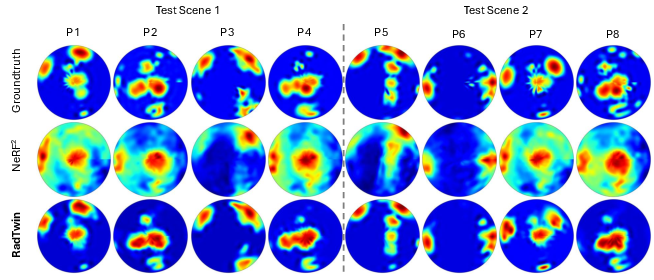
Figure 7: Synthesis of spatial spectrums at eight RX positions, with RadTwin accurately replicating both dominant and fine-grained multipath patterns; NeRF2 suffers in detailed regions.
Quantitatively, RadTwin achieves:
- 31.6% higher SSIM (0.846 vs. 0.643)
- 91.96% lower LPIPS (0.023 vs. 0.286)
compared to NeRF2, across 1,000 RX positions in unseen test scenes.
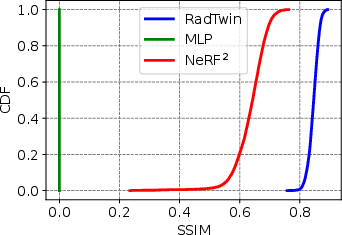
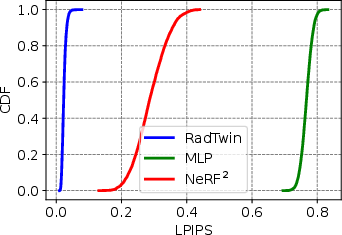
Figure 8: CDF of SSIM values, demonstrating RadTwin's superiority in structural similarity for spatial spectrum synthesis.
Data Efficiency and Scalability
RadTwin maintains robust NMSE performance with reduced training data, exhibiting diminishing returns beyond 600 RXs per scene. Its voxel-based representation and LOS-masked attention scale effectively from small to large indoor scenes, even as spatial coverage becomes sparser.
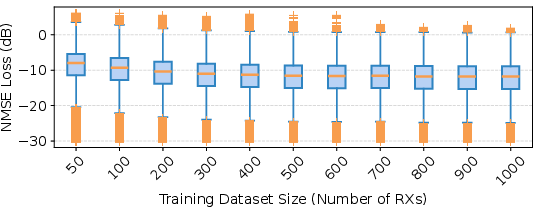
Figure 9: NMSE distribution as a function of training data volume, demonstrating RadTwin's data efficiency.
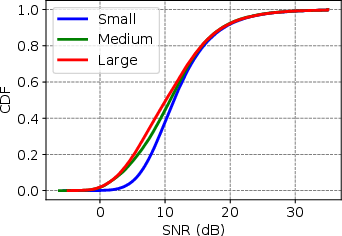
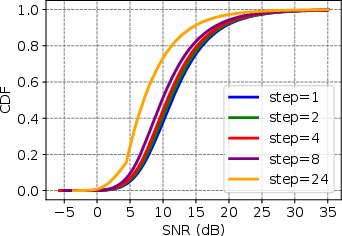
Figure 10: SNR distribution across scene sizes, indicating RadTwin's scalability and robustness in increasing spatial complexity.
Generalization to Dynamic Environments
RadTwin's explicit conditioning on geometry enables interpolation to unseen intermediate furniture positions, critical for dynamic indoor deployment. Even with minimal scene diversity during training, RadTwin preserves high median SNR values, confirming practical adaptability.
Practical and Theoretical Implications
RadTwin validates the principle that explicit geometric conditioning is essential for generalizable channel prediction in multipath-dense environments. By separating scene representation from propagation learning, RadTwin overcomes retraining bottlenecks inherent in both ray tracing and implicit neural field models. Its LOS-guided sparse attention mechanism not only accelerates inference but also enhances interpretability. These design choices are expected to facilitate efficient and reliable wireless DNTs in real-world scenarios—enabling continuous, high-fidelity channel mapping as environments change.
Future research directions could focus on extending RadTwin to outdoor and heterogeneous environments, incorporating online joint optimization of material properties, and refining inference with real sensor data beyond synthetic simulation.
Conclusion
RadTwin exemplifies a rigorous approach to generalizable wireless digital twins in dynamic indoor environments. By employing explicit point cloud-based scene representation, physics-guided attention via ray tracing, and Transformer-based spectrum synthesis, it demonstrates numerically superior, data-efficient, and scalable channel modeling. This sets a foundational direction for practical DNT deployment, demanding further exploration in adaptive wireless network optimization and real-time channel state prediction.

