- The paper introduces FARM, a foundation model that unifies condition-based and condition-free aerial radio map estimation using masked autoencoders and diffusion models.
- It employs a two-phase training pipeline—self-supervised pre-training and generative fine-tuning—to achieve significant reductions in NMSE and RMSE.
- Empirical results show robust performance across complex urban scenarios, low-altitude settings, and zero-shot transfer configurations.
FARM: A Foundation Model for Unified Aerial Radio Map Estimation
Motivation and Context
Large-scale, high-fidelity aerial radio maps (ARMs) are pivotal for next-generation low-altitude wireless networks, enabling robust communication, autonomous logistics, and intelligent urban infrastructure. Traditional ARM estimation methodologies—including both interpolation-based and deep learning-driven approaches—face substantial challenges: poor granularity in complex 3D aerial environments, limited cross-scenario generalization, and excessive reliance on environmental priors. These limitations are particularly acute in low-altitude no-fly zones and heterogeneous base station (BS) configurations, where domain shifts frequently occur.
Recently, the foundation model paradigm has demonstrated superior transferability and sample efficiency in diverse domains such as biology and medical imaging. However, in wireless communications, prior approaches either lack architectural universality (serving only condition-based or condition-free estimation) or depend on fragmented, low-resolution datasets. This motivates the introduction of FARM: a unified foundation model supporting both condition-based and condition-free ARM estimation, underpinned by a newly curated, high-resolution, multi-band, multi-antenna, and large-scale dataset (ARM-Omni), specifically tailored for low-altitude networking environments.
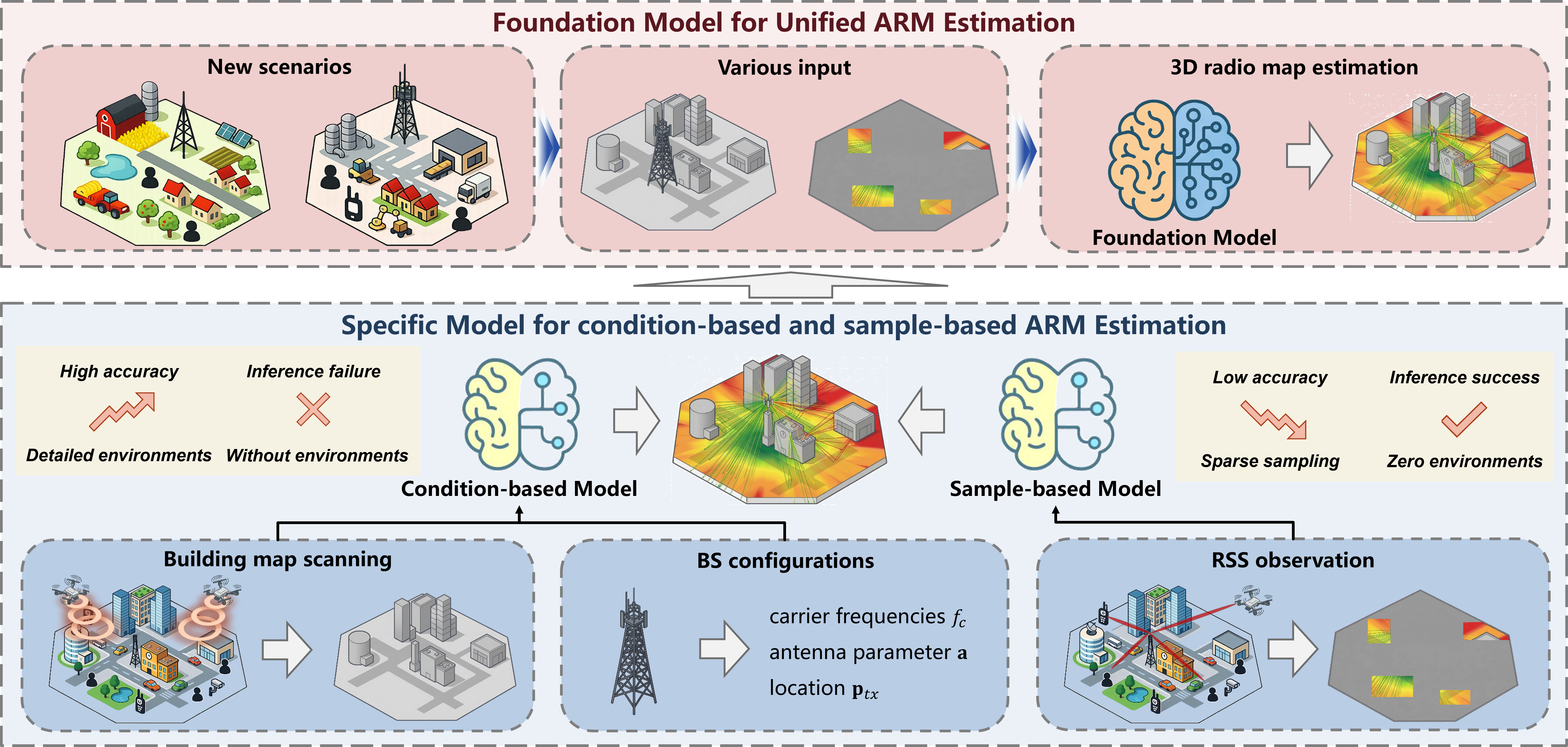
Figure 1: Foundation model versus specific model for ARM estimation. FARM provides significant generalization and performance gains compared to bespoke designs tied to specific environments.
FARM Model Architecture
FARM integrates two powerful deep learning paradigms: masked autoencoders (MAEs) for self-supervised spatial representation learning, and diffusion models for high-fidelity generative reconstruction. The architecture effectively aligns these components in voxel space using a flow-matching ordinary differential equation (ODE) framework, resulting in a robust, generalizable pipeline capable of adapting to diverse BS configurations and environmental priors.
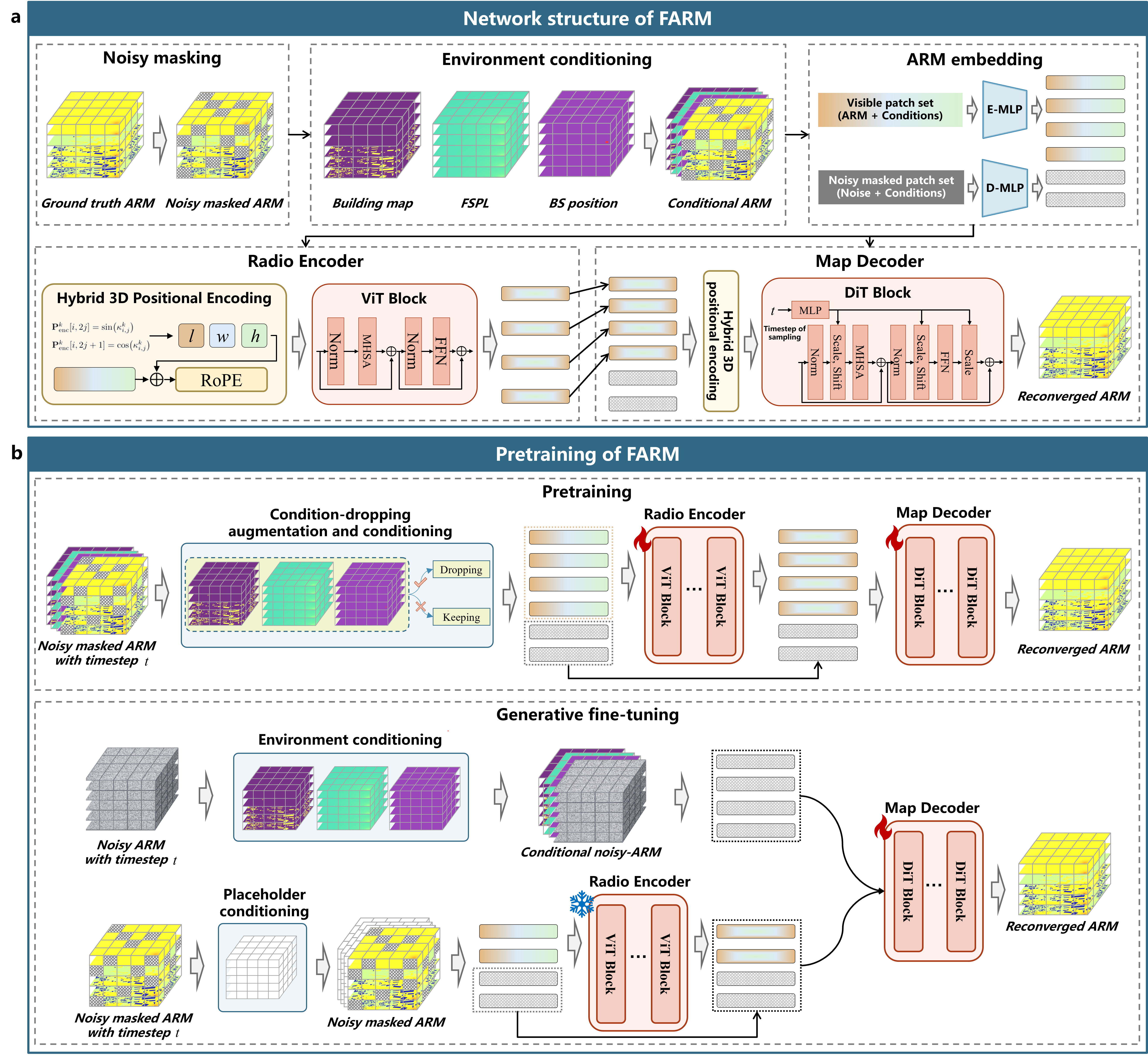
Figure 2: Overview of FARM with MAE-based radio encoder and diffusion map decoder, and two-stage training combining self-supervised pre-training and generative fine-tuning.
Core Components
- Masked Autoencoder (MAE) Radio Encoder: Processes noise-masked voxelized ARM patches, extracting latent representations from partially observed samples. Hybrid positional encoding (absolute SinCos and RoPE) enables 3D spatial awareness and efficient exploitation of both global and relative positional cues.
- Diffusion Map Decoder (DiT-based): Utilizes velocity-based flow-matching to denoise the latent representation back into a full 3D ARM, conditioned on environmental priors as available (BS position, free-space pathloss, building occupancy).
- Voxel-Space Channel-Wise Conditioning: Rather than relying on cross-attention or costly latent fusion, FARM concatenates environmental priors channel-wise, significantly improving computational efficiency and ensuring direct alignment with spatial radio propagation phenomena.
- Dual-Path Patch Embedding: Visible (unmasked) and noise-masked ARM patches are encoded via dedicated MLPs to maintain separation of observed context and reconstruction targets, preserving sharp distinction between condition-based and condition-free modes.
Training and Inference Pipeline
FARM employs a two-phase optimization:
- Self-Supervised Pre-Training: Broadly exposes the model to diverse channel geometries under random maskings, supplemented with condition-dropping augmentation to prevent over-reliance on environmental priors and promote robustness in both estimation modes.
- Generative Fine-Tuning: Further adapts the decoder for accurate 3D ARM reconstruction, optimizing both condition-based and condition-free tasks via velocity-space loss.
At inference, FARM supports all operational regimes:
- Condition-free (sparse observed RSS only)
- Condition-based (BS/environment priors only)
- Hybrid mode (both available)
This flexible dispatch logic obviates the need for separate models in dynamic heterogeneous deployment scenarios.
ARM-Omni Dataset: Enabling Foundation Modeling
A key enabler for FARM is the ARM-Omni dataset, designed to address the paucity and narrow scope of previous ARM datasets.
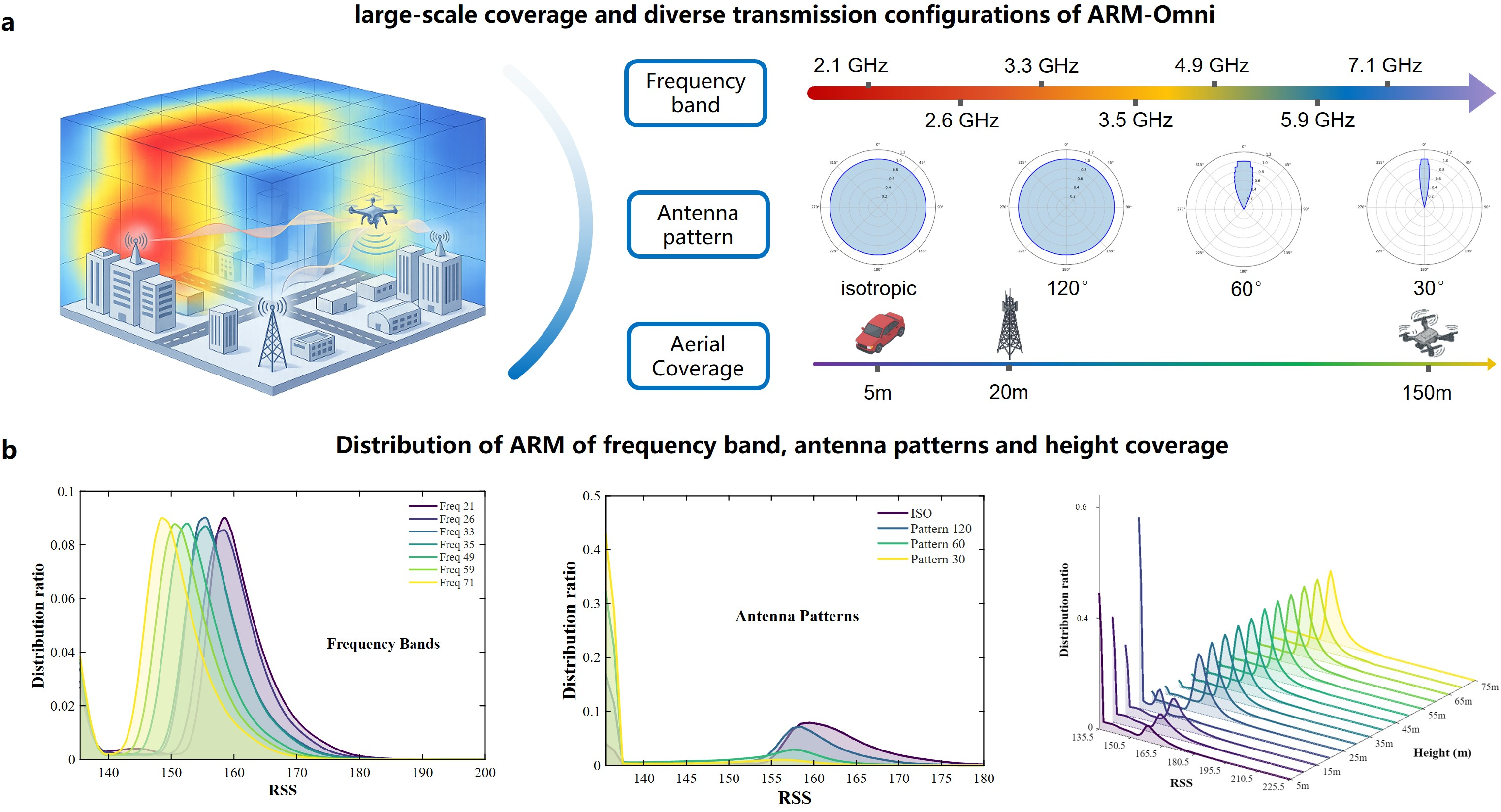
Figure 3: ARM-Omni features diverse transmission configurations, comprehensive height coverage, and detailed signal distributional analysis across frequencies, antenna patterns, and vertical slices.
Notable ARM-Omni Features
- Scale and Resolution: ~26.4 million voxelized RSS samples, 1000×1000 horizontal grid over 1 km², $5$–$150$ m vertical range at $5$ m granularity (30 height levels).
- Diversity: 130 urban scenarios (from OpenStreetMap), 7 carrier frequencies (2.1–7.1 GHz), 4 antenna types (from isotropic to 30° beams), and multiple transmitter orientations.
- Physics-Based Realism: Simulation via Sionna RT ray-tracing captures LoS/NLoS transitions, material-specific attenuation, and structural blockage.
- Support for Heterogeneity: Variations in coverage size, Rx height, frequency, and antenna pattern crucial for foundation model pretraining and robust transfer to previously unseen settings.
This scale and variability enable FARM to learn frequency, spatial, and environmental priors not available to previous slice-wise or configuration-specific models.
Comprehensive experiments compare FARM (in small/base/large variants) to both classical (Kriging) and advanced (AE, RadioUNet, RadioDiff) baselines across condition-free and condition-based estimation modes. Performance is evaluated by NMSE, RMSE, PSNR, and SSIM.
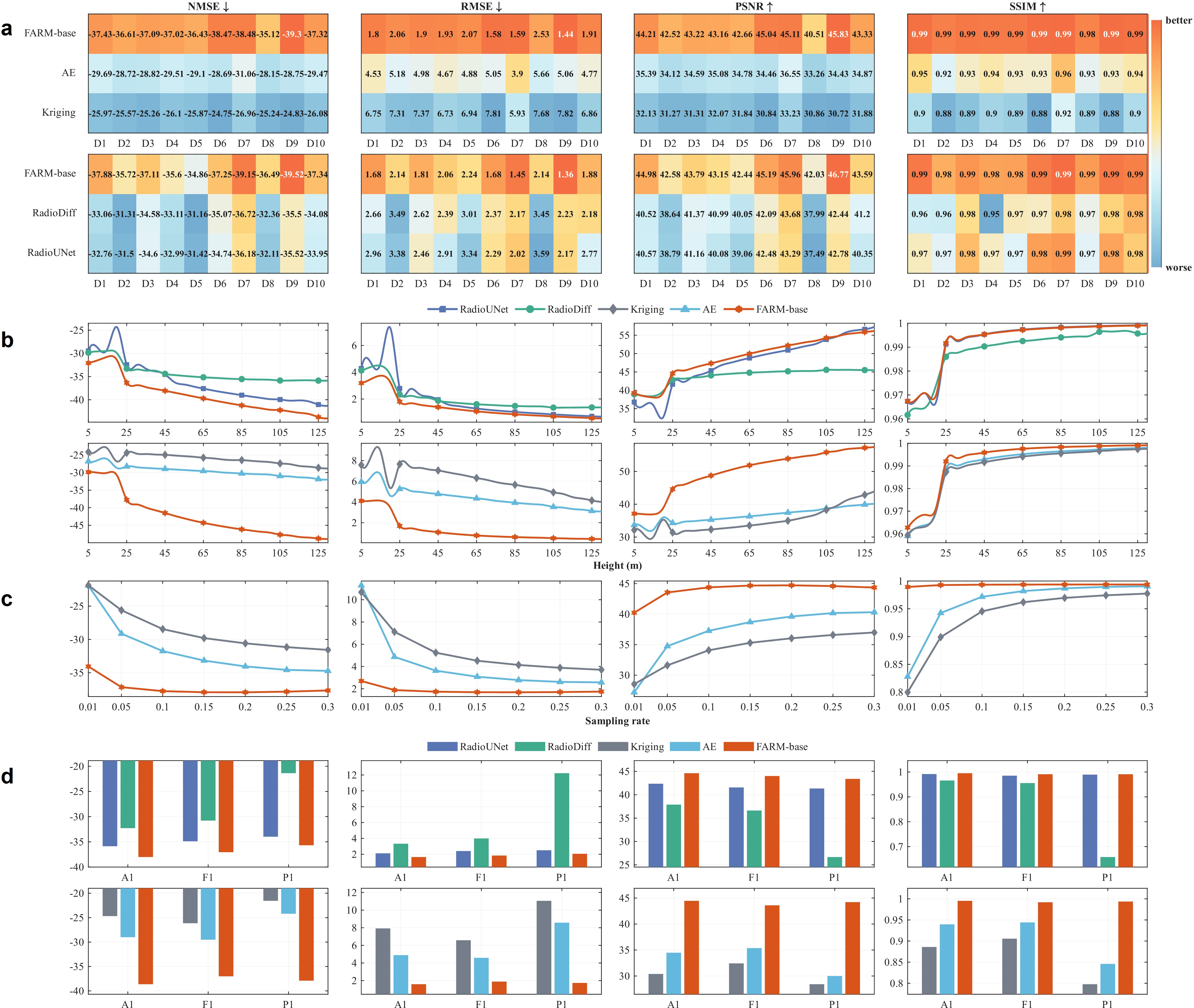
Figure 4: FARM outperforms all benchmarks in both standard (multi-dataset), altitude-resolved, sampling rate ablation, and zero-shot generalization regimes.
Key Findings
- Unified Learning: FARM yields large reductions in NMSE and RMSE (e.g., >8 dB NMSE gain over AE and >11 dB over Kriging in condition-free mode), with corresponding PSNR and SSIM gains, showing it preserves fine structural features of the radio field.
- Height-Resolved Robustness: Substantial improvement at low altitudes (<25 m), which are most challenging due to dense urban blockage, and consistent accuracy across the vertical range. Only FARM maintains stable and low error across all height levels, while baselines degrade sharply near obstacles.
- Sampling Rate Resilience: Unlike AE and Kriging, whose performance collapses under low (1%) RSS sampling rates, FARM maintains NMSE below -34 dB, confirming strong sample efficiency and practical applicability in measurement-constrained scenarios.
- Zero-Shot Transfer: In unseen domains (new carrier frequencies, antenna patterns, spatial coverage), FARM retains high PSNR (e.g., >2 dB over best baseline), indicating successful acquisition of generalizable, configuration-independent spatial priors.
- Scaling and Adaptability: Scaling up model parameters consistently improves performance, especially in sparse or condition-free regimes. Decoder fine-tuning provides pronounced performance jumps in condition-based settings.
Additionally, in terms of inference efficiency, FARM processes the full 3D ARM at once, amortizing computational cost and resulting in the lowest per-height inference latency among learned methods.
Implications and Future Directions
This work provides the first foundation modeling framework for aerial radio environments, demonstrating the feasibility and benefits of transferring large-scale self-supervised and generative paradigms to wireless channel mapping. The unified encoder-decoder architecture enables adaptation to both data-rich and data-sparse environments, with significant improvements in both accuracy and generalization over prior approaches. Importantly, combining volumetric 3D modeling, multi-vector conditioning, and rigorous ODE-based generative refinement positions FARM as an essential infrastructure for intelligent low-altitude communication, network planning, autonomous vehicle routing, and 6G digital twin creation.
Future research could extend this foundation modeling philosophy by:
Conclusion
FARM establishes a robust, unified, and highly generalizable framework for aerial radio map estimation, combining architectural advances with a state-of-the-art dataset. Its superiority over both classical and deep learning baselines is empirically validated across all major metrics and regimes, confirming its foundational status for the next phase of intelligent low-altitude networking and 3D wireless digital twin development (2604.17362).

