3D-RoPE: Three-Dimensional Rotary Positional Embedding
- 3D-RoPE is a method that injects relative positional information into transformers by applying structured 3D rotation matrices to token embeddings.
- It leverages Lie group theory, block-diagonal rotations, and quaternion averaging to ensure translation invariance, sharper spatial reasoning, and low computational overhead.
- Empirical evaluations demonstrate notable improvements in accuracy and alignment across diverse modalities such as images, videos, and biomedical scans.
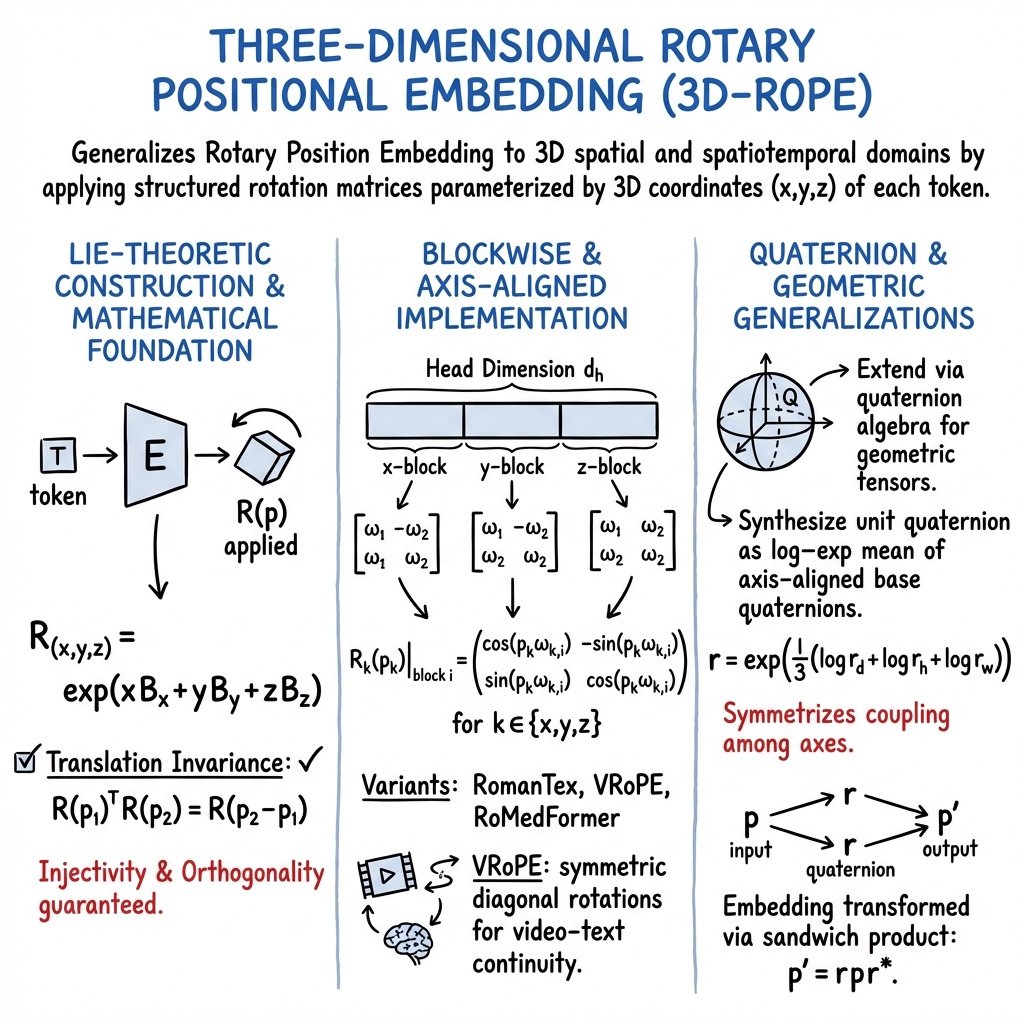
Three-Dimensional Rotary Positional Embedding (3D-RoPE) generalizes the Rotary Position Embedding (RoPE) paradigm from one-dimensional sequence modeling to spatial and spatiotemporal domains. Its central concept is the injection of relative positional information into transformers and attention networks by applying structured rotation matrices parameterized by 3D coordinates of each token. Modern 3D-RoPE designs leverage Lie group and Lie algebra theory, block-diagonal subspace rotations, quaternion averaging, diagonal symmetrization, and coupling schemes, enabling efficient, translation-invariant, and reversible indexing of discrete or continuous locations in volumetric data (images, videos, point clouds, biomedical scans, or geometric tensors). Compared to 1D and 2D positional encoding, 3D-RoPE achieves sharper spatial reasoning, coherent long-range attention, and reliable extrapolation with negligible computational overhead, while supporting diverse transformer architectures for vision, multimodal and scientific modeling.
1. Mathematical Foundations and Lie-Theoretic Construction
The 3D-RoPE principle is the application of a rotation operator to the token embedding, where is the token’s spatial position. In the LieRE (Ostmeier et al., 2024), STRING (Schenck et al., 4 Feb 2025), and “Rethinking RoPE” (Liu et al., 7 Apr 2025) frameworks, the operator is realized as a matrix exponential over generators in the Lie algebra : where are linearly independent, pairwise-commuting, skew-symmetric matrices forming a maximal abelian subalgebra (MASA). For , these are block-diagonalized into three rotation planes; for larger , these blocks are interleaved or tiled across the embedding.
Attention invariance under translation is guaranteed: Injectivity is assured within one period for each axis. Orthogonality is preserved by the skew-symmetry and properties of matrix exponentials. The universality theorem (Schenck et al., 4 Feb 2025) states that any differentiable, translation-invariant encoder in this form reduces to the STRING/RoPE family, confirming optimality for rotary positional encoding in arbitrary dimensions.
2. Blockwise and Axis-Aligned 3D-RoPE Implementations
Most practical transformer instantiations of 3D-RoPE partition the head dimension into three blocks of equal size, corresponding to the 0, 1, 2 axes. Per axis, each 2-dimensional subvector undergoes an independent rotation: 3 for 4 and 5 as the log-scale frequency schedule. The embedding becomes a concatenation or composition of the three rotations.
Variants, such as RomanTex (Feng et al., 24 Mar 2025), VRoPE (Liu et al., 17 Feb 2025), and RoMedFormer (Li et al., 18 Mar 2025), use the above scheme but adapt for spatiotemporal, video, or geometry-driven contexts. For example, in video modeling, VRoPE applies symmetric diagonal-coordinate rotations and contiguous indexing to ensure cross-modal continuity and mitigate spatial bias.
3. Quaternion and Spherical Generalizations
GeoPE (Yao et al., 4 Dec 2025) and Spherical Position Encoding (Unlu, 2023) extend 3D-RoPE via quaternion algebra for geometric tensors and spherical rotations for geotokens. Each triplet of embedding channels is cast as a pure quaternion and rotated by a unit quaternion synthesized as the log–exp mean of axis-aligned base quaternions: 6 thus symmetrizing the coupling among axes and resolving non-commutativity. The embedding is transformed using the sandwich product 7, and the overall operator is block-diagonal across the sequence.
For spherical geotokens, the transformation reduces to blockwise application of Euler-angle rotation matrices parameterized by latitude and longitude, encoding the spatial relationships on a sphere.
4. Spatiotemporal and Multimodal Extensions
VRoPE (Liu et al., 17 Feb 2025) augments RoPE-3D for video and multimodal LLMs by mapping 8 spatial coordinates to diagonal 9 axes, pairing them with symmetric reversals 0 to eliminate monotonic decay bias. Indices are arranged to ensure seamless video-text transitions by advancing a base pointer per frame and realigning text token positions.
RomanTex (Feng et al., 24 Mar 2025) applies 3D-RoPE to texture synthesis, decoupling image and geometry consistency in multiview attention blocks and supporting classifier-free guidance by scaling the rotational bias corresponding to geometric input. This architecture yields marked improvements in alignment and coherence for UV texture generation.
5. Algorithmic Integration and Computational Considerations
Implementation is lightweight: per-token, per-head rotation involves two multiplies and one add per axis per channel pair, resulting in 1 FLOPs and minimal memory overhead. Efficient batching and fused GPU kernels enable practical deployment, e.g., in RoMedFormer (Li et al., 18 Mar 2025) and LieRE (Ostmeier et al., 2024). Optional learnable orthogonal mixing matrices extend representational capacity.
The typical pseudocode pattern is as follows: 4 In advanced forms, blocks may be mixed by a 6×6 orthogonal matrix 2, applied via 3 (Liu et al., 7 Apr 2025).
6. Empirical Performance and Benchmarking
Multiple studies confirm that 3D-RoPE yields significant gains over 1D/2D RoPE and absolute position embeddings in various domains:
| Model/Task | Metric | 1D/2D RoPE | 3D-RoPE | Improvement |
|---|---|---|---|---|
| RoMedFormer (MRI/CT) (Li et al., 18 Mar 2025) | Dice | 0.69 | 0.71 | +0.015–0.025 |
| LieRE (UCF101) (Ostmeier et al., 2024) | Accuracy (%) | 48.6 | 51.1 | +2.5 |
| STRING (ALOHA sim) (Schenck et al., 4 Feb 2025) | Success (%) | ~37 | ~46 | +9 |
| VRoPE (Video-NIAH) (Liu et al., 17 Feb 2025) | Retrieval (%) | 54.84 | 87.03 | +32.19 |
| RomanTex (LAD) (Feng et al., 24 Mar 2025) | UV Alignment | 0.142 | 0.119 | –0.023 |
| GeoPE (ImageNet ViT-B) (Yao et al., 4 Dec 2025) | Top-1 (%) | 81.3 | 82.5 | +1.2 |
VRoPE ablations (Video-LLMs) demonstrate that continuity and symmetric index pairing deliver stronger uniform attention, cross-modal coherence, and superior video reasoning. STRING’s empirical robustness extends to RGB-D transformers and robotic manipulation under distributional shifts.
7. Design Tradeoffs, Limitations, and Future Directions
Key tradeoffs include tuning chunk sizes for long-context 3D-RPE (too large reintroduces attention decay; too small increases compute), block partitioning vs. full mixing for representation power, and axis symmetry (as in GeoPE) for optimal geometric coupling.
Limitations span the inability of pure 3D-RoPE to encode translations (full SE(3)), scaling constraints for large token ranges, and applicability for non-attention architectures. Ongoing work suggests further exploration of learnable phase schedules, multimodal adaptation (linking 3D rotations to tokens in images, graphs), extension to higher-dimensional RoPE (4D for video), and group-theoretic normalization for nonuniform data and affine equivariance.
The growing body of work confirms that 3D-RoPE—formulated via Lie-theoretic blockwise rotations, quaternion-coupled means, or symmetric diagonal indexing—constitutes a principled, versatile, and computationally efficient solution for encoding relative position in modern transformers across scientific, visual, and structured data tasks (Schenck et al., 4 Feb 2025, Liu et al., 7 Apr 2025, Liu et al., 17 Feb 2025, Li et al., 18 Mar 2025, Yao et al., 4 Dec 2025, Ostmeier et al., 2024, Feng et al., 24 Mar 2025).