- The paper presents a novel human-AI system that co-creates persistent knowledge graphs by integrating user input with document-derived insights.
- It employs a multi-agent pipeline featuring intent disambiguation, hierarchical retrieval, and editable graph construction for refined knowledge synthesis.
- User studies show enhanced knowledge organization and reduced cognitive load compared to static, retrieval-only methods.
MindTrellis: Co-Creation of Knowledge Structures via Human-AI Visual Collaboration
Introduction and Motivation
MindTrellis addresses the core challenge of synthesizing multi-document knowledge into structured, persistent, and comprehensible forms through AI-collaborative, visual, and interactive knowledge graphs. Prior paradigms are limited to either (a) LLM-powered retrieval-only systems that generate static structures users cannot edit, or (b) manual mind/concept mapping tools that lack semantic retrieval and intelligent expansion. MindTrellis introduces co-created knowledge graphs, integrating document-derived and user-contributed knowledge, with manipulable graph structures supported through both natural language and direct manipulation. This hybrid approach enables knowledge workers not only to extract and query grounded information, but also to reorganize, extend, and semantically evolve the knowledge artifact as their understanding develops.
System Overview and Technical Architecture
MIndTrellis’s architecture is built on a multi-agent pipeline that routes and processes user interactions along two main pathways—query and contribution—using specialized agents (Oracle, Adaptive Retriever, and Map Manager):
- Oracle: Disambiguates user intent (query vs. contribute) and routes requests accordingly, maintaining conversational context.
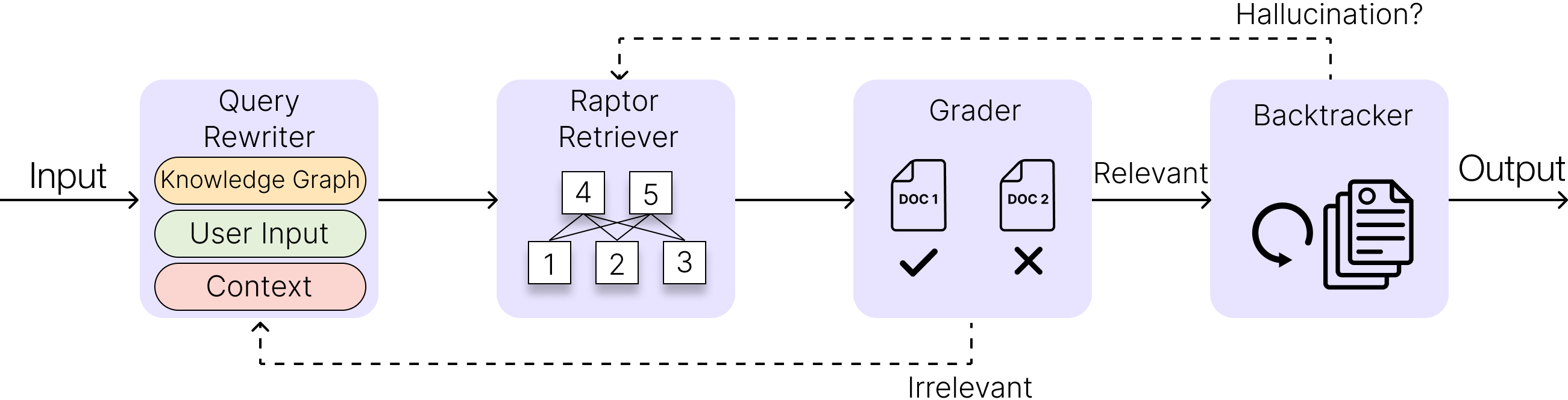
- Adaptive Retriever: Supports document-grounded querying with hierarchical RAG, optimizing retrieval granularity via recursive embedding, clustering, and grading, and ensuring provenance through a backtracking stage.
- Map Manager: Interprets contribution commands for structural augmentation, plans and executes graph modifications, and employs iterative self-correction within a plan-execute-replan loop.
The co-created knowledge graph persists all user and AI modifications, supporting cumulative knowledge exploration and flexible restructuring.
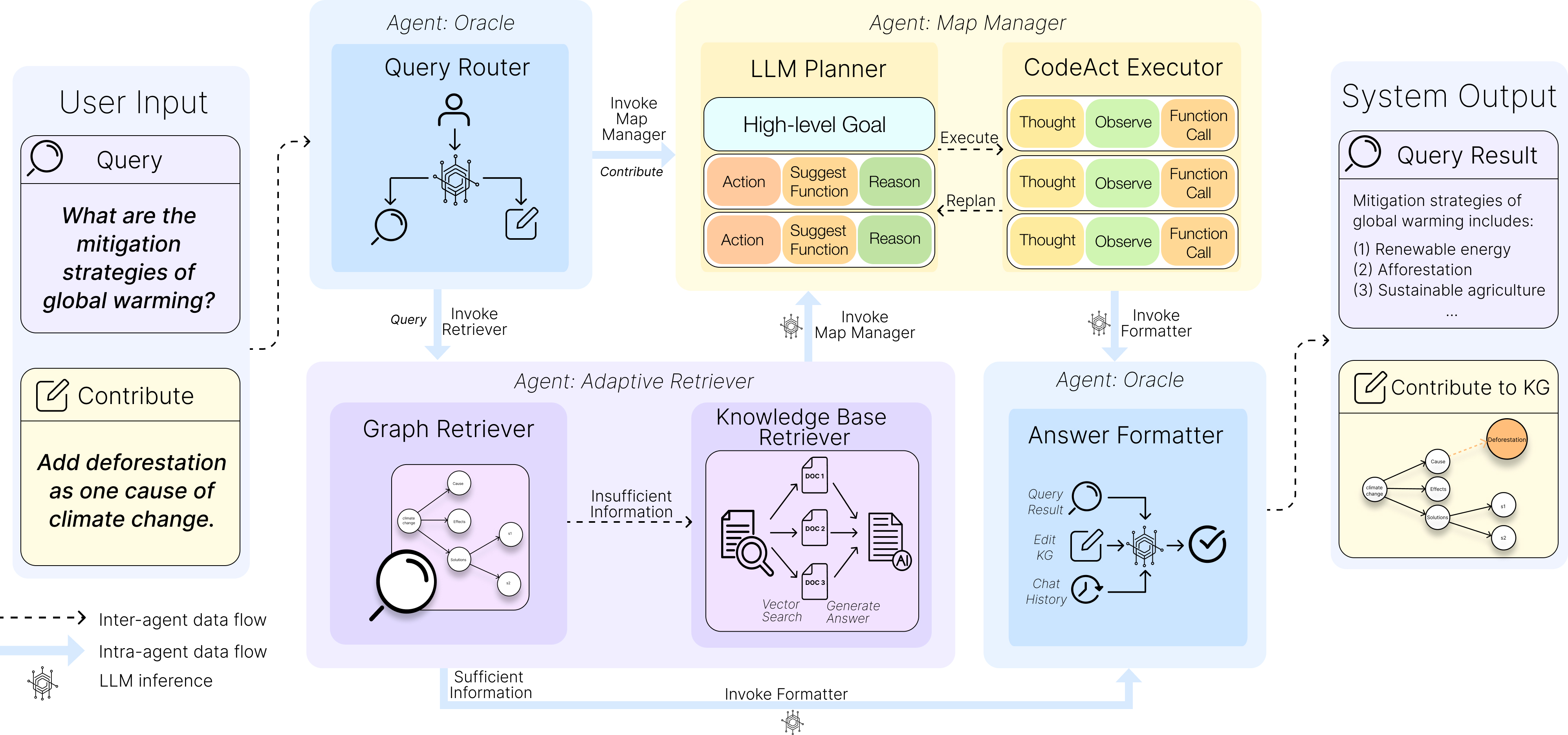
Figure 1: The multi-agent pipeline orchestrates routing, retrieval, and knowledge placement, supporting bidirectional interaction and iterative graph evolution.
User Interaction Paradigms and Cognitive Rationale
MindTrellis enables interaction through both natural language chat—for querying, instructing expansion, or specifying structural changes—and direct manipulation—for precise spatial edits, node creation, grouping, and graph reorganization. This dual-modality addresses diverse user preferences and supports cognitive processes of both incremental sensemaking and explicit representation transformation.
A typical usage scenario demonstrates the iterative process:
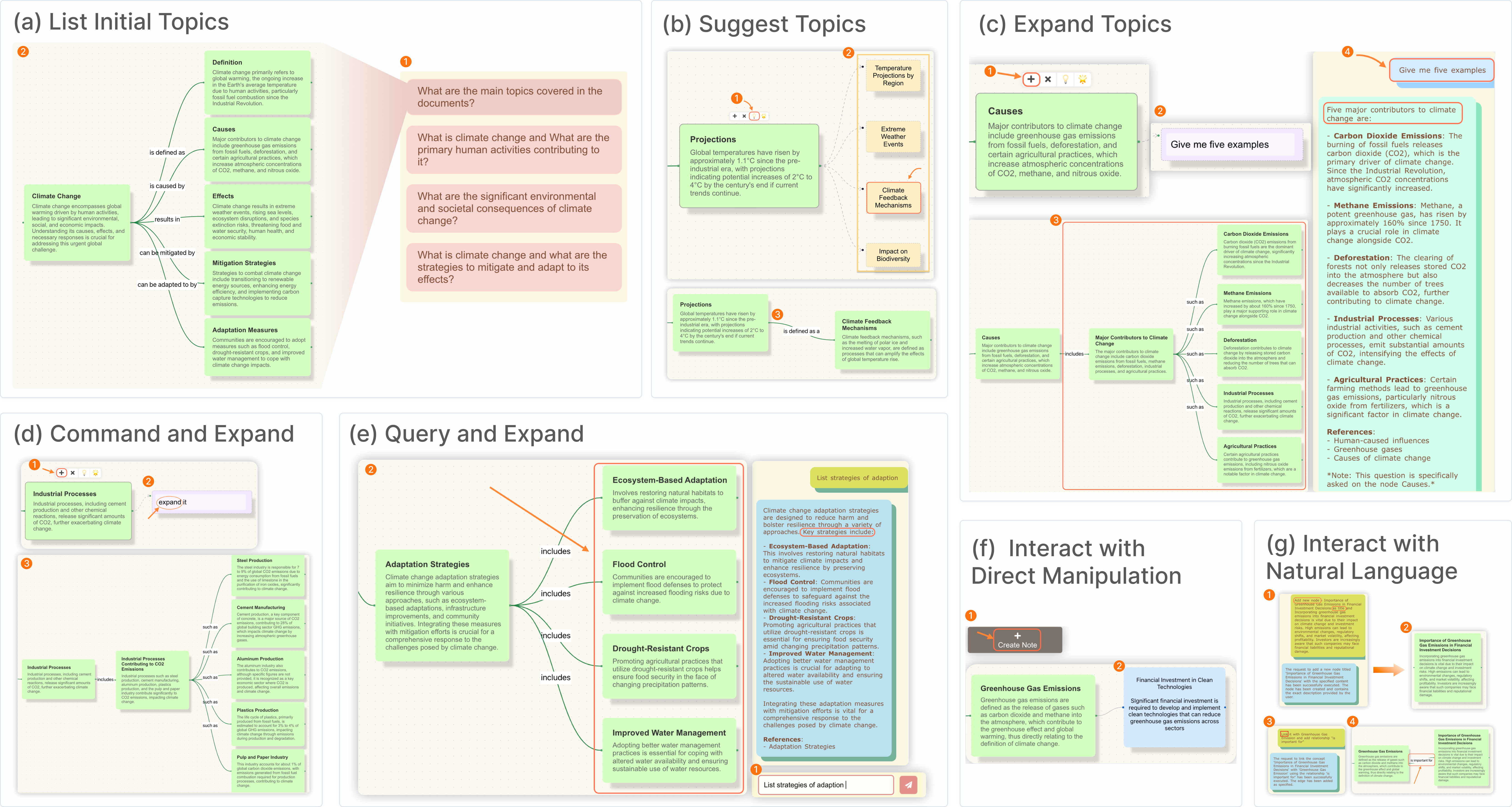
Figure 2: Sequential example of a user-driven knowledge exploration session: initial overview, AI-powered node expansion, query-driven additions, command-based structural edits, chat interactions, direct manipulation, and natural language knowledge contributions.
By integrating real-time suggestions, provenance-linked retrievals, and direct editing, MindTrellis builds a persistent representation, accommodating both top-down and bottom-up knowledge construction strategies.
Knowledge Representation
The underlying knowledge graph merges aspects of mind maps (hierarchical, parent-child navigation) and concept maps (semantic edge labels, multi-parent connections). Semantically labeled edges clarify relationships, while incremental exploration avoids informational overload. Cross-cutting concepts are connected through multiple parents, supporting non-tree structures and accurate modeling of complex domains.
Component-wise and end-to-end pipeline evaluation shows strong numerical results across key axes:
User Study Insights: Effectiveness in Knowledge Organization and Cognitive Load
A controlled study (N=12, within-subject design) contrasted MindTrellis with a retrieval-only baseline:
- Users rated the co-created, editable graph highest for knowledge organization (median 7.0/7), understanding support, and reduced cognitive load during slide preparation tasks.
- Progressive expansion of the knowledge structure—rather than “all-at-once” visualization—was cited as a significant advantage for cognitive manageability.
- Participants leveraged both interaction modalities fluidly, alternately querying for information and contributing or reorganizing structure. Domain or experiential knowledge was frequently integrated, confirming the importance of bidirectionality.
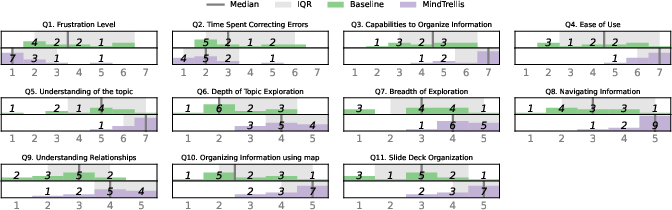
Figure 4: Users' ratings indicate significantly higher usability, effectiveness, and depth of exploration with MindTrellis compared to the static retrieval-based baseline.
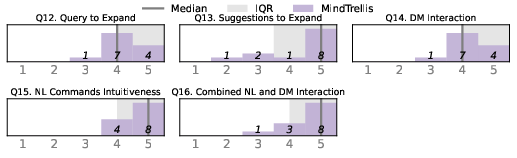
Figure 5: Participants assess MindTrellis's capacity for effective knowledge expansion and the value of system suggestions and interaction mechanisms.
Qualitative feedback emphasized that personalizing and restructuring AI-generated output—rather than being restricted to system-organized representations—was essential for effective knowledge building.
Implications for System and Agent Design
1. Intent Disambiguation as a Bottleneck: Ambiguity in NL input when a single chat channel is shared for both querying and structuring tasks makes intent classification a primary source of failure. Effective systems require explicit feedback, flexible user correction, and possibly clarificatory dialogue or previews prior to graph mutation.
2. Flexible Information Pacing and Granularity: Controlling the pace and grain of expansion (individual node, cluster, subtree) allows users to mitigate overload and adapt the structure to their current cognitive state. Systems should support dynamic switching between summarization and detail expansion.
3. Provisional and User-Correctable AI Structure: All AI-generated placements, relationships, and groupings in the knowledge graph must be exposed as editable artifacts. User intervention, both via chat and direct manipulation, is expected and beneficial; system learning of individual restructuring preferences is a promising future extension.
MindTrellis advances the current landscape beyond both retrieval-only and representational synchronization models:
- Existing LLM-powered visualization tools (e.g., Graphologue, Sensecape, Selenite, Luminate) only allow passive navigation of system-generated structures.
- Commercial offerings such as NotebookLM and Notion AI permit both retrieval and contribution, but operate over non-integrated or non-visual artifact stores, lacking a unified, persistent knowledge graph as the central interface.
- MindTrellis's cognitive and technical benefits derive from the integration of retrieval, progressive structuring, and contribution within a single manipulable artifact.
Limitations and Future Directions
The user study, while rigorous in design, involves a limited sample with high prior exposure to generative AI. Generalization beyond knowledge presentation tasks (e.g., slide decks) requires exploration. There remain challenges scaling pipeline robustness for large and highly interconnected graphs. Future extensions should include multi-representational views (clusters, matrices, timelines), richer provenance visualization, collaborative and longitudinal use scenarios, and ablation or alternative pipeline studies. There is untapped potential in user-preference modeling for automated adaptation of graph organizational choices over time.
Conclusion
MindTrellis proposes and validates an architecture for co-creative, persistent human-AI knowledge construction, unifying querying, AI-powered structuring, and user-based reorganization in a single, editable knowledge graph. Quantitative and user study results confirm superior support for knowledge synthesis and organization over retrieval-only models, largely due to bidirectionality, progressive expansion, and integrated, manipulable representation. The system’s modular multi-agent pipeline provides strong reliability, although intent disambiguation and information provenance remain key technical frontiers. This work has significant implications for the design of future human-AI collaborative sensemaking systems across domains.