- The paper introduces a Cognitive Abstraction pipeline that decomposes LLM outputs into WHV fragments across multiple abstraction levels.
- The system employs R-GCN-guided rewriting and semantic zooming to enable systematic, cross-dimensional design recombination.
- Empirical results demonstrate significant improvements in usability, creative exploration, and structural coherence compared to baseline LLM interfaces.
NexusAI: Cognitive Abstraction and Structured Decomposition for Human-LLM Co-Creative Design Space Exploration
Motivation and Problem Statement
The design ideation pipeline using LLMs is bottlenecked by compositional opacity: outputs from generative models remain undifferentiated, monolithic text, inhibiting decomposition, systematic abstraction, and functional recombination. Existing tools, though they wrap LLMs with graph representations or dimensional maps, elide the internal mechanisms and transformations necessary for expert-level design synthesis and fixation-resistant exploration. This work addresses the absence of computational scaffolds for cognitive decomposition, hierarchical abstraction, and cross-dimensional recombination in AI-assisted creative workflows.
NexusAI System Overview
NexusAI operationalizes a Cognitive Abstraction (CA) pipeline as a layered transformation architecture bridging raw LLM inspiration and graph-based, manipulable design spaces. Three key primitives are implemented:
- Decomposition: Parsing unstructured inspiration into What-How-Value (WHV) fragments, mapping each to its abstraction level (L1–L4).
- Abstraction: Explicit operators shift WHV fragments vertically across a scale from concrete observation (L1) to vision-level (L4) constructs, externalizing semantic generalization, mechanistic inference, and analogical transfer.
- Cross-dimensional recombination: Typed merge operations systematically unify WHV fragments, supporting nonlinear, perspective-shifting synthesis.
This results in a structured, multi-layer design canvas where fragment-level granularity and semantic navigation are exposed as direct manipulations.
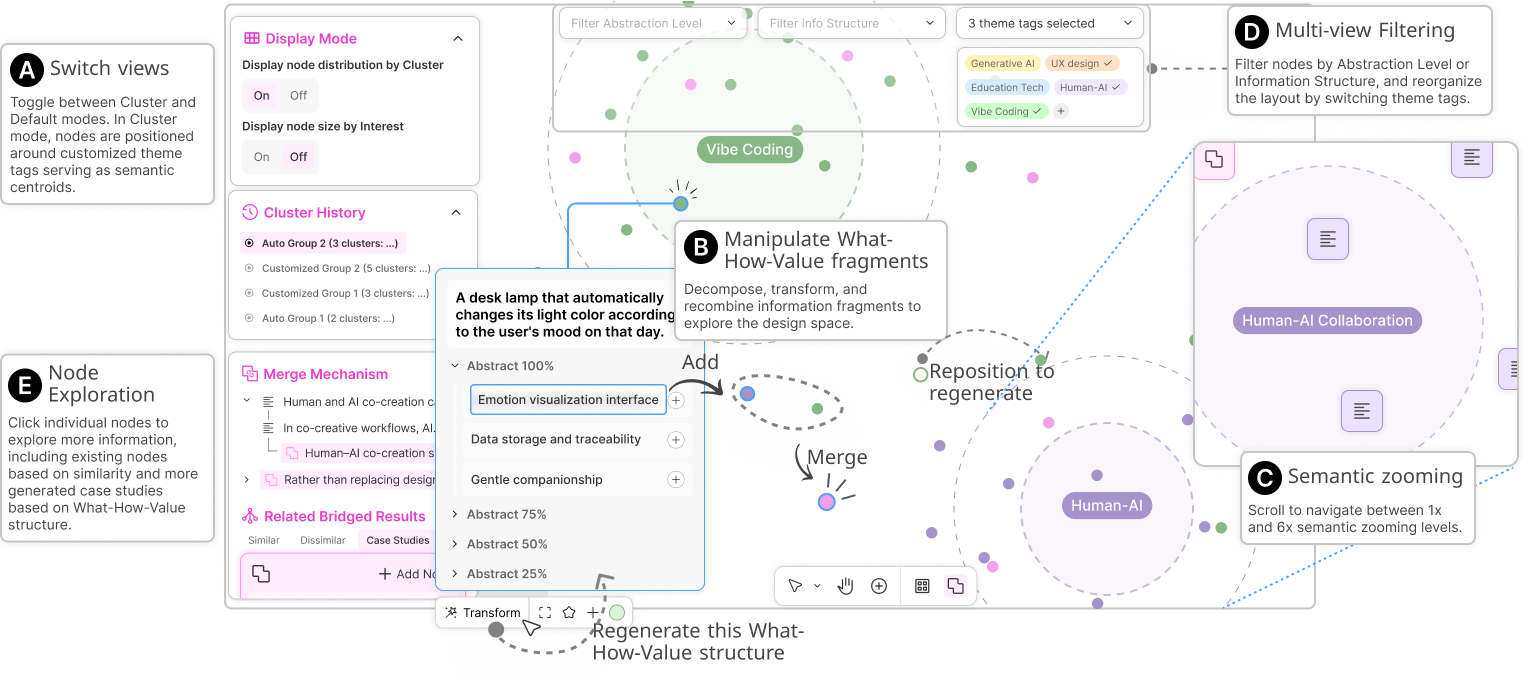
Figure 2: The graph-based interface of NexusAI for manipulating WHV fragments and organizing design spaces via structural operations.
Beyond static parsing, NexusAI introduces an R-GCN-guided rewriting pipeline. Given a target fragment, a prototype graph and relation classifier select transformation exemplars, which are injected as constraints into LLM prompting, ensuring abstraction-level fidelity and transformation regularity.
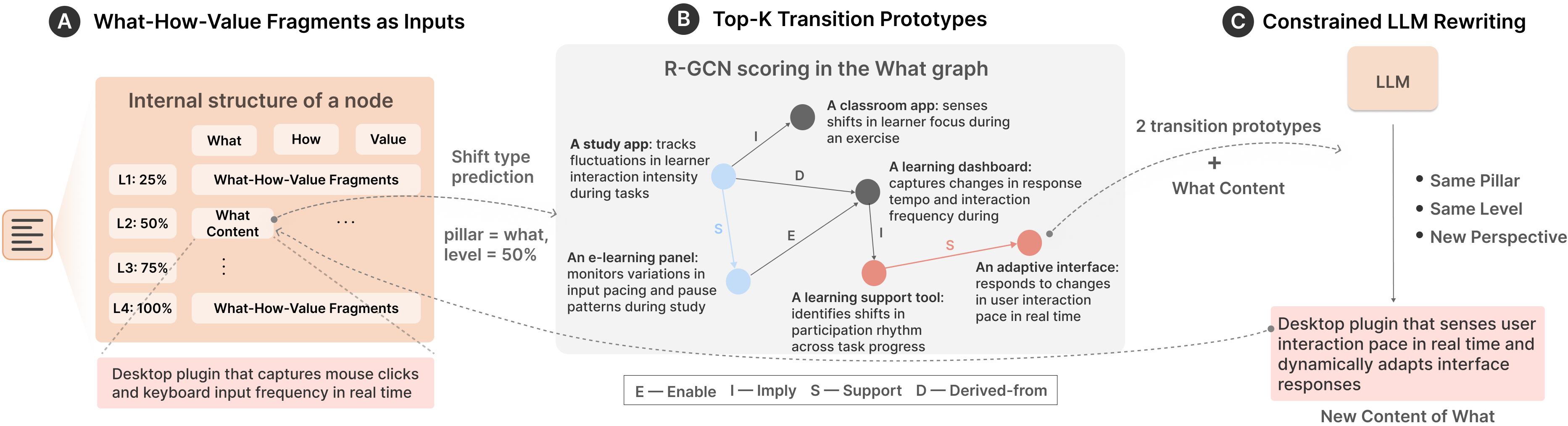
Figure 3: End-to-end CA pipeline: from WHV extraction, through R-GCN-guided rewriting (structural prototype retrieval and prompt injection), to cluster-based semantic layout and recombination.
Abstraction and Semantic Navigability
NexusAI introduces semantic zooming (1x–6x), enabling dynamic shifts in information granularity and focus—from macro-level topology to micro-level fragment content—with interaction paradigms (drag-to-node, semantic theme centroids) designed for cognitive scalability.

Figure 1: Semantic zooming supports scalable navigation between WHV abstraction levels by dynamically adapting both information density and interface layout.
Multi-cluster organization is achieved through thematic-key-based anchors, aligning both automated (embedding-driven) and user-defined centroids to semantic structure in high-dimensional node embedding space. This enables users to holistically survey, spatially organize, and relationally recombine design fragments, surfacing latent analogies and novel syntheses.
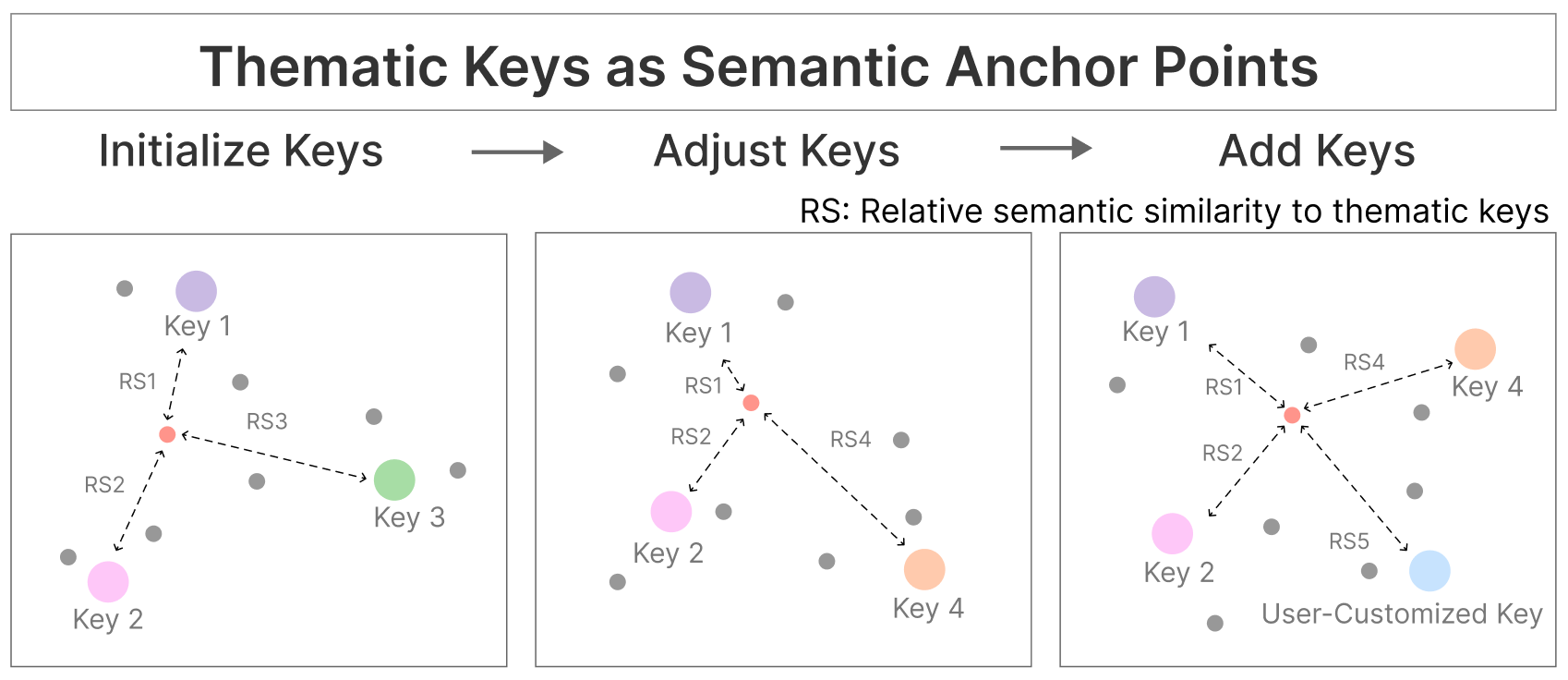
Figure 4: Thematic-key organization: user-configurable semantic axes facilitate holistic structuring and cluster-based exploration.
Empirical Evaluation
A within-subjects, counterbalanced study (N=14) compared NexusAI to a functional LLM-dialogue baseline with equivalent generative capacity but without CA-driven manipulation or multi-abstraction scaffolding. Quantitative outcome metrics include:
- System usability: SUS MNexusAI=69.3, Mbaseline=57.3, p=0.011.
- Exploration depth: Root-to-leaf MNexusAI=1.01 vs. Mbaseline=0.47, p=0.002.
- Structural divergence: Node out-degree MNexusAI=0.98 vs. Mbaseline=0.30, p=0.004.
- Coherence/Coverage: Coverage MNexusAI=0.407 vs. Mbaseline=57.30, Mbaseline=57.31.
- Subjective creative support: CSI Mbaseline=57.32 vs. Mbaseline=57.33, Mbaseline=57.34.
Statistically significant improvements (large Mbaseline=57.35) are observed for cognitive load reduction (NASA-TLX), expressive steering, cross-domain recombination, and sense of control. Users reported higher transparency, with the system’s structural decomposition enabling externalized reasoning strategies and self-aware trajectory mapping.
Mechanistic Advantages
The core contribution is not just in interface design, but in the computational implementation of topological regularization during abstraction. The R-GCN rewritten fragments are structurally anchored: abstraction transitions are contextually faithful, functionally grounded, and theory-attuned (FBS-inspired shift types). This prohibits surface-level paraphrase drift and enforces entailed, semantically meaningful perspective shifts.
Figure 5: R-GCN-guided WHV rewriting pipeline, enforcing pillar/boundary fidelity and transformation regularity in fragment regeneration.
Cross-dimensional hybridization, made possible by exposed WHV fragments at various levels, yields higher-order analogical blends, moving beyond mere lateral chaining typical of prior LLM-ideation interfaces. This recombinant capacity directly counters cognitive fixation and enables systematic domain transfer at the mechanism and value layers.
Theoretical and Practical Implications
The successful externalization of cognitive abstraction primitives reframes the HCI paradigm in LLM-mediated ideation from interpretive consumption of holistic ideas to intent-driven, structural synthesis. This has downstream effects on:
- Divergent thinking: Systematizing both vertical and horizontal design space navigation, allowing users to traverse specificity or blend disparate mechanisms and values.
- Sensemaking: User agency transitions from prompt-reactive querying to architectural configuration of the design graph, with persistent manipulation of functional subunits.
- Agency and transparency: Users obtain interpretable insight into both LLM reasoning and their own cognitive progress within the exploration canvas.
Methodologically, the integration of neural prototype retrieval (R-GCN) with prompt engineering establishes a scalable paradigm for embedding structured cognitive operations directly in LLM-assisted workflows.
Limitations and Future Work
The study is temporally bounded to short ideation sessions; longitudinal effects on graph growth, maintenance, and practical creative artifact generation remain to be evaluated. The enforced WHV decomposition, while structurally powerful, may induce ontological tunnel vision—potentially suppressing creative intuitions that do not map onto function-behavior-value axes. Structural constraint via R-GCN regularizes abstraction but may underexplore serendipitous, non-linear conceptual leaps. Further research is needed on adaptive constraint modulation and longitudinal interpretability of fragmented design graphs.
Conclusion
NexusAI demonstrates that decomposing, abstracting, and recombining LLM-generated ideas through structured fragment-level operations and topologically regularized transformation pipelines yields significant improvements in creative exploration, divergent synthesis, and cognitive ergonomics. This work reframes LLM-driven ideation not as black-box inspiration, but as a substrate for interactive mental-model construction and systematic, perspective-rich design space traversal. These mechanisms are broadly extensible for future AI-collaborative tools in scientific reasoning, policy design, and other domains requiring compositional transparency and structural navigation.
References
- Wang, A., Wang, B., Chen, H., Jiao, K., Lei, H., Tong, X., & Hui, P., "NexusAI: Enabling Design Space Exploration of Ideas through Cognitive Abstraction and Functional Decomposition" (2604.10575)
- Dorst, K., "The core of ‘design thinking’ and its application" (Design Studies, 2011)
- Gero, J. S. & Kannengiesser, U., "The situated function–behaviour–structure framework" (Design studies, 2004)
- Suh, S. et al., "Luminate: Structured Generation and Exploration of Design Space with LLMs for Human-AI Co-Creation" (Forrester et al., 2023)
- Chen, P. et al., "CoExploreDS: Framing and Advancing Collaborative Design Space Exploration Between Human and AI" (Youssry et al., 2024)
- Yee, E., "Abstraction and concepts: when, how, where, what and why?" (Language, Cognition and Neuroscience, 2019)

