- The paper introduces a system that progressively constructs nested entity-relationship graphs to improve comprehension of knowledge-intensive texts.
- The methodology parses texts into subject-verb-object triples and organizes entities hierarchically to optimize semantic clarity and reduce cognitive load.
- Empirical evaluations show significant improvements in response time and comprehension quality compared to traditional static and flat graph visualizations.
Progressive Nested Graph Visualization for Knowledge-Intensive Text Comprehension: An Analysis of GraphTide
Introduction
The paper "GraphTide: Augmenting Knowledge-Intensive Text with Progressive Nested Graph" (2604.12624) presents a novel visualization and interaction paradigm designed to facilitate the comprehension of medium-length, fact-dense texts. Recognizing the cognitive demands of tracking complex, nested entities and relationships commonly present in academic, policy, or expository texts, GraphTide introduces a system that constructs, optimizes, and progressively presents nested entity–relationship graphs that mirror both intra- and inter-sentence semantic structures. The evaluation demonstrates substantial improvements in comprehension and efficiency over both conventional flat graph-based visualization and non-progressive static representations.
Motivation and Design Objectives
The formative study identifies critical user pain points in reading knowledge-intensive text: difficulties constructing and maintaining mental models, frequent and disruptive backtracking for reference, and challenges in post-reading consolidation of key relationships and entities. Existing tools, whether manual (note-taking, mind-mapping), LLM-based summarization, or previous graph-based systems, fail to address these in aggregate due to either lack of semantic clarity, loss of information, absence of contextual continuity, or misalignment with natural reading flow.
Consequently, the design goals for GraphTide prioritize:
- Explicit preservation of nested sentence structure for semantic clarity.
- Progressive, narrative-synchronous graph construction to align with reader model-building.
- Contextual continuity and traceability of cross-sentence relationships.
- Seamless bidirectional mapping between text and visual graph.
- Entity-centric exploration for efficient review and summarization.
The workflow of GraphTide, as illustrated in the usage scenario, operationalizes these principles.
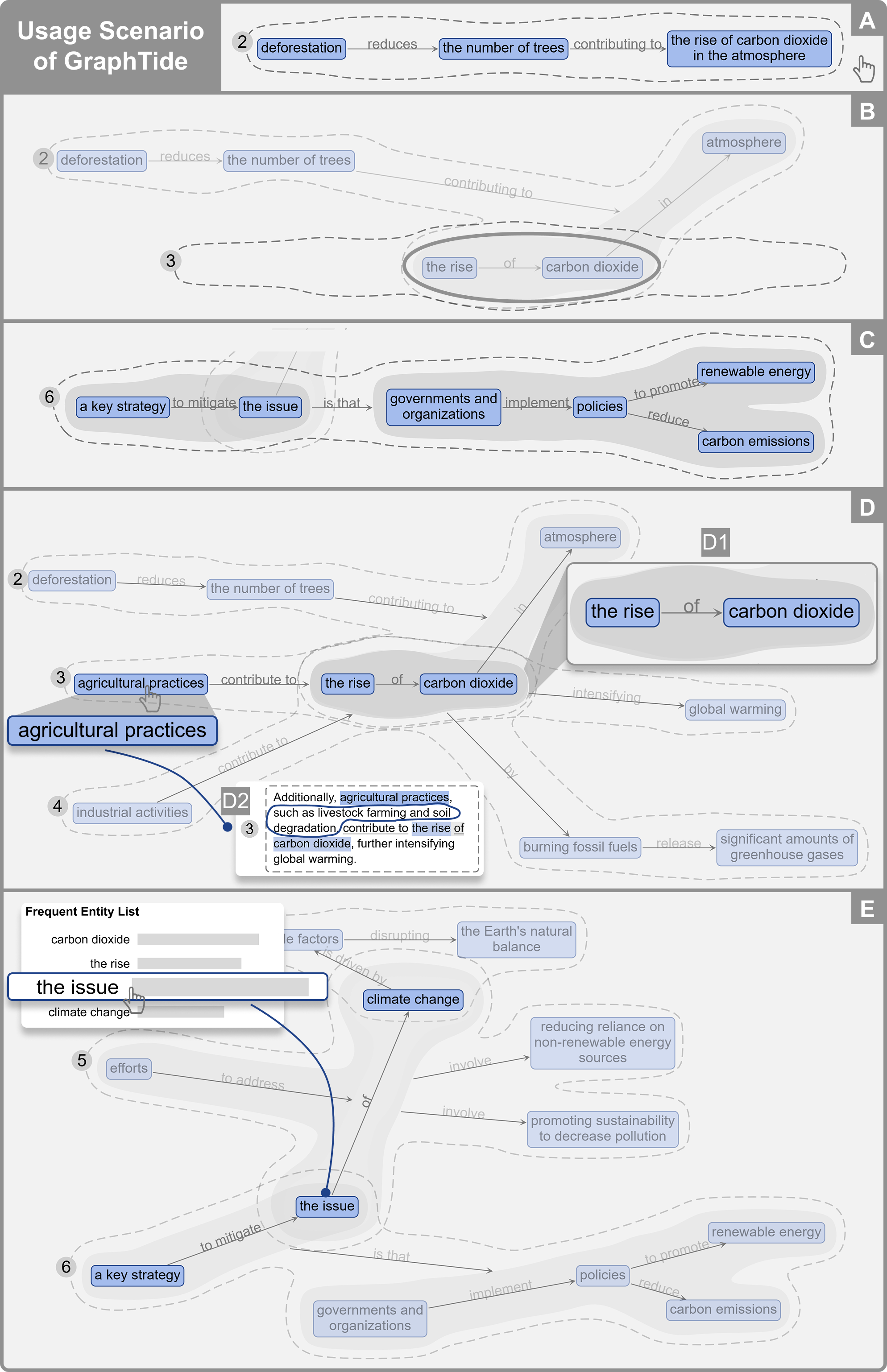
Figure 1: Example scenario demonstrating how users interact with GraphTide to incrementally construct, explore, and review entity-relationship structures in dense, factual passages.
Nested Graph Representation and Decomposition
While most prior approaches either oversimplify relational structure by flattening to a single layer or create excessively fine-grained, fragmented graphs, GraphTide adopts a selective, on-demand decomposition process. Sentences are parsed into subject–verb–object triples and hierarchically decomposed further only when compositionally necessary (e.g., clause-level reuse or reference). This approach balances structural clarity against cognitive load.
The core representational innovation is the explicit mapping of nested entity–relationship graphs: atomic entities are rendered as rectangular nodes, while composite entities are visualized as container nodes encapsulating subgraphs corresponding to complex semantic units. This structure captures essential compositional distinctions, maintains subnode sharing across sentences, and avoids the pitfalls of conventional compound-graph models that assume strict hierarchical containment.
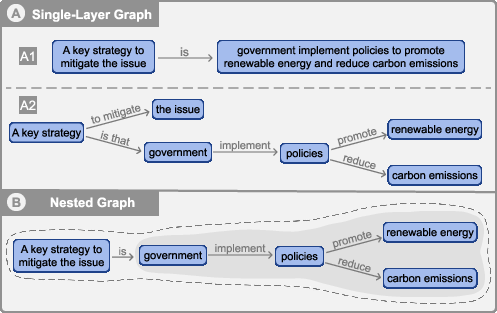
Figure 2: Contrasting single-layer graphs—which either occlude semantic structure or fragment it—with GraphTide’s nested graphs, enabling fine-grained but comprehensible relational clarity.
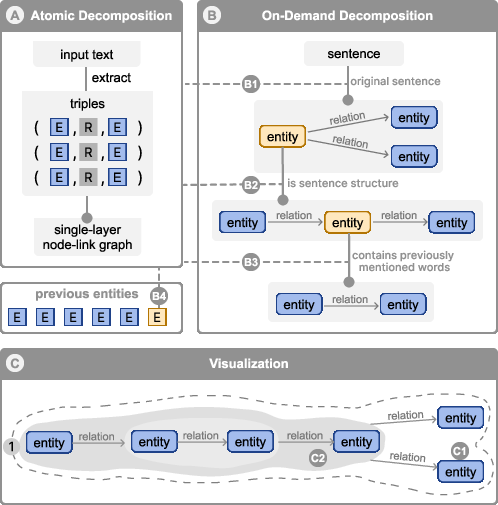
Figure 3: The sentence decomposition pipeline: progressive, GPT-4o-assisted extraction and correction of entities/relations, with iterative refinement yielding the final nested graph visualization.
Quantitative assessment of entity and relationship extraction, performed over 16 Wikipedia or model-generated passages, demonstrates high precision (entities: 93.1%, relations: 88.9%) and recall (entities: 95.1%, relations: 83.8%), validating system suitability for structured information construction.
Structure-Aware Force-Directed Layout
To ensure alignment of the visual graph with both the syntactic ordering and spatial/temporal flow of text, GraphTide employs a composite layout strategy:
- Initial Layout: Each nested level defaults to a layered, left-to-right arrangement mirroring natural reading order, incorporating acyclic and cyclic dependencies appropriately.
- Force-Directed Optimization: Multiple force components are incorporated:
- Link force maintains appropriate edge length for all connections.
- Inclusion force ensures spatial coherence of nodes within composites.
- Exclusion force prevents visual misrepresentation at hierarchy boundaries.
- Overlap force enforces atomic node separation.
- Sentence force explicitly maintains alignment with source sentence positioning.
This produces a structure-preserving, text-synchronous arrangement that supports traceability and reduces user effort in locating contextually relevant content.
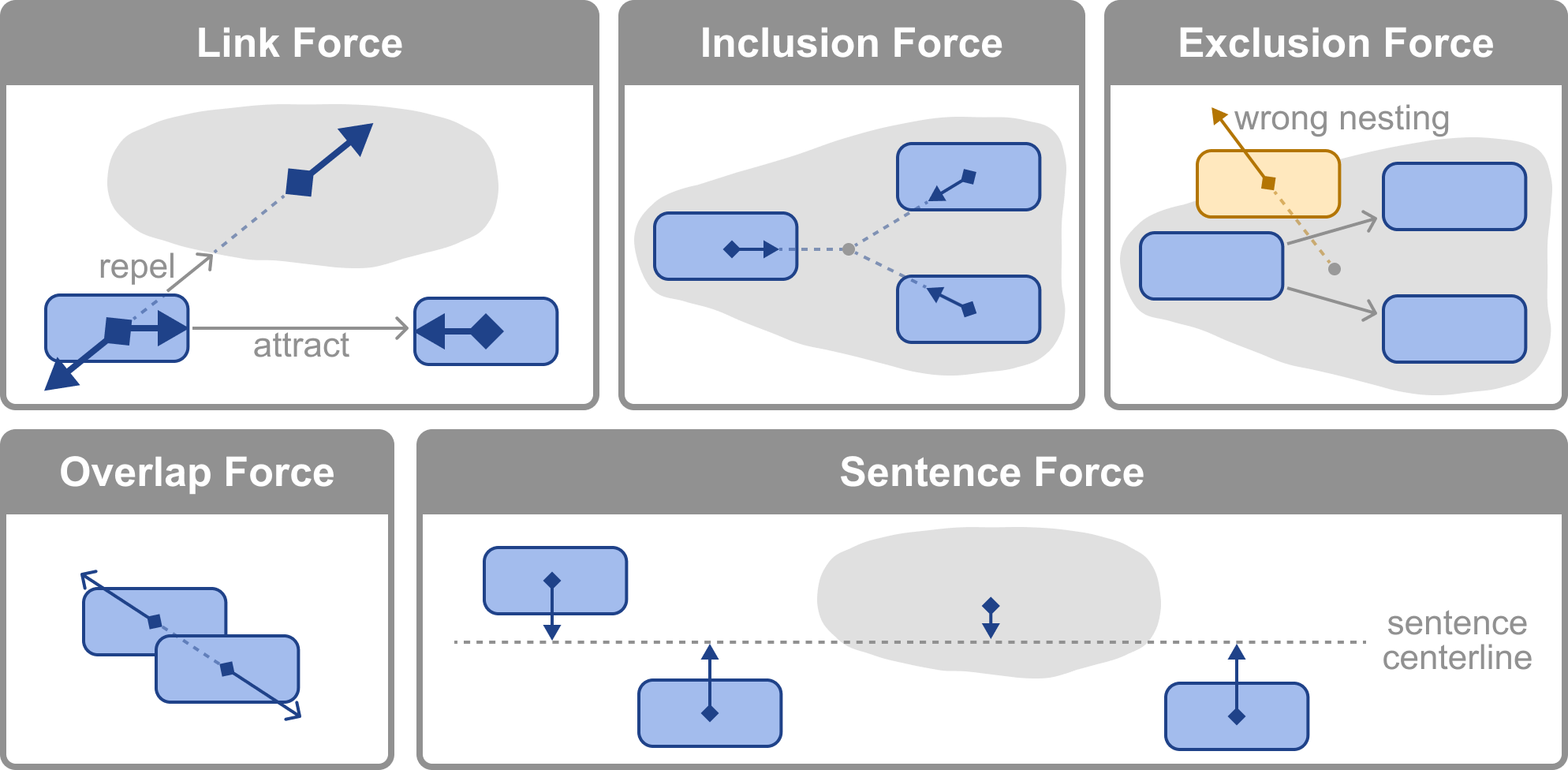
Figure 4: Schematic overview of force-directed process, detailing the combination of forces ensuring both structural fidelity and readability of nested graphs.
Progressive Animated Rendering and Interaction Design
Cognizant of cognitive overload induced by monolithic graph displays, GraphTide synchronizes the graphical construction with the reader’s incremental model-building, introducing new sentence-level subgraphs by animation and smooth transitions. Node splitting and movement vividly signal contextual reuse and semantic continuation, further reinforcing the mapping between text sequence and graph evolution.
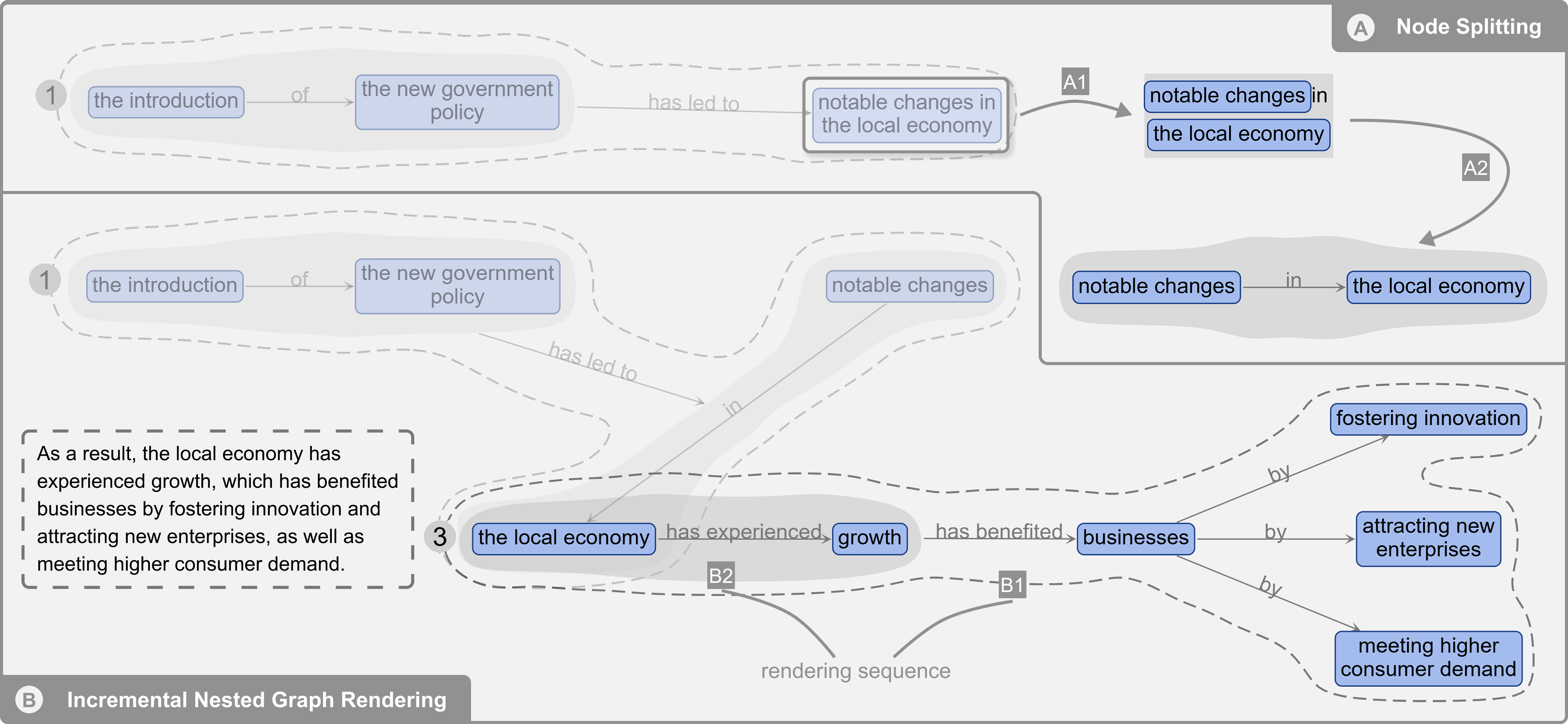
Figure 5: Progressive, animation-driven presentation: decomposition and repositioning of shared nodes prior to new sentence introduction, followed by structured incremental rendering.
To support in-depth exploration and review, GraphTide provides:
- Context-aware bidirectional linking: Hovering over visual nodes (atomic/composite) or text highlights all relevant cross-references, maintaining focus and context.
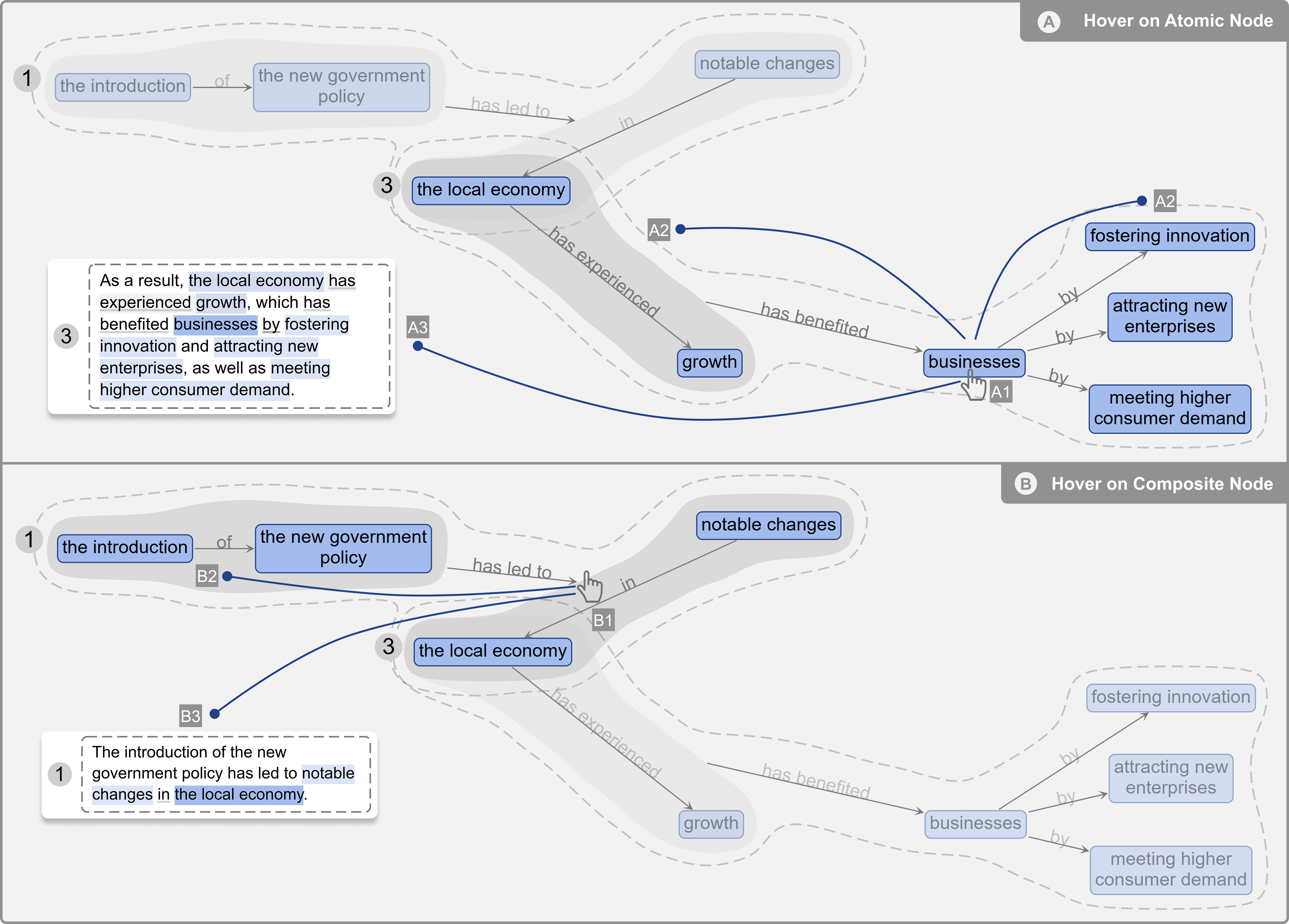
Figure 6: Visual and textual highlighting during node hover events, facilitating immediate cross-referencing of concepts and their network of relationships.
- Entity ranking and selection: Frequently referenced or structurally significant entities are rank-listed for rapid access, supporting both review and entity-centric summarization.
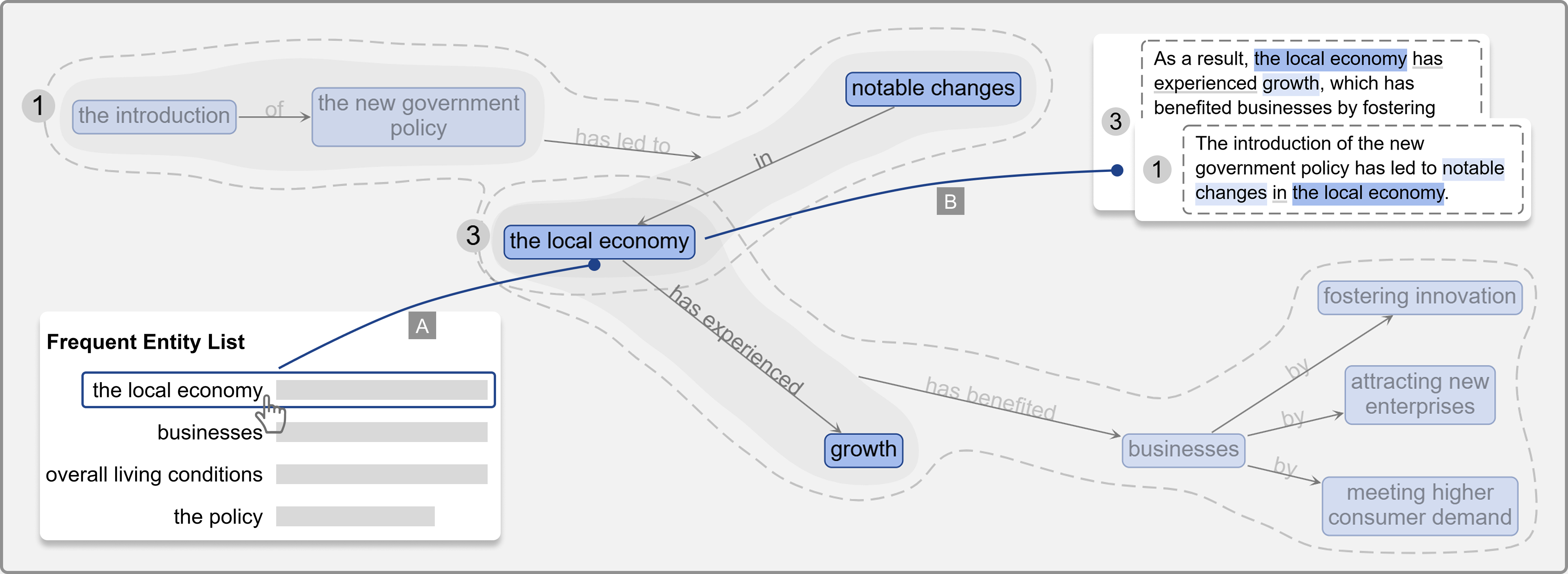
Figure 7: Entity-driven review: interactions with the salient entity list highlight graph components and relevant text sections.
Empirical Evaluation
A within-subjects user study (n=12) compares GraphTide against established baselines: Graphologue (single-layer interactive diagrams) and a static nested graph display (otherwise identical to GraphTide but non-progressive and non-animated). The comprehension tasks include reading of policy/scientific passages and open-ended factual/causal/summarization queries.
Key results:
- Response time per question is statistically significantly shorter with GraphTide versus Graphologue (t = -2.34, p < 0.05).
- Response quality is also significantly improved over both Graphologue and Static Display (t > 2.9, p < 0.05); mean score 4.64 versus 3.42 and 3.72 for baselines, respectively.
- Reading time is comparable across conditions.
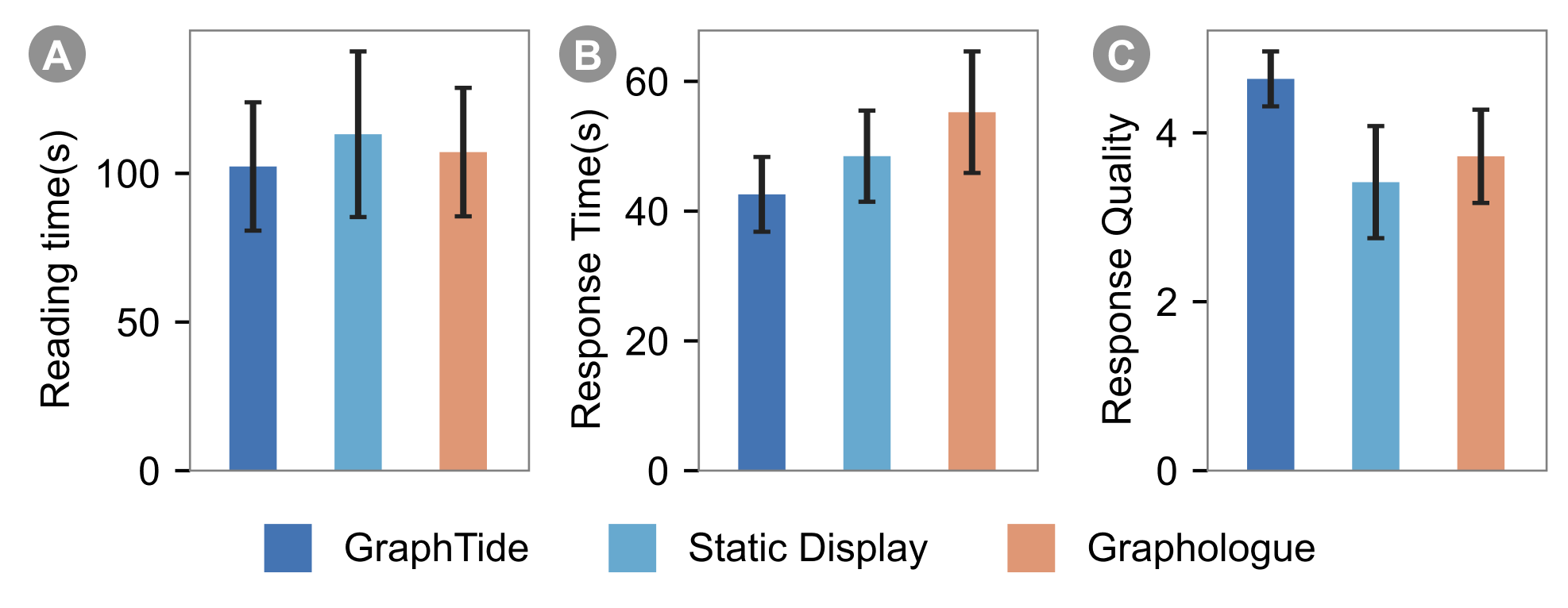
Figure 8: User performance metrics: (A) reading time, (B) response time, (C) response quality, highlighting GraphTide’s improvements in comprehension efficiency and quality.
User feedback highlights:
- Enhanced clarity of complex relationships and sentence structure.
- Reduced cognitive load; smooth, engaging, and less error-prone reading flow.
- Superior contextual integration and ease of information retrieval for review/summarization.
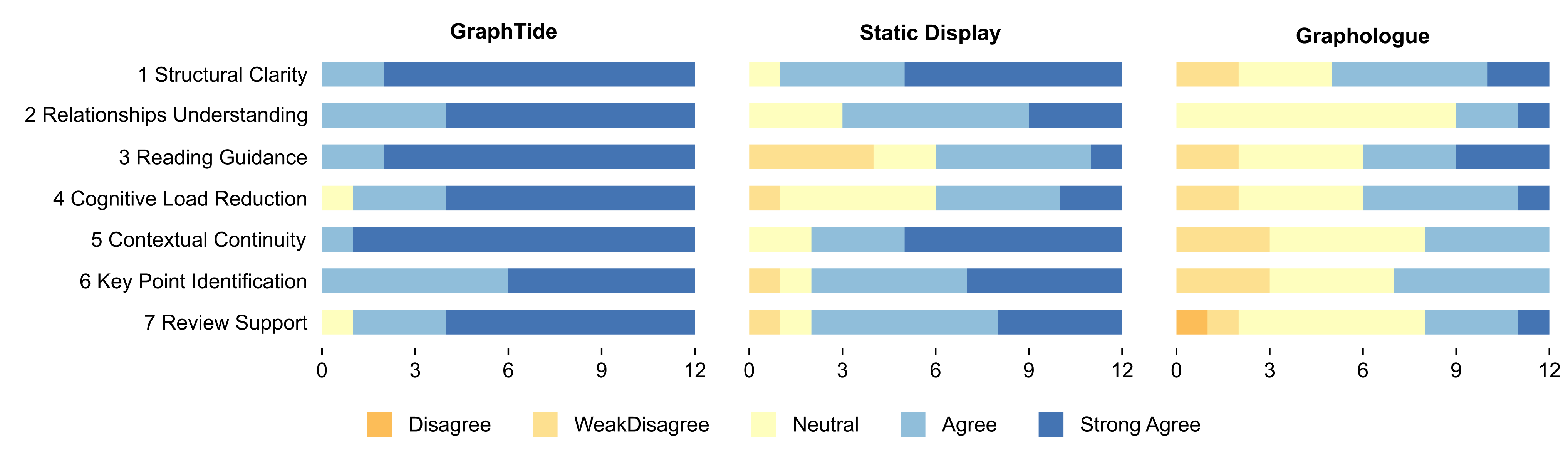
Figure 9: User ratings (Likert scale) across multiple dimensions of comprehension support, structure clarity, cognitive load, continuity, and summarization facilitation.
Implications and Directions for Future Work
GraphTide substantiates the claim that synchronized, progressive nested graph visualizations substantially facilitate reader comprehension of rich, entity-dense text. The theoretical implications are twofold:
- Augmented Reading Models: The system operationalizes close alignment between computational text structure extraction and human narrative model-building, suggesting a pathway to more human-compatible reading aids for knowledge work.
- Hybrid Multimodal Interfaces: Integration of entity-relationship visualization and bidirectional interaction points to an interface architecture generalizable to other dense knowledge domains.
Practically, the approach opens prospects for:
- Enhanced comprehension, review, and collaborative sensemaking in domains such as legal, medical, or scientific text analytics.
- Automated study-aid generation and integration with LLM outputs for improved transparency and trust.
- Extension to discourse-level semantics (e.g., Rhetorical Structure Theory, SDRT) for capturing argumentative, causal, or contrastive relations.
The authors also suggest augmenting graph exploration with annotation tools, personalized reading flow adaptation, and targeted animation refinement based on user cognitive responses.
Conclusion
GraphTide represents a systematic advancement in text-augmentation technology for comprehension of knowledge-intensive text. By employing on-demand nested decomposition, structure-aware spatial-temporal alignment, and progressive rendering with rich interactivity, it delivers measurable improvements in user comprehension and efficiency. The paradigm and empirical findings provide a foundation for future work on multimodal, cognitively aligned external representations in knowledge work, and raise important avenues for expanding automated discourse modeling and user-adaptive visualization.