- The paper demonstrates that integrating expert-authored Skills with LLMs elevates intent extraction accuracy from 44% to over 80% for reproducible workflow generation.
- It introduces a layered agentic architecture that separates semantic translation, deterministic workflow generation, and operational optimization to ensure minimal non-determinism.
- Detailed evaluations reveal substantial resource optimizations, including a 92% reduction in data transfer and end-to-end workflow completion with minimal latency and cost.
Agentic Translation of Scientific Intent to Automated Workflows
Motivation and Problem Statement
Current scientific workflow management systems (WMS) such as Pegasus, Nextflow, Snakemake, and Galaxy automate execution mechanics, including scheduling, resource allocation, and fault tolerance. However, semantic translation from natural-language research queries to workflow specifications remains manual, requiring domain and infrastructural expertise. This semantic gap introduces barriers to entry, risks of error in vocabulary mapping, and compromises auditability and reproducibility. Direct LLM-driven workflow generation typically suffers from non-determinism, where identical prompts can yield divergent artifacts, undermining reproducibility.
Agentic Architecture: Layered Decomposition
The proposed architecture systematically addresses this gap through three functional layers:
- Semantic Layer: An LLM transforms natural-language input into a structured ResearchIntent, encapsulating research parameters (e.g., populations, genomic regions) without binding to execution specifics.
- Deterministic Layer: Validated generators deterministically map ResearchIntent to executable workflow DAGs, ensuring that identical intents always generate identical workflows.
- Knowledge Layer: Domain experts author "Skills"—markdown documents mapping vocabulary, specifying parameter constraints, and encoding optimization strategies. These text artifacts are auditable, version-controlled, and require no ML expertise.
The orchestration is managed by four agents: the Conductor (user-facing), Workflow Composer (intent extraction and planning), Deployment Service (resource provisioning), and Execution Sentinel (workflow monitoring).
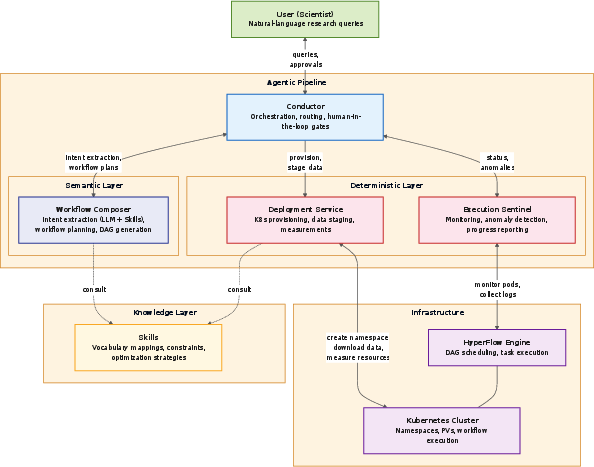
Figure 1: Component architecture. The Conductor orchestrates specialized agents, with the Workflow Composer consulting domain Skills to plan workflows executed deterministically on Kubernetes infrastructure.
Agentic Pipeline and Interaction Sequence
The system implements a multi-phase pipeline, outlined as follows:
- Routing: Conductor classifies research queries, selecting appropriate Composer and Skills.
- Workflow Planning: Composer consults Skills plus LLM to extract structured intent and generate advisory workflow plans.
- User Validation: Scientist reviews proposed plan; clarifications and corrections are supported via conversational loop.
- Infrastructure Provisioning: Deployment Service provisions Kubernetes namespace and measures actual resource/data parameters.
- Deferred Workflow Generation: Composer generates final DAG using measured parameters for calibrated parallelism and optimized data staging.
- Execution Approval and Submission: Scientist approves execution summary, triggering workflow execution.
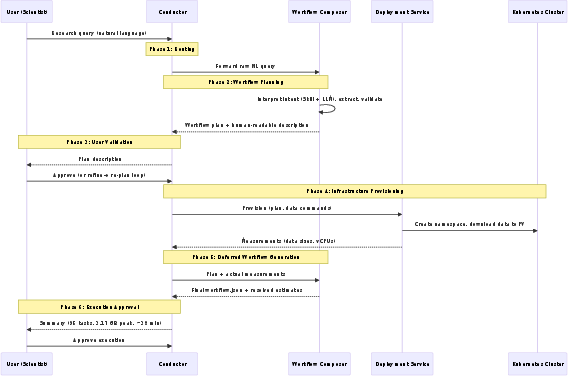
Figure 2: Sequence diagram of the agentic pipeline stages, highlighting agent interaction and deferred workflow generation.
Skills: Explicit Knowledge Representation
Skills are markdown documents specifying:
- Vocabulary mappings (e.g., "British" → GBR)
- Genomic region coordinates (e.g., HLA region as chr6:28477797–33448354)
- Analysis contexts (e.g., "pharmacogenomics" → specific regions)
- Data source strategies (e.g., tabix vs. full download)
- Workflow Composer tool parameters and guidelines
Skills are leveraged for both precise translation and operational optimization (e.g., minimizing data transfer by selecting extraction strategies based on region size and location). By separating domain knowledge from operational logic and encoding it transparently, Skills ensure provenance, versionability, and domain ownership.
Evaluation: Numerical Analysis and Strong Claims
The architecture was evaluated using the 1000 Genomes population genetics workflow managed by Hyperflow on Kubernetes. The dataset comprised 150 queries stratified across tiers from explicit to adversarial, annotated with ground-truth intents.
Intent Extraction (Ablation Study):
Skills elevated full-match accuracy for intent extraction—using Claude Opus 4.6, accuracy improved from 44% (no Skills) to 83% (all Skills). GPT-5.4 improved from 39% to 80%. All models achieved 100% accuracy for explicit and synonym queries when Skills were applied. For implicit queries, accuracy improved dramatically only with full Skills. Notably, Skills are indispensable for domain inference and adversarial tiers—parametric LLM knowledge alone is insufficient for precise intent translation. These results strongly assert the criticality of explicit, expert-authored Skills.
Deferred Workflow Generation:
Execution-time data measurement enabled calibrated parallelism and substantial data transfer optimizations. For small genomic regions (e.g., HBB, APOE), parallelism dropped from 66 to 1, and data transfer savings exceeded 99.9% (e.g., downloading 1.1MB instead of 1GB). Overall, a 92% reduction in data transfer was observed across evaluated regions, attributable to skill-driven extraction strategies.
Pipeline Efficiency:
End-to-end workflow completion for complex queries resulted in LLM overhead below 15 seconds and per-query cost under \$0.001. Execution times were dominated by actual workflow processing, and intent extraction achieved perfect accuracy in all evaluated fields for test queries.
Practical and Theoretical Implications
Practical:
The architecture demonstrates that agentic AI can fully automate the semantic translation stage, provided domain knowledge is codified in Skills. It eliminates the necessity for scientists to possess both domain and infrastructure expertise, enabling scalable and reproducible scientific automation. The deferred generation design reduces resource over-provisioning and optimizes cluster utilization.
Theoretical:
By confining LLM non-determinism to intent extraction and enforcing deterministic workflow generation, the system ensures reproducibility—a crucial requirement for scientific computation. Skills as domain-owned, auditable artifacts represent a paradigm shift from ephemeral prompt injection and classically implicit schema validation.
Future Directions
Expansion to new domains will require domain-specific Skills and deterministic generators. The architecture's modularity facilitates domain adaptation, but effectiveness in implicit domain reasoning (tier T3) may necessitate richer Skill formats or improved LLM architectures. System telemetry feedback and collaborative tooling for Skill curation are promising areas for further development.
Conclusion
The agentic architecture architecturally separates semantic intent extraction, deterministic workflow generation, and explicit domain knowledge representation, achieving robust and reproducible scientific workflow automation. Strong empirical results demonstrate Skill-driven intent extraction accuracy and operational efficiency, with the pipeline delivering minimal latency and cost. The persistent challenge lies in cross-domain generalization and supporting implicit reasoning. This approach establishes a foundation for scalable, domain-adaptive science automation, fundamentally addressing semantic translation and reproducibility in scientific workflow systems.