- The paper introduces ETI, a framework that explicitly infers partner traits (warmth and competence) through structured post-interaction prompts to improve coordination.
- ETI integrates into existing MAS pipelines without fine-tuning and significantly enhances decision optimality and payoff metrics across iterated economic games.
- Evaluations across diverse scenarios demonstrate ETI’s robust generalization and its capacity to provide actionable partner models for adaptive planning and communication.
Explicit Trait Inference for Multi-Agent Coordination: A Technical Synthesis
Problem Statement and Psychological Motivation
LLM-based Multi-Agent Systems (LLM-MAS) show increasing promise on collaborative and complex tasks, but these systems suffer from pervasive coordination failures—manifesting as goal drift, error cascades, and misaligned actions—which undermine system reliability and scalability. While existing structural and reflective prompting approaches scaffold task decomposition, they largely neglect adaptive, partner-aware coordination. Addressing this, the paper introduces Explicit Trait Inference (ETI), drawing on the dual dimensions of social cognition—warmth (e.g., trust, intent) and competence (e.g., skill, reliability)—as operationalized in human psychology. ETI instantiates agent models that explicitly infer, track, and leverage these traits from observed multi-agent interaction histories, modulating decision-making and coordination schemas accordingly.
ETI Architecture and Integration in MAS Pipelines
ETI proceeds by mapping partner behavior into concrete, behaviorally-anchored trait ratings on warmth and competence axes, using structured post-interaction prompting. After each interaction round, agents receive a summary of observed actions, communications, and outcomes, and then generate Likert-scale ratings (1–7) for each trait, supplemented by evidence justifications. The eight trait schema (four per dimension) is strictly operationalized to prevent collinearity or collapse (e.g., distinguishing unreliability from low cooperation). The resulting profiles are injected into subsequent agent contexts, explicitly scaffolding both immediate planning and communication strategies.
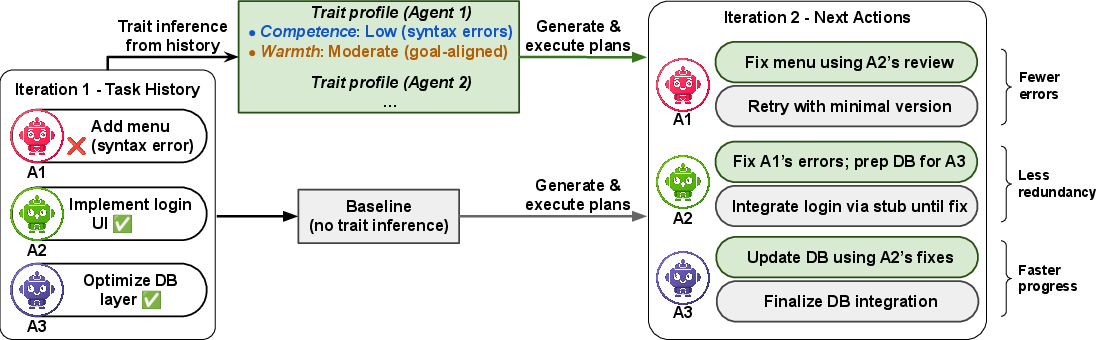
Figure 1: ETI enables multi-agent teams to dynamically infer competence and warmth traits from observed histories, guiding contextualized task allocation and risk mitigation.
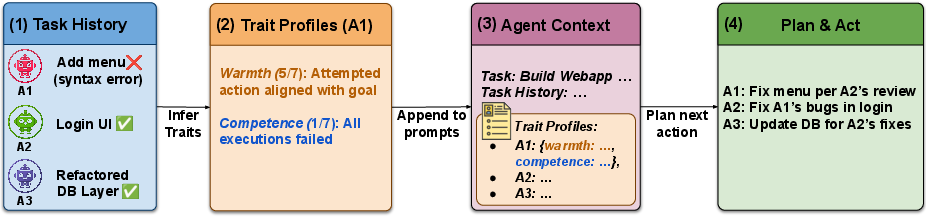
Figure 2: The iterative ETI pipeline: agents summarize histories, infer trait profiles, update their local context, and plan new actions with explicit partner models.
The ETI process is completely prompt-based, model-agnostic with no fine-tuning, and easily integrates into existing coordinating agent architectures. All trait inference and profile incorporation can be throttled, cached, or sparsified to limit context window and cost overhead.
Baselines and Prior Work
The principal baseline leverages Chain-of-Thought (CoT) scaffolding, where agents reason through historic actions/outcomes before making decisions, but without structured trait inference. This contrasts ETI's explicit, psychologically-motivated, modular partner modeling. Existing methods such as theory-of-mind prompting and reputation systems generally focus on ephemeral beliefs or aggregate outcome tracking, rather than persistent, minimally biased trait attributions.
Controlled Economic Game Evaluations
ETI is first validated in iterated economic game environments (iterated Prisoner’s Dilemma [PD] and Stag Hunt [SH]), where ground truth for “warmth” (cooperative probability) and “competence” (execution reliability) can be explicitly parameterized. In these settings, agents face scripted opponents with latent trait configurations and must adapt over 50 rounds of interaction.
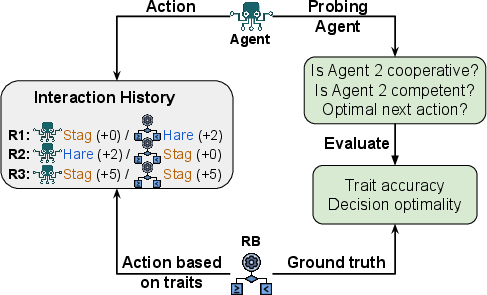
Figure 3: In the controlled economic game setup, ETI agents infer partner traits during iterative rounds, enabling joint analysis of inference accuracy and optimality of subsequent choices.
Empirical results show ETI substantially improves trait inference accuracy (F1), particularly under noisy opponents: e.g., in PD, competence F1 rises from 0.69 (CoT baseline) to 0.89, and cooperation F1 from 0.43 to 0.73. Decision optimality metrics (matching payoff-maximizing strategies given true partner traits) increase proportionally—e.g., payoff deviation is reduced by 45–77% relative to baseline.
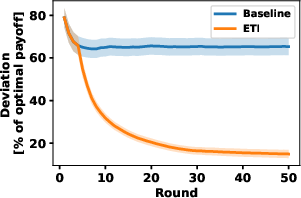
Figure 4: Relative deviation from optimal decisions rapidly decreases with ETI intervention, converging to optimal agent response within a few interaction rounds.
Generalization, Adaptability, and Robustness
ETI trait profiles demonstrate strong out-of-domain generalization: static trait profiles “warmed up” on a prior interaction and carried forward yield nearly identical performance to continuously updating ETI. Profiles further transfer across games (PD→SH or vice versa) with minimal loss of decision optimality, suggesting that explicit partner models generalize across various domains when the underlying partner behaviors are consistent.
In scenarios with abrupt latent trait changes (e.g., a shift from cooperative→uncooperative), ETI agents exhibit inertia—adapting slower than baseline agents—but remain more robust to noise and do not overfit short-term oscillations, reflecting the theoretical goal of encoding dominant, stable partner patterns rather than ephemeral behaviors.
MultiAgentBench: Complex Multi-Agent Scenarios
To interrogate ETI beyond toy games, experiments deploy it on four core MultiAgentBench scenarios spanning collaborative (Coding, Research), competitive (Bargaining), and adversarial (Werewolf social deduction) regimes, using both GPT-4o-mini and Qwen3-8B as agent and trait inference engines.
ETI consistently improves both coordination and aggregate task metrics:
- Coordination gains: 6–42% depending on scenario, agent, and ETI profile source
- Task completion gains: 3–29% over strong CoT baselines
- Largest effects: found in scenarios with explicit partner selection, task allocation, or adversarial settings (e.g., Coding-Tree, Research, Werewolf)
Performance is tightly coupled to the informativeness and variance of the trait profiles: high-variance, diagnostic profiles (as generated by Qwen) yield larger effects than positively-skewed, generic profiles (GPT). This pattern holds even in cross-model settings (e.g., GPT agents with Qwen ETI outperform those with GPT ETI).
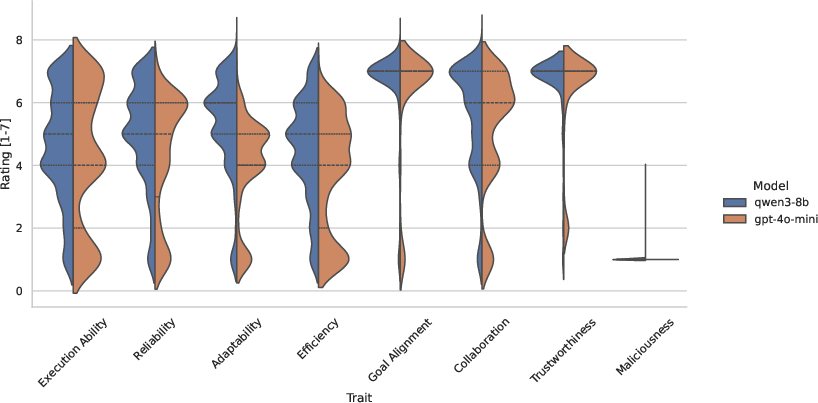
Figure 5: In the Coding-Graph benchmark, both model families produce appropriately granular trait distributions; low maliciousness reflects the absence of adversarial incentives.
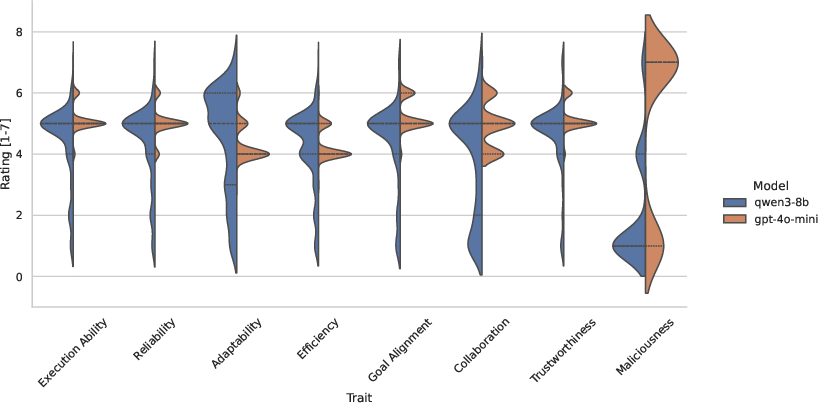
Figure 6: In Bargaining, Qwen produces higher-variance, less biased trait ratings than GPT, emphasizing diagnostic value.
Figure 7: In Research, Qwen’s trait profile variance remains higher; GPT exhibits positive skew and spurious elevation of maliciousness, potentially degrading coordination.
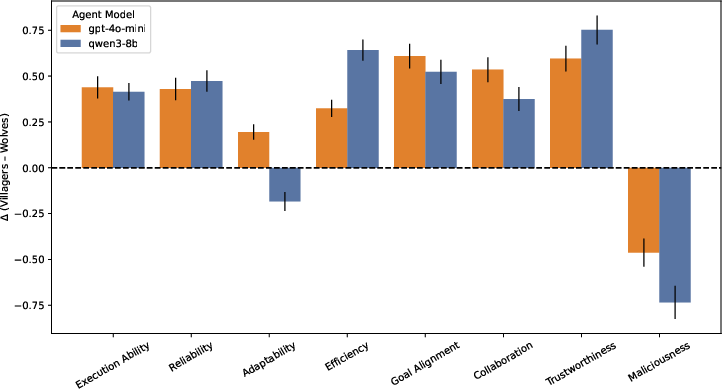
Figure 8: ETI trait profiles clearly distinguish hidden roles (villager vs werewolf), demonstrating that trait inference from interaction patterns can expose adversarial structure.
Mechanistic Analysis: Trait Profiles Shape Agent Behavior
Analysis of agent plans and milestone completion, as well as regression of subsequent actions on prior trait profile values, reveals that ETI profiles causally influence decisions. For example, in Werewolf, high “maliciousness” scores are robust predictors of agents being targeted for elimination, and low “trustworthiness” scores by the special “Witch” role lead to increased probability of poisoning. This mechanistic link validates ETI's role as a direct supply of actionable partner models for downstream agent reasoning, surpassing the indirect effects observed in reputation or CoT-based systems.
Limitations
The paper is prompt-based and run on mid-sized open and closed LLMs. While preliminary experiments with SOTA models indicate that qualitative coordination metrics still improve with ETI (even as hard task win rates saturate), further scaling and fine-tuning may yield different dynamics. ETI’s focus on fixed traits can slow response to abrupt latent shifts (i.e., concept drift), but this can be mitigated via adaptive context management strategies. The trait schema is also fixed; future work could dynamically discover task- or domain-specific trait dimensions or develop latent trait encodings.
Implications and Future Directions
Theoretically, ETI demonstrates that explicit, psychologically motivated trait modeling is not only tractable in practical LLM-MAS, but also generates significant empirical gains in coordination and task performance. Critically, it offers a transparent and robust diagnostic for comparing LLM family biases, informing agent selection and deployment. Practically, ETI profiles can serve as drop-in modules for any MAS that demands coordination under uncertainty and misalignment—ranging from world simulation to human–AI collaboration.
Future avenues include integrating ETI with ToM and belief-state trackers for richer, multi-timescale partner models, end-to-end learning of latent trait representations during RL-from-interaction, and adaptive trait dimensionality discovery for domain-specialized MAS. As LLM coordination systems scale, ETI could provide both the backbone of transparent social cognition and a mechanism for model- and task-specific calibration and auditing.
Conclusion
Explicit Trait Inference substantially advances the robustness and adaptability of multi-agent LLM systems by grounding partner modeling in psychologically sound trait inference. By providing actionable, compact partner profiles, ETI facilitates more reliable, flexible, and effective coordination across a range of complex, multi-agent tasks, and serves as a foundation for future research into transparent and socially intelligent agentic AI.