- The paper introduces an event-centric framework that quantifies delegation, contradiction, and merge events in LLM multi-agent systems.
- It demonstrates heavy-tailed cascade laws and preferential attachment, showing a small subset of agents drives most cognitive work.
- The study reveals integration bottlenecks and validates a deficit-triggered integration intervention to mitigate elite dominance.
This work delivers a systematic, fine-grained empirical analysis of coordination in large-language-model (LLM) multi-agent systems (MAS). Addressing fundamental scaling limitations in current LLM-based agent societies, the authors develop an atomic event-based formulation, decomposing multi-agent reasoning into primitives: delegation, revision, contradiction, synthesis (merge), and aggregate total cognitive effort (TCE). This enables rigorous quantification of how reasoning propagates and concentrates across agents, tasks, and communication topologies.
The event-centric trace methodology captures not only outputs but the structure of reasoning: the propagation, contestation, and integration of claims over agent societies. Claims and events are assembled into directed acyclic graphs (DAGs) with cascades rooted at initial claims. This formulation provides observables reflecting expansion (delegation, contradiction), consolidation (merge), and overall cognitive load (TCE).
Heavy-Tailed Cascade Laws in Coordination
A principal result is the identification of robust heavy-tailed distributions in the sizes of all coordination events—tasked reasoning, revision, contradiction, and overall TCE—across diverse topologies and task regimes.
As established in the global analysis, event sizes conform to truncated power-law (TPL) regimes with scaling exponents 2<α^<3, confirmed by rigorous maximum likelihood estimation and likelihood-ratio tests against log-normal and pure power-law alternatives.
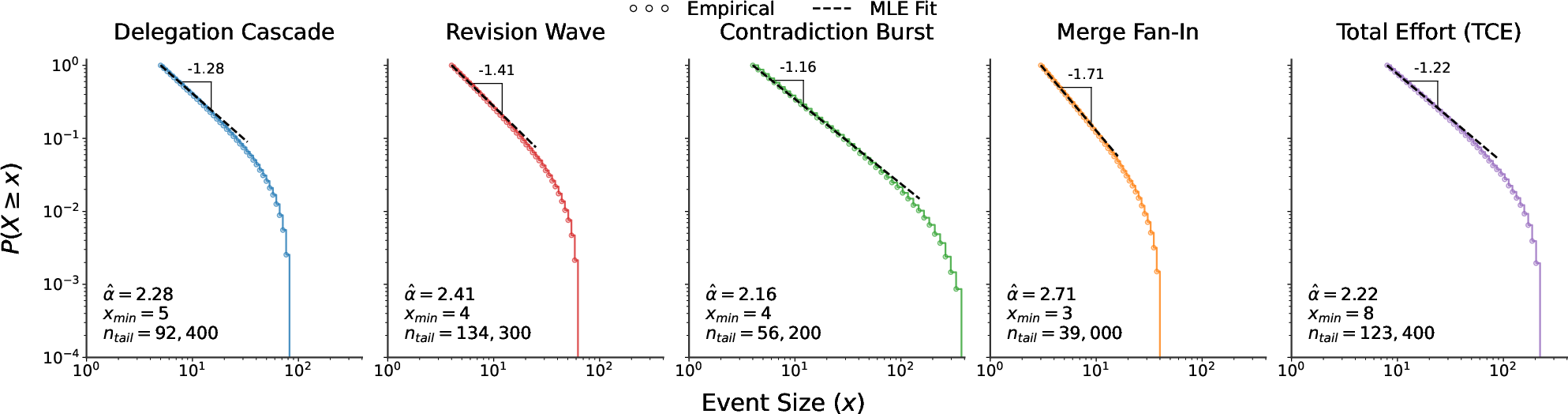
Figure 1: Heavy-tailed coordination cascades across event types, with TPL scaling (2<α^<3) and finite-size truncation at large event sizes.
The observed TPL regime holds consistently over agent population sizes and system configurations. Delegation and contradiction yield the broadest tails; merge (integration actions) is sharply truncated, indicating a systemic asymmetry favoring expansion over consolidation. This structure is robust for stronger models (lower α^, larger cutoff), but present even for lower-capability LLMs.
Ablation over topologies and task families reveals systematic variations in scaling exponents and truncation thresholds but the overall heavy-tailed signature persists.
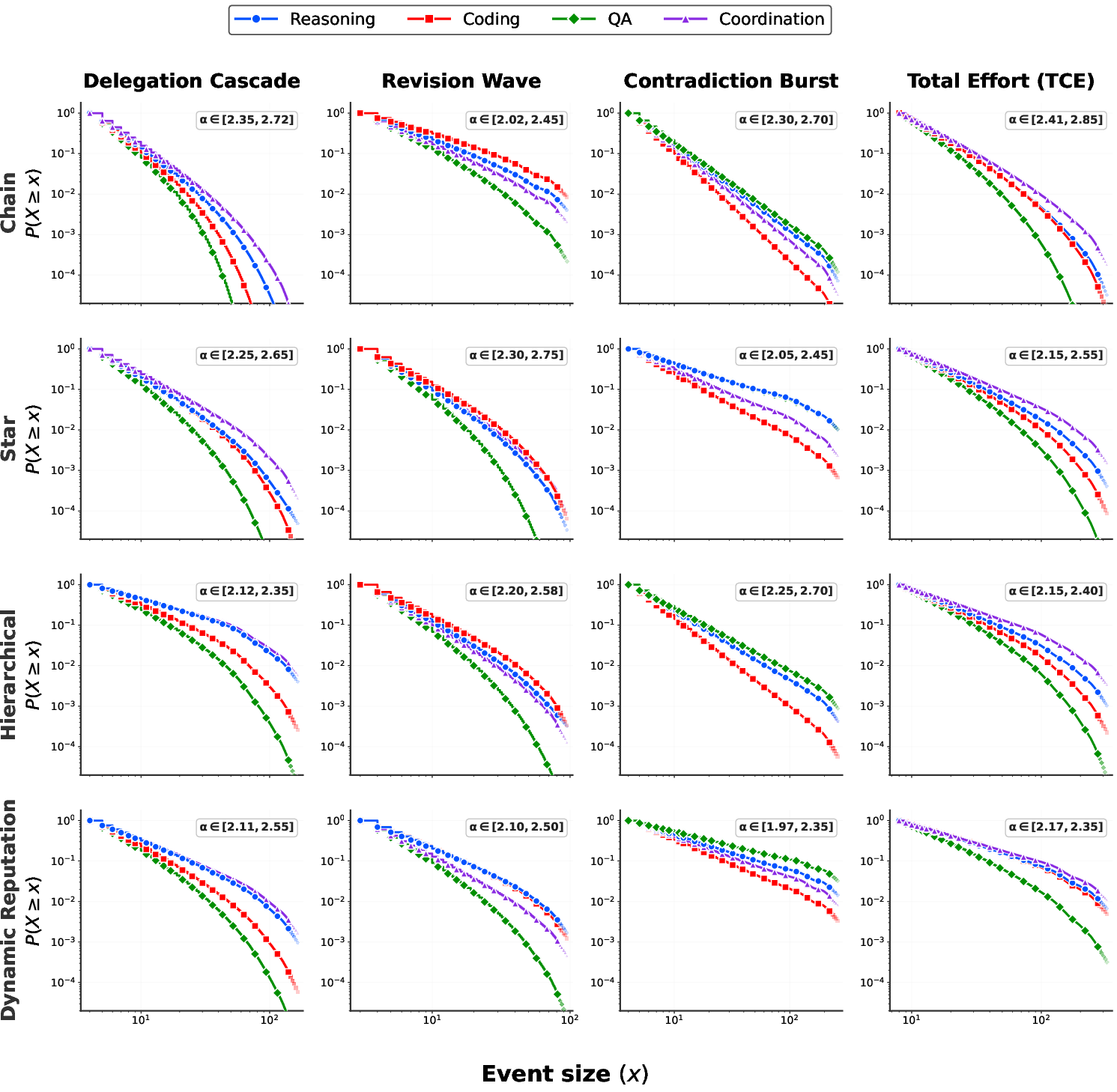
Figure 3: Topology- and task-specific CCDFs for key coordination event types, with scaling exponents 2<α^<3 persistent across all communication structures and reasoning domains.
The finite-size scaling of the heavy tail is further validated: tail exponents stabilize with society size (N≳64), and maximum event size expands as a power-law in N, consistent with predictions from extreme value theory.
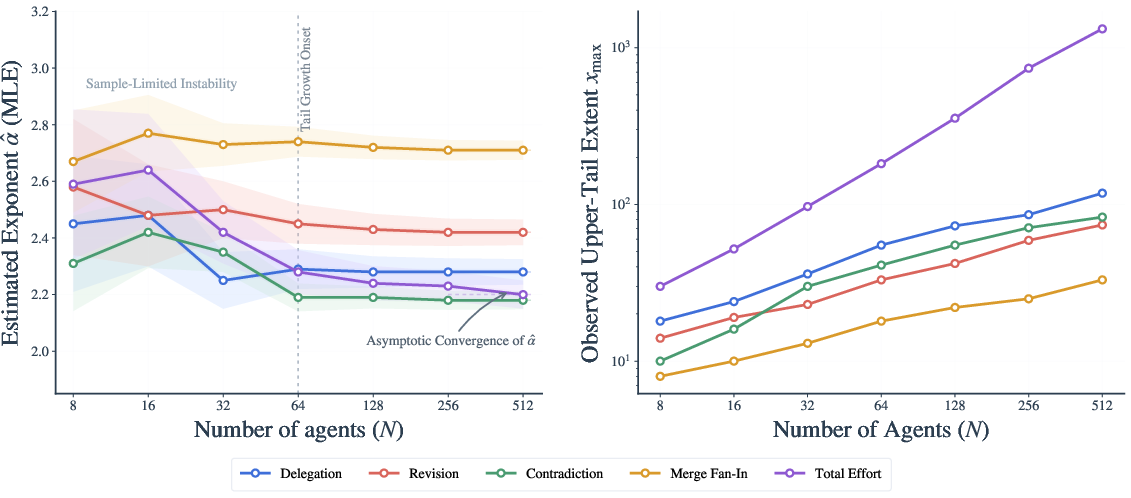
Figure 2: Stability of the tail exponent and systematic expansion of maximum event size with increasing agent count.
Preferential Attachment and the Emergence of Intellectual Elites
Quantitative analysis of contribution shares reveals that coordination effort self-organizes into highly unequal regimes, with a small subset of agents—the intellectual elite—accounting for a superlinear share of total cognitive work. As N increases, the fraction of effort captured by top-k agents is further amplified, violating egalitarian baselines.
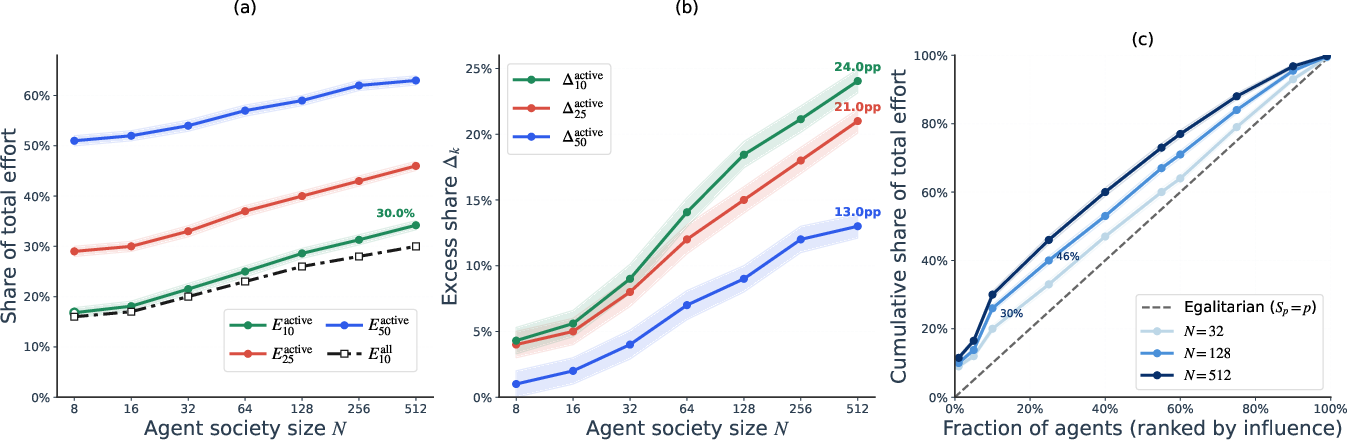
Figure 4: Expanding intellectual elite: top-k active agents capture disproportionately large share of total cognitive effort, with excess concentration increasing with system scale.
This elite formation is mechanistically linked to preferential attachment: claims with early engagement become disproportionately likely to attract further attention and modification. The empirically measured local attachment slope β^ predicts macro-level elite concentration with high correlation.
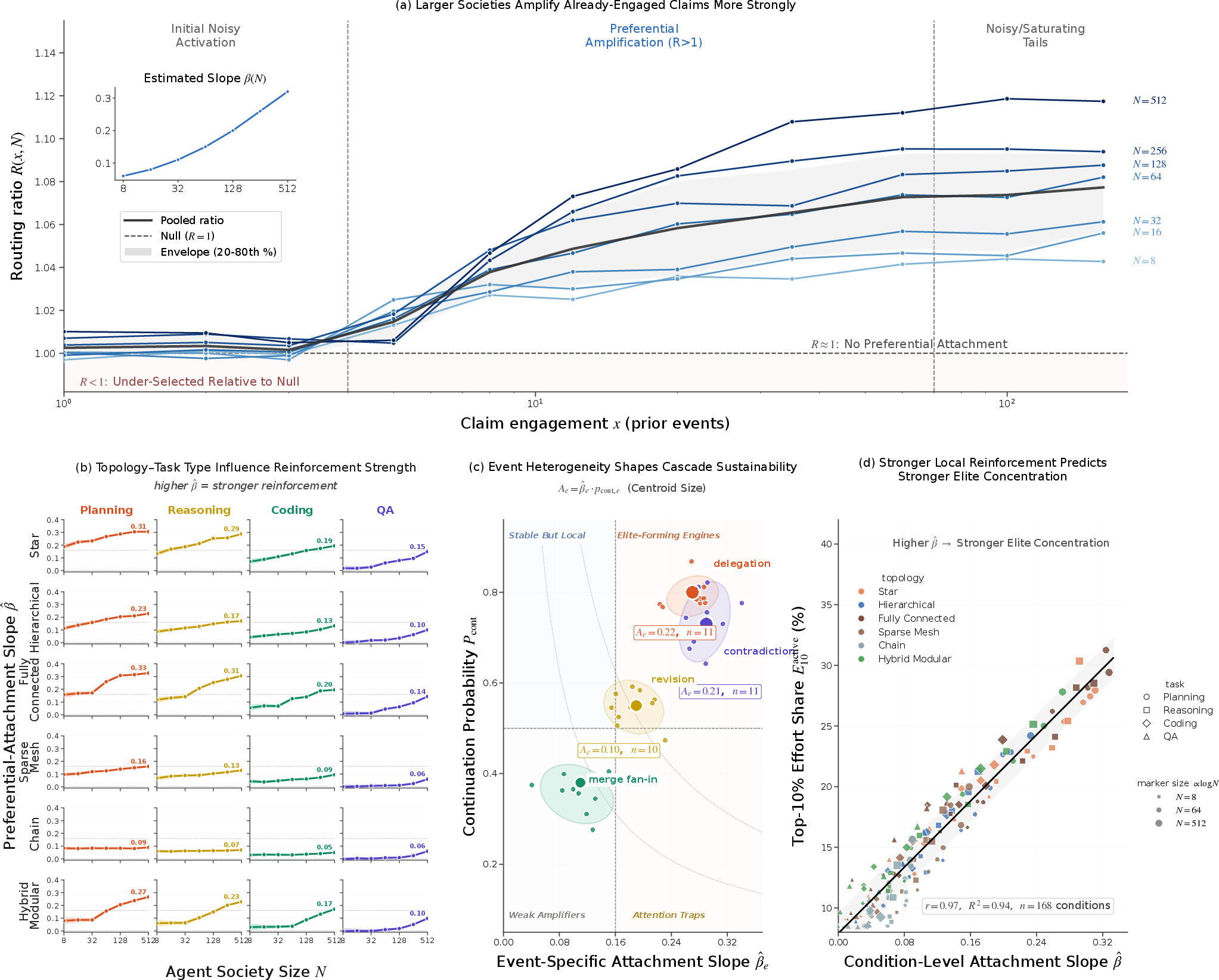
Figure 5: Preferential attachment in reasoning: routing ratio to claims with prior engagement increases sublinearly with claim activity, with this reinforcement intensifying as agent society size grows.
Importantly, the elite phenomenon is not simply a byproduct of agent inactivity. Even after normalizing by the fraction of engaged agents, systemic reinforcement and high-activity cascades channel work into rapidly recycling subsets of agents and claims.
The internal composition of large cascades reveals that as coordination scales, generative actions (delegation, contradiction) dominate ever more strongly, while merge events (integration) become sublinear and increasingly insufficient. This produces large, complex, but weakly integrated cascades.
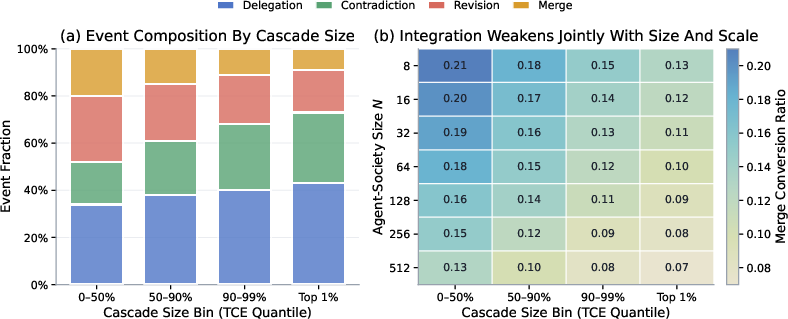
Figure 7: Internal composition of claim-level cascades: the tail shifts toward delegation and contradiction, while merge (integration) becomes increasingly subproportional with both cascade size and agent scale.
The structural expansion-integration imbalance leads to fragile coordination in high-intensity regimes: task success peaks at moderate cognitive load, then collapses for high-TCE runs where contradiction rates are high and merge is ineffective, indicating systemic failure to resolve conflict and consolidate knowledge.
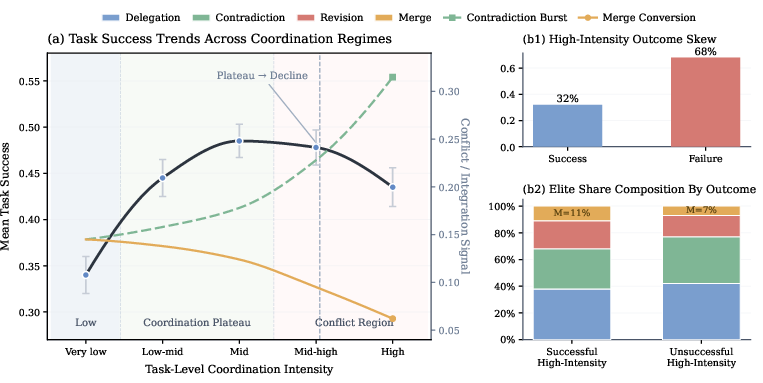
Figure 8: Performance collapse in the high-intensity regime, driven by excessive contradiction burden, low merge efficiency, and the inability of elite-dominated branches to resolve conflict.
Extreme-value scaling further demonstrates that the maximum achievable coordination event (cascade) size grows systematically with society scale, even as the proportion of successful integration falls.
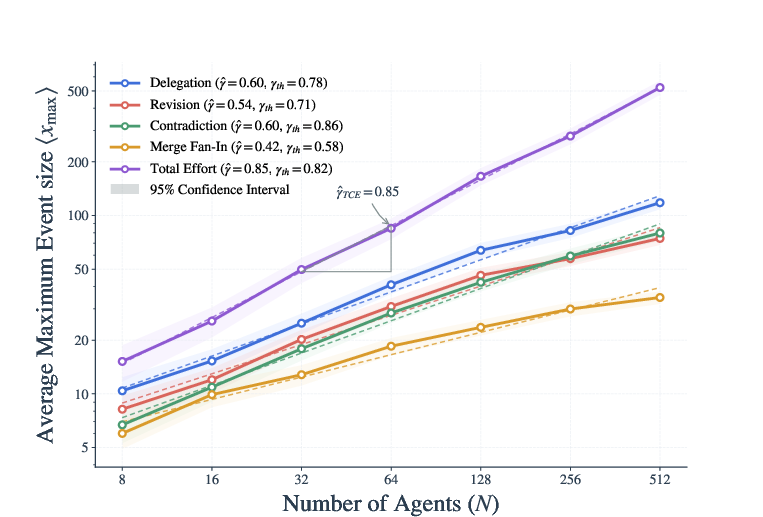
Figure 9: Scaling of maximum cascade size with 2<α^<30; TCE growth aligns closely with extreme value theory predictions for TPL regimes.
Law-Aware Interventions: Deficit-Triggered Integration (DTI)
To experimentally validate the causal role of the expansion-integration imbalance and supply a regulable solution, the authors introduce Deficit-Triggered Integration (DTI). DTI tracks the real-time ratio of expansion to integration within each cascade and triggers merge actions when imbalance passes a context-specific threshold, thereby enforcing structural consolidation.
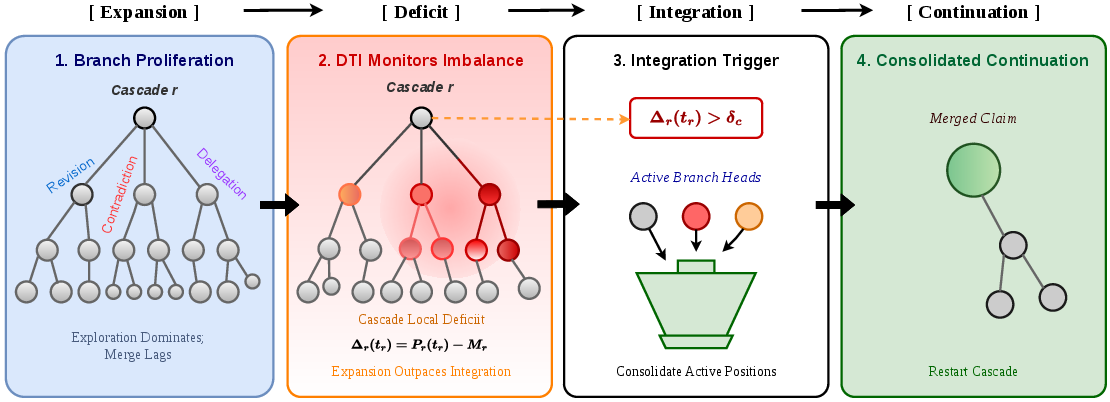
Figure 10: DTI schematic: local cascade deficit monitoring triggers integration/merge events once expansion outpaces consolidation beyond a critical threshold.
DTI preserves the underlying heavy-tailed coordination structure but systematically reduces extreme tail mass, moderates elite concentration, and increases merge activity, especially in regimes with the most severe expansion-integration imbalance. This leads to direct performance improvements; the strongest gains arise in planning and mesh topologies, which exhibit maximal baseline imbalance.
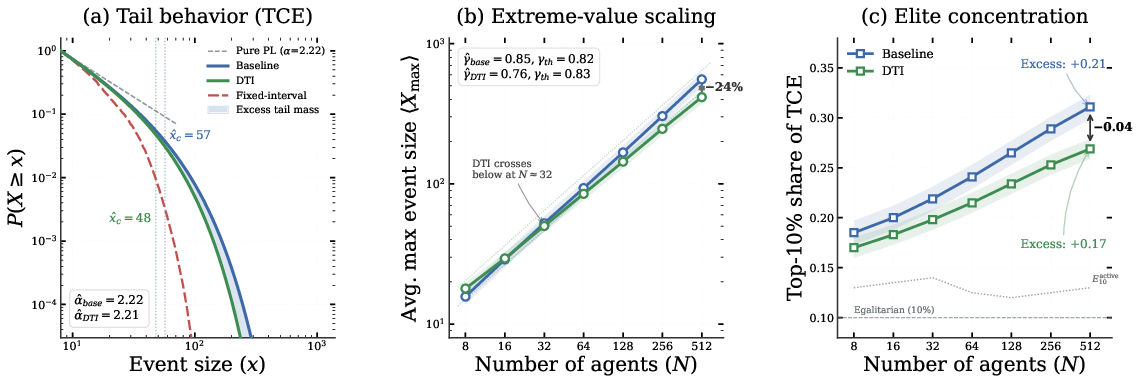
Figure 11: DTI intervention preserves heavy-tailed cascades but shifts truncation earlier, attenuating excessive late-stage expansion and reducing elite dominance.
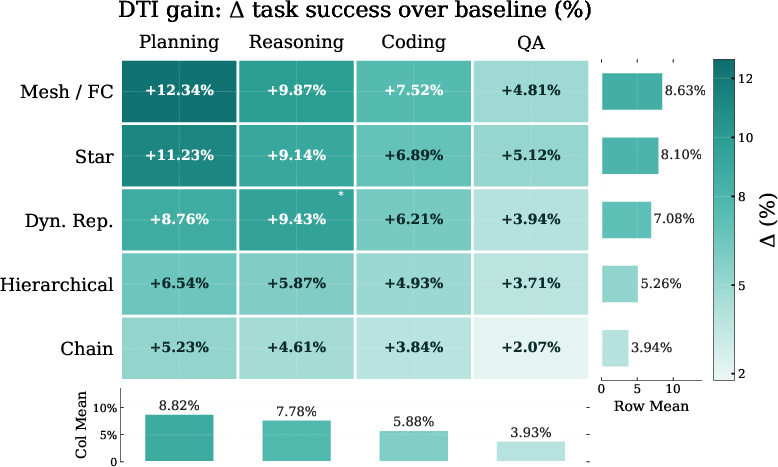
Figure 6: DTI yields largest relative performance gains in regimes of extreme expansion-integration imbalance, validating its target specificity.
Theoretical and Practical Implications
The paper establishes quantitative, empirically testable coordination laws for LLM MAS, linking system structure to macro-level performance outcomes. The discovery of TPL-governed coordination, preferential attachment-induced elite formation, and systematic integration bottlenecks provides a framework for describing and diagnosing scaling limitations in agentic LLMs beyond traditional performance metrics.
Implications include:
- Task/architecture co-design: Systemic scaling cannot be achieved by increasing agent count or LLM capability alone. Communication topology, task decomposition, and integration mechanisms must be co-designed to ensure proportional growth of integrative capacity.
- Coordination-aware evaluation: Future benchmarks and diagnostics should report tail exponents, elite concentration, and merge efficiency, not merely correctness or reward, to assess structural coordination health.
- Regulable interventions: Approaches such as DTI demonstrate that structural coordination laws can serve as algorithmic targets, enabling targeted remediation of specific scaling pathologies without suppressing productive large-scale reasoning.
- Elite/inequality dynamics: Endogenous emergence of elite contributors in LLM agent societies parallels structural inequalities in human organizations and information networks, indicating that further study of mitigation and redistribution strategies is warranted.
Future developments may focus on dynamically adaptive topologies, selective reinforcement attenuation, and learning-to-integrate mechanisms for scaling collective reasoning more robustly and equitably.
Conclusion
This study provides the most detailed measurement to date of the structural dynamics that govern collective intelligence in LLM-based multi-agent systems. It establishes the dominance of heavy-tailed coordination cascades and preferential concentration of cognitive effort as emergent, quantitatively predictable laws of agent societies. The identification and regulation of the expansion-integration bottleneck—operationalized via DTI—opens a new axis for the design and control of scalable LLM agent collaboratives, shifting focus from mere output accuracy to the underlying architecture of collective cognition.