- The paper introduces a global-view optimization framework for multi-agent web navigation that dynamically allocates exploration via a Bayesian multi-armed bandit approach.
- It employs structured global analysis, targeted crawling, and LLM-powered candidate ranking to efficiently navigate complex web hierarchies.
- Experimental results show significant success rate improvements and robust action efficiency, confirming the method's adaptability and practical advantages.
Multi-Agent Web Navigation via Global-View Optimization in Mango
Introduction and Motivation
Contemporary advances in LLM-driven web navigation agents have exposed scalability bottlenecks for deep and complex websites, primarily attributed to a myopic, root-based exploration strategy. Web navigation agents typically initiate all traversals from the homepage, neglecting the latent global structure of modern websites with extensive hierarchies. This often results in inefficiencies—agents waste budget on irrelevant subtrees, get trapped in non-goal pages, or prematurely abandon promising but deep navigation paths.
The Mango framework addresses these inefficiencies through multi-agent web navigation with global-view optimization, dynamically identifying query-relevant entry points and adaptively allocating navigation effort. Mango incorporates lightweight site structure analysis, multi-armed bandit URL selection (via Thompson Sampling), and episodic agentic memory. The approach formally models URL selection as a budget-constrained MAB with reflection-guided Bayesian updates, aiming to maximize the information-gain and task success rate under stringent action budgets.
System Architecture and Core Algorithms
The Mango system is architecturally decomposed into structured global analysis, adaptive URL selection, plug-in LLM-based navigation, and reflection with memory-based update mechanisms.
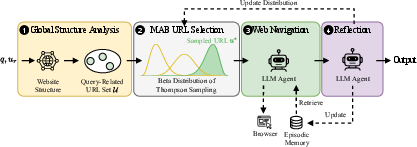
Figure 1: Overview of the web navigation agent system.
Upon receiving a user query and the root URL, Mango incrementally constructs a partial global site map using BFS-limited crawling and targeted site-specific search. Candidate URL sets are semantically ranked (BM25, optionally augmented with LLM-guided keyword extraction and Google site: search), balancing coverage and computational tractability.
Candidate URLs are then prioritized using Thompson Sampling over a MAB formulation with finite lifetimes. Each URL is parameterized with a Beta(αu,βu) distribution, initialized using normalized BM25 relevance scores scaled by a hyperparameter κ. At each selection iteration, the agent samples θu∼Beta(αu,βu) for all active candidates, visiting the maximally sampled URL.
The agent's browser interaction proceeds in a plug-in compatible environment. After each navigation pass (success, budget exhaustion, or dead end), a reflection agent evaluates the trajectory, computes the reward (Bernoulli), and updates the posteriors. The reflection module classifies navigation attempts as “adequate”, “inadequate but promising”, or “dead-end”, modulating the subsequent sampling distribution.
Episodic memory archives full trajectories and reflective summaries, which are retrieved to reduce redundant behaviors and adapt exploration based on previous outcomes.
Experimental Results
Extensive benchmarking is performed on WebVoyager and WebWalkerQA. These datasets comprise complex, real-world navigation/Q&A scenarios, necessitating both shallow and deep traversal, and intra-site information aggregation.
Success Rate:
- Mango achieves an SR of 63.6% on WebVoyager with the GPT-5-mini backbone, outperforming AgentOccam by 7.3% and WebWalker by 47.3%.
- On WebWalkerQA, Mango secures a 52.5% SR, exceeding AgentOccam by 26.8% and doubling WebWalker on multi-source QA tasks.
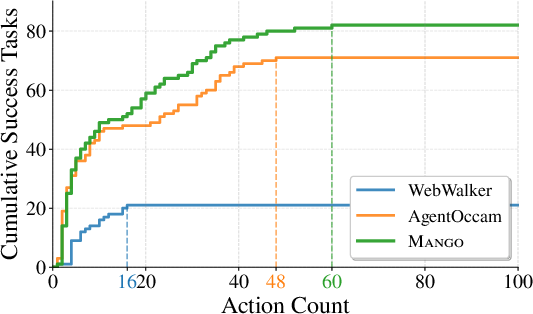
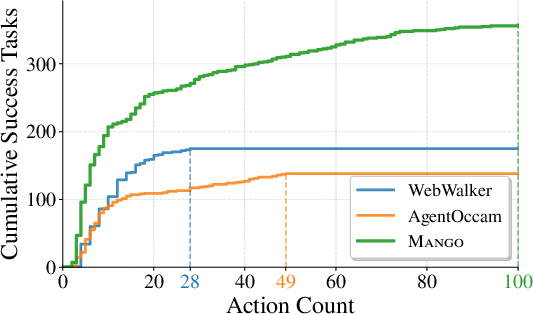
Figure 2: WebVoyager
Scaling with LLM size (Qwen3-4B to Qwen3-32B) produces monotonic SR improvements, with the action efficiency maintained via improved initial ranking and bandit exploration. Ablation demonstrates that replacing Thompson Sampling with MCTS or greedy/rand selection results in 5–17% drops in SR, evidencing the effectiveness of global-view pruning and Bayesian allocation.
Action Count:
- With Qwen3 models, Mango matches or outperforms baselines in efficiency (actions per task).
- When using GPT-5-mini, Mango’s higher action counts are correlated with the ability to succeed in long-horizon, complex scenarios (where baselines plateau).
Robustness:
Sensitivity analysis over budget b, κ, candidate set size, and crawl depth reveals optimal regimes that emphasize the trade-off between partial global visibility and focused exploration. Mango’s performance degrades gracefully with lower budgets or more restrictive global analyses, but maintains a significant lead over baselines.
Ablation and Variant Analysis
Ablation studies validate each core Mango component:
- Global structural analysis: Replacing targeted candidate selection with random or Google-only leads to 4–8% SR reduction.
- Thompson Sampling vs. Greedy/Random/MCTS: Mango’s bandit approach consistently outperforms both deterministic and simulation-based search strategies, especially under resource constraints.
- Episodic memory: Removal causes 8% reduction in SR, confirming the necessity of trajectory-informed adaptive behavior.
Error Analysis and Practical Implications
Manual error analysis on 323 failures (WebWalkerQA, GPT-5-mini) identifies:
- 52% from action budget exhaustion (either insufficient candidate coverage or initial misallocation).
- 25% from off-target navigation (ambiguous link following).
- 15% from backend LLM reasoning errors (hallucinations or incorrect comprehension).
- 6% from evaluation artifacts (outdated gold answers).
- 2% from reflection misclassification.
This pinpoints the primary challenge as partial structural observability and the quality of candidate set construction, rather than the exploration mechanism per se.
Theoretical and Practical Implications
Mango’s global structure-driven navigation paradigm introduces an efficient regime for budget-limited web automation. By decoupling entry-point selection from stepwise tree search, and adaptively balancing exploration/exploitation via bandit feedback, Mango empirically overcomes the depth and breadth constraints inherent in root-based or local-only strategies. The episodic memory mechanism further regularizes exploration, systematizing trajectory-level reasoning across navigation attempts.
Practically, Mango generalizes well across LLMs (open/closed source) and website classes, supporting plug-in browser environments. The code and extensive benchmarks support reproducibility and extension. The limits of Mango remain in the incompleteness of lightweight global analysis for truly massive or dynamic sites, and reliance on LLM backbones for reasoning steps.
Future Directions
Potential research avenues include:
- Adaptive crawling and search augmentation, potentially learned or LLM-driven.
- End-to-end differentiable relevance scoring for initialization.
- Dynamic budget allocation per candidate and per exploration branch.
- Cross-agent collaborative navigation.
- Integration with task-specific rollback (Zhang et al., 16 Apr 2025) or more advanced reflective agents.
Conclusion
Mango systematically advances multi-agent web navigation through global-view optimization and adaptive, feedback-driven URL allocation. The method’s strong empirical gains over existing SOTA agents underline the theoretical value of leveraging explicit, query-conditioned global structure representations and stochastic allocation under bounded budgets. The framework provides an extensible foundation for scaling web automation to arbitrary, real-world web information environments while quantifying and addressing the remaining limitations of partial observability and backend model reasoning.