- The paper introduces LFM-enabled multi-agent systems (LMASs) that overcome classical MAS limitations by leveraging pretrained models for semantic reasoning.
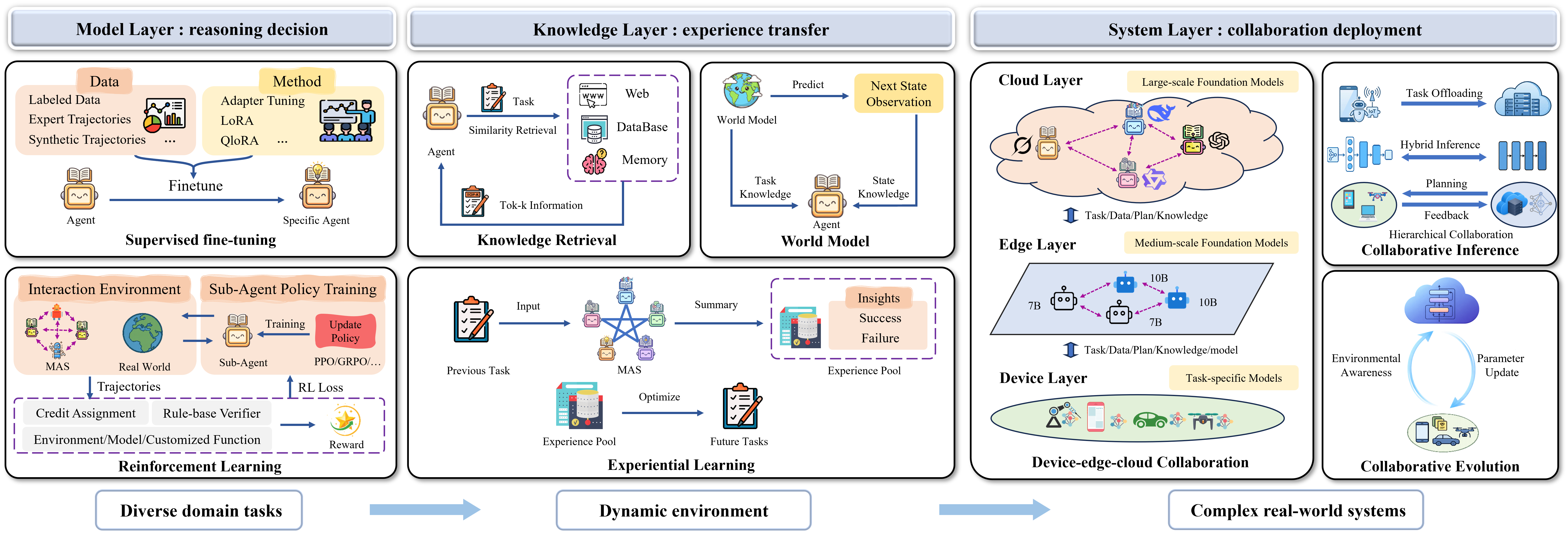
- It utilizes a hierarchical optimization strategy across model, knowledge, and system layers to enhance planning, adaptation, and scalability in dynamic environments.
- The analysis contrasts structured, efficient CMAS protocols with flexible, language-mediated LMAS interactions, informing future hybrid agent designs.
From Classical Multi-Agent Systems to LFM-Enabled Agentic Collaboration
The reviewed paper, "Multi-Agent Systems: From Classical Paradigms to Large Foundation Model-Enabled Futures" (2604.18133), provides a comprehensive analysis of the evolution of multi-agent systems (MASs), contrasting traditional, model-driven paradigms (CMASs) with emerging approaches leveraging large foundation models (LFMs), termed LMASs. This survey systematically delineates technical progress, core capabilities, and the shifting research landscape towards cognitively-enabled, scalable agentic systems.
Classical Multi-Agent Systems: Structure and Limitations
Classical MASs are rooted in decentralized coordination inspired by biological swarms and distributed control theory. Their operation is structured around four fundamental components: perception, communication, decision-making, and control.
Perception in CMASs initially focused on single-modality, agent-centric sensing, with cooperative perception advancing through early, intermediate, or late-stage feature fusion. Communication architectures are typically graph-based, allowing for static or dynamic topology adaptation, with communication intervals triggered either by events or at fixed rates. Decision-making frameworks are bifurcated into model-based strategies—rule-based, game-theoretical, and optimization-driven—and learning-based methods, notably MARL. Control paradigms such as consensus and formation control rest on explicit modeling for provable convergence and stability guarantees.
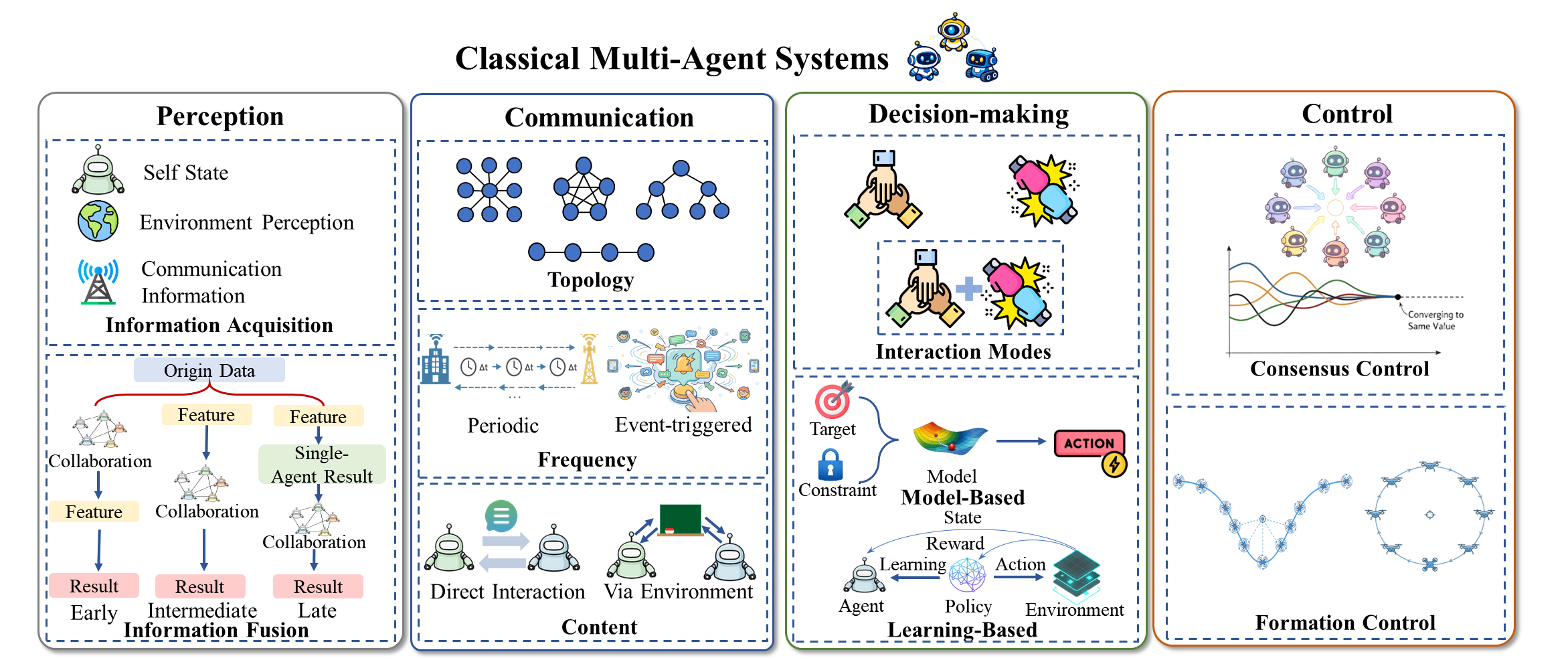
Figure 1: The canonical signal loop in CMASs: agents sequentially acquire, share, decide, and execute under decentralized protocols.
However, despite deep theoretical foundations and deployment in mission-critical domains, CMASs exhibit four core limitations:
- Restricted generalization: Agents require redesign or retraining for new tasks or environments.
- Sample inefficiency: MARL-based approaches demand extensive environment interaction for effective policy discovery.
- Interpretability challenges: Increasing system complexity yields opaque decision logics.
- Limited scalability: Structural and computational bottlenecks hinder adaptation in open-ended, dynamic settings.
Paradigm Shift: Large Foundation Model-Based MASs
LMASs integrate LFMs as cognitive backbones, fundamentally altering the agentic landscape. Unlike CMASs' reliance on task-specific models and handcrafted protocols, LMASs instantiate agent cognition through pretrained models, enabling semantic-level perception, sophisticated reasoning, dynamic memory, and flexible planning.
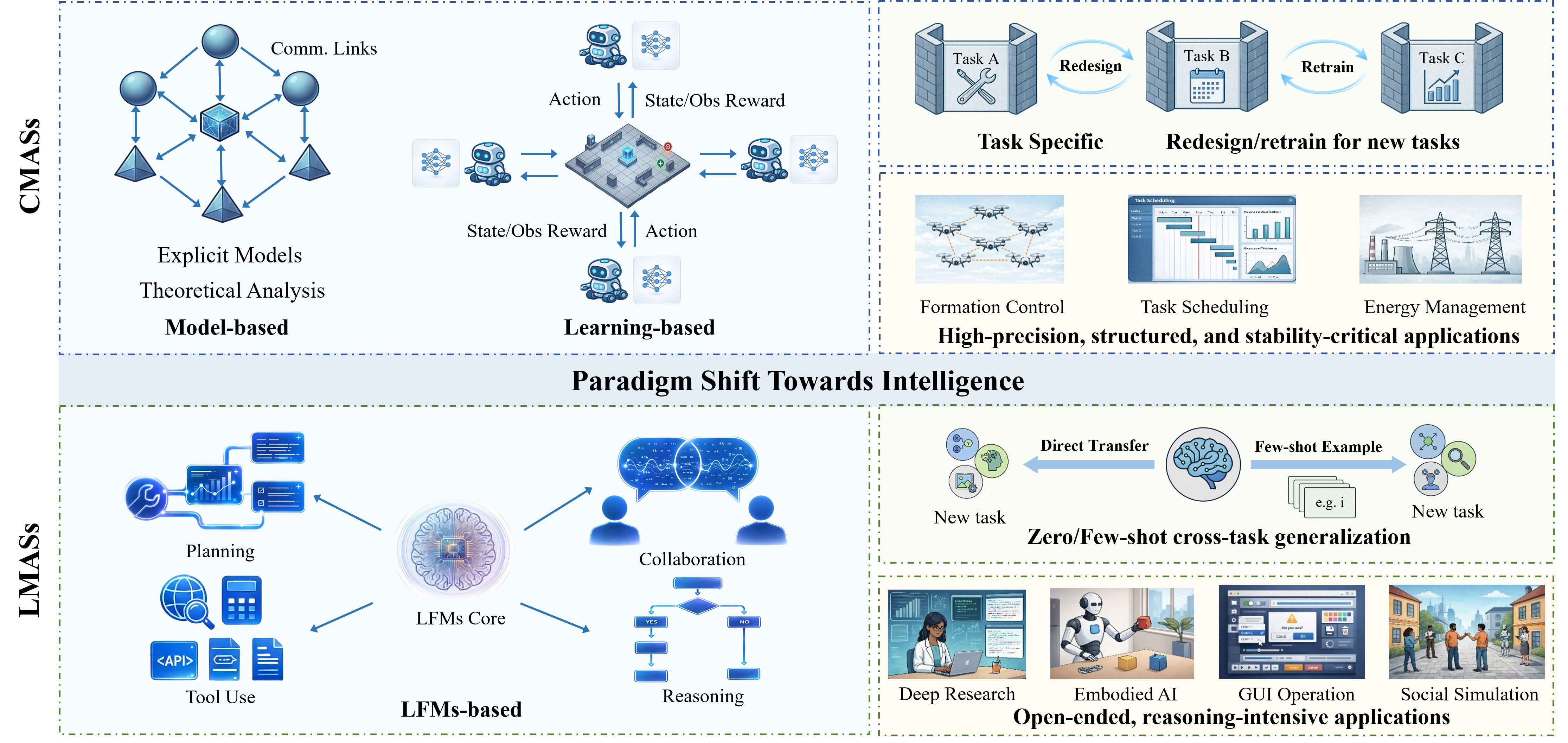
Figure 2: The transition from task- and structure-dependent CMASs to LMASs equipped with LFM-enabled planning, reasoning, and rapid generalization.
LMAS agent architecture comprises five core modules:
- Role definition (manual/task-adaptive)
- Hierarchical perception (semantic, situational, cognitive)
- Planning (structured, feedback-adaptive, reliability-augmented)
- Memory (short- and long-term, inspired by human mnemonic systems)
- Execution via tool-use and action composition
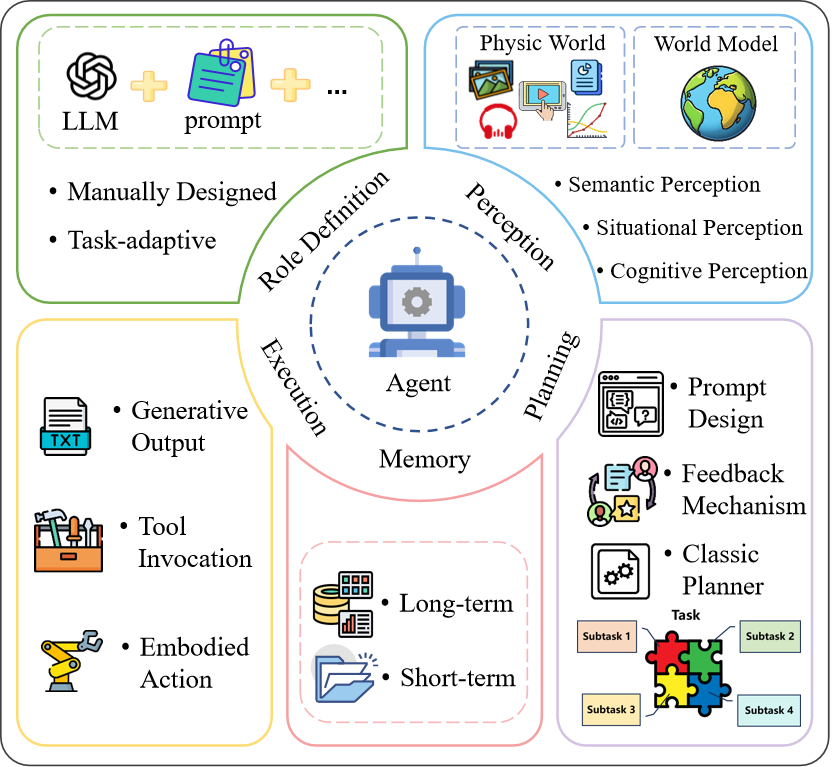
Figure 3: Modular LMAS agent, integrating role specification, perception, planning, contextual memory, and external execution.
Interaction mechanisms advance beyond closed, static information exchange toward language-mediated communication protocols, iterative collaborative workflows, and multimodal human–agent teaming.
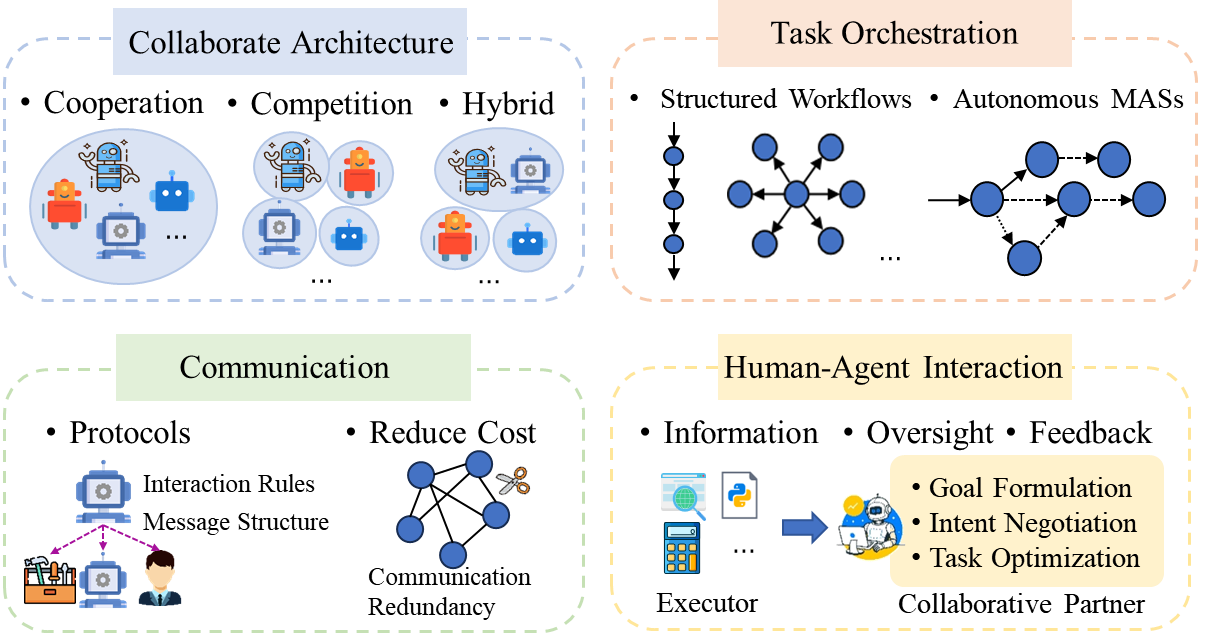
Figure 4: LMAS interaction mechanisms: enabling iterative, semantic-driven group coordination and robust human-in-the-loop control.
Hierarchical Optimization
To enable robustness and scalability in fast-changing environments, LMASs employ a hierarchical optimization strategy:
Emergent Collective Intelligence
LMASs demonstrate small-scale emergent cooperation (via modular expert teams and spontaneous alignment), as well as population-level emergent social behaviors in large-agent simulations (information diffusion, social stratification, group formation), underlying the transition from isolated intelligence to truly collective cognition.
Comparative Analysis: CMASs vs. LMASs
The survey delivers a rigorous, dimension-wise comparative analysis:
- Architecture: LMAS agents inherit autonomy and sociality but gain dramatically increased reasoning power and semantic flexibility compared to CMASs. However, deployment becomes compute-intensive, and inference incurs higher latency.
- Operating Mechanism: CMASs exchange structured, compact data, ensuring efficiency and verifiability. LMASs rely on context-rich language, enabling high-level collaboration but incurring substantial communication costs.
- Adaptability: LMASs provide superior zero-/few-shot generalization and experience-augmented adaptation but introduce risks of hallucination, drift, and tool misuse.
- Application Domain: LMASs extend the MAS applicability spectrum into open-world, unstructured, and knowledge-centric domains, outstripping classical applicability in both virtual and embodied settings and facilitating new modalities of agentic coding, scientific discovery, and large-scale social simulation.
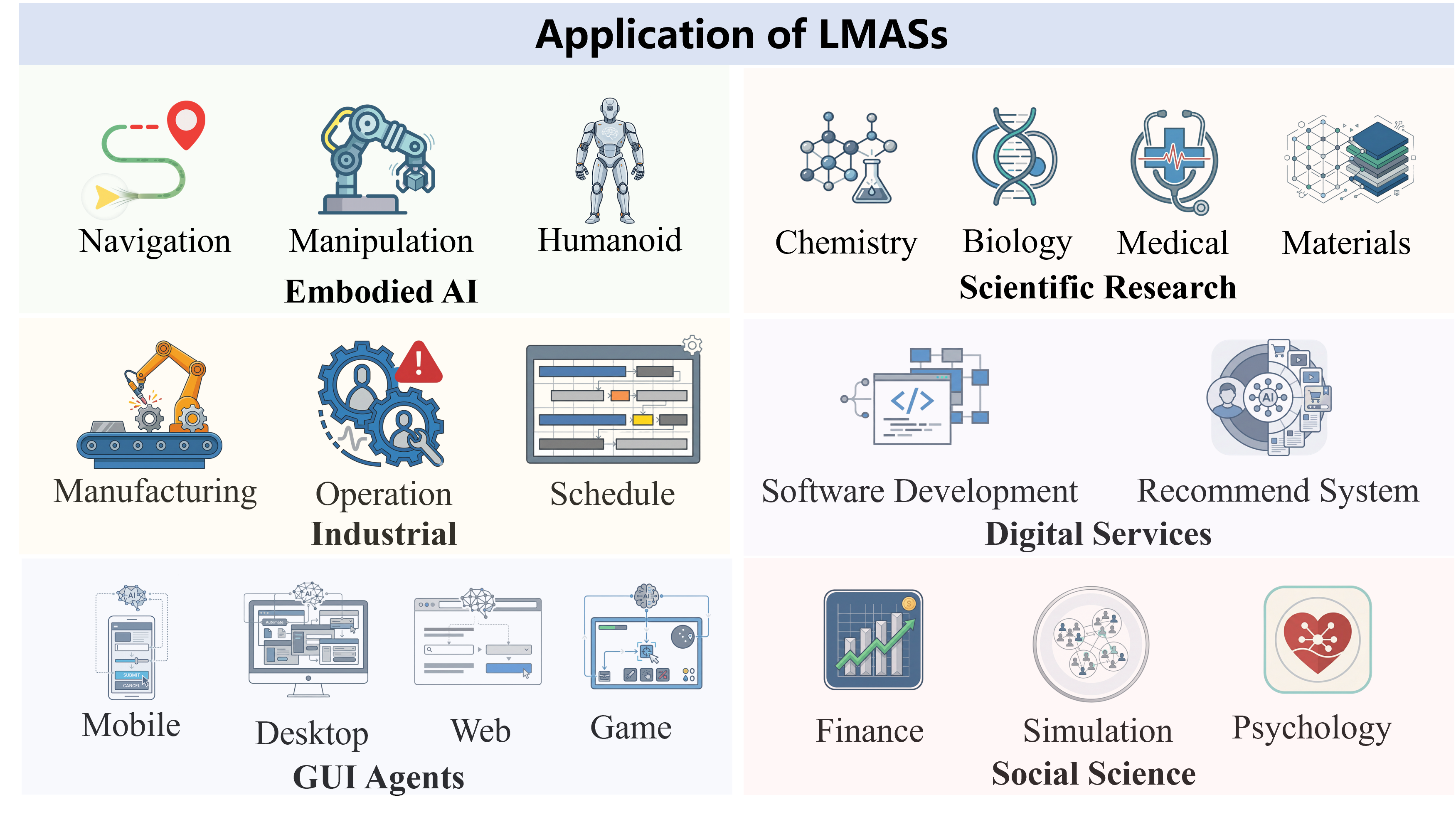
Figure 6: LMAS application diversity, spanning virtual digital collaboration, software engineering, scientific research, embodied AI, and social systems.
Implications and Future Prospects
The paper posits several forward-looking research directions:
- Co-evolution of CMASs and LMASs: Hybrid architectures combining the reliability and interpretability of CMASs with the semantic adaptability of LMASs
- Multimodal scaling: Incorporation of auditory, tactile, and olfactory perception, mitigated by cross-modal representation alignment
- Causality-enhanced reasoning: Integration of causal inference to improve interpretability, robustness, and stability
- Device–edge–cloud orchestration: Federated, resource-aware agentic computation for real-time, large-scale deployment (hardware–cloud integration)
- Embodied intelligence: Evolution from digital-only agents to multi-robot, cross-embodiment collaboration, leveraging LFM-driven high-level reasoning atop robust control
- Ethics and safety: System-level value alignment, human-in-the-loop governance, and explicit auditability in critical domains
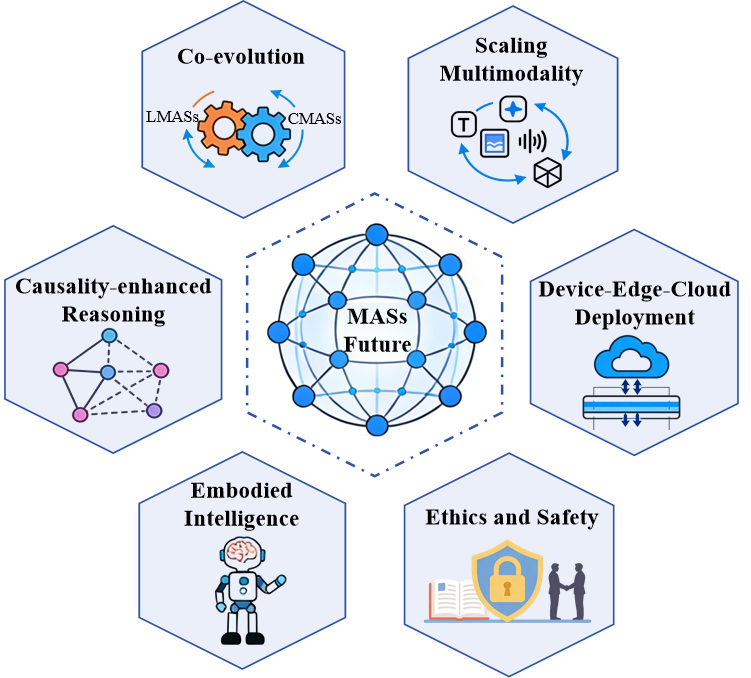
Figure 7: Strategic research directions—robust, scalable, interpretable, generalizable future MASs operating in complex, open-world environments.
Conclusion
The reviewed survey methodically consolidates the conceptual and technical transition from classical to LFM-empowered MASs, establishing LMASs as systematic extensions rather than replacements for established CMAS paradigms. By dissecting both foundational similarities and fundamental divergences, it frames the agentic evolution in terms of layered cognition, adaptable collaboration, and collective emergence. The outlined research agenda—spanning multimodal scale-out, causal reasoning, adaptive deployment, and enhanced safety—highlights the centrality of MASs in orchestrating cognitively-capable, open-world AI systems.