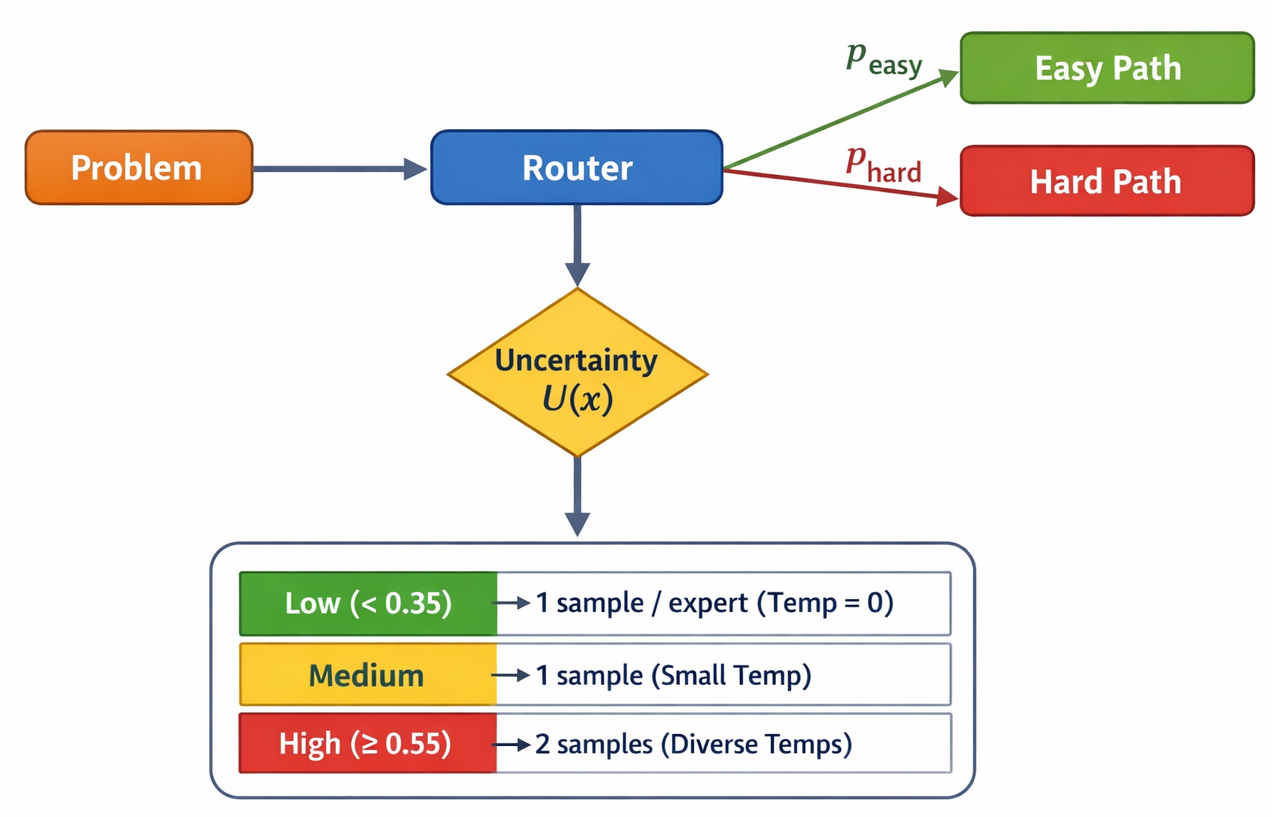
- The paper presents an adaptive framework that routes math problems to specialized experts using difficulty-aware and uncertainty-guided strategies.
- It employs modular components including a neural verifier and answer clustering to achieve a GSM8K accuracy of 75.28% at a 7B scale.
- The approach demonstrates data efficiency by outperforming larger models without relying on synthetic data augmentation.
Adaptive Multi-Expert Reasoning via Difficulty-Aware Routing and Uncertainty-Guided Aggregation
Motivation and Context
Adaptive Multi-Expert Reasoning (AMR) addresses the inconsistent performance of LLMs on mathematical reasoning tasks, particularly the GSM8K benchmark, as a result of problem complexity variation and lack of inference-time flexibility. Prevailing approaches either rely on large-scale synthetic data augmentation, prompt engineering, or monolithic architectures without adaptive expert selection. AMR contrasts with static approaches by introducing a framework that modulates reasoning strategies at inference time according to the predicted difficulty and epistemic uncertainty of each problem instance, enabling efficient and robust solution generation without substantial scaling or data augmentation.
Architecture Overview
AMR consists of four interlocking modules: a difficulty-aware router, a collection of stylistically specialized reasoning experts, a neural verifier, and an uncertainty-guided, clustering-based answer aggregation mechanism.
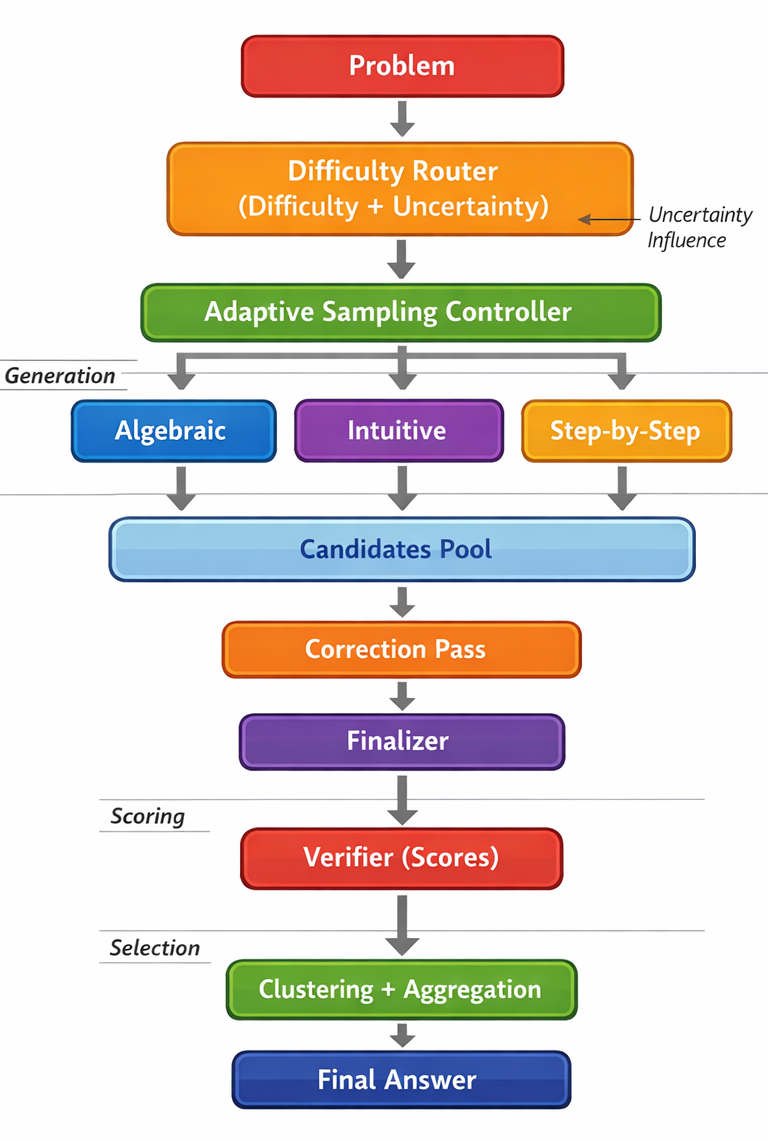
Figure 1: AMR processes each problem based on predicted difficulty and uncertainty, routes them to various potential solution generators in different expert categories, and guides answer selection via correction and finalization to answer clusters as determined by a verifier.
The workflow begins with the router, which—using problem text only—inferentially predicts the difficulty and estimates a hybrid uncertainty score leveraging Shannon entropy and class margin. Based on this score, the system dynamically adapts the number, diversity, and temperature of generations by dispatching the input to relevant experts.
Difficulty-Aware Routing and Generation Strategy
Difficulty-aware routing forms the crux of adaptive inference in AMR. The router assigns a normalized uncertainty metric U(x) for a problem x, combining entropy of the difficulty prediction and the classification margin. The inference pathway is governed by uncertainty:
This approach deviates from sparse, parameter-based MoE methods by routing at inference over diverse reasoning styles, not via parameter sparsity.
Multi-Expert Reasoning and Refinement Pipeline
AMR's core is three LoRA-adapted experts, each trained with specialized reasoning paradigms:
- Algebraic (equation-driven)
- Intuitive (natural language, mental math)
- Step-by-step (explicit derivation)
After initial candidate generation, a correction pass is performed using the step-by-step expert, attempting to repair leading erroneous responses. A finalizer pass then yields concise, high-quality solutions. Only candidates providing explicit, unambiguous answers are retained in subsequent selection.
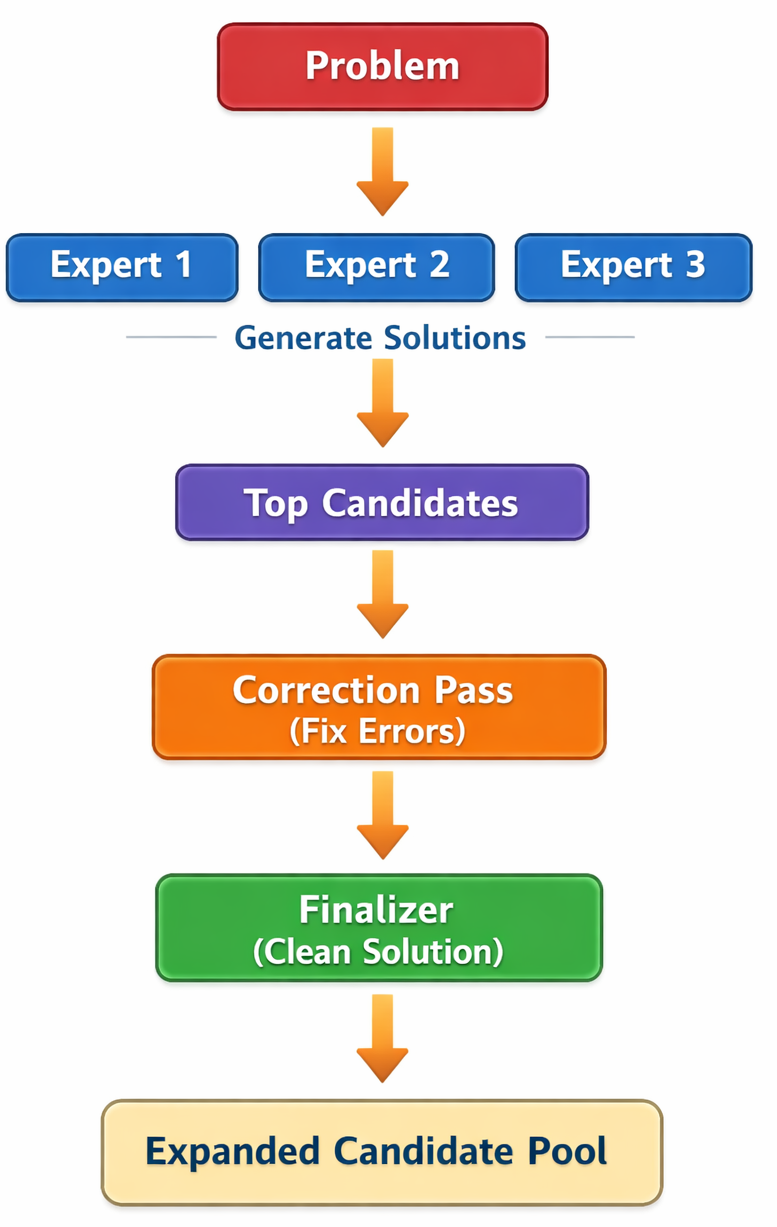
Figure 3: Multi-expert reasoning pipeline. Specialized experts generate diverse solutions, which are refined through a correction stage and a finalization stage to improve accuracy and clarity.
Neural Verification and Clustering-Based Aggregation
The verification stage leverages a DeBERTa-v3-based binary classifier to estimate the correctness probability of each candidate. Numerical answer extraction is used for clustering, grouping candidates by their predicted solution.
The clustering-based aggregation computes a weighted score for each candidate, taking into account:
- Verifier confidence
- Heuristics for answer structure and conciseness
- Answer coherence as a function of normalized length
- Bonus for candidates derived from correction/finalizer passes
Clusters aggregate these scores, incorporating maximal/mean candidate scores, expert support diversity, and cluster cardinality. The final answer is selected from the highest-scoring cluster.
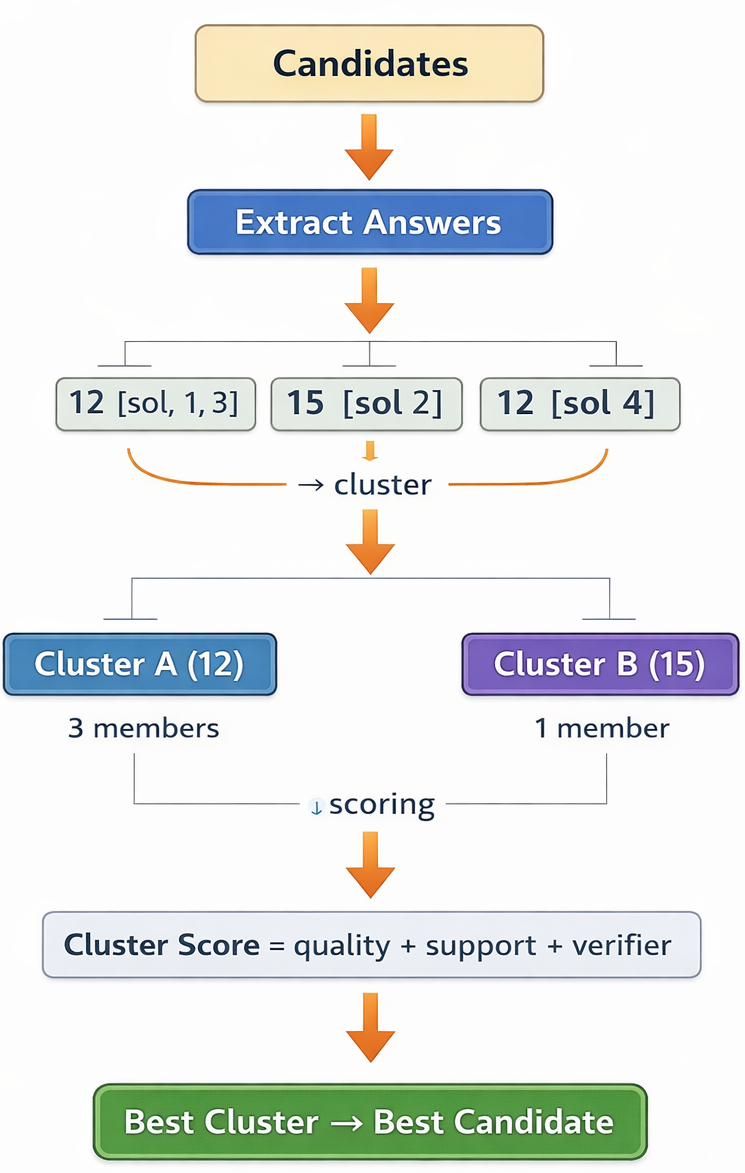
Figure 4: Aggregation by clustering. Candidate answers are grouped by the extracted answers and the clusters are scored based on verifier confidence, quality, and consensus. The best answer is selected from the best cluster.
AMR was evaluated exclusively on the GSM8K test set using only its original 7,473 training examples, without reliance on synthetic augmentations. Results are as follows:
- Overall GSM8K accuracy: 75.28%
- Easy (predicted): 82.6%
- Hard (predicted): 64.1%
Notably, this outperforms most open-source and math-specialized baselines in the 7B parameter bracket that do employ synthetic datasets. AMR approaches the performance of some 13B-scale models and low-data variants such as Phi-GSM (2604.10335).
The adaptive routing and uncertainty-modulated diversity yield substantial robustness for harder problem instances; especially, 64.1% accuracy for hard-labeled tasks surpasses several static approaches.
Implications and Future Directions
AMR demonstrates that dynamic inference-time architectures—adaptive routing, ensemble reasoning with specialized experts, and consensus-based selection—can yield competitive mathematical reasoning accuracy without massive data or computational overhead. Its inference-time orthogonality allows modular integration with orthogonal approaches such as semantic prompt engineering (e.g., DUP [Zhong2024AchievingO]) and self-consistency-based decoding [unknown].
Strong claims by the authors include:
- Achieving 75.28% GSM8K accuracy at 7B scale with only original data, outperforming larger and/or synthetic-data-trained models.
- Data efficiency from solving the task with no synthetic augmentation, contrary to current dominant trends.
- Robustness to inference-time distributional shifts is hypothesized, though not evaluated on benchmarks such as GSM-PLUS.
Observed limitations include sub-optimal router classification accuracy (73.4% alignment with gold) and evaluation restricted to GSM8K; effectiveness on broader benchmarks and out-of-distribution robustness remains an open question. Modular extensions—such as dynamic expert pooling, improved uncertainty calibration, and cross-task generalization—are prioritized for future exploration.
Conclusion
AMR establishes the viability of inference-time architectural diversity as an effective path to data-efficient mathematical reasoning with LLMs. It highlights the possibility of closing the performance gap with larger, heavily augmented models by leveraging adaptive, uncertainty-aware expert selection and consensus-driven answer finalization. These findings suggest a broader paradigm for AI reasoning systems, where architectural dynamism at inference can compensate for both scale and data constraints, warranting further investigation into this axis of model improvement.