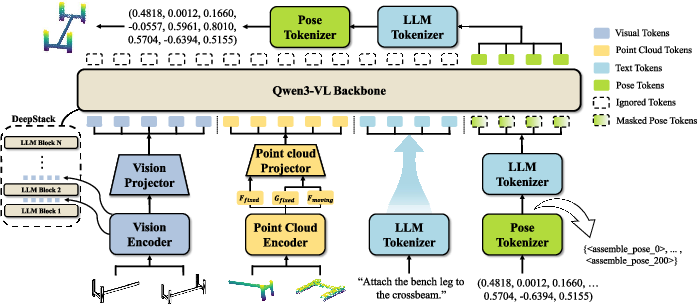
- The paper introduces AssemLM, a unified multimodal model that fuses assembly manuals, point clouds, and language to predict accurate 6D poses in robotic assembly.
- The approach leverages a SE(3)-equivariant encoder and embedding-level fusion with DeepStack, achieving significant improvements in pose accuracy and zero-shot generalization.
- Real-world experiments demonstrate robust sim-to-real transfer with >80% per-step success, underscoring the model's potential for complex robotic assembly tasks.
AssemLM: A Multimodal LLM Framework for Robotic Assembly
Introduction
AssemLM provides a spatially rigorous, multimodal LLM architecture designed to bridge 3D geometric perception and high-level reasoning for robotic assembly. Unlike previous approaches, which are constrained by either their reliance on single-modal inputs (e.g., only point clouds) or their inability to achieve fine-grained 6D (SO(3) × SE(3)) spatial registration, AssemLM achieves precise, generalizable pose prediction by fusing rich modalities including assembly manuals, point clouds, and natural language instructions. Trained on the comprehensive AssemBench dataset—which contains over 900K annotated multimodal samples spanning 150K assembly steps and 50+ object categories—AssemLM demonstrates robust zero-shot generalization, achieving high-fidelity pose predictions across seen and unseen domains, including in real-world manipulation tasks. The architecture's modular design introduces a SE(3)-equivariant point cloud encoder, embedding-level intermodal fusion with DeepStack, and a highly specialized pose tokenizer. These elements collectively advance the state of the art in spatial reasoning for embodied AI.
Architecture and Methodology
AssemLM is centered on a 2B-parameter transformer backbone based on Qwen3-VL-2B-Instruct. The architecture is characterized by the following components and strategies:
AssemBench: The Multimodal Assembly Benchmark
Addressing the critical deficit in large-scale, multimodal, spatially annotated datasets for assembly, AssemBench leverages procedural mesh generation, rendering, and multimodal annotation (combining generative and rejection sampling approaches). The dataset encompasses 150K unique steps and 900K multimodal samples, with assets normalized into a canonical coordinate frame and annotated with deterministic, high-precision 6D pose ground truths. Render styles (Freestyle, Non-Freestyle, Lineart) diversify visual supervision, while instructions are curated at varying semantic granularities.
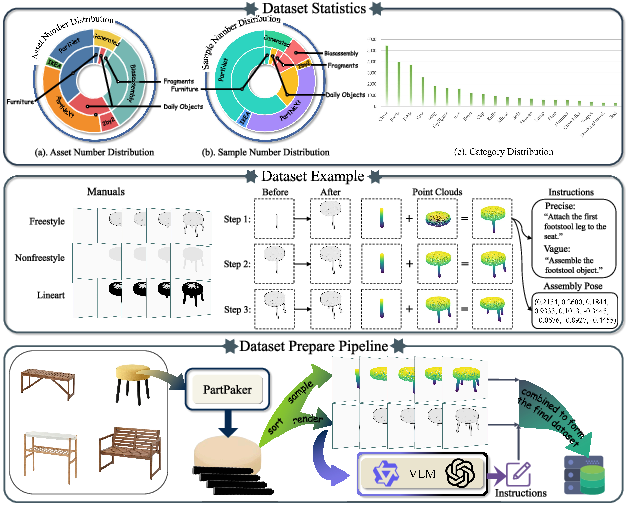
Figure 2: AssemBench statistics and data pipeline, illustrating scaling and curation mechanisms for multimodal annotation.
Quantitative and Qualitative Evaluation
Multi-Category and Zero-Shot Generalization
Compared to leading SE(3)-equivariant assembly models (e.g., TwoByTwo) and large foundation LMMs (GPT-5.2, DeepSeek-V3.2), AssemLM achieves:
- Mean RMSE(T): 0.0203 (order of magnitude lower vs. baselines)
- Symmetric Chamfer Distance (SCD): 0.0109
- Success Rate (SR): 89.4% (vs. 14.5% for TwoByTwo)
Performance remains robust in zero-shot evaluation on the full IKEA dataset—a notably OOD source—with SR of 81.0%. Category-wise, AssemLM maintains strong generalization across Fragments, Furniture, and Daily Objects.
Modality Importance and Ablations
Interpretability analysis via cross-attention attribution demonstrates a dominant reliance on SE(3) point cloud features (82%), with visual manuals (14%) resolving part identity/global context and language (4%) guiding task intent—consistent with the architectural aim of geometric grounding rather than superficial pattern learning.
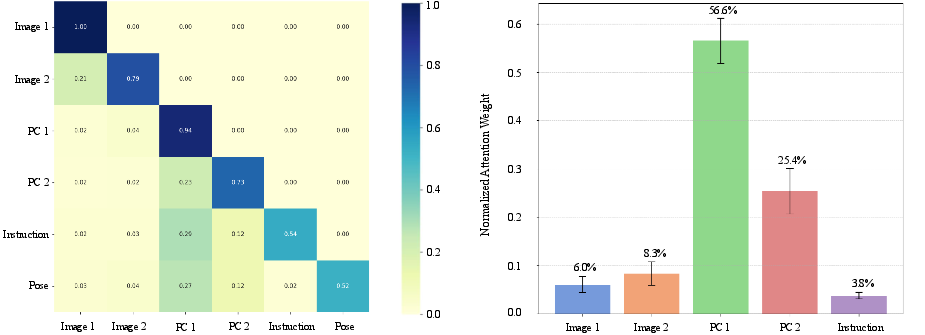
Figure 3: Aggregated attention heatmap and modality contribution analysis highlight geometric dominance and auxiliary augmentations from images/instructions.
Ablation studies affirm the indispensable contributions of the pose tokenizer, DeepStack multimodal injection, and the explicit SE(3)-equivariant module. Removal of any component yields substantial translation/rotation accuracy degradation.
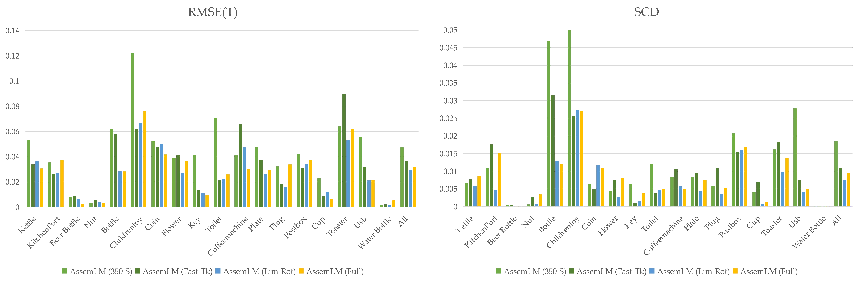
Figure 4: Ablation study: dataset scale, rotation randomization, and tokenizer design critically impact generalization and geometric stability.
Real-World Assembly and Asset Workflow
Evaluations on a Flexiv Rizon 4s robot across four high-precision, multi-step assembly tasks (Insert Plug, Store Cans, Insert Flower, Build Blocks) confirm effective sim-to-real transfer without domain-specific fine-tuning. AssemLM surpasses TwoByTwo on all tasks—Insert Plug (43.3% vs 20.0%), Store Cans (63.3% vs 0.0%), Insert Flower (66.7% vs 63.3%), Build Blocks (30.0% vs 13.3%)—demonstrating not only single-step accuracy but improved task-horizon resilience. The model maintains >80% per-step success, with error accumulation rather than intrinsic prediction error as the principal limiting factor.
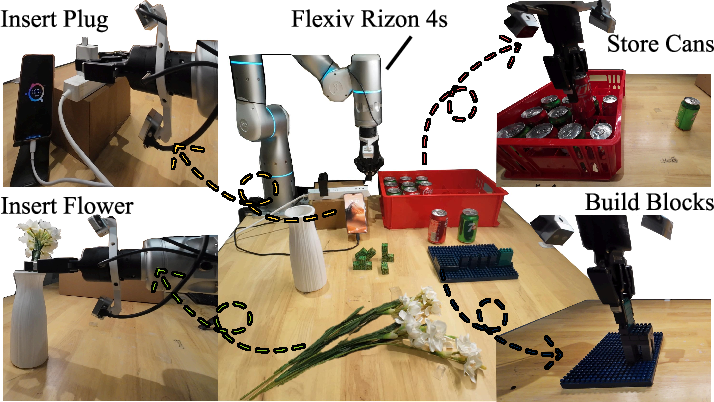
Figure 5: Real-world experimental setup: four robotic assembly tasks reveal real-world applicability with challenging physical constraints.
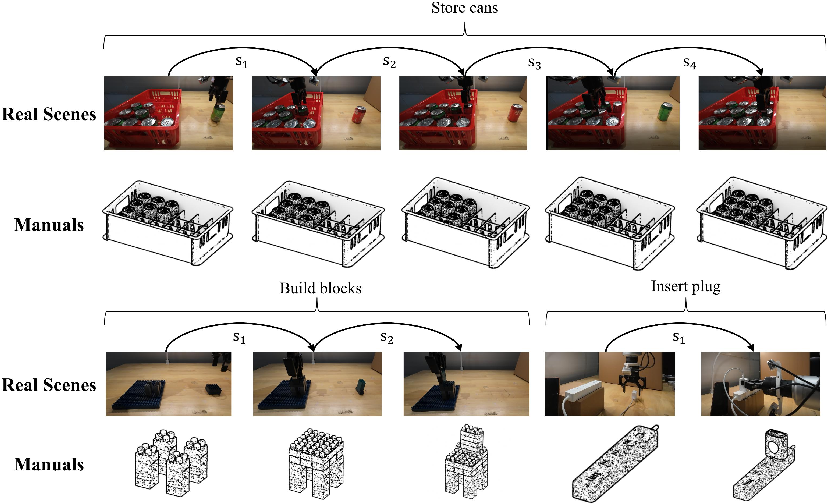
Figure 6: Real-world assembly steps and corresponding instruction manuals utilized for multimodal pose prediction.
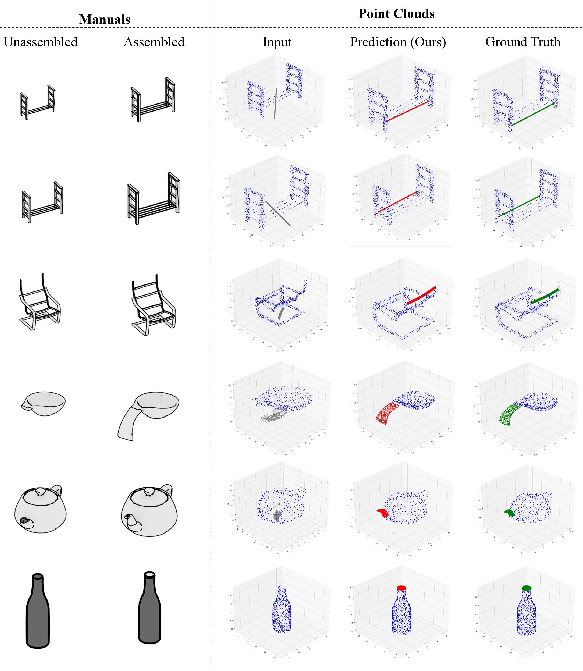
Figure 7: Visualization of assembly pose predictions by AssemLM, demonstrating high correspondence with ground truth across diverse assemblies.
Implications and Future Directions
AssemLM represents a significant step towards scalable, generalizable spatial reasoning in embodied AI:
- Unified Multimodal Reasoning: The architectural innovations enable cross-modal grounding of language, vision, and geometry, supporting compositional generalization essential for long-horizon robotic manipulation.
- High-Fidelity Pose Prediction as Autoregressive Modeling: The pose tokenization approach facilitates stable, discrete regression goals, offering a blueprint for integrating geometric targets into next-token prediction pipelines—potentially applicable to trajectory or action planning in broader manipulation settings.
- Scalable Training and Sim-to-Real Transfer: The combination of large-scale synthetic training (with procedural supervision) and strong real-world generalization underscores the potential for data-centric sim2real pipelines in assembly and beyond.
Several theoretical and practical research avenues emerge:
- Extension to General Manipulation Pipelines: AssemLM's structured outputs position it as a high-level reasoning module for downstream planning, simulation, and instruction-following tasks, particularly when compositionality or multi-modal grounding is critical.
- Policy Learning and Closed-Loop Control: Integration with low-level motion policies, tactile sensing, and vision-based feedback loops can leverage AssemLM's pose grounding for robust closed-loop execution.
- Further Dataset Expansion: With easy scalability, AssemBench can be extended for hierarchical, multi-object, or damage-aware assembly settings, supplying a foundation for robust self-supervised representation learning in robotics.
Conclusion
AssemLM establishes a new benchmark for large-scale, multimodal, 6D pose-centric spatial reasoning in robotics. Through tight integration of SE(3)-equivariant geometric encoders, efficient embedding-space fusion, and a discretized pose modeling paradigm, AssemLM achieves state-of-the-art accuracy, robust generalization, and effective deployment in real-world assembly tasks. The architectural and dataset advances in this work are likely to inform both foundational research into 3D-aware LLMs for robotics and practical methodologies for sim2real transfer, spatial program induction, and human-robot collaboration.