- The paper presents a novel probabilistic CBF framework that leverages particle-based methods and sub-Gaussian concentration to enforce safety under state estimation and process disturbances.
- It reformulates one-step chance constraints as tractable CVaR-type guarantees, providing finite-sample, distribution-free risk certificates without excessive conservatism.
- Empirical evaluations on mobile robot navigation show the method achieves a 2% safety violation rate and 100% task success, outperforming deterministic and DKW-based approaches.
Probabilistic Control Barrier Functions under State Estimation Uncertainty: Sub-Gaussian Concentration Framework
Introduction and Problem Statement
This work presents a particle-based framework for probabilistic control barrier functions (CBFs) that provides formal safety guarantees for stochastic nonlinear systems with both state estimation uncertainty and process disturbances. The motivation arises from critical applications—such as robotic and spacecraft systems—where process noise, estimator-induced uncertainty, and model mismatch yield unbounded stochastic uncertainty, making strict safety constraints for CBF-based controllers infeasible in the deterministic sense. The proposed method addresses the core challenge of enforcing safety in probability for systems where both the state and dynamics are subject to uncertainty, with an explicit focus on computational tractability and finite-sample statistical guarantees.
The system is modeled as a discrete-time nonlinear control-affine system with additive Gaussian disturbances, where the true state is unobservable and estimated via a Gaussian estimator (e.g., EKF). The key objective is to synthesize feedback controllers that maximize performance while ensuring probabilistic invariance of a state-dependent safe set over finite horizons. Classical CBF conditions are extended to the probabilistic regime using one-step chance constraints, which are then relaxed and reformulated as conditional value-at-risk (CVaR)-type constraints for computational tractability.
Sub-Gaussian Structure and Finite-Sample Guarantees
A significant theoretical contribution of the paper is the identification and exploitation of the sub-Gaussian structure of the increment of the barrier function (i.e., h(xt+1)−γh(xt)) resulting from Gaussian disturbances propagating through Lipschitz-continuous, nonlinear, control-affine dynamics. Specifically, the paper proves that:
- The random increment Δh is itself sub-Gaussian with a parameter that admits a closed-form bound in terms of system Lipschitz constants, maximum control input, and the covariance matrices of the state estimate and process disturbance.
- This property enables the use of powerful sub-Gaussian concentration inequalities to derive tight, finite-sample, distribution-free bounds on the approximation error of empirical CVaR estimates (obtained via particle propagation) with respect to the true risk level.
A precise finite-sample CVaR upper bound is derived using the Dvoretzky–Kiefer–Wolfowitz (DKW) inequality and sub-Gaussian tail bounds. This result guarantees that the constraint incurs vanishing conservatism as the number of samples increases and does not require artificial distribution truncation, circumventing the key limitations of scenario-based and support-bounded concentration approaches.
To ensure computational tractability, the authors present a novel reformulation of the probabilistic CBF constraint as a tractable optimization problem:
- The original intractable one-step probabilistic CBF is relaxed to a sufficient empirical CVaR constraint, which, due to the sub-Gaussianity result, is upper-bounded by a data-dependent term involving particle-based order statistics and a computable tail correction factor.
- The structural form of the empirical CVaR estimate allows reformulation as a linear program in auxiliary variables without explicit sorting, and for convex barrier and control structures, the entire controller synthesis program is a convex quadratic program.
- When dynamics are linear and the barrier function is affine, a further simplification yields a linear program with the same finite-sample statistical certificate.
This approach ensures that the theoretical probability guarantee on safety is preserved in the finite-sample regime and is amenable to real-time embedded implementation.
Empirical Evaluation and Comparative Results
The proposed method is validated through Monte Carlo simulations on a non-holonomic mobile robot navigation problem with process and estimation uncertainty:
- Three methods are compared: (1) a deterministic CBF, (2) a probabilistic CBF using the DKW inequality with artificial support truncation, and (3) the proposed sub-Gaussian-based method.
- Each simulation involves both Gaussian localization errors and dynamical noise, with state estimates generated by an EKF. The control barrier enforces a geofence constraint in the workspace.
The results show that the deterministic CBF baseline fails catastrophically—100% safety violation rate—as it cannot account for unbounded disturbances. The DKW-based method achieves safety but at the cost of excessive conservatism—only 56% goal-reaching success. The sub-Gaussian-based approach achieves a safety violation rate of 2.0% (well below the user-specified threshold of 10%) and 100% task success, thus balancing safety and task completion.
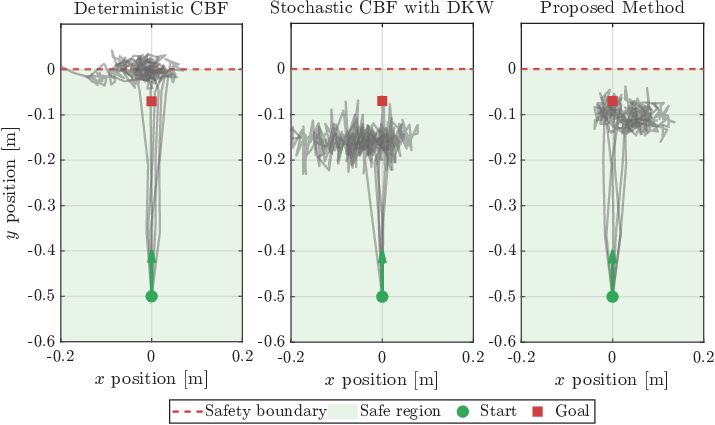
Figure 1: Representative trajectories for the three tested methods. The plots display the robot's path from the start position (green circle) to the goal position (red box), with the safety boundary at y=0 (red dotted line).
Detailed evolution of barrier values across time and empirical CVaR error curves further substantiate that the proposed method closely tracks ground-truth risk, avoiding the pronounced over-conservatism of DKW-based techniques.
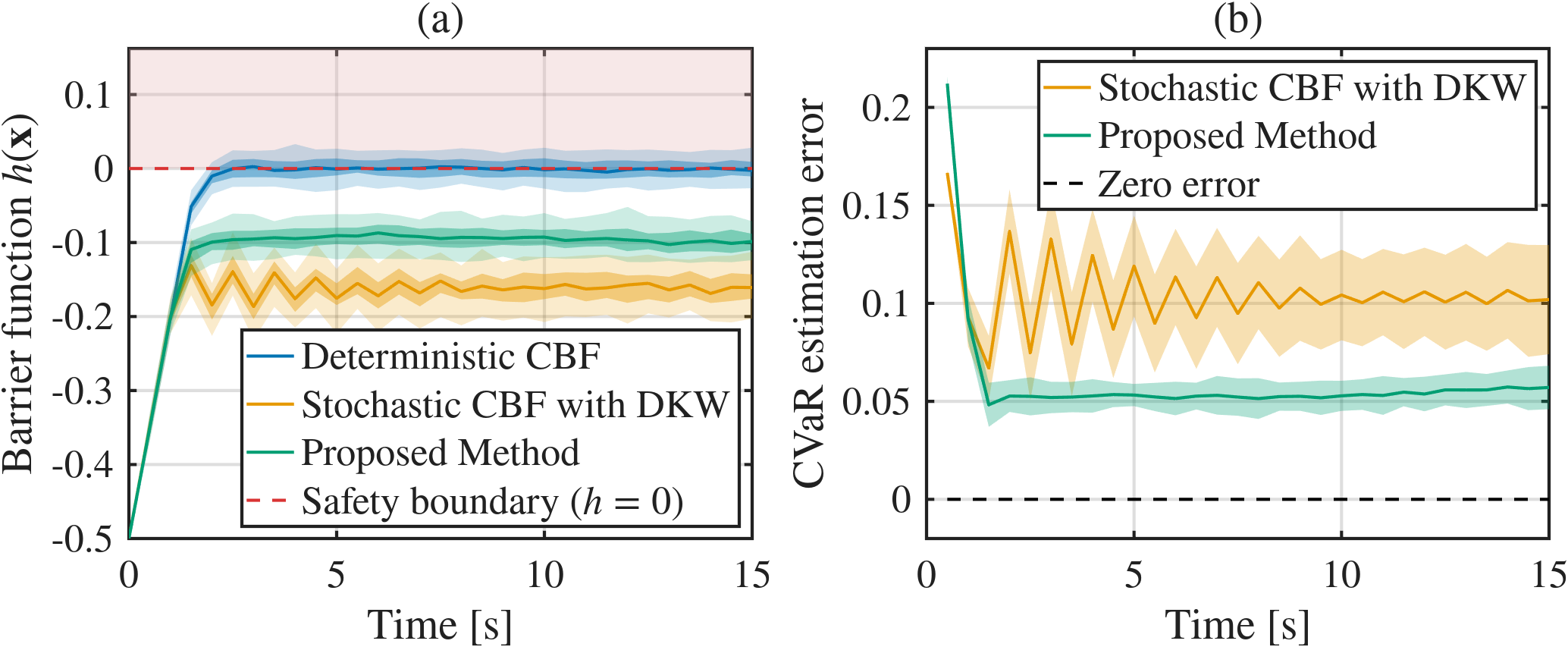
Figure 2: Performance metrics across Monte Carlo trials. (a) Barrier function evolution over time for each method, with the safety boundary at h=0 (red dotted line). (b) CVaR estimation error over time.
Implications, Limitations, and Future Directions
This framework represents a essential advance in stochastic safe control:
- It provides a universal, distribution-free, finite-sample statistical certificate for particle-based probabilistic safety controller synthesis under both process and state estimation uncertainty.
- Its non-asymptotic correctness, computational tractability, and avoidance of conservative truncations or information loss make it directly applicable to real-world stochastic control in robotics, aerospace, and autonomous systems where safety is non-negotiable and real-world uncertainty is unbounded.
Theoretically, the results elucidate the role of the system's Lipschitz structure and uncertainty propagation in the statistical risk profile, consolidating the connection between sampling-based safety verification and high-dimensional probability tools.
There remains the double probability structure: the finite-sample CVaR bound holds with high probability 1−δ, and the safety constraint holds with probability 1−α. Unification or composition of these guarantees for long-horizon or recursive feasibility, as well as extensions to non-Gaussian, heavy-tailed, or dependent uncertainty structures, remains a key direction for future research.
Conclusion
This paper establishes a sub-Gaussian probabilistic CBF framework for stochastic safety-critical control synthesis, providing tight finite-sample risk certificates without artificial truncation or excessive conservatism. The framework yields tractable controllers with explicit statistical guarantees, validated empirically with strong safety and performance in the presence of joint process and estimation uncertainty. The sub-Gaussian approach advances the state of the art in risk-aware safe control and points to further unification of statistical learning, optimization, and robust control for safety-critical AI.

