- The paper demonstrates an almost sure control barrier framework that ensures probabilistic safety for two-wheeled vehicles experiencing stochastic vibrations.
- It synthesizes a feedback law combining LiDAR measurements and stochastic dynamics to maintain the safety set under uncertain operating conditions.
- Hardware experiments on the Lightrover platform validate the approach, showing superior safety performance compared to deterministic CBF methods.
Collision Avoidance for Stochastic Two-Wheeled Vehicles via Almost Sure Control Barrier Function
Introduction and Background
Collision avoidance remains a critical aspect of autonomous mobile robotics, especially in operational domains affected by stochastic disturbances. Traditional reactive and planning-based methods—such as artificial potential fields, dynamic window approach, nearness diagrams, and fuzzy inference—do not offer safety guarantees under stochastic perturbations. Control Barrier Functions (CBFs) provide a rigorous framework for safety-critical control, yet classical deterministic CBF formulations fail to account for the non-determinism encountered in physical deployments, where mechanical vibrations, sensor noise, and unmodeled dynamics may dominate.
This paper proposes an almost sure safety-critical controller for a two-wheeled vehicle subjected to stochastic vibration, leveraging recent advances in stochastic CBF theory. Specifically, the methodology combines AS-RCBF (Almost Sure Reciprocal Control Barrier Function) design for safety with direct utilization of LiDAR point-cloud measurements, as exemplified in "Collision Avoidance Control for a Two-wheeled Vehicle under Stochastic Vibration using an Almost Sure Control Barrier Function" (2603.27934). The contribution is validated through rigorous hardware experiments with the Lightrover mobile platform under vibration-induced noise.
System Modeling and Stochastic Dynamics
The work employs a two-wheeled vehicle equipped with a 2D LiDAR whose center does not coincide with the vehicle's axle. The core state variables consist of LiDAR-measured distances and angles to N discrete points on the environment. The vehicle's continuous-time nonlinear dynamics are expressed with affine control structure, incorporating both nominal (pre-planned) and safety compensator terms.
To accurately represent the stochastic operating regime, additive Gaussian white noise is imposed on the system evolution, yielding a stochastic differential equation for each measured point:
dxi=gi(xi)(uo+u)dt+σidw,
where σi is the diffusion vector, and w is a standard Wiener process. The system-level model aggregates all N points, resulting in the stochastic process
dx=g(x)(uo+u)dt+σdw,
with x∈R2N and σ∈R2N×d.
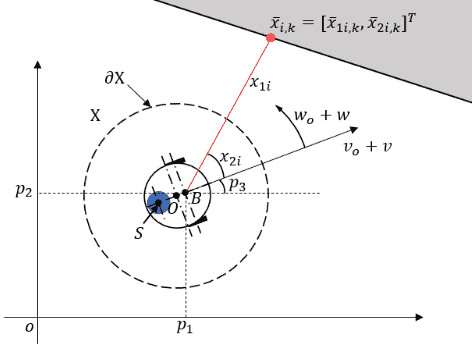
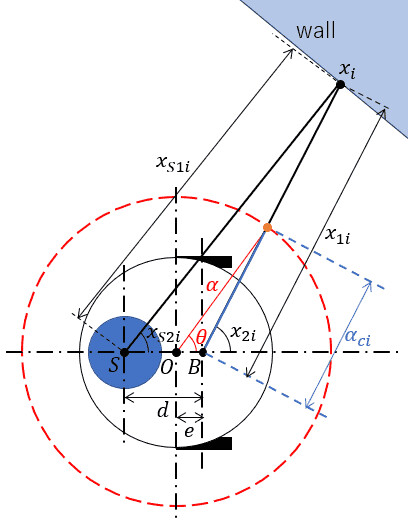
Figure 1: A block-level schematic of the two-wheeled vehicle and sensor measurement configuration.
Control Barrier Function Synthesis in Stochastic Setting
The control objective is formalized as forward invariance of the set where all sensor-obstacle distances exceed a state- and geometry-dependent threshold function αci(x2i), parameterized by vehicle geometry and measurement configuration. The barrier function for each LiDAR ray is
Bi(xi)=x1i−αci1,
and the overall AS-RCBF is aggregated as dxi=gi(xi)(uo+u)dt+σidw,0. The set dxi=gi(xi)(uo+u)dt+σidw,1 defines the safe set.
Under stochastic evolution, the AS-RCBF framework mandates a control law ensuring that for almost every sample path, the system state remains in dxi=gi(xi)(uo+u)dt+σidw,2, achieving probabilistic safety with probability one. The resulting compensator dxi=gi(xi)(uo+u)dt+σidw,3 is computed explicitly using the stochastic Lie derivatives, taking into account the drift, actuation, and diffusion terms.
The authors derive the stochastic forward invariance condition based on the extended generator (Itô formula), leading to the specific feedback law
dxi=gi(xi)(uo+u)dt+σidw,4
where dxi=gi(xi)(uo+u)dt+σidw,5 and dxi=gi(xi)(uo+u)dt+σidw,6 represent the actuation and stochasticity-induced derivatives, respectively.
Experimental Validation
Comprehensive hardware trials were conducted using a Lightrover vehicle subjected to both stationary and vibration-induced environments, with the latter emulating realistic stochastic disturbances via a vibration platform. A 2D LiDAR system with dxi=gi(xi)(uo+u)dt+σidw,7 measurement points provided real-time state information.
Experimental scenarios included:
- Deterministic safety-critical control (Exp. 1d, 2d; dxi=gi(xi)(uo+u)dt+σidw,8).
- Stochastic almost sure safety-critical control (Exp. 1n, 2n; dxi=gi(xi)(uo+u)dt+σidw,9).
Parameter values were chosen via direct experimental estimation of diffusion coefficients (Appendix A), resulting in σi0, with other settings such as σi1 and σi2.
The environment and experimental layout are illustrated in Figure 2.
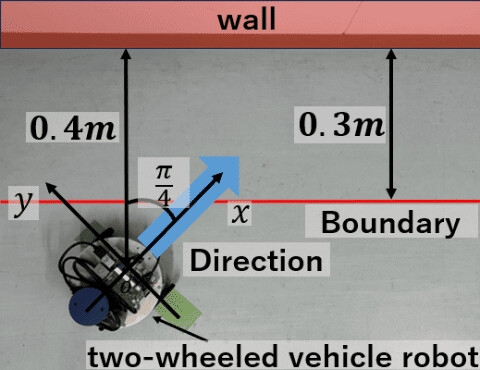
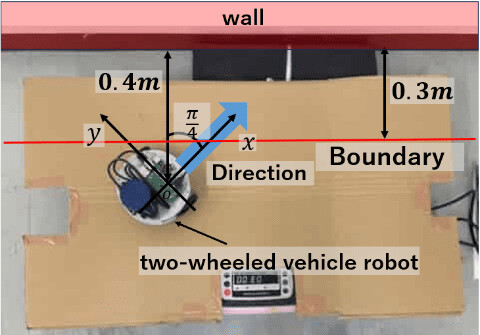
Figure 2: Experimental environments for collision avoidance under various disturbance regimes.
Key experimental metrics included the distance to the closest obstacle point, the time-evolution of system states, control inputs, and the AS-RCBF itself. Notably, trajectories (Figure 3) and state responses (Figures 5 and 6) demonstrated that the deterministic controller failed to guarantee safety under stochastic vibration, occasionally exceeding the safety boundary. The AS-RCBF-based controller, in contrast, maintained strict adherence to the safe set, validating the almost sure invariance property.
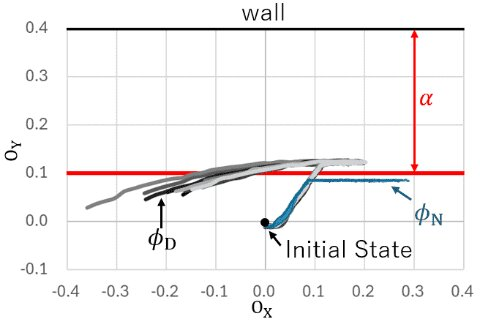
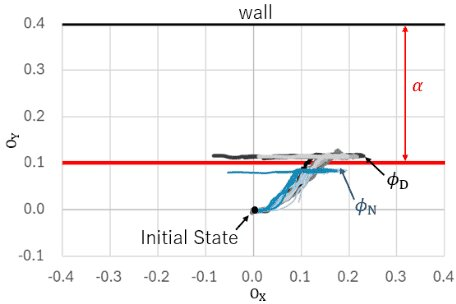
Figure 3: Vehicle center trajectories illustrate superior safety maintenance under AS-RCBF-based control, especially in the presence of disturbance.
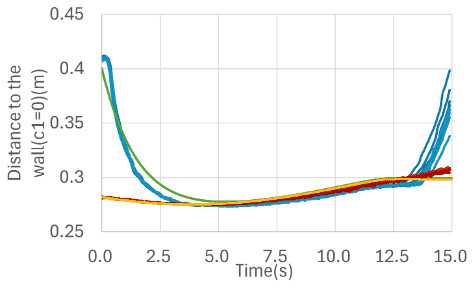
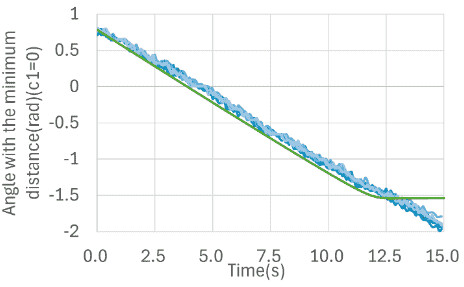
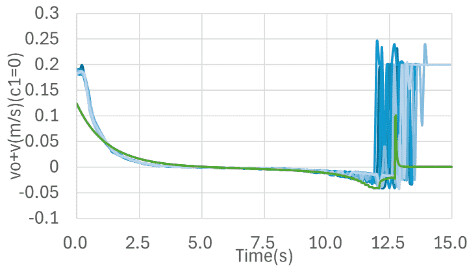
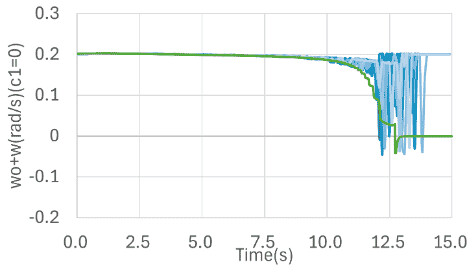
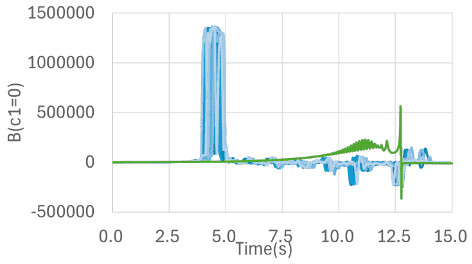
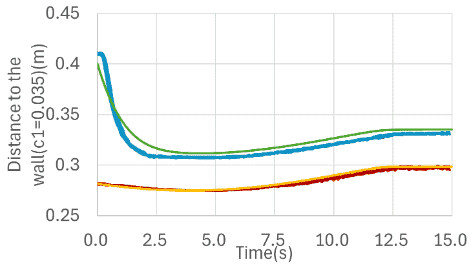
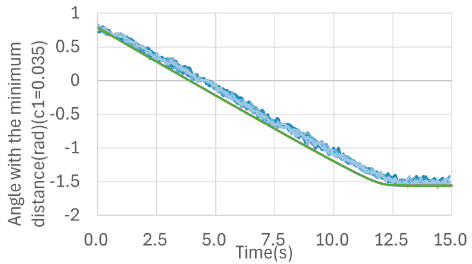
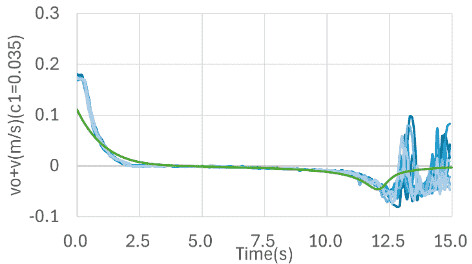
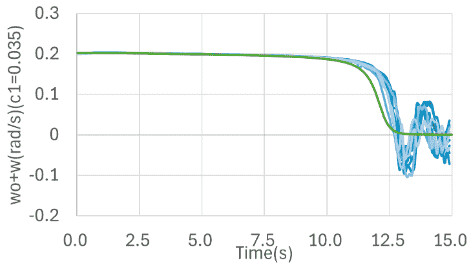
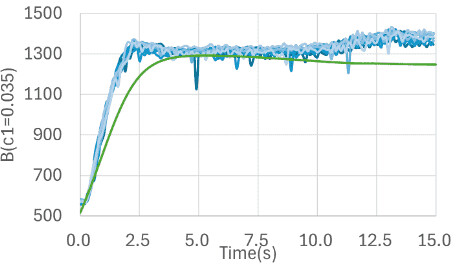
Figure 4: Time responses of σi3 (minimum obstacle distance) confirm strict adherence to safety threshold under proposed control.
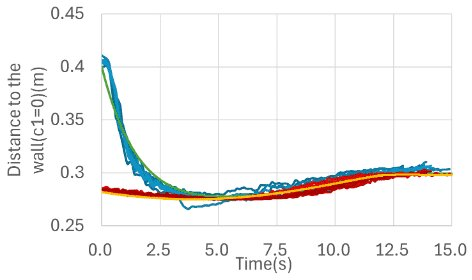
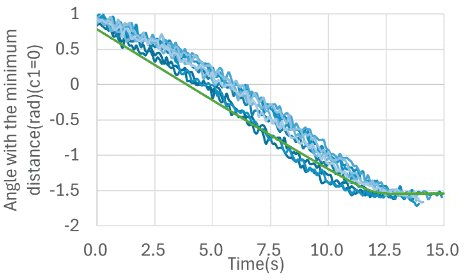
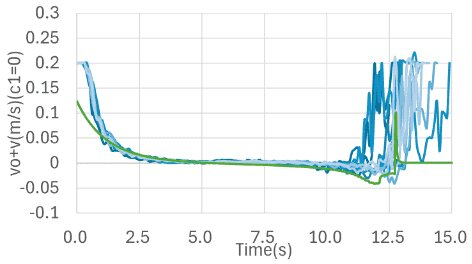
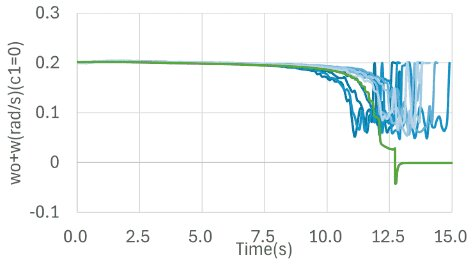
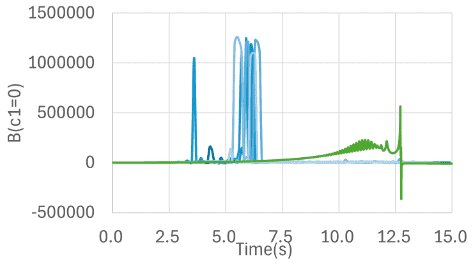
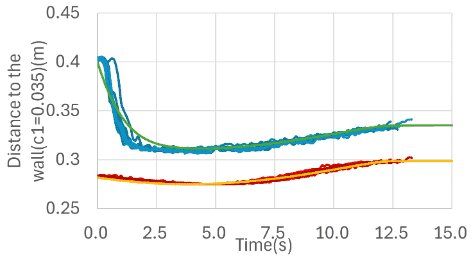
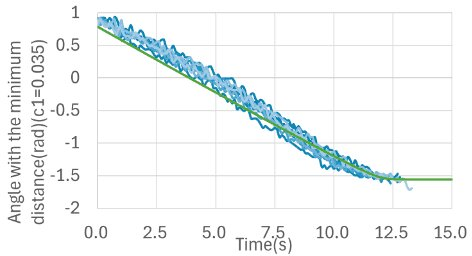
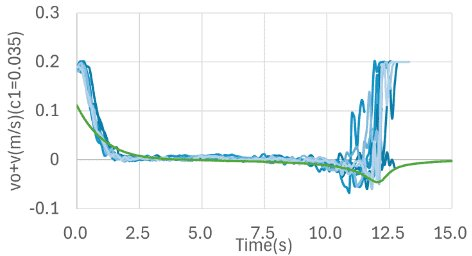
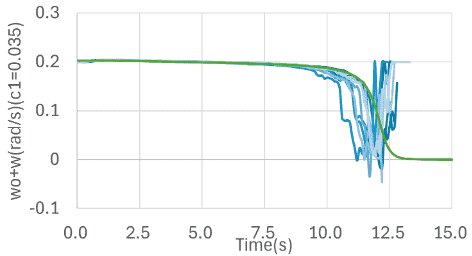
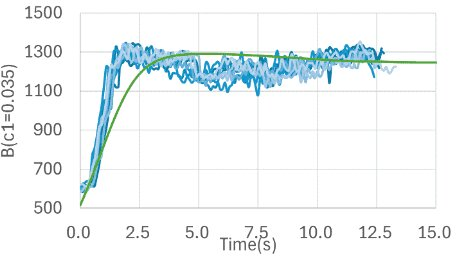
Figure 5: Time responses of the AS-RCBF σi4 remain strictly positive with the stochastic controller.
Analysis, Insights, and Limitations
The experimental results confirm that naive deterministic CBF-based controllers do not provide robust safety under realistic disturbances; state trajectories frequently cross the theoretical safe set boundary due to unmodeled noise and measurement timing jitter. When designed with stochasticity in mind, the AS-RCBF controller compensates for noise and modeling error margins, delivering strict probabilistic guarantees. Time series analysis of the RCBF and relevant system states further corroborates these findings.
The control law exhibits transient oscillations near singularity points (σi5) in the action of σi6, underscoring the need for further treatment of measurement geometry and control gain scheduling to suppress high-frequency input fluctuations. Increase in LiDAR point count can mitigate these artifacts by cancellation in the aggregated derivatives.
Implications and Future Directions
Theoretical implications are immediate: the work operationalizes the AS-RCBF safety paradigm on resource-constrained, real-world embedded platforms. Practically, this paves the way for formal safety certification of autonomous vehicles operating under significant uncertainty. The approach extends naturally to other pointcloud-based robotic systems, such as human-assistive robotics and industrial AGVs, subject to adversarial environmental variations.
Potential research extensions include:
- Adaptive online estimation of diffusion terms for deployment in dynamic environments with time-varying noise statistics.
- Integration with model predictive safety filters for improved control smoothness.
- Extension to multi-robot scenarios and the inclusion of dynamic, non-stationary obstacles.
- Hardware implementation of higher-order stochastic safety filters combined with robust perception pipelines.
Conclusion
This study formally establishes and experimentally validates the almost sure safety-critical control of a LiDAR-equipped two-wheeled vehicle operating under stochastic vibration. The controller, built upon the AS-RCBF feedback law, ensures forward invariance of safety sets with probability one, a property unattainable by deterministic CBF methods in the presence of realistic disturbances. The results stress the necessity of stochastic rigor in autonomous robotic safety design and lay groundwork for robust deployment of safety-assured mobile platforms in uncertain environments.