- The paper proposes a novel stochastic safety-critical control framework using zeroing control barrier functions to guarantee a minimum safety probability in marine tracking.
- It integrates a linear tracking model with both linear and nonlinear safety compensation methods to effectively counteract additive Gaussian disturbances.
- Numerical simulations validate the approach with significant improvements in safety probabilities, offering a rigorous foundation for autonomous vessel operations.
Stochastic Safety-critical Control with Safety Probability Compensation for Marine Vessel Tracking
The paper "Stochastic Safety-critical Control Compensating Safety Probability for Marine Vessel Tracking" (2603.27943) systematically addresses the challenge of marine vessel trajectory tracking under stochastic disturbances, focusing on ensuring safety with a quantifiable probabilistic guarantee. Vessel maneuvering is modeled as a nonlinear control system subject to external stochastic disturbances such as wind and waves, causing deviation from nominal trajectories. The work integrates stochastic safety-critical control formalism, specifically through the lens of stochastic zeroing control barrier functions (ZCBFs), to formally guarantee that vessel errors remain within a designed safe set with a provable lower bound on the safety probability.
The mathematical model follows Fossen's canonical approach to vessel hydrodynamics as the foundation, then reformulates the tracking objective to error dynamics amenable to stochastic analysis.
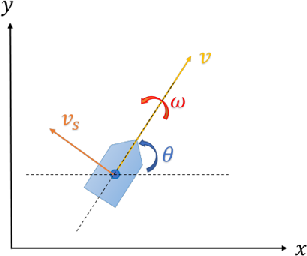
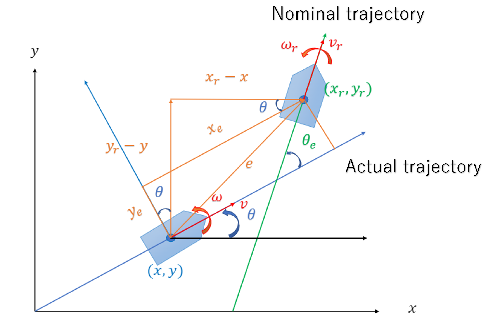
Figure 1: Marine vessel maneuvering kinematic model as formulated by Fossen.
The state is defined as the tracking error relative to a reference trajectory. Control is introduced via linear feedback for tracking, but the core contribution comes from quantifying and compensating the impact of additive Gaussian disturbances on safety-critical constraints.
Linear Tracking Controller and Stochastic System Construction
Modeling commences with a kinematic vessel model in global coordinates incorporating surge, sway, and yaw states. The model is re-centered to account for pivot dynamics and then augmented for error-state dynamics relative to a nominal (reference) path. The resulting error system includes control terms designed to drive the error to zero under ideal disturbance-free scenarios.
With realistic disturbances, the system is recast as a stochastic differential equation (SDE) using additive Wiener processes:
dx(t)={f(x(t))+g(x(t))u(t)}dt+Gdw(t)
where G encodes the diffusion coefficients for each state variable, with the disturbance assumed as Gaussian white noise.
To facilitate tractable controller synthesis, the error system is linearized around the reference, yielding:
x˙(t)=Ax(t)+Bu(t)
Standard LQ optimal control is deployed for baseline tracking by minimizing a quadratic cost, leading to:
utra(x)=−Kx
with K computed from the Riccati equation. In absence of noise, this ensures asymptotic tracking.
Safety Probability Quantification via Stochastic ZCBFs
The central theoretical innovation is in formalizing, quantifying, and compensating the safety probability, defined as the likelihood that the trajectory error remains within a safe set over time, given stochastic disturbances.
The safety set is constructed as a level set of a quadratic Lyapunov function:
h(x)=−xTPx+M,χ={x∣h(x)>0}
where P is the unique positive definite solution to the Riccati equation and M is a design parameter. The probability that, starting from a shrunken initial set, the state remains in χ is lower bounded via explicit expressions involving the system matrices and disturbance magnitude.
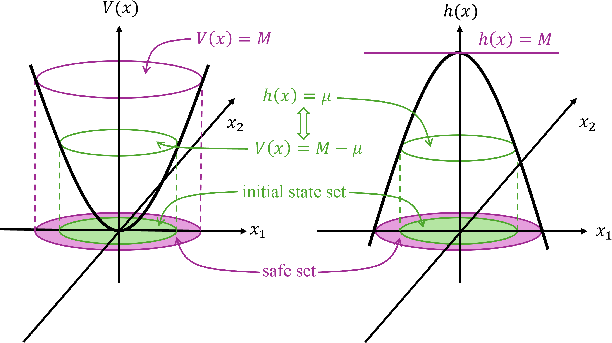
Figure 2: Schematic of the Lyapunov function V(x), stochastic ZCBF G0, safe set G1, and initial state set G2.
Key numerical parameters (e.g., the diffusion matrix G3 and set thresholds G4, G5) directly influence the provable minimal safety probability, highlighting the tight coupling between system uncertainty and control design.
Safety-critical Compensation: Linear and Nonlinear Strategies
Recognizing that baseline LQ tracking does not adequately protect safety under significant noise, the authors introduce both linear and nonlinear safety compensators:
- Linear Compensator: An additive state feedback G6, where G7 is synthesized to explicitly increase the safety probability by adjusting the stochastic ZCBF's drift condition. The impact is quantified by the increased exponent in the lower bound G8, where G9 is achieved for appropriately chosen compensators.
- Nonlinear Compensator: To manage cases where disturbances may push the state far from the origin, a nonlinear state-dependent controller x˙(t)=Ax(t)+Bu(t)0 is designed. This compensator activates adaptively near the safety boundary, using the ZCBF's drift to take strong corrective action only where the system approaches the unsafe set.
Analytical synthesis procedures (see Section 6 in the paper) guarantee continuity and feasibility for both compensators. The design is guided by the explicit impact of diffusion—controllers are tuned to dominate stochastic effects, ensuring rigorous safety probability enhancement.
Numerical Simulations
Extensive simulations validate the theoretical results. Three main control regimes are compared:
- Baseline tracking (x˙(t)=Ax(t)+Bu(t)1 only): Most stochastic trajectories breach the safety region, matching the tight theoretical lower bound on probability (x˙(t)=Ax(t)+Bu(t)2).
- Tracking + linear safety compensation (x˙(t)=Ax(t)+Bu(t)3): All sample paths are retained within the safety set; the empirical safety probability approaches 0.997.
- Tracking + nonlinear safety compensation (x˙(t)=Ax(t)+Bu(t)4): All sample paths also remain safe, matching a calculated safety probability of 0.950.
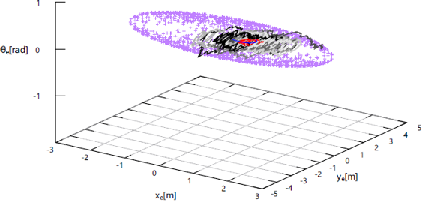
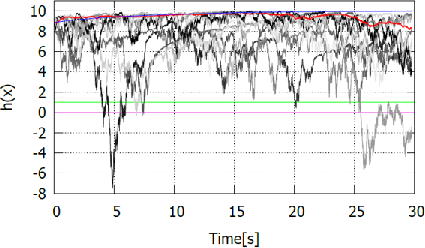
Figure 3: Trajectories using only x˙(t)=Ax(t)+Bu(t)5 (no compensation); several paths leave the safety set.
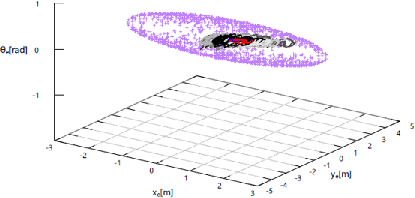
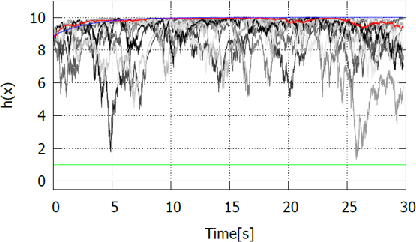
Figure 4: Trajectories with x˙(t)=Ax(t)+Bu(t)6 (linear compensation); all paths remain within the safety set.
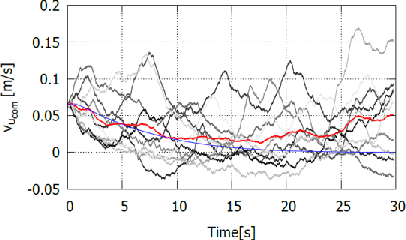
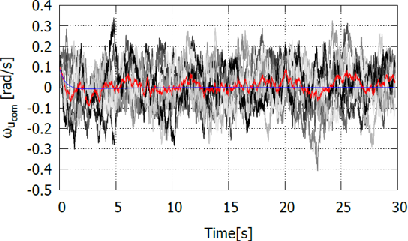
Figure 5: Control input x˙(t)=Ax(t)+Bu(t)7 components with linear compensation.
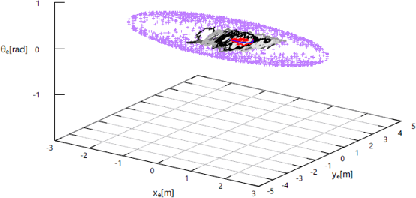
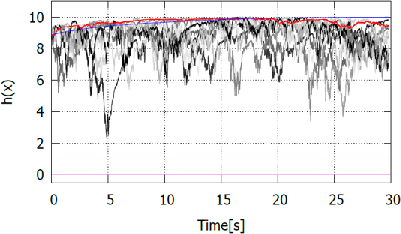
Figure 6: Trajectories with x˙(t)=Ax(t)+Bu(t)8 (nonlinear compensation); all paths stay safe.
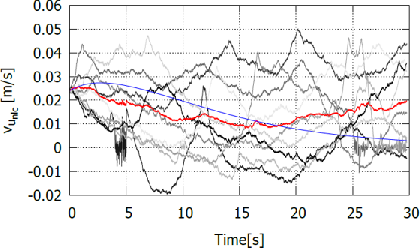
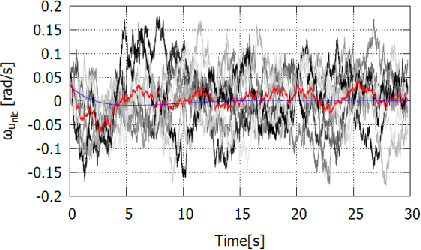
Figure 7: Control input x˙(t)=Ax(t)+Bu(t)9 components with nonlinear compensation.
Sample paths, averages, and boundaries are all illustrated as per the figures. The close match between empirical and theoretical safety probabilities substantiates the correctness and strength of the analytic framework.
Theoretical and Practical Implications
This work advances the integration of safety-critical control and formal stochastic system analysis in marine vessel applications. By rendering safety constraints as probabilistic barrier functions and directly compensating the probability, the approach supports systematic controller synthesis that scales with uncertainty, rather than relying on heuristic or worst-case deterministic margins.
Implications include:
- Theoretical: The extension and formalization of stochastic ZCBFs to provide explicit, tight safety probability bounds under state-dependent disturbances offers a unifying pathway for stochastic safety proofs in continuous-time systems. The developmental framework generalizes prior safety-critical control to accommodate SDEs and facilitates synthesis in both the linear and nonlinear domains.
- Practical: The methodology enables practitioners to explicitly specify acceptable risk levels and synthesize compensators that guarantee at least that level, given the disturbance covariance. This directly addresses certification and industrial safety standards for autonomous vessel operation, potentially catalyzing robust deployment in variable maritime environments.
Future Directions
Possible future extensions include:
- Application to more complex, higher-dimensional vessel models with coupled dynamics and input saturation constraints.
- Integration with robust adaptive estimation for parametric disturbances.
- On-line adaptation of threshold parameters for dynamic risk allocation.
- Generalization to fleets and cooperative vessel tracking with distributed safety guarantees.
Conclusion
The paper presents a rigorous and systematic methodology for marine vessel trajectory tracking under stochastic disturbances, providing explicit lower bounds on safety probabilities via safety-critical control design using stochastic ZCBFs. Both linear and nonlinear compensators are proposed, theoretically analyzed, and validated empirically, yielding controllers that can be directly engineered for safety-aware autonomous maritime systems. The framework opens new avenues for formal safety-critical design in stochastic control and its application to safety-centric autonomy in uncertain environments.

