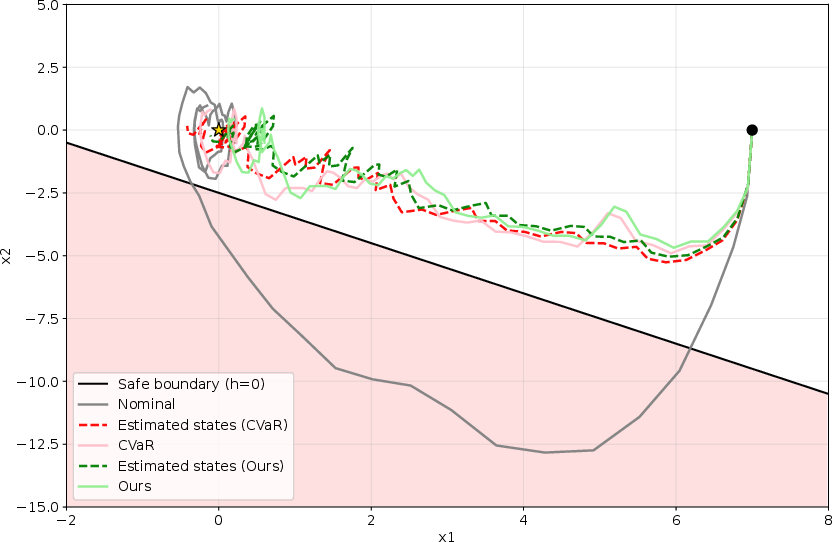
- The paper introduces an expectation-based output-feedback control barrier function framework using Kalman filtering and Jensen-type inequalities to manage chance constraints.
- It reformulates safety constraints into a convex optimization problem, enabling tractable real-time control with explicit finite-horizon probabilistic guarantees.
- Empirical results demonstrate significant computational gains and robust safety performance in sensor-limited, high-noise stochastic environments.
Output-Feedback Safe Control of Discrete-Time Stochastic Systems with Chance Constraints
Introduction and Motivation
This work addresses the safe control of discrete-time stochastic systems under incomplete state information, a scenario prevalent in practical cyber-physical applications where sensor noise and process disturbances are inevitable. Traditional CBF-based approaches either presume perfect state feedback or are constrained to deterministic settings. Existing stochastic CBF methods emphasize continuous-time systems and rarely address the output-feedback case in discrete time. The authors' main innovation is an output-feedback control barrier function framework leveraging expectation-based discrete-time conditions that accommodate the presence of estimation uncertainty. This is achieved by integrating Kalman filtering with a statistically rigorous deterministic reformulation of the CBF constraint using Jensen-type inequalities.
The paper considers discrete-time linear stochastic systems:
xk+1=Akxk+Bkuk+wk,yk=Ckxk+vk,
where wk and vk denote mutually independent, zero-mean Gaussian noise components. Safety is encoded via a function h(x)≥0, demarcating forward invariance of a designated safe set. The primary objective is to design an output-feedback controller that tracks a nominal policy while ensuring the probability of violating the safety constraint over a finite horizon T remains below a specified threshold ϵ.
The critical limitation with expectation-based stochastic CBFs is their intractability in presence of nonconvex domains or complex safety sets, especially when the true system state is unavailable for feedback. The authors address this by:
- Introducing an expectation-based CBF condition over the Kalman filter estimate, thus transferring safety properties from the unknown state to the estimated state;
- Employing a second-order Taylor expansion and a sharp Jensen-type inequality to deterministically upper bound the expectation in terms of mean and covariance statistics of the belief state;
- Reformulating the output-feedback CBF condition to a tractable optimization constraint, compatible with established online control and MPC solvers.
This machinery enables converting safety enforcement, previously reliant on sampling or min-max risk estimation (as required by CVaR-based methods such as [kishida2024risk]), into a deterministic program with explicit finite-horizon probabilistic guarantees.
Output-Feedback CBF Design and Theoretical Guarantees
The output-feedback CBF synthesis proceeds as follows:
- State Estimation: A time-varying Kalman filter generates the belief mean x^k and error covariance Pk. The key insight is that the estimation error covariance is completely characterized by Pk for linear-Gaussian models.
- Safety Function Transformation: The CBF is rendered over the estimated state, and the barrier function is offset by the worst-case error across the confidence set, ensuring nonnegativity of the true state implies that of the estimate with high probability.
- Jensen-Based Reformulation: For a twice continuously differentiable h with bounded Hessian, the following deterministic constraint is enforced:
wk0
where wk1 is a tunable slack capturing second-order uncertainty, parameterized in terms of the Kalman gain, noise covariances, and the Hessian bound.
- Probabilistic Guarantee: By leveraging wk2-step exit probability bounds and relating true and estimated safety functions, the closed-loop system is guaranteed to satisfy:
wk3
where wk4 is the probability that the estimate violates the offset safety condition and wk5 controls the confidence level over the estimation error.
This entire procedure is formalized as a convex optimization problem (for concave wk6), thus ensuring computational tractability. The framework generalizes beyond half-space and ellipsoidal sets to general nonlinear safety specifications, provided regularity and boundedness conditions on wk7.
Empirical Evaluation and Numerical Results
The framework's efficacy is assessed via simulation studies paralleling and extending [kishida2024risk]. Specifically:
Critically, the Jensen-based output-feedback CBF filter achieves the same empirical safety probability (wk9 under half-space; vk0 under the ellipsoidal constraint) as the Kalman-CVaR-CBF, while the average runtime decreases by up to two orders of magnitude in complex sets (e.g., ~46 ms for the proposed method vs. ~2800 ms for CVaR-CBF in ellipsoidal constraints).
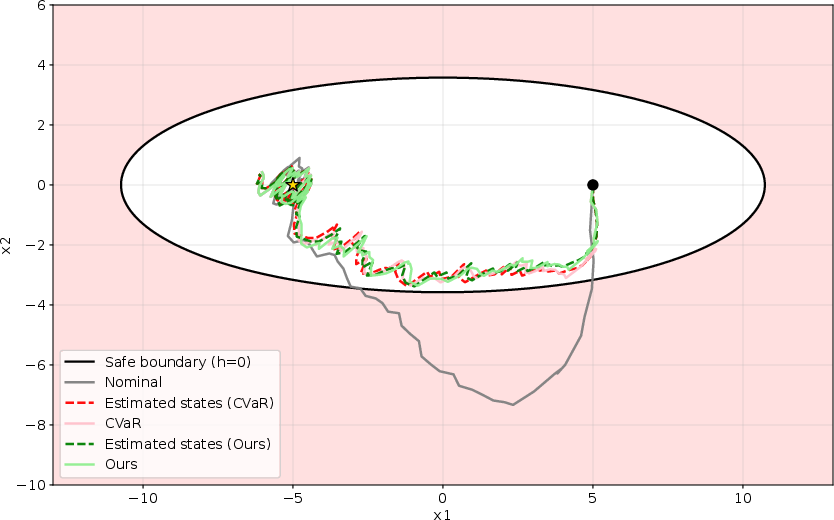
Figure 2: One realization of the closed-loop trajectories by the two methods under the ellipsoidal safety constraint. Both methods achieve the same empirical safety probability vk1.
Robustness across Monte Carlo trials and generalization to alternative initial conditions and nominal policies validate that theoretical probabilistic guarantees are not overly conservative and align tightly with measured performance.
Practical and Theoretical Implications
On the practical side, the presented methodology enables real-time enforcement of finite-horizon chance constraints in safety-critical stochastic control, directly applicable to robotics, autonomous systems, and digital control implementations. The ability to handle general nonlinear safety specifications (beyond ellipsoids or half-spaces) enhances applicability to complex, real-world safe set geometries. The deterministic reformulation also facilitates deployment on embedded platforms without the computation overhead of scenario-sampling or robust counterpart derivations.
Theoretically, the results extend the class of tractable stochastic CBF designs for discrete-time, output-feedback settings. Unlike previous approaches limited to state feedback or bounding convex sets, this framework systematically accounts for estimation error and statistical covariance propagation, providing explicit, computable finite-horizon guarantees. The connection to convex programming for concave vk2 broadens the spectrum of safety verifiable systems within existing optimization-based control toolchains.
Future Directions
Potential future avenues include:
- Extension to output-feedback stochastic CBF design within model predictive control architectures, leveraging longer receding horizons for reduced conservatism and anticipatory safety enforcement.
- Application to nonlinear systems via extended or unscented Kalman filtering, or leveraging distributional reinforcement learning for belief propagation.
- Integration with multi-agent safety assurance in the presence of networked measurement and correlated disturbances.
- Exploring less conservative higher-order truncations or non-Gaussian uncertainty propagation for robustness enhancement.
Conclusion
This paper contributes a principled, expectation-based output-feedback CBF framework for discrete-time stochastic systems, integrating Kalman filtering and Jensen-type deterministic reformulation for tractable enforcement of chance constraints. Empirical studies demonstrate reliability and strong computational advantages, particularly for complex safety sets, while providing less conservative and rigorously grounded theoretical safety guarantees for real-world, sensor-limited, stochastic control problems.