- The paper presents a scalable certificate approach to compute tight probabilistic bounds for safety specifications in stochastic systems.
- It employs an augmented state-space transformation to convert randomly evolving predicate sets into a deterministic framework using expectation-based barrier certificates.
- Monte Carlo simulations validate the analytical safety bounds, demonstrating the impact of stochastic uncertainties on system performance.
The study rigorously addresses the challenge of verifying temporal logic (LTL) specifications in stochastic dynamical systems where atomic predicates, such as initial and unsafe sets, evolve randomly due to environmental uncertainties or sensor perception errors. This results in the satisfaction of temporal specifications becoming a probabilistic event contingent both on the system trajectory and the stochastic evolution of predicate sets. Traditional dynamic programming approaches for probabilistic specification satisfaction exhibit scalability limitations as system and specification dimensions grow. The paper's main contribution is a scalable certificate-based method to compute tight probabilistic bounds for temporal specification satisfaction, especially in the safety domain.
Augmented System Representation
The authors introduce an augmented state-space encapsulating both system states and stochastic predicate parameters. This transformation enables mapping specifications with randomly evolving sets into deterministic specifications over an extended space, thus allowing the use of deterministic methods. The stochastic transition kernel on the augmented space is explicitly defined, and control policies are synthesized accordingly. The paper formalizes the stochastic evolution of parameters through probability kernels, permitting the modeling of perception uncertainty and sensor reliability as Markov processes.
Analytical Barrier Certificate Conditions
The focus is narrowed to discrete-time stochastic linear time-invariant (LTI) systems with linear feedback control. The augmented LTI system is analyzed, including random initial and unsafe set inflation via Gaussian noise. Modified control barrier certificate (CBC) conditions are developed for the augmented system. Unlike classical CBFs, these certificates incorporate expectations over the stochastic parameter space, giving rise to averaged CBC conditions:
- Initial Set Condition: Expected barrier function value over all stochastic initial set realizations is bounded above by η.
- Unsafe Set Condition: Expected barrier function value over all stochastic unsafe set realizations is bounded below by β.
- Supermartingale Condition: The expected value of the barrier function at the next step, conditioned on current state, does not exceed the current value plus c.
Explicit expressions for η, β, and c are derived in terms of system matrices, stochastic set distributions, and feedback gain (see Theorem 1). For ball-shaped sets and positive Gaussian uncertainties, closed-form CBC expressions are additionally provided.
Rigorous Safety Probability Bounds
Probabilistic safety guarantees are given via Markov-type inequalities leveraging CBC supermartingale properties. The principal result (Theorem 2) states that for a valid CBC and feedback control, the lower bound for the probability that the controlled system trajectory avoids the unsafe set under stochastic uncertainty is
psafe≥1−βη+cT,
where T is the time horizon. Significantly, this bound accounts for both system noise and random predicates, highlighting the nontrivial impact of stochastic specifications as opposed to deterministic formulations.
Simulation Validation and Numerical Results
Case studies are presented for a stochastic RLC circuit, where both initial and unsafe sets are randomly inflated at each timestep. Extensive Monte Carlo simulations corroborate the analytical bounds, revealing only moderate conservativeness relative to empirical safety probabilities.
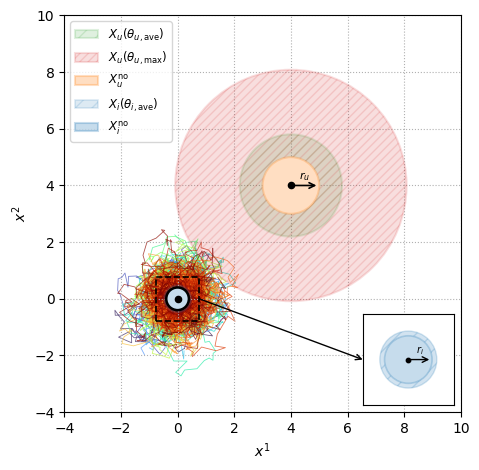
Figure 1: Monte Carlo simulation of 200 system trajectories under stochastic uncertainties, illustrating probabilistic evolution of the initial and unsafe sets and empirical safety probability.
The simulation explores a range of system uncertainties σw, initial set uncertainties σi, and unsafe set uncertainties β0. For each scenario, analytical lower bounds computed from the CBC framework are compared against extensive sampling-based safety estimates.
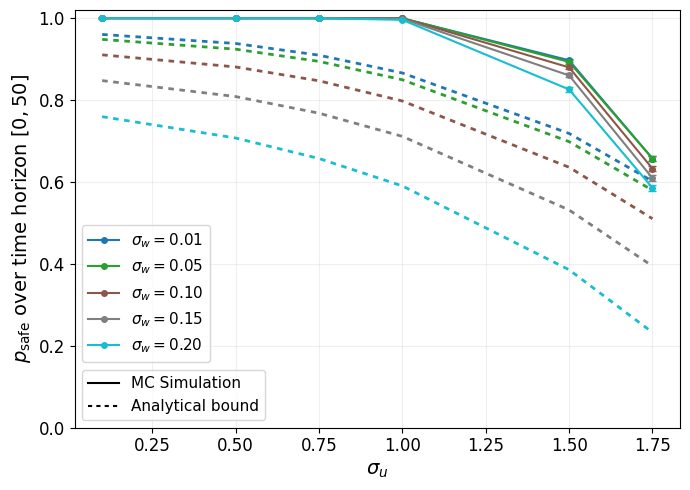
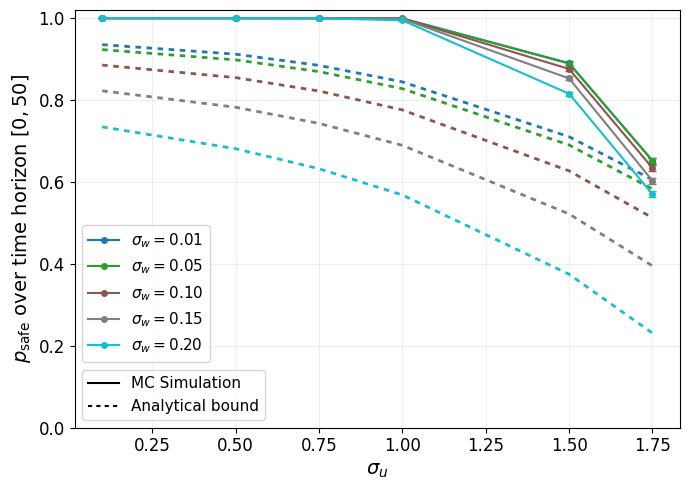
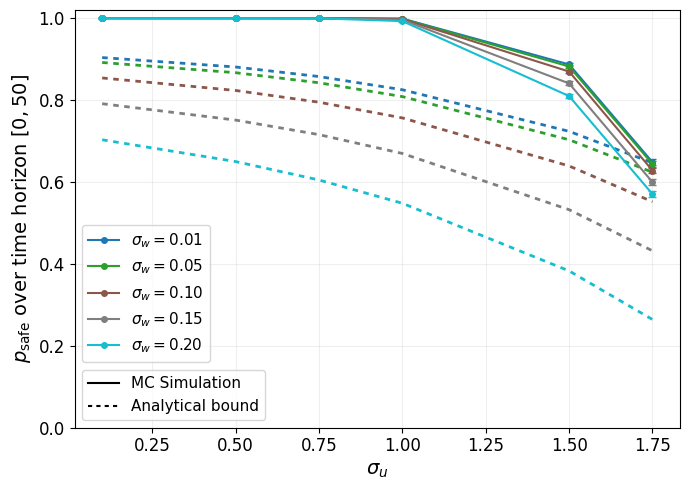
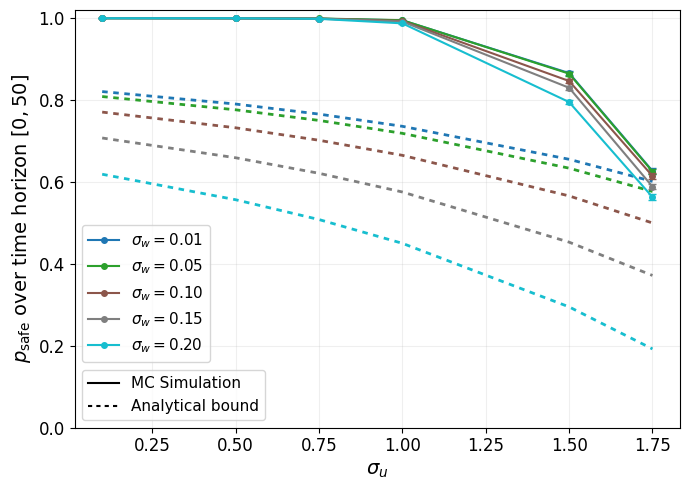
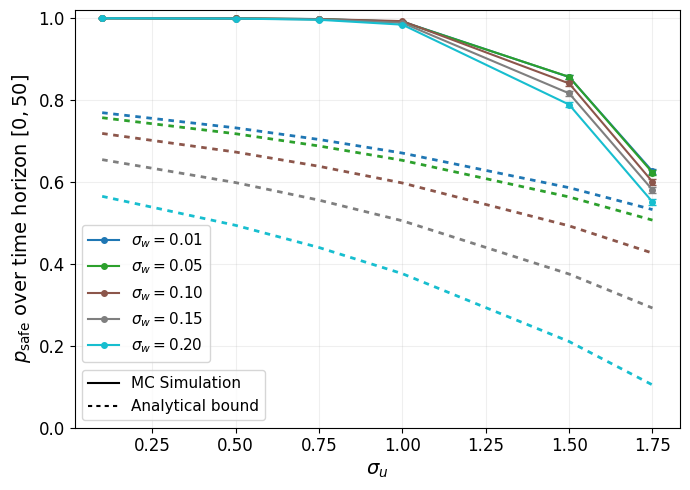
Figure 2: Analytical (dashed) versus Monte Carlo (solid) safety probability plots for various uncertainty levels in system noise and predicate set parameters.
An especially notable numerical result is the realization that specification uncertainty can reduce the empirical and analytical safety probability by considerable margins compared to the nominal (deterministic) problem. The explicit dependency on β1 in the CBC conditions provides flexibility to tune the certificate for various ranges of uncertainty, thereby managing the conservativeness of the safety bound.
Implications and Directions for Future Research
Practically, the framework enables scalable certification of probabilistic specification satisfaction without enumerating all possible predicate realizations or engaging in high-dimensional dynamic programming recursions. Theoretically, the approach connects stochastic analysis, formal methods, and barrier certificates, extending CBFs to inherently stochastic specifications. The explicit augmentation strategy and CBC design can be further developed for broader classes of temporal logic formulas and extended predicate uncertainty models (e.g., non-Gaussian, dependent processes).
Future research could explore: (1) extension to nonlinear systems, (2) learning-based estimation of parameter kernels in partially observed environments, (3) synthesis under richer temporal logic (beyond safety), and (4) adaptive certificate construction using data-driven or Bayesian approaches for unknown stochastic systems.
Conclusion
The paper presents a formal, tractable framework for the verification and synthesis of stochastic systems under uncertain temporal logic specifications by reformulating the problem on an augmented space and applying expectation-based barrier certificates. Analytical bounds derived for safety-type specifications are empirically validated and shown to be substantially less conservative than existing worst-case approaches. This work lays a foundation for scalable certification of perception-driven and environment-aware autonomous systems, bridging stochastic formal methods and control theory.