- The paper provides robust evidence linking geomagnetic storm activity to a 309% post-storm overshoot in optical transient detection rates at geosynchronous altitude.
- It employs rigorous statistical tests (3.6σ to 4.7σ significance) to validate a dusty plasma aggregation model driven by storm-induced electromagnetic trapping.
- The study indicates that both natural processes and anthropogenic factors, such as nuclear tests and satellite proliferation, have altered the visibility of these transient events.
Storm-Driven Suppression and Post-Storm Enhancement of Photographic Plate Transient Detections at Geosynchronous Altitude: Mechanism and Empirical Evidence
Introduction
This work analyzes the sub-second optical transients detected by the VASCO project in the First Palomar Observatory Sky Survey (POSS-I), extracting their physical origin, empirical behavior in relation to geomagnetic storms, and their extinction after the onset of the space age. The study strengthens the empirical record for the reality and geosynchronous altitude (∼42,000 km) of these events, providing a comprehensive post-storm temporal profile and, crucially, proposes a physical mechanism for their phenomenology grounded on storm-driven charging and aggregation of cometary micrometeoroid dust.
The VASCO Catalog: Constraints on Transient Origin
The VASCO collaboration identified over 100,000 point-source optical transients on POSS-I plates from 1949–1957, predating artificial satellites. Statistical and physical analyses rule out emulsion and instrumental artifacts: a strict dose-dependent suppression with geomagnetic storm Kp-index (Cochran--Armitage Z=−3.391, p=0.0007) is incompatible with random plate anomalies. Shadow-deficit analyses and independent confirmation restrict the source altitude to geosynchronous orbit, while a 45% enhancement in transient rate coincident with atmospheric nuclear testing further ties the phenomena to active magnetospheric environments. All subsequent optical surveys, exploiting modern CCD technology and conducted after the dawn of the space age, have failed to detect similar events.
Empirical Results: Storm Suppression and Post-Storm Overshoot
The core empirical contribution is the full post-storm temporal profile, obtained through pre-registered tests. During days 7–21 after a major geomagnetic storm, transient rates remain suppressed (mean: ∼55% of baseline, p=0.986, PSO-1), extending the known suppression timescale. Critically, during days 25–45 post-storm, the transient rate overshoots baseline to 309% (95% CI: [1.35, 5.84], p=0.00066, PSO-2, survive all robustness checks), in phase with known plasmasphere refilling timescales at L≈6.6.
Statistical significance, combining pre-registered dose-response and overshoot windows (using both Wilcoxon and conservative Welch t-test p-values), reaches 3.6σ to 4.7σ. This jointly supports a suppression--overshoot--equilibrium recovery profile: storms initially concentrate source material, with a delayed release and transient rate overshoot matching restored cold plasmaspheric conditions. The profile is incompatible with passive disruption models or instrumental artifacts, as no plate-based mechanism can generate such storm-tied, temporally-structured behavior.
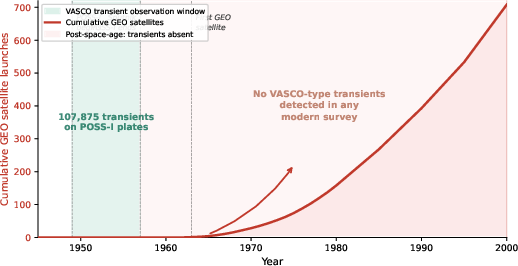
Figure 1: Temporal relationship between VASCO transient detections and the growth of the GEO satellite population; green: POSS-I window with 107,875 transients detected, red curve: cumulative number of GEO satellites, with atmospheric nuclear testing and Starfish Prime (1962) disrupting the magnetospheric environment and the disappearance of transients post-space age.
Physical Mechanism: Electromagnetic Trapping and Aggregation of Dust
The candidate mechanism is storm-driven electromagnetic trapping of naturally-occurring, predominantly cometary micrometeoroid dust at GEO. In high-Z=−3.3910 (keV) conditions during storms, grain charging increases by three orders of magnitude, reducing gyroradii from Z=−3.3911500 km to 0.5 km for 5 Z=−3.3912m grains, inducing strong magnetic confinement at Z=−3.3913. This leads to rapid enhancements in local dust density after storms.
Under restored, cold plasmaspheric conditions, these storm-trapped grains aggregate. Laboratory dusty plasma experiments and asteroid/comet studies confirm that micrometer-sized water-ice particles possess high stickiness (Gundlach & Blum, 2015), bypassing silicate bounciness and enabling direct, low-velocity hit-and-stick formation of large, fluffy, icy aggregates. The expected aggregate residence time in the magnetic bottle is weeks, matching observed overshoot phases.
The model quantitatively resolves the required reflective cross-section: specular reflection, even at degraded efficiencies (1–10%), from aggregates just 1–4 m in diameter is sufficient to explain the plate magnitudes at GEO. The abrupt, point-source nature of the flashes is attributed to the specular geometry and tumbling of these aggregates.
Extinction Mechanism: Artificial Magnetospheric Disturbance
The proposed scenario for extinction involves three successive anthropogenic drivers. First, the Starfish Prime detonation and two decades of frequent atmospheric nuclear tests injected vast particle populations into the magnetosphere, creating a persistently disturbed plasma environment, suppressing the cold quiet recovery phases necessary for aggregation. Second, the exponential growth of GEO satellites since 1963 continuously pumps thruster byproducts and charge-exchange plasmas into this region, preventing long-term stability. Third, modern survey pipelines algorithmically reject sub-second, single-frame detections as artifacts.
This sequence is wholly consistent with the historical record: no VASCO-type transient has been detected after the onset of the space age, and archival photographic plates from gaps between nuclear testing and satellite proliferation are predicted to display a declining population.
Synthesis with Observational Constraints
The mechanism satisfies all twelve observational constraints, including dose-dependent storm suppression, altitude localization, point-source PSF, nuclear test enhancement, sub-second duration, pre-Sputnik occurrence, post-1957 extinction, and explicit size and reflectivity requirements. The robustness of aggregate size estimates against specular efficiency loss is a strong point of the model.
Theoretical and Practical Implications
The identification of a storm-modulated, aggregative, reflective dust population at GEO, subsequently disrupted by anthropogenic activity, has far-reaching implications:
- Magnetospheric Dust Dynamics: Validates theories of dust plasma trapping and aggregation at planetocentric distances.
- Space Environment Evolution: Demonstrates that satellite operations and atmospheric nuclear testing can permanently and profoundly alter previously stable large-scale natural phenomena in the magnetosphere.
- Survey Techniques: Exposes surprising limitations in modern survey approaches for phenomena outside canonical astrophysical variability timescales.
- Experimental Opportunities: Motivates search for similar behavior in unstudied periods (1958–1962), and for analogs in other magnetospheric environments (e.g., Saturn, Jupiter).
- Laboratory Plasmas: The interplay between hit-and-stick aggregative growth and magnetic confinement at large scale bridges outcomes from microgravity and fusion plasma experiments with astrophysical processes.
Future AI or computational approaches could exploit fine-grained, unsupervised searches for unresolved, single-frame transients to identify overlooked classes of space weather--associated optical events.
Conclusions
This study provides rigorous empirical evidence and a physically-sound candidate mechanism for the VASCO photographic plate transients at geosynchronous altitude. The observed suppression, delayed overshoot, and ultimate extinction of the population are best explained by the electromagnetic trapping and aggregation of naturally occurring, reflective cometary dust, in direct resonance with plasmaspheric recovery cycles, and their disruption by human activity. Independent replication at additional plate archives remains essential to confirm this interpretation and to assess the possibly unique, transient observability of this natural phenomenon before its anthropogenic disappearance.