Searching for Fast Astronomical Transients in Archival Photographic Plates
Abstract: Fast astronomical transients were observed by the VASCO Project (Villarroel et al 2020) in photographic sky surveys conducted in the 1950s. Those searches analyzed the Palomar Observatory Sky Survey (POSS-I and POSS-II) digitized plates. In this article, we present a preliminary report on a similar but independent search using archival plates taken at the Hamburg Observatory with the Großer Schmidtspiegel 1.2-m Schmidt camera, also from the mid-1950s. These plates were digitized by the APPLAUSE Archive, which provides both images and tables of detected objects. By analyzing pairs of plates taken in rapid sequence (about 30 minutes apart) of the same sky regions, we find evidence of transients similar to those previously reported by the VASCO Project for POSS plates. While the analysis is ongoing, one notable result is that our findings independently confirm that these transients exhibit systematically narrow full width at half maximum (FWHM) compared to stellar point spread functions. This provides further support for their interpretation as sub-second optical flashes, consistent with reflections from flat, rotating objects in orbit around Earth.
Paper Prompts
Sign up for free to create and run prompts on this paper using GPT-5.
Top Community Prompts
Explain it Like I'm 14
Overview
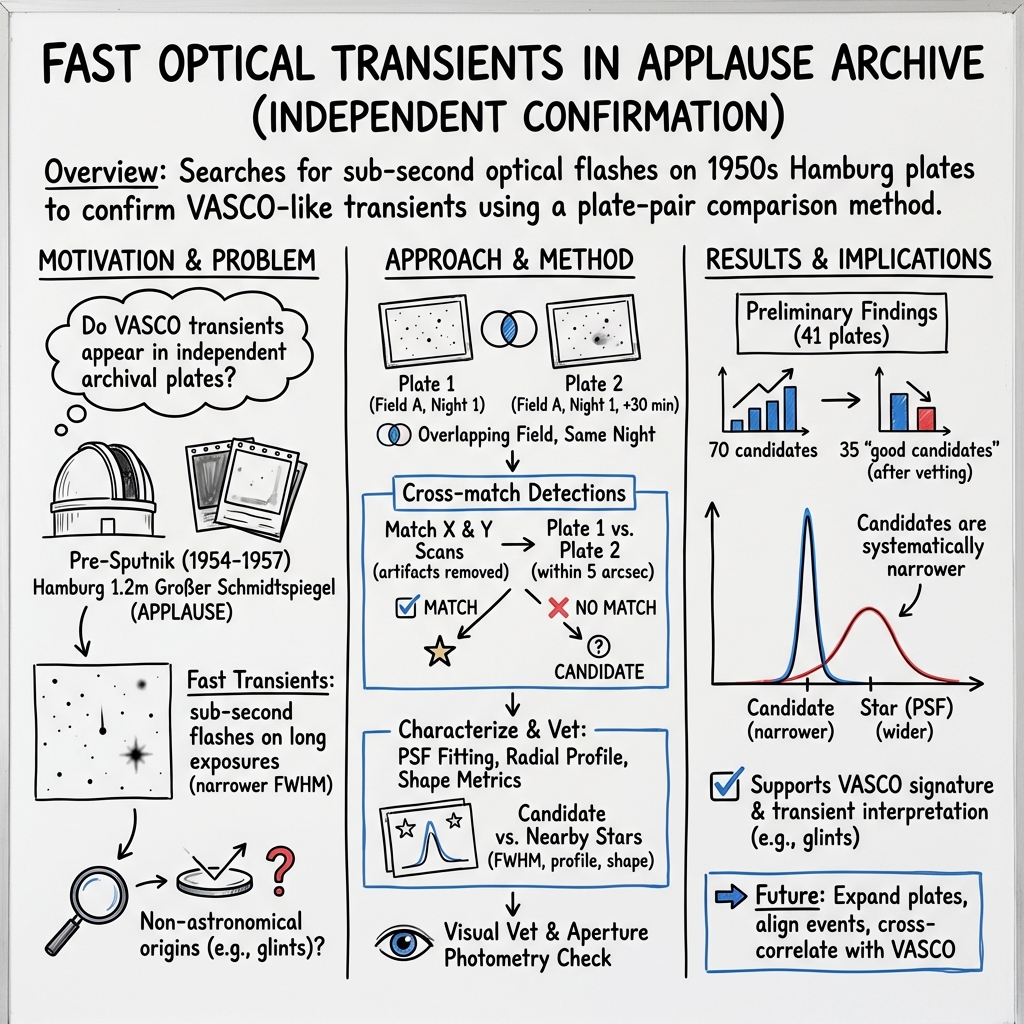
This paper is about hunting for very quick, blink-and-you-miss-it flashes of light in the night sky, seen on old photographic plates (glass “photos” of the sky from the 1950s). A previous project, VASCO, found such fast “transients” on plates from the Palomar Observatory. This new study looks at a different set of plates from the Hamburg Observatory to see if similar flashes show up there too. Finding the same kind of flashes in an independent archive would make the earlier results more trustworthy.
Key questions the study asks
- Do old sky photos from Hamburg (taken before the first satellite was launched in 1957) show the same kind of fast, one-off flashes that VASCO reported?
- Do these flashes have a “sharper” look than normal stars on the plates (a clue that they were extremely short, sub-second bursts of light)?
- Can we confirm these events using only the plates themselves (without relying on modern star catalogs), and carefully filter out dust, scratches, and scanning artifacts?
How they searched (in simple terms)
Think of taking two pictures of the same part of the sky, about 30 minutes apart. If you spot a bright dot in the first picture that isn’t in the second, that dot might be a fast transient—something that flared up and then vanished.
Here’s how the team did that with old plates:
- They used digitized copies of 1950s plates from the APPLAUSE archive, focusing on a 1.2-meter Schmidt camera at Hamburg Observatory (similar to the Palomar telescope used by VASCO).
- They picked sets of plates that:
- Covered the same sky area,
- Were taken the same night,
- Were about half an hour apart,
- And were from before October 1957 (pre-satellite era).
- Each plate had two scans (“X” and “Y”) done at right angles. Comparing X vs. Y helps spot and remove scanning junk like dust or smudges—if something shows up in one scan but not the other, it’s probably not a real sky object.
- They compared the lists of detected dots (stars and other objects) from Plate A to Plate B. Anything on A with no match on B (or vice versa) is a candidate transient.
- To tell real flashes from fakes, they measured how “sharp” each dot looks. Two helpful ideas:
- Point spread function (PSF): how a single point of light (like a star) spreads out on a photo, making a little fuzzy blob.
- FWHM (Full Width at Half Maximum): a simple “sharpness” measure—imagine the dot as a hill; FWHM is how wide the hill is halfway up. Smaller FWHM = sharper looking.
- They compared each candidate’s sharpness and brightness profile to nearby normal stars of similar brightness, then visually checked the most promising ones.
Why sharpness matters: stars on long-exposure plates get a bit smeared by the atmosphere and tiny tracking errors, so they look wider. A very fast flash (less than a second) won’t smear as much, so it looks sharper and more compact.
What they found and why it matters
- From 41 plates, the team found 70 candidates. After careful checking, 35 looked like good candidates for real fast transients.
- A key pattern: these candidate flashes generally look sharper (narrower FWHM) than normal stars on the same plates. That matches what VASCO reported.
- This “too sharp for a normal star trail” look is exactly what you’d expect for ultra-quick flashes caught during long exposures.
- The team also learned that FWHM by itself isn’t perfect—sharpness can vary across the plate and depends on how you model the dot. Comparing the detailed brightness profile (how light falls off from the center) to nearby stars is often more reliable.
Why this is important: seeing the same signatures on a different telescope’s plates, analyzed with a different method, is strong independent support that these fast transients are real features recorded in the 1950s data.
What it could mean and what’s next
One idea—suggested by earlier work—is that some of these flashes might be sunlight glinting off flat, rotating objects passing above Earth (like mirrors). That’s intriguing because these plates were taken before the first human-made satellite (Sputnik) in 1957. If true, it raises big questions and connects to SETI (the search for extraterrestrial intelligence). To be clear, the paper doesn’t claim a definite origin—it focuses on carefully confirming that the flashes are real and have the expected “sharp” look of sub-second events.
What’s next:
- Analyze more plate pairs (including ones with only two plates and those taken on different nights).
- Build a larger database of events and look for patterns—like alignments or repeated directions.
- Compare the Hamburg results directly with VASCO’s Palomar events to see connections.
In short: This study independently finds fast, sharp-looking flashes on 1950s sky photos, reinforcing earlier discoveries and motivating a deeper investigation into what could be causing them.
Knowledge Gaps
Knowledge gaps, limitations, and open questions
The paper leaves several concrete issues unresolved that future work could address to strengthen the methodology and interpretation of fast transient candidates on archival plates:
- Sampling limitations and selection bias:
- Only 41 plates (yielding 35 “good candidates”) from a single telescope have been analyzed; no rate estimates (per area–time) are reported, preventing comparison with VASCO or expected backgrounds.
- Plate pairs are restricted largely to same-night, overlapping fields with ≥50% overlap, biasing the sample and excluding many usable plates; the impact of this selection on detectability and inferred rates is unquantified.
- No cross-instrument analysis yet within APPLAUSE or other archives to test generality beyond the Großer Schmidtspiegel.
- Incomplete plate metadata usage:
- Exposure start/stop times, durations, filters, emulsions, sky conditions, and tracking modes are not incorporated, inhibiting temporal modeling, photometric calibration, and PSF/seeing normalization across plates.
- The “~30 minutes” separation is not quantified with uncertainties; exact mid-exposure times are needed for physical interpretation and solar-system object screening.
- Astrometric registration and matching:
- A fixed 5″ cross-match radius is used without local re-registration between plate pairs; unmodeled field distortions and edge effects can inflate mismatches. A robust, locally refined plate-to-plate WCS solution is not applied.
- No assessment of how match radius and astrometric uncertainties affect false-mismatch rates, especially near plate edges or in crowded regions.
- Photometric and PSF modeling:
- Gaussian fits are known to bias FWHM on photographic plates and to vary with radius; yet the key result hinges on “systematically narrow FWHM.” A position- and brightness-normalized PSF model (e.g., empirical PSF, PSFEx) is not used to quantify this effect.
- No control sample with local PSF normalization (e.g., size ratio to neighbor stars matched in magnitude and radius) is provided to statistically validate that candidates are genuinely sharper than stars after correcting for known systematics.
- No injection–recovery tests (simulated sub-second point flashes with realistic plate response) to measure completeness and the accuracy of size/shape recovery under varying seeing, focus, and scanning conditions.
- Artifact and background discrimination:
- Cosmic-ray hits and emulsion defects (present on the physical plate) would appear in both X and Y scans and thus survive the X–Y scan artifact filter; a dedicated cosmic-ray/defect classifier (e.g., multi-scale morphology, grain structure, edge statistics) is not implemented or validated.
- Moving solar-system objects (asteroids, NEOs), meteors, aircraft/baloon lights, and high-altitude rocket tests (pre-Sputnik) are not systematically excluded. No cross-matching with ephemerides, no trail/centroid-shift tests, and no modeling of expected motion between plates are reported.
- Scanner-induced systematics beyond dust (e.g., directional PSF/blur, stitching artifacts) are not quantified; the impact of X vs. Y scan differences on morphology and photometry remains uncharacterized.
- Pipeline robustness and reproducibility:
- Manual vetting plays a large role; criteria and inter-annotator agreement are not quantified. No blinded evaluation or pre-registered selection thresholds to limit confirmation bias.
- Parameter fine-tuning “per plate/sequence” introduces variability; sensitivity of results to SExtractor thresholds, flags, and filtering parameters is not systematically explored.
- A false-positive rate, false-discovery rate, and end-to-end uncertainty budget for candidate selection are not reported.
- Symmetry and completeness of transient search:
- The search emphasizes “vanishing” sources from plate 1 to plate 2; it is unclear if symmetric “appearing” candidates (present only on plate 2) are equally analyzed with identical thresholds and artifact controls.
- Candidates near bright stars, plate edges, or regions with high vignetting/distortion are not separately analyzed to quantify environmental biases.
- Rate and population modeling:
- No empirical surface density or occurrence rate (with uncertainty) of candidates is provided, normalized by exposure time and area.
- No forward model of expected sub-second glint rates given solar phase, sky position, and plausible orbital populations (natural or artificial), making it impossible to test whether observed counts are consistent with hypothesized glints.
- No comparison against null models (e.g., cosmic-ray/defect rates per plate, asteroid densities at given ecliptic latitudes) to evaluate significance.
- Cross-validation and external corroboration:
- No cross-correlation yet with VASCO transient positions/times, or with other plate archives for recurrence, alignments, or independent detections of the same events.
- The 35 “good candidates” are not presented with full cutouts, metadata, and machine-readable parameters for community vetting and replication.
- Shape and profile diagnostics:
- Shape parameters are “still being worked out”; no defined, validated set of morphology metrics (e.g., second moments, kurtosis, concentration, asymmetry) with thresholds and error bars.
- Radial-profile comparisons are used qualitatively; a quantitative classifier (e.g., supervised model trained on known stars, injected flashes, and known artifacts) is not developed.
- Systematic FWHM dependence and corrections:
- FWHM variation with radius and local focus is acknowledged but not modeled or corrected per plate when making claims about “systematically narrow” events.
- No plate-by-plate PSF maps or spatially varying PSF models are constructed to standardize morphology measurements across the field.
- Data quality controls:
- SExtractor “misses” on the second plate are handled with aperture photometry locally, but there is no global quantification of catalog completeness or bias as a function of magnitude and crowding.
- The impact of field crowding, deblending errors, and bright-star halos on mismatch rates and false transients is not assessed.
- Interpretation and alternative hypotheses:
- The sub-second glint interpretation is highlighted, but alternative explanations (e.g., cosmic rays, meteors without visible trails, emulsion flaws) are not quantitatively tested against the data with likelihood or Bayesian model comparison.
- No physical modeling connects measured sizes/fluxes to expected plate responses for sub-second flashes (e.g., exposure-time convolution, reciprocity failure, emulsion nonlinearity), leaving the “sharpness” interpretation qualitative.
- Future database and alignment studies:
- The plan to search for alignments among events is stated, but methodological details (alignment metrics, chance-alignment probabilities, control experiments) are not specified.
- No strategy is described for harmonizing astrometry and photometry across plates, instruments, and epochs when building the combined database.
Addressing the above items with quantitative tests (e.g., injection–recovery, local WCS refinement, PSF standardization, ephemeris cross-checks, and null-model comparisons) would enable rigorous rate estimates, artifact rejection, and a defensible interpretation of the candidates as sub-second glints or alternative phenomena.
Practical Applications
Immediate Applications
The following applications can be deployed now using the paper’s methods, tools, and results, with minimal additional research or infrastructure.
- Plate-to-plate transient searches across other archives
- Description: Apply the presented pairwise cross-matching pipeline (no external catalogs required) to other APPLAUSE collections and to global photographic plate archives to rapidly surface fast optical transients.
- Sector(s): academia, software (data pipelines), cultural heritage
- Tools/products/workflows: Jupyter-based “plateanalysis” notebooks; SQL-driven master table extraction; two-plate minimum workflow; batch pipeline on laptops or modest servers
- Assumptions/dependencies: Access to digitized plates with astrometric solutions and SExtractor tables; sufficient overlap and short time separation between exposures
- Dual-scan artifact rejection as a digitization quality-control standard
- Description: Adopt “X/Y perpendicular scan mismatch” filtering to suppress scanner-bed dust, rotation-induced debris, and scan-specific artifacts in plate digitization programs and downstream analyses.
- Sector(s): cultural heritage, astronomy archives, software
- Tools/products/workflows: Dual-orientation scans; automated cross-scan mismatch filters; plug-in for digitization QA
- Assumptions/dependencies: Availability of two per-plate scans at 90°; consistent SExtractor catalogs for both scans
- Morphology-based filtering of sub-second optical glints in modern surveys
- Description: Integrate narrow-FWHM and radial-profile mismatch criteria into transient-vetting pipelines (e.g., ZTF, LSST alert brokers) to flag probable satellite/glint-like events and reduce false positives.
- Sector(s): astronomy/software (alert brokerage), SSA-adjacent analytics
- Tools/products/workflows: “GlintGuard” plugin for alert brokers leveraging FWHM ratios and local PSF profile comparisons
- Assumptions/dependencies: Calibration of criteria for CCD/CMOS PSFs (versus plates); training/validation on modern imaging
- Classroom-ready, low-cost data-analysis labs
- Description: Use the open notebooks to teach astrometry, cross-matching, PSF modeling, and vectorized analysis in undergraduate/graduate data-science and astronomy courses.
- Sector(s): education
- Tools/products/workflows: Turn-key Jupyter notebooks; curated sample plate pairs; rubric for student-led vetting
- Assumptions/dependencies: Public datasets; basic Python/Astropy/SExtractor familiarity
- Citizen-science vetting of transient candidates
- Description: Crowdsource human-in-the-loop review of candidates using the pipeline’s multi-panel visual diagnostics (thumbnail, neighbor profiles, shape metrics).
- Sector(s): education, public engagement, academia
- Tools/products/workflows: Zooniverse-style portal seeded with pipeline outputs; community guidelines for vetting
- Assumptions/dependencies: Hosting platform; moderation and gold-standard labels for quality control
- Benchmark datasets for glint-like event classification
- Description: Publish curated sets of “good candidates” with morphology metrics (FWHM, profiles, shapes) as benchmarks for algorithm development in transient filtering and SSA-adjacent tasks.
- Sector(s): academia, software, aerospace/SSA analytics
- Tools/products/workflows: Open benchmark with labels and metrics; baseline scripts for evaluation
- Assumptions/dependencies: Licensing/permissions from archives; minimal consensus labeling
- Catalog-free cross-matching for poorly cataloged fields
- Description: Reuse the “paired-exposure only” approach in domains lacking reliable reference catalogs (e.g., crowded fields, archival solar-system imaging).
- Sector(s): academia, software
- Tools/products/workflows: Drop-in module for pairwise-only cross-match with positional tolerances and local PSF checks
- Assumptions/dependencies: Availability of at least two overlapping exposures with consistent astrometry
- Operational scanning guidance for archives
- Description: Recommend routine acquisition of perpendicular scans and publish scan-aligned source catalogs to enable automated artifact suppression for future digitizations.
- Sector(s): cultural heritage, policy (archive standards)
- Tools/products/workflows: Digitization SOPs; metadata schema for scan orientation and catalog provenance
- Assumptions/dependencies: Minor throughput trade-offs for double scanning; archive buy-in
- Reproducible anomaly-analysis standards for SETI-adjacent studies
- Description: Adopt the paper’s open, notebook-driven workflow as a reproducibility template when publishing anomalous transient claims.
- Sector(s): academia, policy (research norms), SETI
- Tools/products/workflows: Code+data release checklist; Docker/Conda environments; provenance logging
- Assumptions/dependencies: Community/journal support for reproducibility requirements
Long-Term Applications
These applications may require further research, scaling, integration with additional data sources, or development of new tools/sensors.
- Global database of fast optical transients from historical plates
- Description: Aggregate candidates from APPLAUSE and other archives into a single, queryable repository for statistical studies (e.g., alignments, recurrence, sky distribution).
- Sector(s): academia, SETI, policy (data infrastructure)
- Tools/products/workflows: Centralized catalog with image cutouts, morphology features, and provenance; API access
- Assumptions/dependencies: Large-scale digitization; standardized metadata; sustained funding and curation
- ML classifiers trained on morphology and local-PSF features
- Description: Train models on radial-profile contrasts, FWHM ratios, and shape metrics to automate separation of sub-second glints from astrophysical transients and artifacts in modern surveys.
- Sector(s): software, astronomy
- Tools/products/workflows: Feature-engineering library; labeled training sets; model cards and calibration reports
- Assumptions/dependencies: Robust ground truth; domain adaptation from plates to CCD/CMOS data
- High-speed optical transient monitoring networks
- Description: Deploy dedicated instruments (high frame-rate, wide-field) to capture sub-second flashes and validate morphology-based interpretations in real time.
- Sector(s): aerospace/SSA, academia
- Tools/products/workflows: Instrumentation specs; real-time detection and classification pipeline; alert dissemination
- Assumptions/dependencies: Funding for sensors; sky coverage; integration with satellite ephemerides; weather/seeing constraints
- SSA-informed reflectivity and glint-mitigation policy
- Description: Use glint statistics and morphology models to guide standards for spacecraft surface reflectivity, panel orientation, and operational modes that minimize optical interference.
- Sector(s): aerospace, policy, astronomy
- Tools/products/workflows: “Glint probability” models; design guidelines; compliance metrics
- Assumptions/dependencies: Transferability from plate-era morphology to modern satellites; stakeholder coordination (industry-agency-astronomy)
- Cross-archive alignment and trajectory inference
- Description: If multiple events align in sky coordinates across plates/times, develop methods to infer plausible trajectories or constrain object populations (natural or artificial).
- Sector(s): academia, SSA research
- Tools/products/workflows: Trajectory solver using sparse, historical constraints; Bayesian inference frameworks
- Assumptions/dependencies: Sufficient multi-epoch coverage; accurate timing; robust astrometric solutions
- Standards and funding for legacy-plate preservation and open analytics
- Description: Establish policy to prioritize digitization with dual-scan QA, open catalogs, and compute grants for archival mining.
- Sector(s): policy, cultural heritage, academia
- Tools/products/workflows: Best-practice documents; grant programs; interoperable data schemas
- Assumptions/dependencies: Institutional commitment; long-term stewardship plans
- Cross-domain digitization QA in medical and industrial imaging
- Description: Adapt perpendicular-scan mismatch logic to detect scan-induced artifacts in film radiography, pathology slide scanning, and industrial NDT film digitization.
- Sector(s): healthcare, manufacturing
- Tools/products/workflows: Dual-orientation scan protocols; artifact-detection modules integrated into PACS/LIS/NDT systems
- Assumptions/dependencies: Workflow changes acceptable; validation on domain-specific image statistics
- Commercial “Archive Analytics” and consulting services
- Description: Offer packaging of the pipeline (plus ML extensions) as a service to museums, observatories, and agencies to extract events and clean artifacts from digitized collections.
- Sector(s): software/services, cultural heritage
- Tools/products/workflows: Cloud-hosted processing; dashboard for event review; API for results
- Assumptions/dependencies: Market demand; data-sharing agreements; privacy/licensing compliance
- Physical modeling and simulation of sub-second optical glints
- Description: Build simulators linking object geometry, rotation, surface BRDF, and observing conditions to expected FWHM and radial profiles; validate against historical and modern detections.
- Sector(s): academia, aerospace/SSA
- Tools/products/workflows: “Glint-simulator” library; parameter inference tools from observed profiles
- Assumptions/dependencies: Accurate atmospheric/seeing models; ground-truth calibration datasets
- Evidence standards for ambiguous anomalies (SETI/UAP-adjacent)
- Description: Develop community guidelines for multi-instrument corroboration, open workflows, and statistical thresholds before policy-relevant claims are made about non-conventional sources.
- Sector(s): policy, academia
- Tools/products/workflows: Consensus white papers; preregistered analysis plans; independent replication procedures
- Assumptions/dependencies: Cross-agency collaboration; careful communication to avoid over-interpretation
Notes on key assumptions and dependencies shared by multiple applications
- The “narrow FWHM + distinct radial profile” signature is assumed to be a reliable marker of sub-second flashes on long exposures; further validation on diverse datasets and modern sensors is required.
- Pre-1957 “glint” interpretations are hypothesis-generating and must be weighed against alternative explanations (plate/telescope systematics, atmospheric phenomena); reproducible, cross-archive corroboration is essential.
- Scaling beyond plate data requires domain adaptation (plates vs CCD/CMOS PSFs, exposure regimes, atmospheric differences).
- Many policy-facing applications depend on open data, open methods, and cross-stakeholder coordination (archives, observatories, satellite operators, funding agencies).
Glossary
- APPLAUSE: A European archive that digitizes and catalogs historical astronomical photographic plates and extracted sources. "The APPLAUSE archive contains about 98,000 scanned plates,"
- aperture photometry: A photometric technique that sums light within a defined circular aperture to estimate an object’s brightness. "an additional filter based on aperture photometry is used to reject these (few) false positives."
- arcminute (arcmin): An angular measurement equal to 1/60 of a degree in the sky. "( arcmin)"
- arcsecond (arcsec): An angular measurement equal to 1/3600 of a degree in the sky. "looking for matches in celestial coordinates (within 5 arcsec)."
- astrometric solution: The calibration that maps image coordinates to celestial coordinates, enabling accurate sky positions. "astrometric solutions are mandatory for the plate scans to be usable in any form."
- Astropy: A community-developed Python library for astronomy, supporting coordinates, units, and data analysis. "astropy \cite{2013A&A...558A..33A,2018AJ...156..123A,2022ApJ...935..167A}"
- celestial coordinates: A coordinate system (e.g., RA/Dec) used to specify positions of objects on the sky. "looking for matches in celestial coordinates (within 5 arcsec)."
- cross-match: The process of identifying the same astronomical sources across different catalogs or images based on positional agreement. "cross-match the first plate's source table, with the second plate's source table."
- field of view (FOV): The angular extent of the sky captured in a single observation or image. "We work only with plate pairs that share a common FOV on the sky,"
- full width at half maximum (FWHM): A measure of image or profile width at half its peak intensity, often used to characterize image sharpness. "narrow full width at half maximum (FWHM) compared to stellar point spread functions."
- Gaussian fitting: Modeling an object’s intensity profile with a Gaussian function to extract parameters like FWHM. "the FWHM by itself, as derived by Gaussian fitting, is not a reliable discriminator against artifacts:"
- glint (optical): A brief, specular flash of reflected sunlight from a flat rotating object, such as space debris. "sub-second glints from reflected Sun light"
- isophote: A contour of constant brightness in an image, used to analyze object shapes and profiles. "for a fixed isophote,"
- limiting magnitude: The faintest apparent magnitude detectable in an image or survey under given conditions. "resolutions, and limiting magnitudes."
- magnitude (mag): A logarithmic measure of an astronomical object’s brightness; lower numbers indicate brighter objects. "within 0.1 mag of its peak flux."
- Palomar Observatory Sky Survey (POSS): A mid-20th-century photographic survey of the sky using the Palomar telescopes, with phases POSS-I and POSS-II. "POSS-I and POSS-II"
- photographic plate: A glass plate coated with a photosensitive emulsion historically used to record astronomical images. "archival photographic plates taken decades ago."
- plate scale: The conversion factor between angular sky distance and image distance, often in arcsec per pixel or mm. "plate scales, plate sizes, resolutions, and limiting magnitudes."
- point spread function (PSF): The response of an imaging system to a point source; characterizes image blur. "stellar point spread functions."
- radial profile: The brightness distribution of an object as a function of radius from its center, used to compare shapes and sharpness. "computes radial profiles for each non-matched object,"
- Schmidt camera: A wide-field telescope design using a spherical primary mirror and corrector plate, ideal for sky surveys. "GroÃer Schmidtspiegel 1.2-m Schmidt camera"
- seeing: Atmospheric turbulence-induced blurring of astronomical images. "stars are significantly blurred by seeing and tracking errors."
- SETI: The Search for Extraterrestrial Intelligence; scientific efforts to detect signs of intelligent life beyond Earth. "in the context of SETI."
- SExtractor: Software for automatic detection and photometric measurement of sources in astronomical images. "tables of detected objects in each plate, obtained by running the SExtractor software"
- sub-second optical flash: A very short-duration burst of optical light, often sharper than stellar images on long exposures. "sub-second optical flashes"
- transient (astronomy): A short-lived astronomical event that appears and disappears on timescales from milliseconds to days. "Fast astronomical transients were observed"
- VASCO Project: The “Vanishing and Appearing Sources during a Century of Observations” project investigating unusual transient phenomena in archival surveys. "the VASCO Project"
- X and Y scans: Two digitizations of the same photographic plate taken after rotating the plate by 90°, used to distinguish real sources from scan artifacts. "rotating the plate by 90 deg over the scanner bed in between scans (generating X and Y scans)."
Collections
Sign up for free to add this paper to one or more collections.