- The paper introduces a novel framework that converts natural language instructions into executable, reproducible, and scalable task families within a structured physical domain.
- The methodology leverages a modular pipeline with LLM agents for language parsing, validation, repair, and context-aware task evolution to ensure logical and physical feasibility.
- Empirical results demonstrate high usability and significant performance differences, revealing systematic generalization failures under even mild task variations.
RoboPlayground: Framework and Implications for Democratized, Structured Robotic Evaluation
Motivation and Context
Robotic manipulation evaluation has been historically constrained by rigid, expert-designed benchmarks that predefine all task instances, semantics, and evaluation protocols. Such static benchmarks centralize evaluative authority and inhibit the systematic exploration of policy behaviors under user-authored variations and alternative notions of task success. RoboPlayground redefines the manipulation evaluation paradigm, introducing a framework that compiles natural language instructions into executable, reproducible task families within a highly structured physical domain. The explicit intent is to democratize task authoring to a broad user base, supporting principled, fine-grained, and scalable evaluation that more accurately reflects diverse operational expectations.
System Architecture
RoboPlayground operationalizes four key desiderata—accessibility, continuous growth, reproducibility, and structured control—via a modular pipeline that transforms free-form natural language into validated, versioned task artifacts.
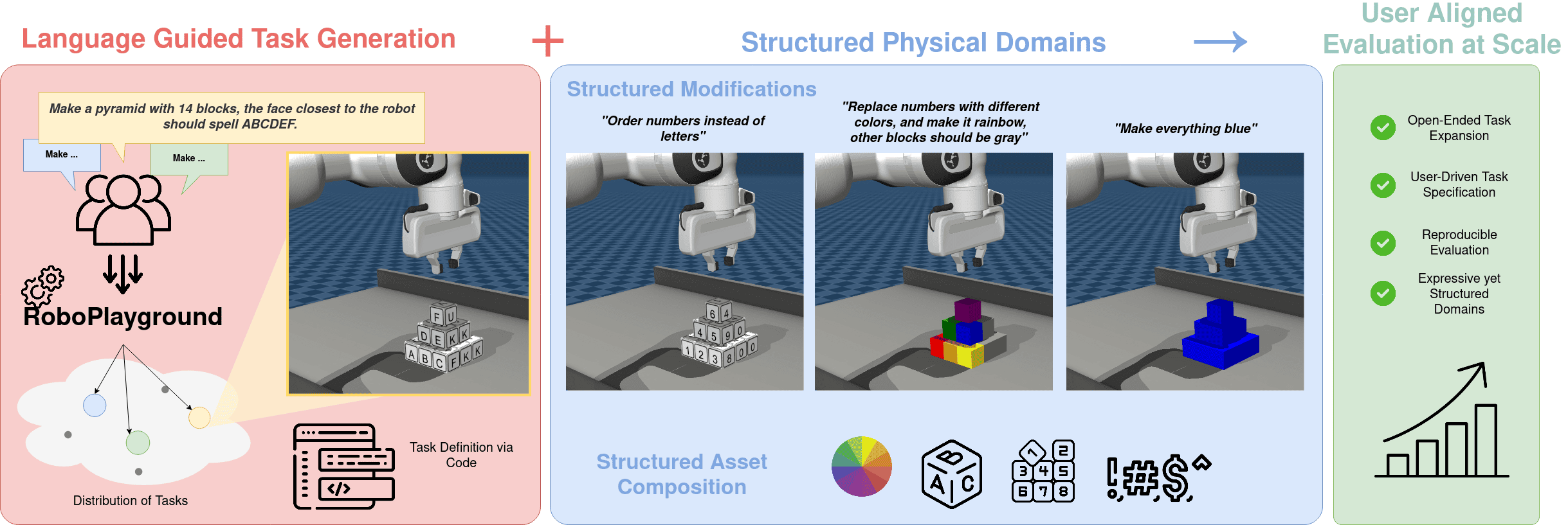
Figure 1: Language-guided task specification enables continuously extensible—yet semantically controlled—task generation and systematic open-ended evaluation.
High-level, the system parses natural language inputs into structured task schemas specifying asset composition, initialization distributions, and explicit success predicates. An LLM agent synthesizes these schemas into executable code, making use of API documentation, error pattern retrieval, and code libraries to ensure robust and contextually appropriate program generation. A multi-stage validation and repair pipeline enforces software correctness and physical feasibility, systematically routing failures to specialist agents for targeted repair. Task evolution is tracked with explicit intent classification (Tweak, Extend, Modify, Pivot, Fresh), supporting controlled variation, proper lineage, and explicit reference handling.
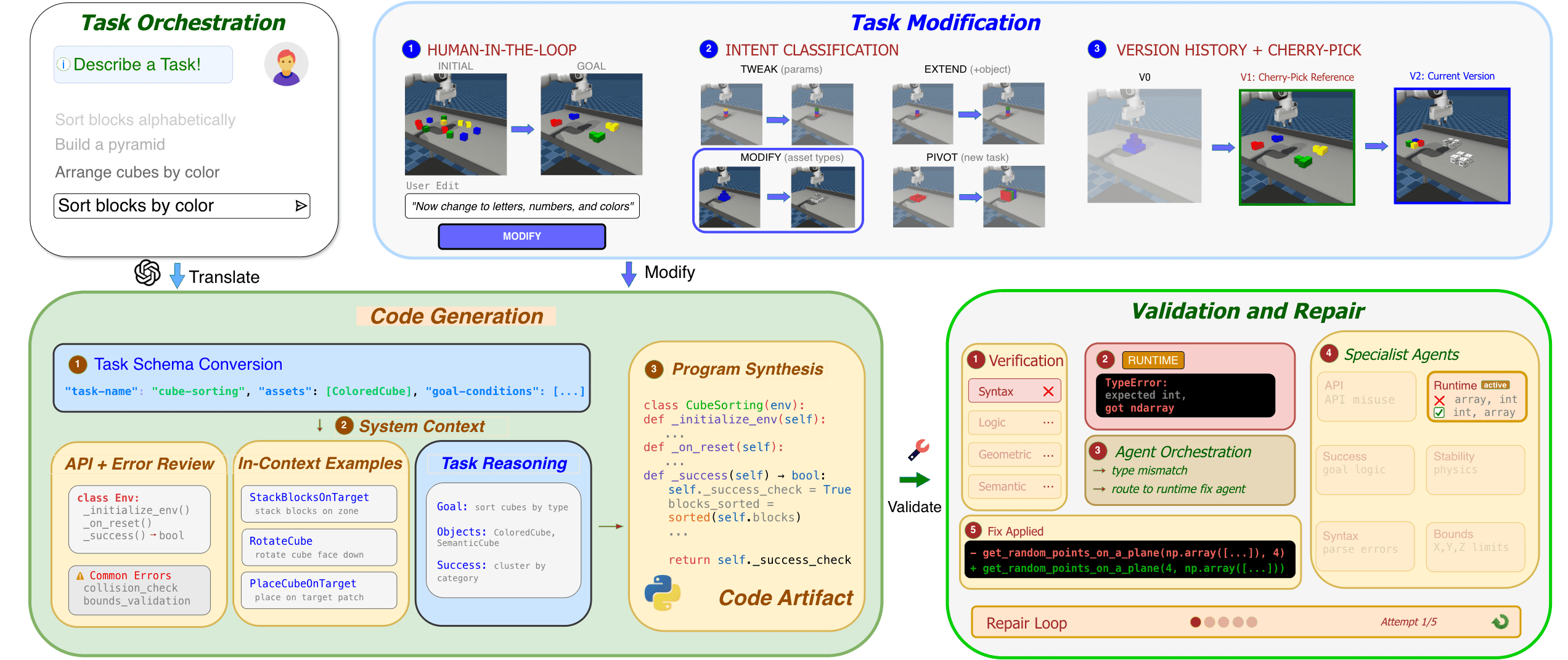
Figure 2: The core system: language compilers, validation/repair pipeline, and versioned context-steering enable structured semantic task evolution with guaranteed comparability and reproducibility.
Structured Physical Domains for Manipulation
Unlike approaches that leverage LLMs only for policy conditioning or data augmentation, RoboPlayground instantiates full task logic within a parameterized and constrained manipulation domain (block manipulation in MuJoCo). Every natural language instruction results in an artifact that codes up assets, initializations, and procedural success logic. Task families are represented as tuples (A,ρ0,G,ℓ,V), with language and paraphrase sets explicitly mapped to goal semantics, mitigating issues of ambiguity or under-specification.
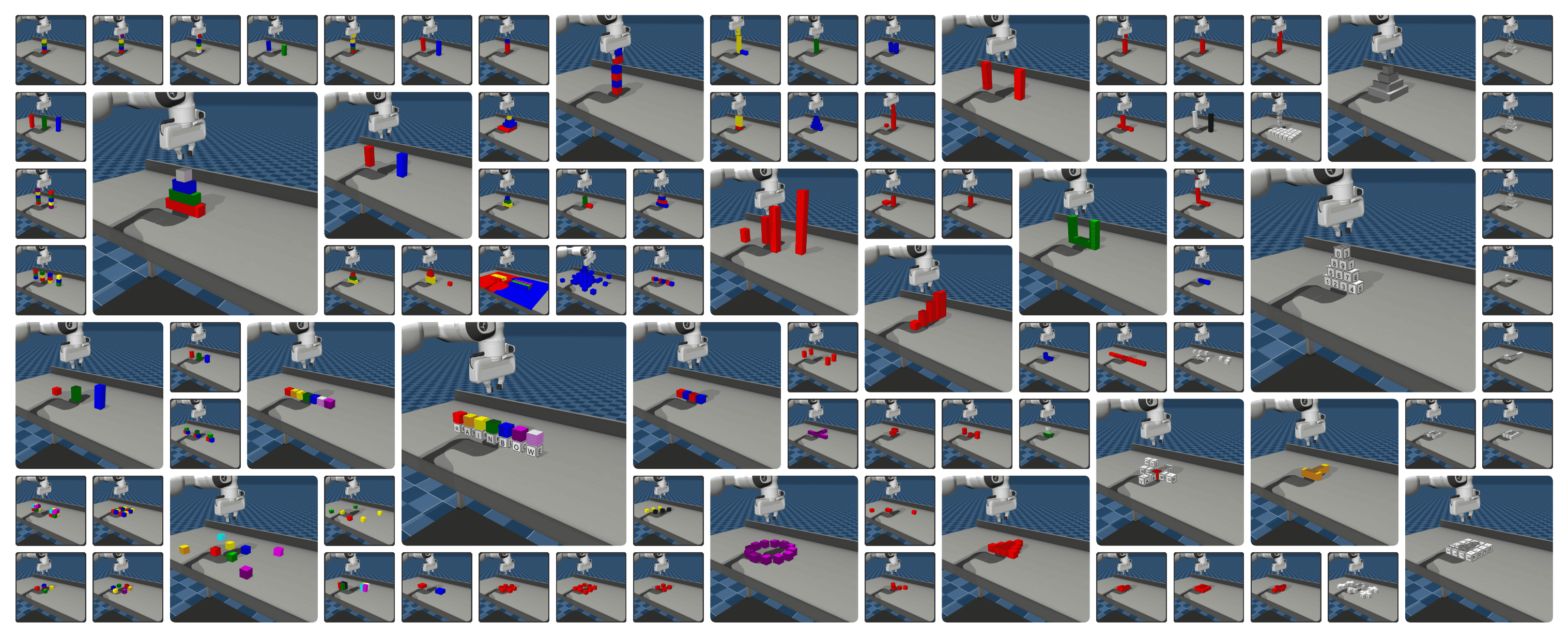
Figure 3: Examples from the language-defined manipulation task manifold: tasks cluster by construction, constraint, and semantics in a learned embedding, covering geometric, spatial, and semantic dimensions.
Validation, Repair, and Reproducibility
Central to RoboPlayground's contribution is the rigorous enforcement of executability and physical realizability via staged validation:
- AST-level syntactic and API validation
- Isolated runtime and smoke-testing to guarantee initialization
- Direct goal-state physics realization (forward simulation and stability checks)
- Constraint satisfaction and logical feasibility checking of goal predicates
Validation failures are mapped to failure sources and serve as dynamic feedback for the LLM agents to propose minimally invasive repairs, ensuring that only tasks with logically, physically, and semantically sound specifications are admitted into the live evaluation set.

Figure 5: Validation pipeline interleaves static, simulation-driven, and goal-conditioned checks, with failures routed to targeted specialist repair agents.
Context-Aware Steering and Task Evolution
RoboPlayground's context-steering mechanism disambiguates and controls the evolution of tasks across user-driven modifications by explicit intent parsing and fine-grained context selection. Version histories are maintained in structured snapshots (asset class, goals, hash) such that subsequent modifications can refer to and preserve semantic invariants, or cleanly pivot to alternative structures.
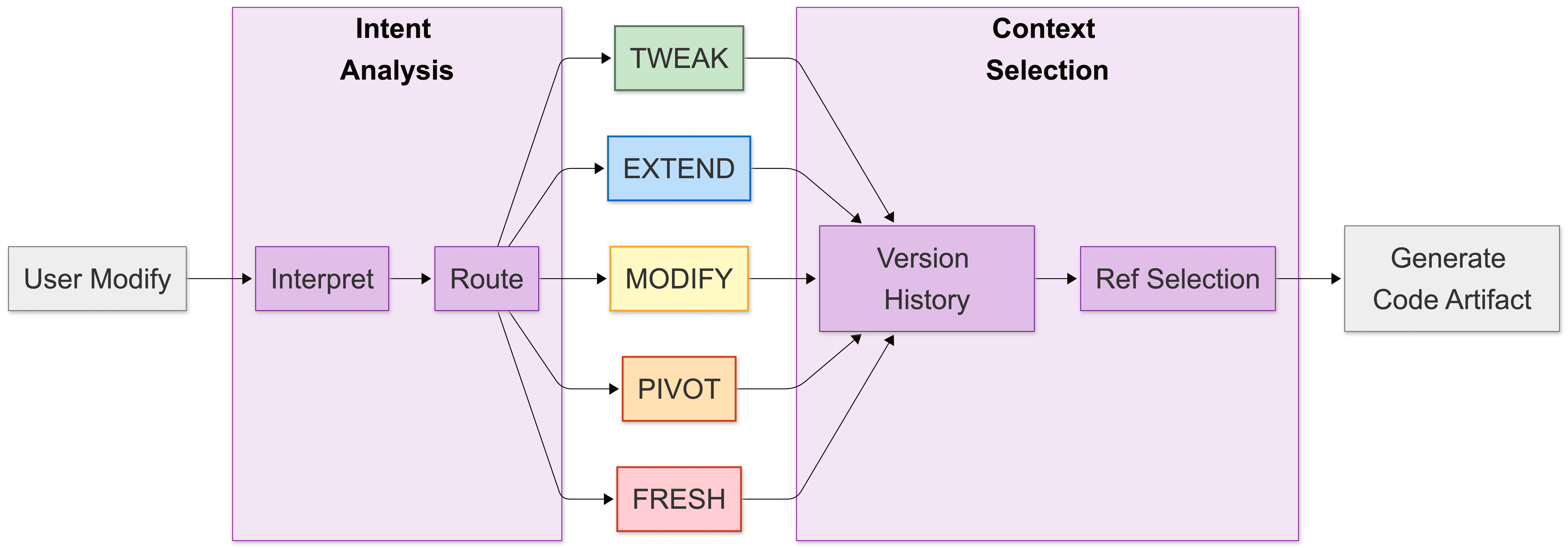
Figure 7: Context Steering: structured intent classification, version history, and context selection enable controlled, lineage-tracked evolution of complex task families.
Empirical Evaluation: Usability, Generalization Failure, and Diversity
Usability
A controlled study (N=26) compared RoboPlayground to GenSim and Cursor baselines in terms of System Usability Scale (SUS) and cognitive workload (NASA-TLX). RoboPlayground yielded significantly higher usability (SUS 83.4 ± 6.9) and reduced workload (TLX 18.6 ± 7.7), with 69% preference—substantially outperforming code-centric and code-assisted baselines. Statistical evidence indicates more consistent, less error-prone specification from non-expert users.
Policy Evaluation and Generalization
Learned manipulation policies (Adapter, GR00T, Dual, Qwen-OFT, Pi-0.5, Pi-0.5 LoRA) scored highly on training (in-distribution) tasks but demonstrated systematic generalization failure under even mild semantic, visual, or behavioral perturbations in RoboPlayground-generated task families. Tasks requiring compositionality, procedural variation, or semantic re-indexing universally led to sharp drops in success, independent of backbone or action-generation architecture.
Task Diversity and Contributor Scaling
Task diversity, measured as mean pairwise embedding distance, scales superlinearly with the number of contributors rather than with raw task count per user. Empirically, single-user collections plateau in diversity, while aggregation across users ensures continued coverage of novel semantics, compositional structures, and constraint combinations.
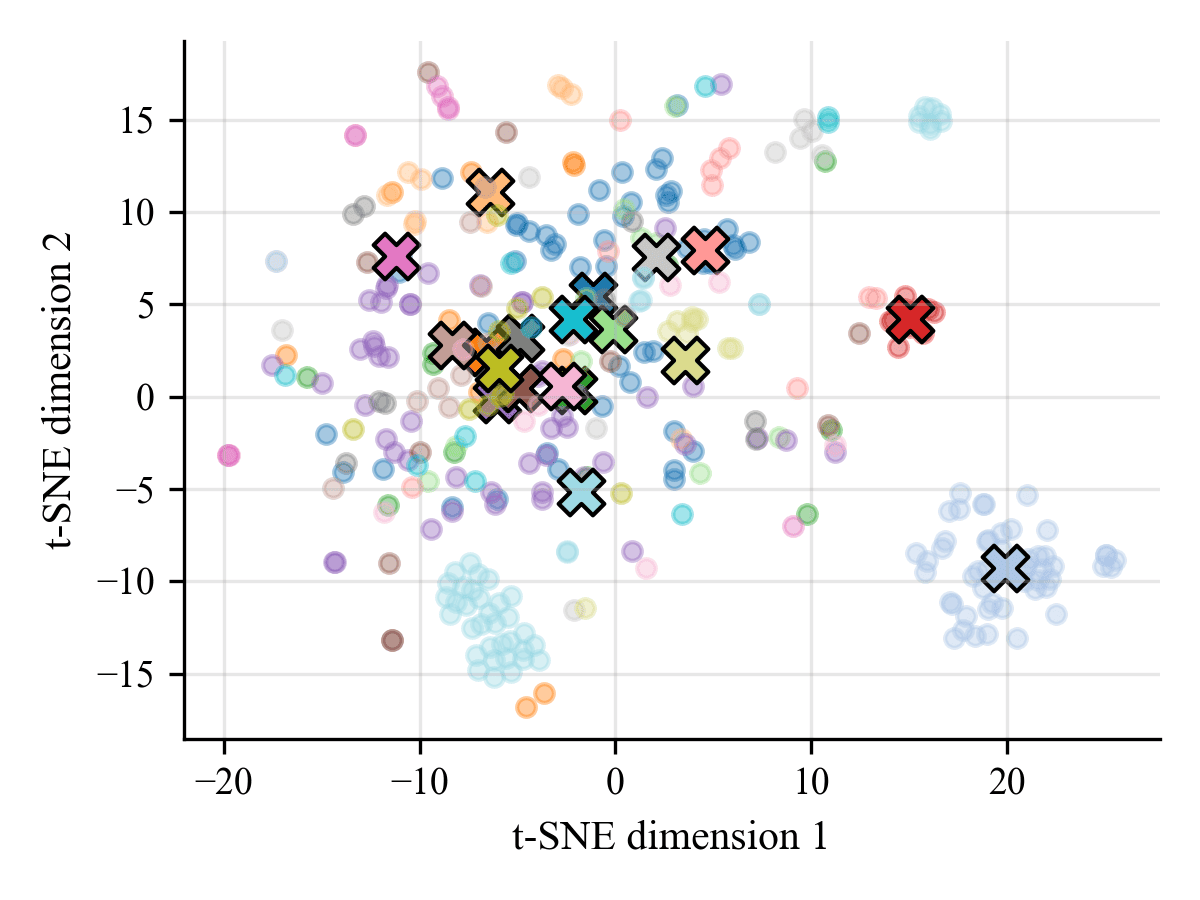
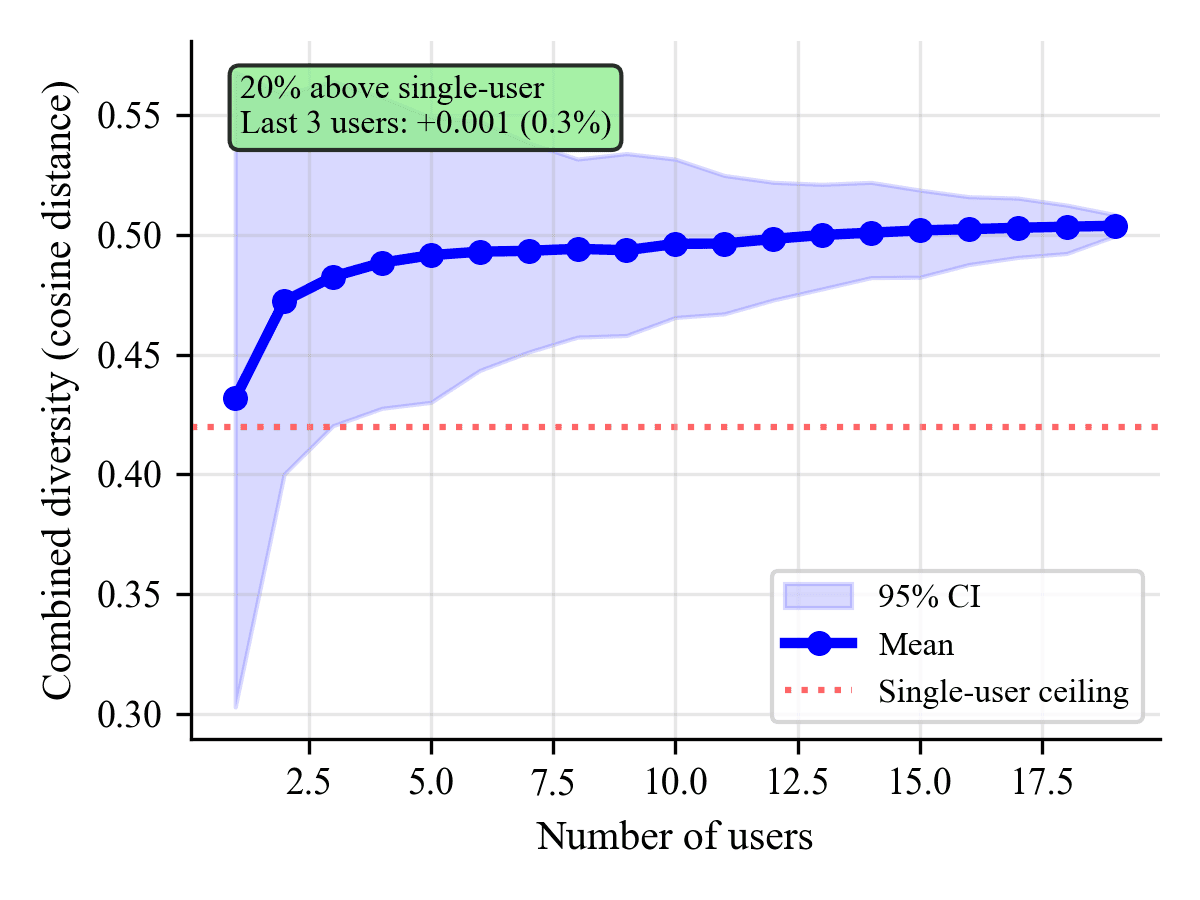
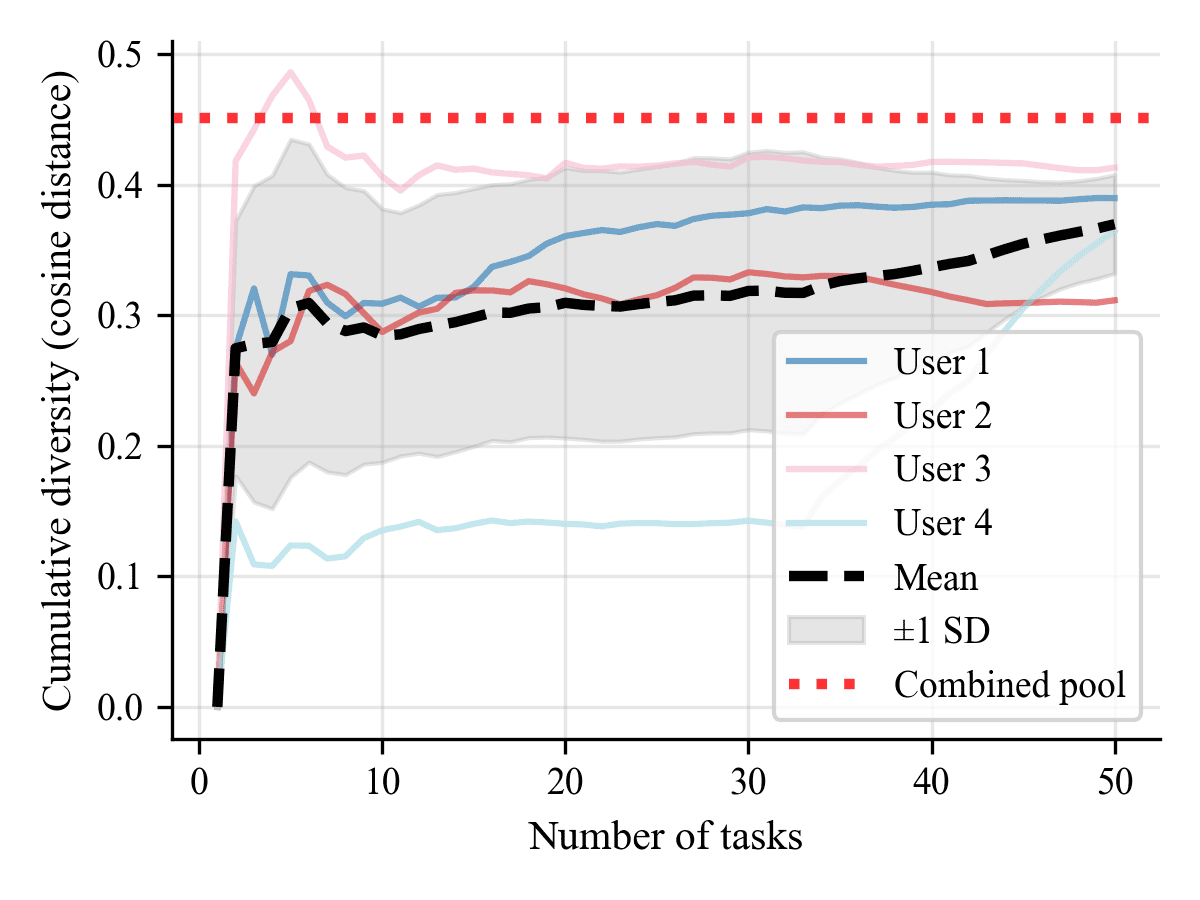
Figure 8: t-SNE embedding demonstrates increased diversity and coverage as an effect of pooling across independent contributors.
Ablation: Pipeline Component Contribution
Cumulative ablation studies reveal validation as the dominant determinant of executable and goal-aligned generation, with context-steering essential for semantically controlled task-family evolution. Disabling pipeline stages results in a dramatic reduction in task success and semantic alignment, underscoring the necessity of the modular, gated design.
Practical and Theoretical Implications
RoboPlayground demonstrates that language-driven, structured, and user-steerable evaluation enables both (1) scalable, reproducible, and systematic diagnostic evaluation and (2) access to the compositional and semantic variations required to expose the true generalization limits of modern manipulation policies. Success on fixed benchmarks no longer correlates with robustness; failure to generalize is routine when task specifications even slightly deviate from hard-coded expert-written canonical forms.
These results have direct implications for the reproducibility, fairness, and extensibility of policy benchmarking. Dynamic, language-driven evaluation frameworks will be essential both for accelerating the feedback loop in policy innovation and for community-driven definition of assessment criteria.
Future Directions
Generalization beyond structured block domains will require scalable schemas for richer asset spaces, dynamic interactions, and higher-level goals. The controlled, lineage-tracked approach of RoboPlayground provides a template for how simulation, program synthesis, and robust validation can be combined to safely democratize evaluation across other robotic, embodied, or interactive AI domains.
Conclusion
RoboPlayground marks a transition away from static, expert-centric evaluation practices toward open, structured, and reproducible language-driven frameworks. Its core contribution is a pipeline that ensures precise execution and versioned lineage of semantically diverse, user-authored tasks at scale, enabling robust assessment of both policy competence and methodological generalization. These contributions fundamentally expand what it means to evaluate robotic and embodied AI, shifting agency—and rigor—back to the broader research community.

