- The paper introduces an automated pipeline using PSF filtering, astrometric alignment, and cross-epoch matching to detect disappearing sources on POSS-I plates.
- The method reliably recovers known transients with a 79.2% completeness and 96.7% artifact rejection rate, ensuring high positional fidelity.
- The study finds no statistically significant association between vanishing sources and nuclear test events, highlighting the need for refined survey designs.
Independent Verification of Vanishing Sources on POSS-I Plates via Automated Detection and Cross-Epoch Matching
Overview
This work develops and evaluates a fully automated pipeline for the detection of candidate vanishing sources on digitized photographic plates from the first-epoch Palomar Observatory Sky Survey (POSS-I). The pipeline achieves robust, source-level verification of vanishing transients by combining PSF-morphology filtering, astrometric alignment, and strict cross-epoch positional matching—including the use of Pan-STARRS DR1 as a modern persistence screen. The results offer strong catalog-level agreement with previous human and semi-automatic surveys and provide an independent test of proposed temporal associations between vanishing-source rates and above-ground nuclear test events.
Methodology
Source Detection and Cross-Epoch Matching
The pipeline operates on DSS digitized cutouts from three epochs (POSS-I Red, POSS-I Blue, POSS-II Red). Detection is performed via 8σ thresholding and local PSF-morphology classification (FWHM and ellipticity filtering). Local astrometric registration is refined using affine corrections derived from ∼20–50 isolated bright stars per cutout, yielding final median residuals of $0.2$–$0.5$ arcsec.
Candidate vanished sources are defined as those present on POSS-I Red but with no matching source within $8$ arcsec on both POSS-I Blue and POSS-II Red, after registration correction. This stringent matching requirement ensures high specificity for true astrophysical transients as opposed to plate-specific or color-dependent sources. Final candidates are cross-matched against Pan-STARRS DR1; those with a Pan-STARRS counterpart within $3$ arcsec are eliminated to further suppress false positives due to astrometric mismatch or imperfect plate-to-CCD morphological matching.
The pipeline is benchmarked using two canonical fields: (1) the April 1950 transient field containing 9 previously identified vanishing sources, and (2) the July 1952 field hosting a recently reported triple transient. Random sky locations and crowded Galactic plane fields are also included to assess false-positive and control rates, respectively.
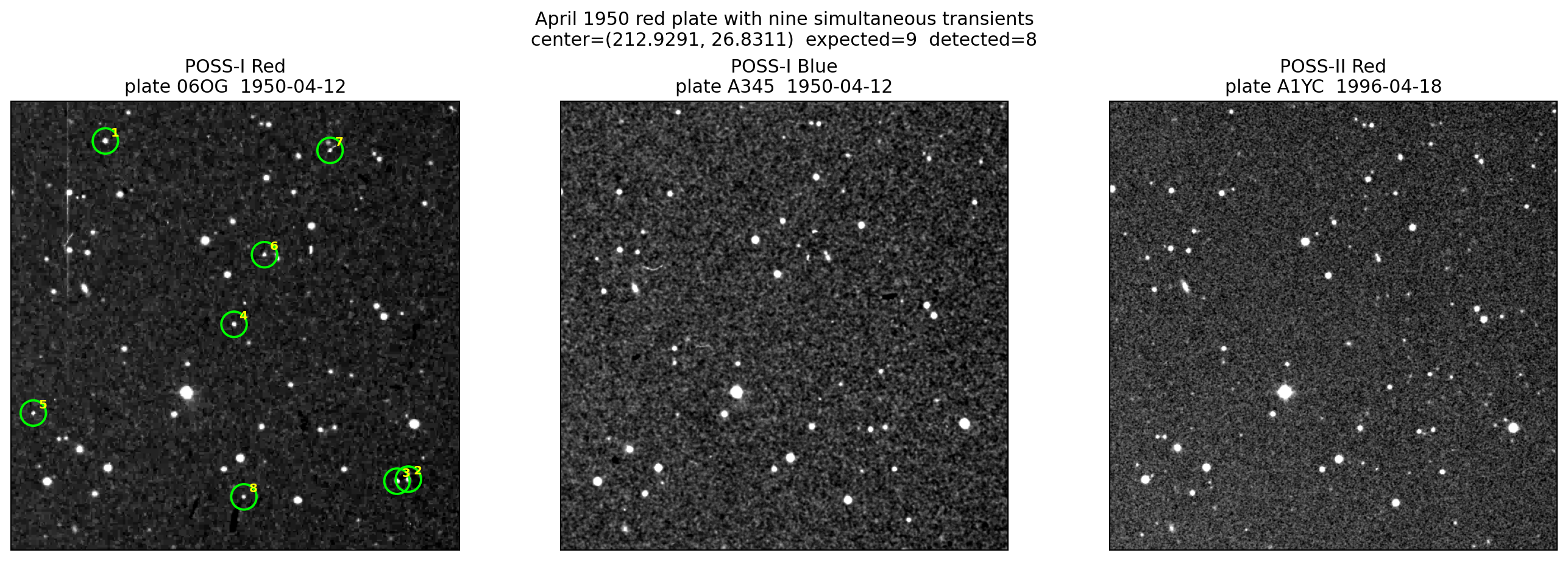
Figure 1: April 1950 benchmark field, showing 8/9 transient candidates independently recovered (Left: POSS-I Red). Main background controls (Center: POSS-I Blue, Right: POSS-II Red) confirm absence of detections at candidate positions.
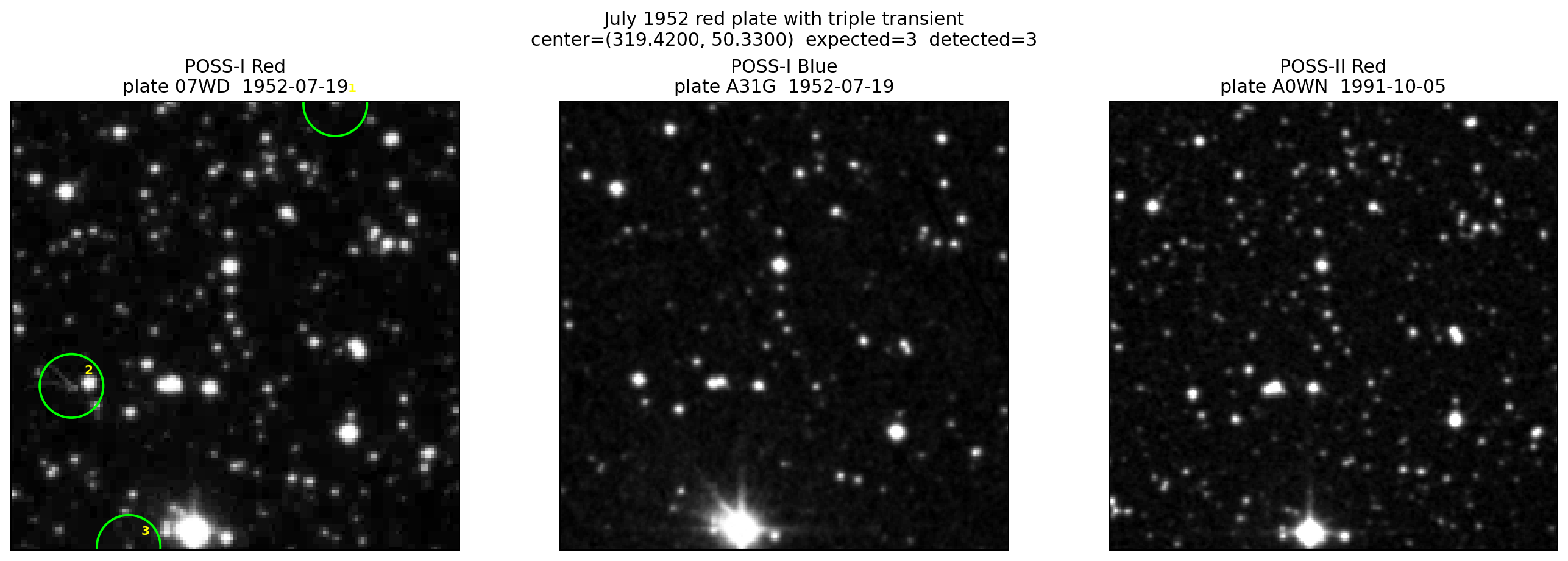
Figure 2: July 1952 field demonstrates recovery of all 3 known transients, again showing absence in contemporaneous and modern epochs.
Synthetic source injection tests reveal a recovery completeness of 79.2% for stars and a 96.7% rejection rate for artificially generated artifacts, quantifying the trade-off between purity and completeness under the selected filter parameters.
Catalog-Level Results and Source Agreement
Executing a full survey sweep over the POSS-I footprint (using $30$ arcmin grid patches) with preliminary, less stringent parameterization (prior to benchmark calibration) yields ∼2.85 million candidate vanished sources after PSF cutting, deduplication, and Pan-STARRS rejection.
Cross-matching this new catalog against the independent 5,399-source public VASCO catalog of unidentified transients [solano2022] yields 3,450 matches (63.9%) with a median cross-catalog separation of only $0.94$ arcsec, indicating effective astrometric concordance and low random match likelihood.
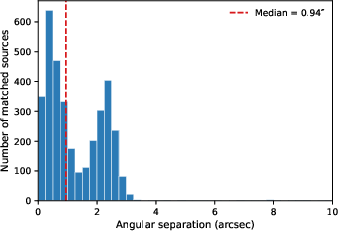
Figure 3: Angular separation distribution for matched catalog entries, illustrating high-precision positional reproduction across independent pipelines.
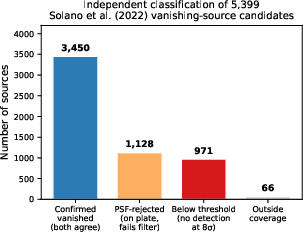
Figure 4: Detailed breakdown of matched/missed VASCO catalog entries: ∼54% of missed entries are rejected by the PSF filter, and ∼046% fall below detection thresholds.
Among unrecovered VASCO sources, none have Pan-STARRS DR1 counterparts within ∼1 arcsec, corroborating their status as archive-absent sources and validating the main underlying astrophysical claim. Approximately half of the unrecovered cases are detected but excluded by PSF morphology; the rest appear to be below-threshold or spurious detections, indicating conservative performance relative to prior pipelines.
Analysis of Temporal Correlation with Nuclear Testing
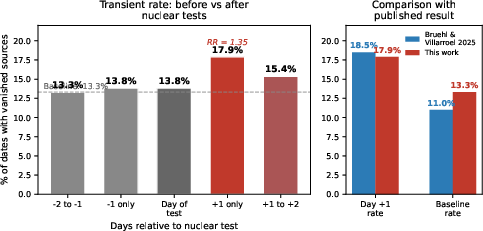
The study applies the ensemble-detected, catalog-level candidate list to the question of whether POSS-I vanishing sources are temporally over-represented in proximity to above-ground nuclear tests, following methods and event lists used in previous reports [bruehl2025]. Two main statistical strategies are employed:
These analyses collectively indicate that while qualitative patterns reported by prior work [bruehl2025] are directionally reproduced, the current, pipeline-driven survey offers only null or inconclusive statistical evidence for a real temporal association. The results highlight the sensitivity of ensemble tests to operational confounds (e.g., observation schedule, detection threshold) and reinforce the need for precise catalog construction, exposure modeling, and window specification in future studies.
Practical and Theoretical Implications
This work establishes the feasibility and performance ceiling for fully automated, morphology-driven source detection and cross-epoch matching as a rigorous approach for vanishing-source science on digitized survey plates. The cross-pipeline agreement with the VASCO catalog (63.9%) sets a quantifiable baseline for catalog-level reproducibility, while the explicit analysis of unrecovered candidates exposes the role of algorithmic choices in the validation of large-scale astrophysical anomaly surveys.
From a practical perspective, automated verification pipelines of this type will become critical as new, higher-cadence and higher-sensitivity time-domain surveys (e.g., LSST) come online, necessitating robust, scalable information extraction and validation for rare or controversial transient phenomena. The demonstrated rejection of Pan-STARRS counterparts further clarifies the classification boundaries for true vanishing sources, but does not alone confirm astrophysical disappearance, indicating the need for a multi-instrument and multi-pronged follow-up strategy.
Theoretically, the null result for a count-level association between vanished-source rates and nuclear test events suggests that, in the absence of stronger filtering or observational controls, environmental or instrumental effects linked to such events are either much weaker than previously claimed or strongly masked by survey systematics in extant datasets. Future work should reprocess these catalogs with higher-fidelity filtering, explicit schedule modeling, and independent replication across other sky surveys and wavelength regimes.
Conclusion
An automated, PSF-filtered, cross-epoch matching pipeline can replicate the majority of previously published POSS-I vanishing-source candidates with high positional fidelity and low contamination in well-behaved regions. Catalog-level replication is strong, supporting the efficacy of automated retrospective anomaly detection in historical data. However, statistical association tests with exogenous events (e.g., nuclear tests) remain inconclusive, emphasizing methodological sensitivity and demanding more rigorous survey design and analysis in future work. The pipeline, benchmark strategies, and negative results in temporal association analyses outlined here provide a template for robust population-level astrophysical anomaly studies going forward.