2024 YR4: Identification of Possible Precoveries in 2016 IPTF Data
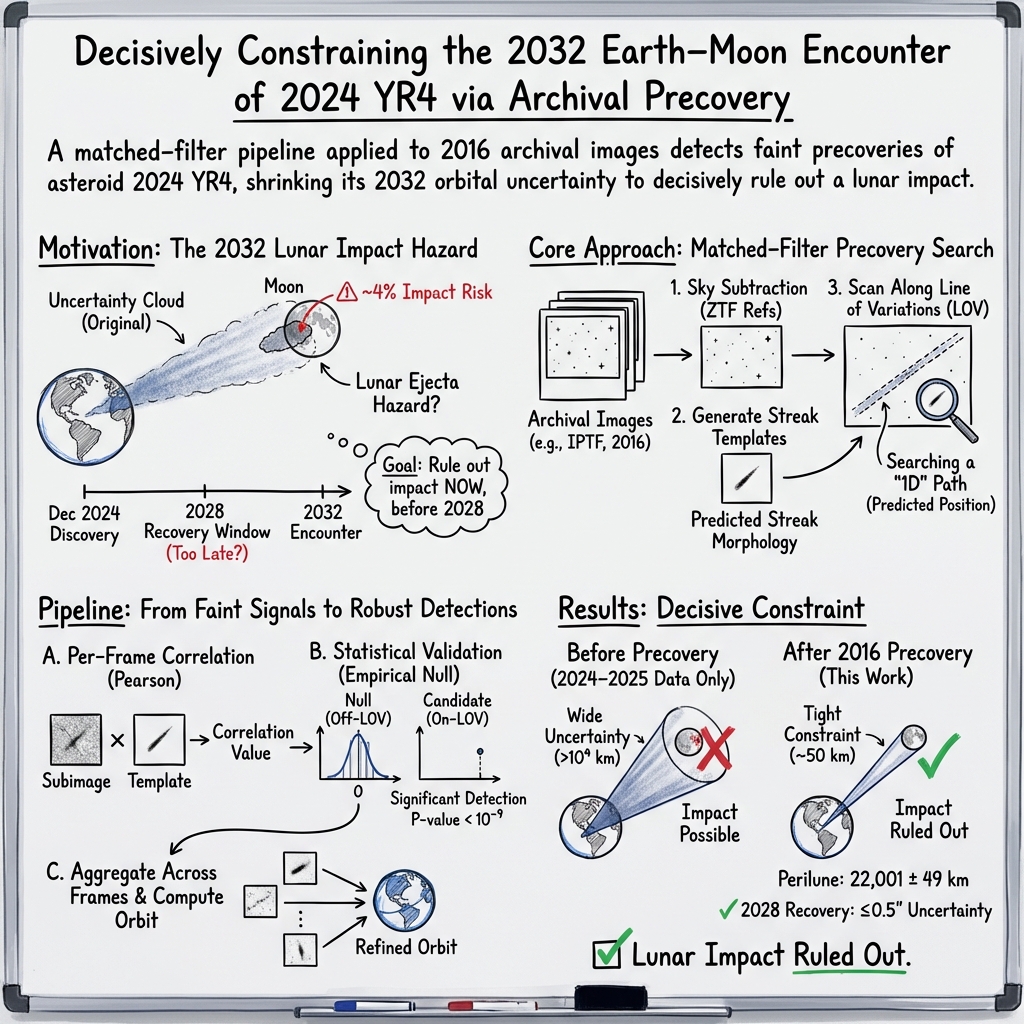
Abstract: 2024 YR4 is a 40-100 meter-diameter asteroid and former Torino Scale 3 object which currently has a roughly 4% chance of impacting the Moon on 2032 December 22, an event which recent studies suggest could pose a hazard on Earth due to impact ejecta. We present a search for, and identification of, potential precovery observations of the virtual lunar impactor in Intermediate Palomar Transient Facility (IPTF) survey data, as well as other publicly accessible surveys, dating from 2016. These candidate detections, not accounting for any currently-undetected Yarkovsky forces, predict a perilune of 22001 +/- 49 km and a perigee of 277534 +/- 46 km (relative to the center of each respective body) representing an improvement of > 300 times in the approach distance uncertainty above the existing orbit solution and, if confirmed, decisively ruling out a lunar impact in 2032. Using a matched filter tuned to 2024 YR4's predicted appearance in each image, we find the detection to be significant at Pnull = 5x10⁻⁹. The resultant possible orbit solution should be easy to confirm during 2024 YR4's 2028 approach to Earth, potentially greatly reducing the effort required by the planetary defense community at large to characterize 2024 YR4 before its potential lunar impact.
Paper Prompts
Sign up for free to create and run prompts on this paper using GPT-5.
Top Community Prompts
Explain it Like I'm 14
2024 YR4: What this paper is about, in simple terms
Overview
This paper is about a small near‑Earth asteroid called 2024 YR4, about the size of a school gym (roughly 40–100 meters across). When it was first discovered at the end of 2024, it briefly ranked as a Torino Scale 3 object, meaning it seemed to have a non‑tiny chance of hitting Earth in 2032. Later observations ruled out an Earth impact—but a hit on the Moon in 2032 still looked possible, which could still matter for us because a big Moon smash could spray debris into space.
The authors went hunting through old telescope pictures from 2016 to see if the asteroid had been unknowingly photographed back then. Finding such “precovery” images would lengthen the time span of observations and make its future path much clearer. They think they found it in a set of 2016 images from the Intermediate Palomar Transient Facility (IPTF), and show strong evidence that this detection is real. If confirmed, this would tighten the asteroid’s predicted 2032 flyby so much that a lunar impact can be ruled out.
What questions did the researchers try to answer?
- Can we find 2024 YR4 in old sky photos from 2016, taken years before its official discovery?
- If yes, does adding these old sightings sharpen its orbit enough to tell whether it could hit the Moon in 2032?
- How confident can we be that the faint “streaks” they see in those images are really the asteroid and not random noise?
How did they look for it? (Methods explained simply)
Think of the sky like a giant photo album. The asteroid is a tiny, faint object that moves a little between pictures, so it doesn’t look like a sharp dot—more like a short streak. The team:
- Collected old images:
- They searched public archives and, with help from the IPTF team, accessed unreleased IPTF images from 2016.
- They also checked images from Subaru (HSC) and DECam (Chile).
- Narrowed where to look:
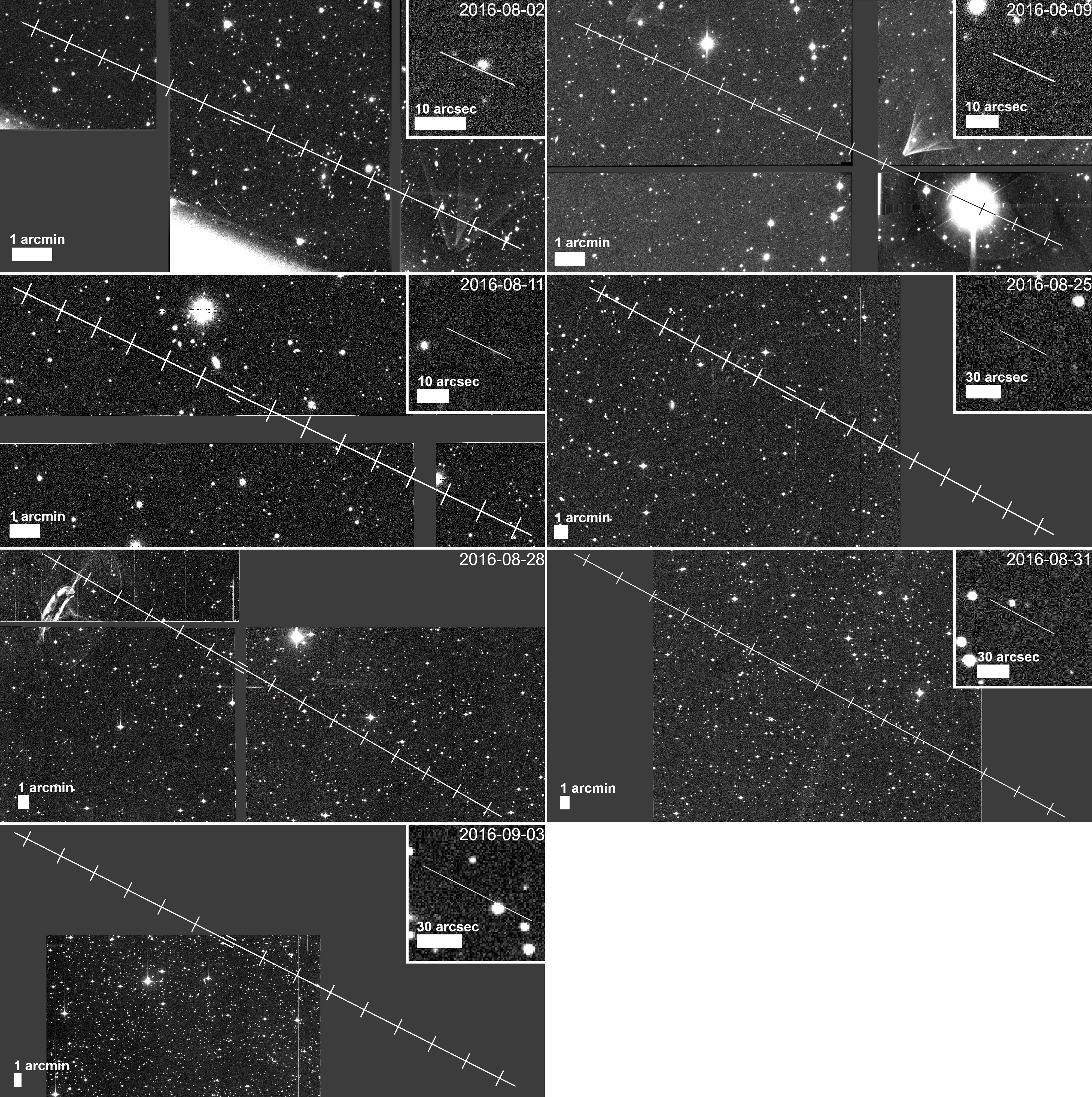
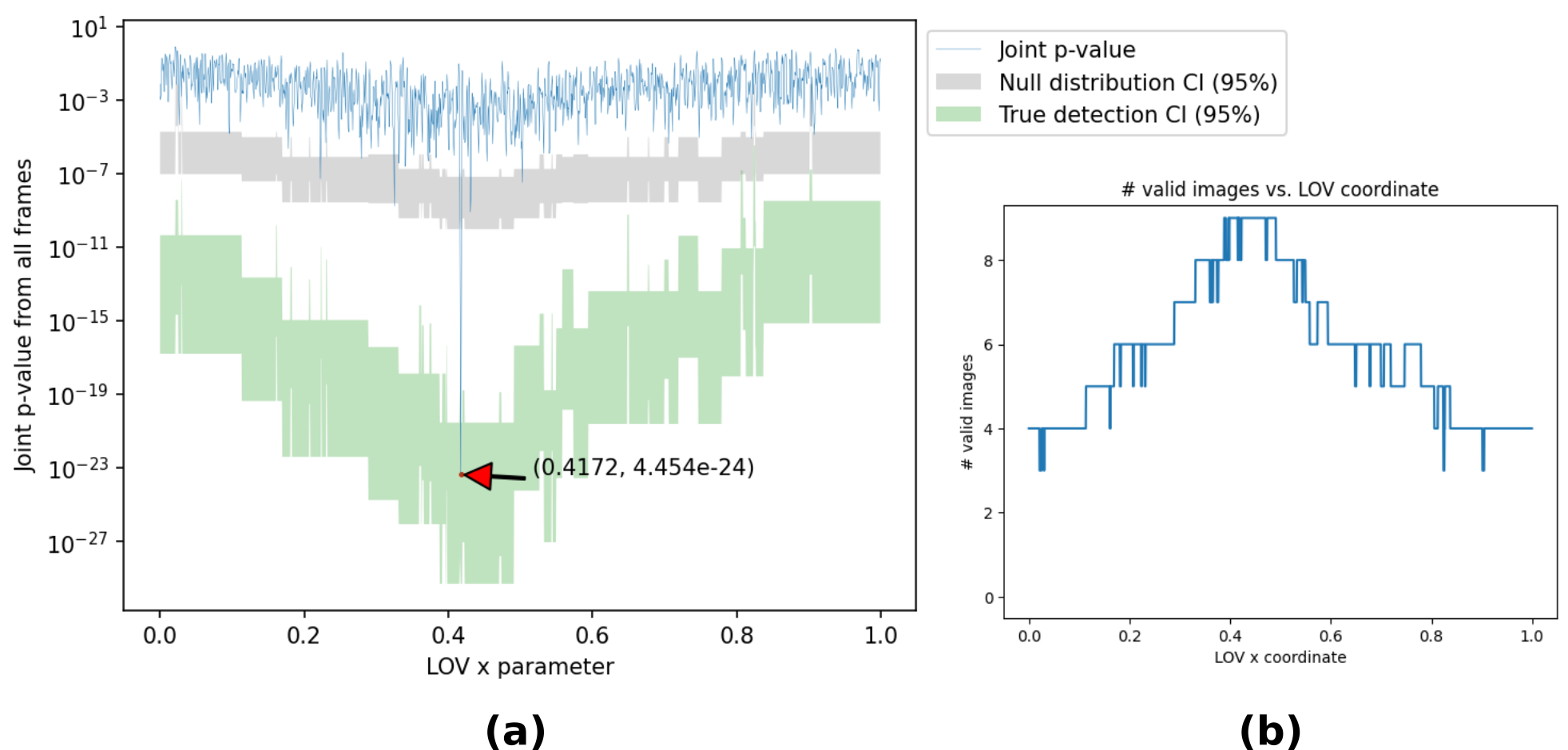
- Even if you know an asteroid’s orbit, there’s always some uncertainty. That uncertainty looks like a very thin “line of possible positions” across the image called the line of variations (LOV). Instead of scanning the whole picture, they searched along this thin line.
- Removed background stars:
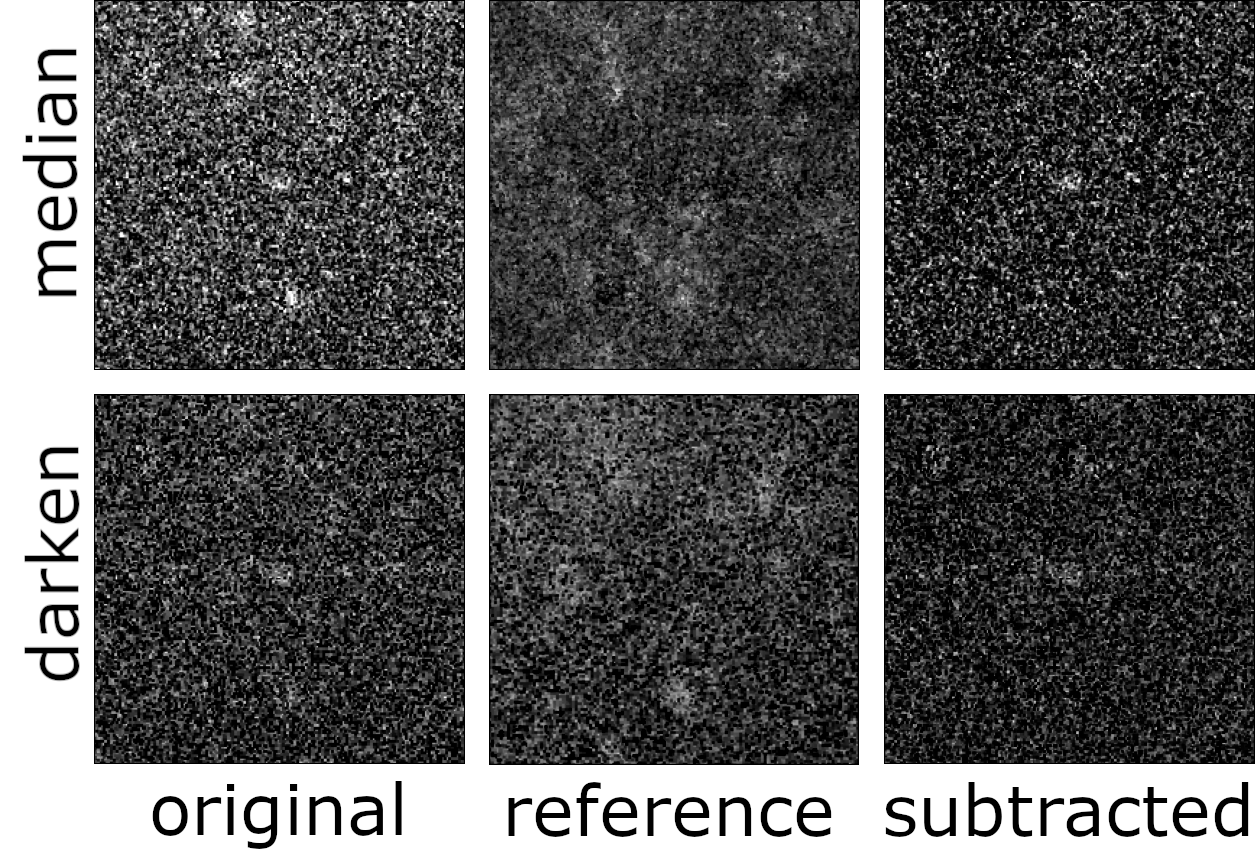
- They used very deep, sharp “reference” images from another survey (ZTF) and aligned them with the IPTF photos.
- Subtracting the reference star field from the IPTF image is like erasing all the known, steady stars to leave behind only things that move or change—like the asteroid.
- Looked for the right-shaped signal:
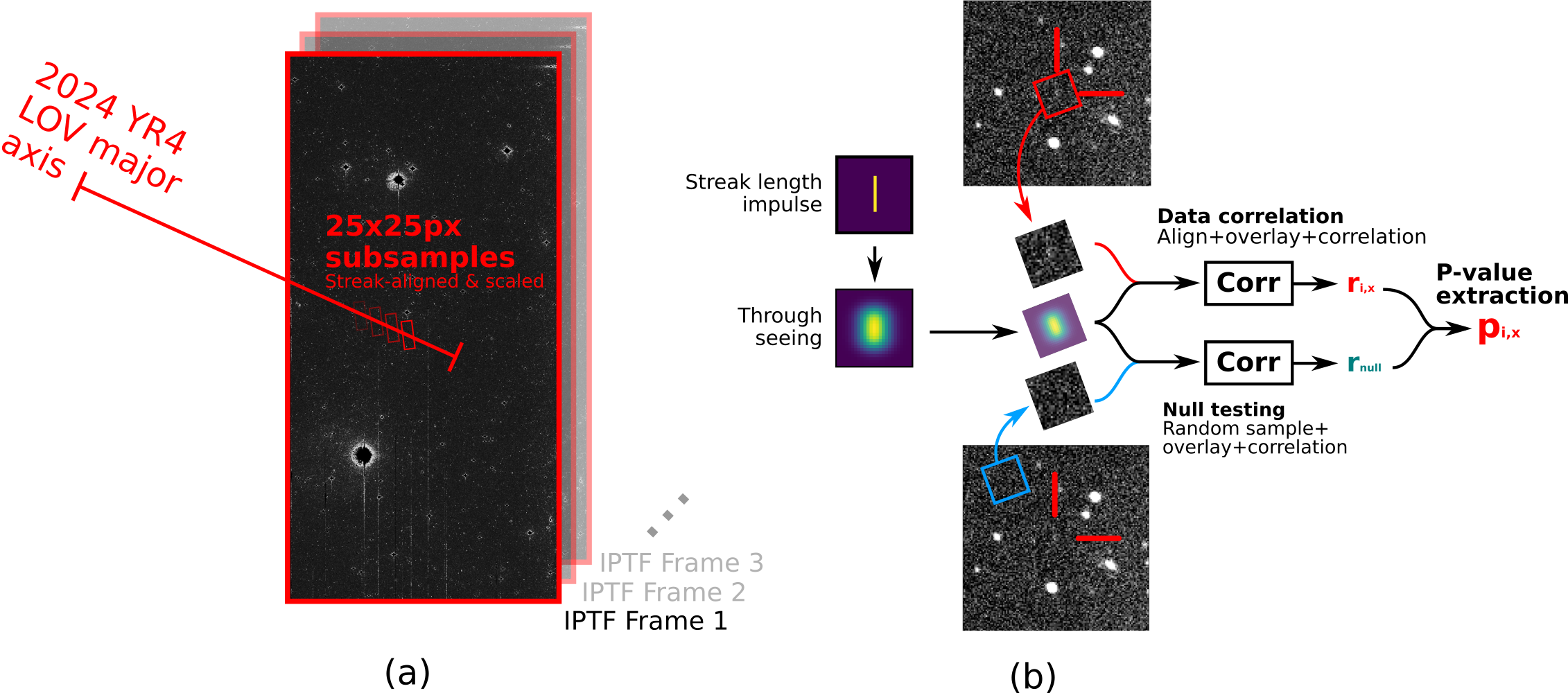
- They used a “matched filter,” which you can imagine as sliding a transparent stencil of the expected streak across the image. If the pattern under the stencil matches well, you get a high score.
- They did this at many points along the LOV in each image.
- Tested if it could just be chance:
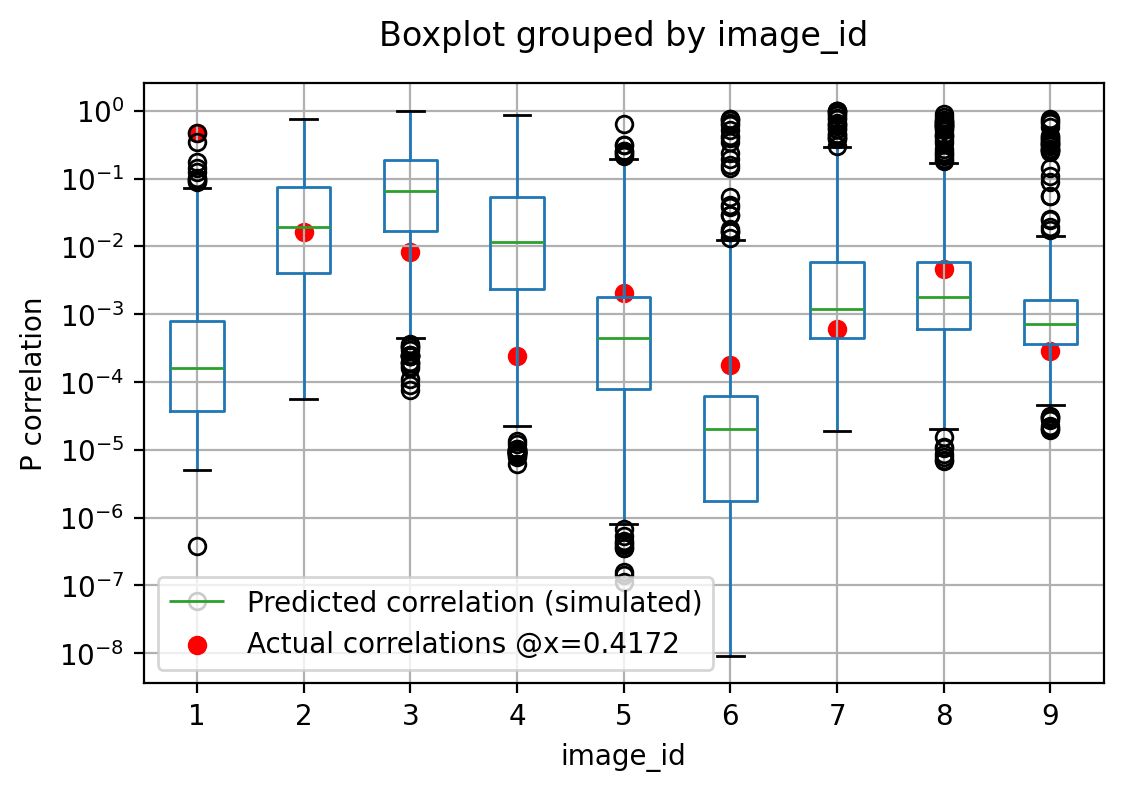
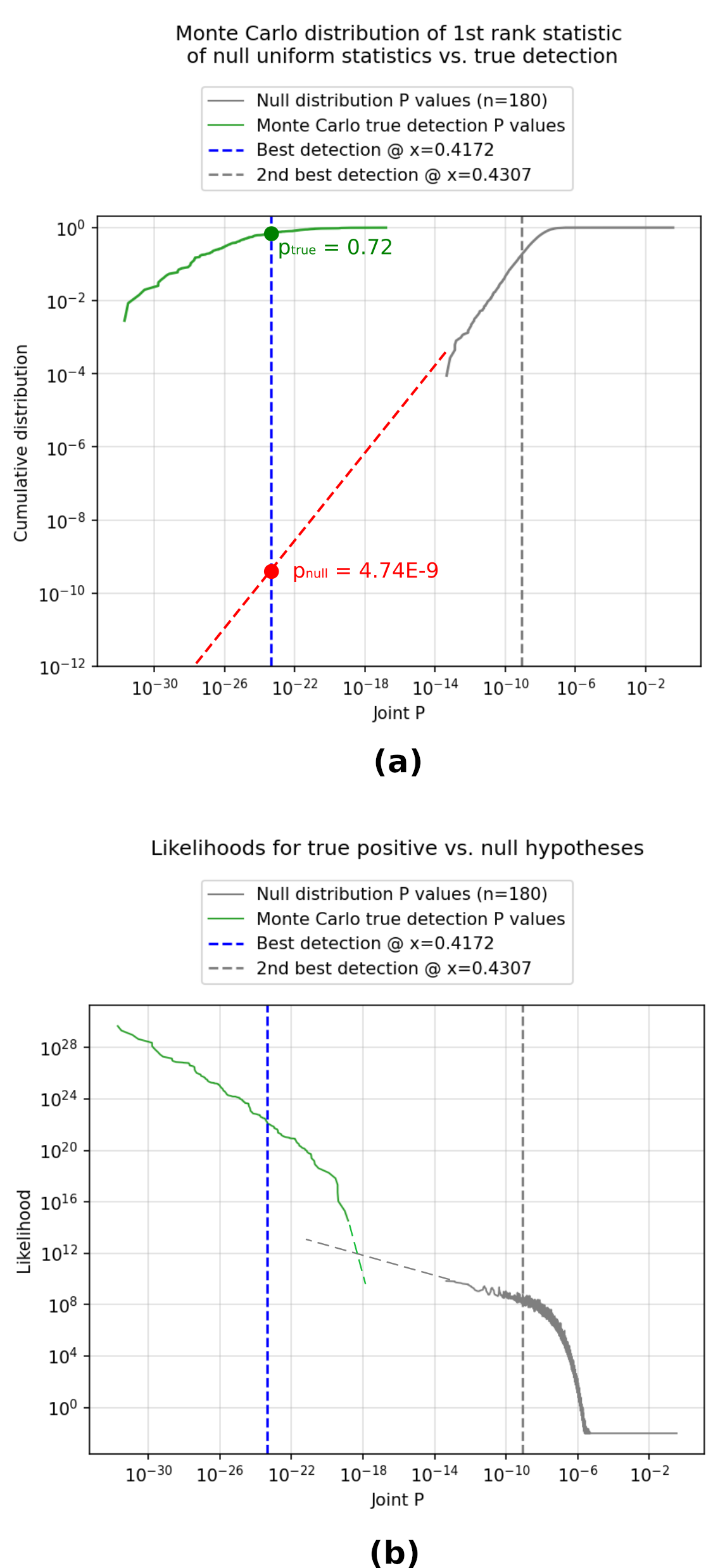
- They measured how often random noise (leftover fuzz, faint star remnants) produced similar scores elsewhere in the images.
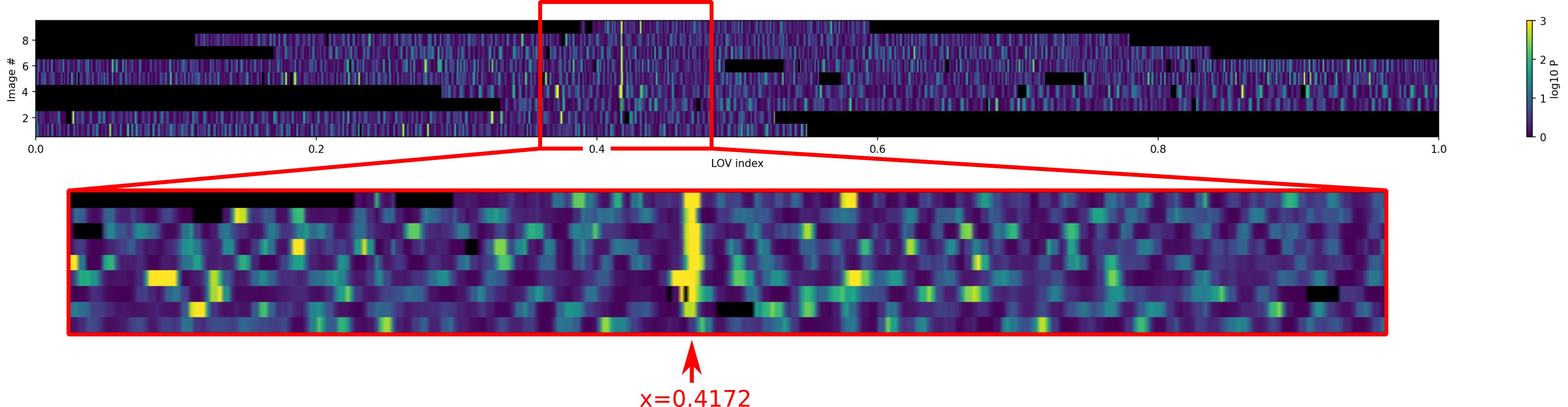
- By combining results from multiple nights, they calculated how likely it is that the detection is just luck. That “null” probability came out around 5 in a billion (about 5 × 10⁻⁹), which is extremely unlikely.
- Checked consistency:
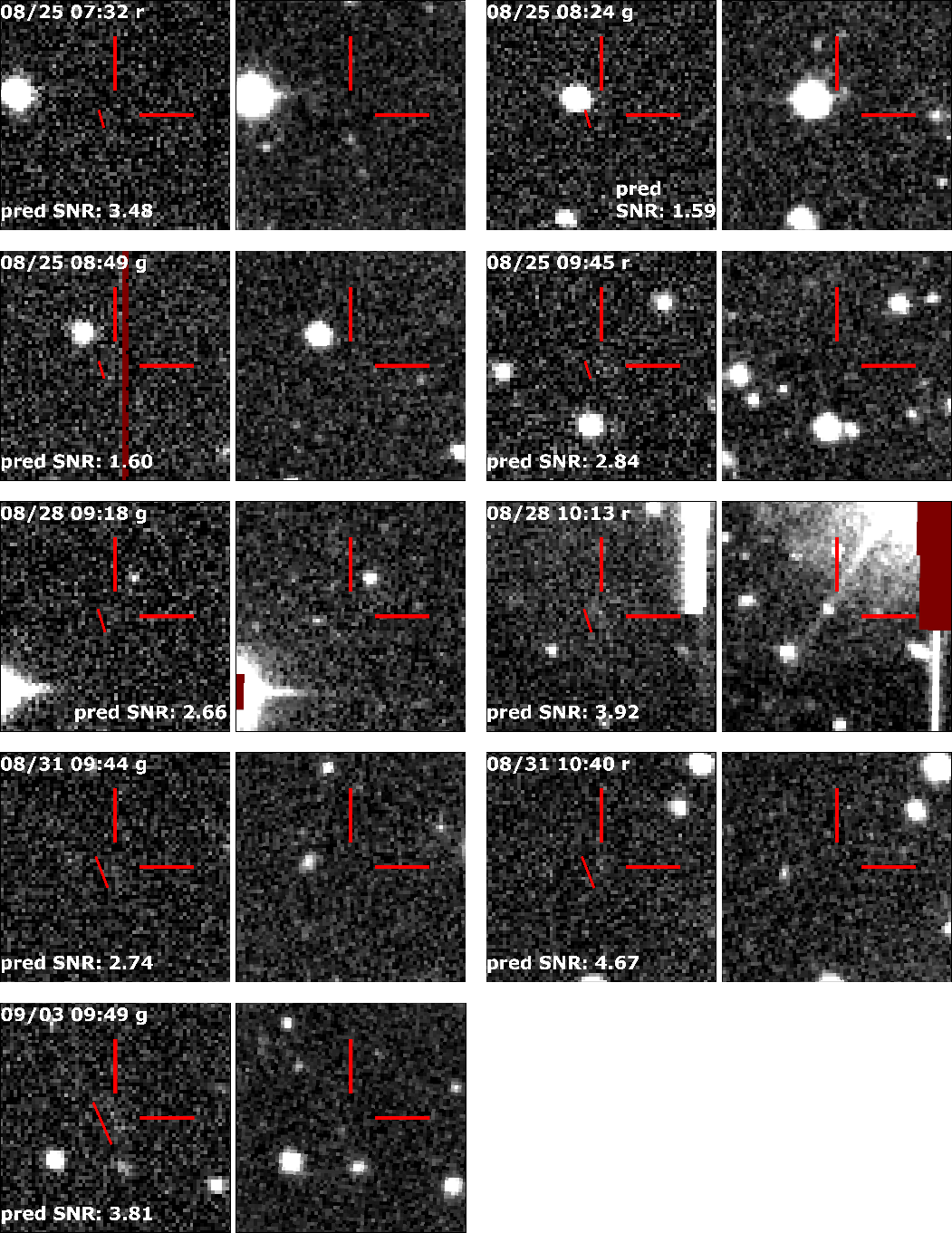
- A real asteroid should show up across several images in the right places, with the right direction and length of streak for that date and time. The candidate they found does that.
In short: they carefully erased the background, searched along a skinny “treasure map line,” used a shape‑matching tool to find a faint moving streak, and showed the chance of a false alarm is tiny.
What did they find, and why does it matter?
- They found a consistent, faint detection of 2024 YR4 in nine IPTF images from August–September 2016.
- When they include these 2016 positions in the orbit calculation, the asteroid’s 2032 flyby distances get much more precise:
- Closest approach to the Moon’s center (perilune): about 22,001 ± 49 km.
- Closest approach to Earth’s center (perigee): about 277,534 ± 46 km.
- That’s an improvement of more than 300 times in how well we know the approach distance compared to before. With this sharper orbit, a 2032 lunar impact is effectively ruled out.
What about tiny forces from sunlight (the Yarkovsky effect) that can slowly nudge small asteroids over years? The authors tested a wide range of those effects. Even then, the predicted miss distance still stays safely above the Moon’s surface, keeping “no impact” as the expected outcome.
They also note:
- Earlier Subaru and DECam images were deep but didn’t spot the asteroid—mainly because parts of the LOV fell into chip gaps or near very bright stars, or the asteroid was too faint and streaked in those specific setups. That’s consistent with the IPTF detection being real, not a contradiction.
What does this mean going forward?
- Planetary defense planning: If these precovery detections are confirmed, the Moon is safe from this asteroid in 2032, which reduces worries about lunar debris threatening satellites or space infrastructure.
- Easier future tracking: The asteroid will be observable again in 2028, reaching around magnitude 20–21 (within reach of many larger amateur and professional telescopes). With the new orbit, the predicted position in 2028 will be pinned down to within about half an arcsecond—very small—making follow‑up simple and saving valuable telescope time.
- Big-picture impact: This work shows the huge value of old survey data and careful image processing. Even faint, streaky objects can be recovered if you:
- Search along the precise uncertainty line,
- Subtract deep reference images,
- And use shape‑matching with solid statistical tests.
- It also highlights the IPTF archive as a powerful, sometimes overlooked resource for precovery studies.
Key terms, quickly explained
- Precovery: Finding an object in images taken before it was officially discovered.
- Line of variations (LOV): A super thin path in the sky where the asteroid could be, given current uncertainties—like a pencil line across the photo where you search.
- Matched filter: A pattern‑matching tool; think of sliding a transparent stencil of the expected streak across the image to see where it fits best.
- Yarkovsky effect: A gentle push on an asteroid from sunlight being absorbed and re‑emitted as heat. Tiny per second, but over years it can add up.
Bottom line
The authors likely found 2024 YR4 in 2016 IPTF images and show strong, multi‑night, statistically convincing evidence. Using those detections, the asteroid’s orbit becomes much better known, and a 2032 Moon impact is essentially ruled out. This lowers risk, saves future observing time, and demonstrates a smart, efficient way to use old survey data to solve high‑stakes space problems.
Knowledge Gaps
Below is a single, focused list of the paper’s unresolved knowledge gaps, limitations, and concrete open questions that future work could address.
- Reproducibility of detection: the IPTF frames used are not publicly released; without public access to the raw images, precise WCS, and the authors’ full processing code/scripts, independent verification and reanalysis are limited.
- Statistical trial factors: the reported significance (P_null ≈ 5×10⁻⁹) does not fully quantify the look-elsewhere effect across all epochs, multiple frames, and the larger LOV explored earlier in the project; a global false-alarm probability that includes all trials is needed.
- Assumptions of independence: multiplying P-values across frames implicitly assumes independence of residuals and systematics; correlations introduced by common reference images, calibration steps, or sky background structures should be tested and, if present, modeled in the significance estimate.
- Template-model fidelity: the matched-filter uses a streak model (line convolved with a Gaussian). The impact of PSF anisotropy, non-Gaussian PSF wings, seeing variation within exposures, tracking jitter, and DCR on centroid bias and detection significance is not quantified.
- Starfield subtraction systematics: subtraction relies on ZTF deep references Gaussian-blurred to match IPTF seeing; no kernel-based PSF matching (e.g., Alard–Lupton) or color-term corrections are applied. Residuals from bandpass mismatch, variable stars, or spatial PSF changes could inflate correlations; quantify this via controls and alternative subtraction methods.
- Calibration uncertainties: the paper does not detail astrometric solutions (e.g., reference catalogs, distortion maps, proper-motion treatment, DCR correction, time-stamp accuracy, field-dependent WCS residuals). Their contribution to centroid uncertainties and the final orbit covariance remains unquantified.
- Centroid uncertainty model: RA/Dec uncertainties for streak centroids are reported per frame, but the method for deriving them (e.g., from correlation peak curvature, injection–recovery scatter, or analytic error propagation) is not described; a validated error model is needed for robust orbit weighting.
- Injection–recovery completeness: synthetic injections assess correlation distributions but do not vary key nuisance parameters (e.g., brightness deviations from rotation, PSF ellipticity, background gradients) or simulate full pipeline astrometry/orbit-fitting; a comprehensive end-to-end injection–recovery test would better constrain detection efficiency and astrometric bias.
- Confirmation in independent datasets: the Subaru (2016-08-09) and DECam (2016-08-11) frames provide only negative/ambiguous evidence due to chip gaps and depth; forced matched-filter photometry at the candidate’s predicted positions and motion vectors in these frames is not reported and could strengthen or weaken the case.
- Additional archival searches: beyond SSOIS, CATCH, and Mega-Precovery, further mining of other 2016 surveys (e.g., Pan-STARRS single-epoch stacks, SkyMapper, CFHT, DES non-DECam fields, KMTNet, CSS/MLS raw frames) might yield corroborating precoveries; search parameters and non-detection upper limits should be documented.
- Orbit covariance reporting: the paper presents best-fit elements and 1σ uncertainties but not B-plane coordinates/covariance for the 2032 Moon/Earth encounters; providing the full covariance (including correlations) and sensitivity maps would enable external risk analyses.
- Impact probability quantification: the claim that a lunar impact is decisively ruled out “if confirmed” is qualitative; a formal computation of impact probability (with and without 2016 measurements) using full covariance and Yarkovsky priors would make the conclusion testable.
- Yarkovsky (A2) constraints: A2 is effectively unconstrained by current astrometry; the wide prior bounds are adopted from population statistics, not object-specific physics. Thermal modeling (spin state, size, albedo, thermal inertia) and/or targeted 2028 astrometry are needed to reduce A2 uncertainty and tighten 2032 dispersion.
- Physical properties missing: no constraints on rotation period, lightcurve amplitude, color (g−r), taxonomic class, albedo, diameter, or thermal parameters are derived from 2016 photometry; these are key to bounding non-gravitational forces and hazard assessments.
- Brightness modeling in significance tests: the matched filter assumes expected magnitudes per epoch; sensitivity of detection significance to plausible rotational modulation (≥0.5–1.0 mag) is not quantified. Re-running detection with magnitude-marginalized templates would test robustness.
- Alternative hypotheses: the possibility of an unrelated moving object producing similar streak morphology is not formally excluded by cross-matching MPC/SSO for known movers in those fields/times or by evaluating off-LOV matched-filter detections with similar apparent rates.
- Orbit-fit robustness: the impact of down-weighting or removing the lowest-SNR epochs on the fitted orbit and 2032 perilune is not shown; leave-one-out and jackknife tests would quantify reliance on individual frames.
- Time-stamp and exposure mid-time accuracy: potential timing biases in IPTF headers (e.g., shutter delays, leap-second handling) and their effect on streak-centroid timing—and hence astrometry—are not assessed.
- Negative-observation integration: non-detections in Subaru/DECam are used qualitatively, but formal incorporation of upper limits (e.g., via likelihood penalties) could refine the orbit or rule out alternatives.
- Data products for community vetting: precise per-frame cutout IDs, WCS solutions, photometric zeropoints, reference-subtracted cutouts, and per-epoch template images are not archived for public re-analysis; providing them would facilitate independent confirmation.
- 2028 recovery plan details: the paper states a ±≤0.5″ prediction (if candidate is real) but does not translate this into a fielding strategy (e.g., pointing grid vs. LOV, cadence, band/filter choice, exposure time trade-offs) that external teams can adopt.
- Long-term risk context: with the improved orbit (if confirmed), the paper does not explore post-2032 Earth/Moon impact probabilities or resonant returns; a forward-integrated risk assessment would contextualize the broader hazard timeline.
- Lunar approach modeling fidelity: it is not stated explicitly which ephemerides and lunar perturbation models are used in Find_Orb; at a nominal perilune of ∼22,000 km, documenting the dynamical model, force set, and integrator tolerances is necessary to justify ±tens-of-km claims.
- Photometric calibration systematics: zeropoint fitting uses PS1 DR2, but color terms between IPTF and PS1 filters and spatial zeropoint variations across the IPTF field are not reported; these can affect expected SNR modeling and injection scaling.
- Stacking strategies: only median/darken stacks are shown; matched-filter coadds aligned per-epoch along the predicted motion (intra-night and inter-night) could improve SNR and astrometric precision—this is not attempted or quantified.
- JWST 2025 linkage: although residuals are reported to be small, the paper does not present how including/excluding 2016 data shifts the predicted B-plane at 2032 or the fit to JWST measurements; a comparative residual and covariance analysis would clarify the incremental value of the precovery.
- Satellite-ejecta hazard update: given the revised nominal perilune, the paper does not re-evaluate the Wiegert et al. 2025 ejecta hazard scenarios using the new dispersion; a re-analysis would make the practical implications of the precovery concrete.
Practical Applications
Overview
Below are practical, real-world applications of the paper’s findings and methods, organized by deployability and linked to relevant sectors. Each item includes specific use cases, potential tools/products/workflows, and key assumptions or dependencies that affect feasibility.
Immediate Applications
- Planetary defense risk refinement and resource reallocation (space/defense, policy)
- Use case: Immediately update risk assessments for 2024 YR4 and similar Torino-scale objects by incorporating precovery-derived orbit constraints that shrink approach-distance uncertainty by >300× and effectively rule out a 2032 lunar impact.
- Tools/workflows: Integrate the paper’s LOV-targeted matched-filter pipeline into CNEOS/NEOCC/NEODyS workflows; propagate new orbit solutions via Find_Orb and JPL Horizons; publish ADES updates via MPC.
- Assumptions/dependencies: Candidate detection stands; agency willingness to adopt precovery evidence; access to archival datasets and reference catalogs; manageable Yarkovsky uncertainties.
- Targeted 2028 recovery planning with minimal telescope time (space operations, academia)
- Use case: Plan small-to-medium telescope campaigns for 2028 with sub-arcsecond search windows to confirm the orbit cheaply and rapidly.
- Tools/workflows: Automated pointing lists tied to the nominal LOV; schedule optimization; use ZTF Deep Reference images for contamination checks; apply photometric calibration with Pan-STARRS DR2 and ATLAS ASRC; astrometry via Astropy/photutils/DAOPHOT.
- Assumptions/dependencies: Availability of suitable observatories; community coordination; stable ephemerides; atmospheric/seeing conditions.
- Archive mining for precoveries of high-priority NEAs (software, academia)
- Use case: Deploy the paper’s matched-filter and correlation-based search on IPTF/PTF, ZTF, Pan-STARRS, DECam, Subaru/HSC, Catalina Sky Survey, Spacewatch, and other archives to accelerate orbit arcs for current virtual impactors.
- Tools/workflows: Starfield subtraction using deep reference stacks; Gaussian FWHM matching; Pearson correlation scoring; null/true distribution modeling with tail-aware statistics; pipeline orchestration with Astropy, photutils, Astroquery; Tycho Tracker for limiting-magnitude estimation.
- Assumptions/dependencies: Access to deep reference stacks, consistent metadata (FWHM, zero points), robust handling of streaked sources; sufficient compute/storage.
- Satellite operator risk communication regarding lunar ejecta (space industry, policy)
- Use case: Share updated lunar impact likelihood (effectively ruled out) with GEO/MEO/LEO satellite operators to avoid unnecessary mitigation planning driven by earlier uncertainty (citing relevance from Wiegert et al. 2025).
- Tools/workflows: Operator advisories; joint agency-industry bulletins; integration into orbital debris modeling dashboards.
- Assumptions/dependencies: Acceptance of updated orbit solution; cross-agency coordination; clear translation of uncertainties to operational guidance.
- Data-release advocacy for planetary-defense-critical archives (policy, research infrastructure)
- Use case: Encourage timely public release of unreleased survey data (e.g., IPTF) given their demonstrated value in precoveries for risk-critical objects.
- Tools/workflows: Data-sharing MOUs; IRSA portal expansion; standardized metadata/zero-point publishing; ADES-ready formats.
- Assumptions/dependencies: Institutional approvals; funding for curation; long-term archival sustainability.
- Training modules for astro-data analysis and precovery methods (education, academia)
- Use case: Incorporate the paper’s method as course labs/workshops, teaching LOV-aware search, matched-filter design for streaked asteroids, and robust significance testing.
- Tools/workflows: Teaching notebooks; synthetic injection exercises; open datasets and code; reproducible pipelines.
- Assumptions/dependencies: Access to datasets and example code; instructor expertise; student compute resources.
Long-Term Applications
- Scalable “Precovery-as-a-Service” platform (software, research infrastructure, space/defense)
- Use case: Build an automated system that continuously scans multi-survey archives for precoveries of newly-listed virtual impactors, returning orbit-improving candidates with quantified significance and ready-to-ingest ADES measurements.
- Potential products: Cloud-native pipeline; LOV-aware matched-filter library; correlation and null/true distribution service; operator dashboard for agencies; API hooks to MPC/CNEOS.
- Assumptions/dependencies: Cross-archive interoperability, standardized metadata (FWHM, zero points), funding for operations, governance for data rights.
- Integration of precovery pipelines into global NEO early-warning networks (policy, space/defense)
- Use case: Formalize precovery workflows as part of triage procedures for Torino ≥1 objects to rapidly reduce uncertainties and prioritize follow-up.
- Potential workflows: Risk-list triggers → automatic archive scan → candidate validation → policy update and public communication protocols.
- Assumptions/dependencies: Multinational cooperation; operational readiness (24/7 pipelines); common statistical acceptance criteria for detections.
- Enhanced Yarkovsky modeling with multi-year arcs (academia, software)
- Use case: Use extended arcs from scalable precoveries to better constrain parameters for small NEAs, improving long-term encounter predictions with Earth/Moon and satellites.
- Potential tools: Joint gravitational + non-gravitational fitters; data assimilation frameworks; uncertainty propagation toolkits.
- Assumptions/dependencies: Sufficient precovery density; high-quality photometry/astrometry; robust thermal/physical models.
- Cross-survey matched-filter engines for streaked targets (software, observatory operations)
- Use case: Generalize the pipeline to handle diverse instruments, filters, seeing regimes, and motion vectors, enabling robust detection of faint, fast movers (asteroids, space debris).
- Potential products: Instrument-agnostic matched-filter kernels; adaptive FWHM matching; motion-vector estimators; simulator for synthetic injection tests.
- Assumptions/dependencies: Standardized PSF/FWHM reporting; access to reference stacks; continued catalog quality (Pan-STARRS, Gaia, ATLAS).
- Lunar and cislunar infrastructure risk frameworks (policy, space industry)
- Use case: Develop standardized procedures to assess hazards from lunar impacts/ejecta to satellites and future lunar assets; link to precovery outcomes to activate or stand down mitigation.
- Potential products: Cislunar risk models; decision-support dashboards; insurance underwriting guidelines.
- Assumptions/dependencies: Accurate impact probability conversion to ejecta risk; shared models; sustained collaboration between agencies, industry, and insurers.
- Citizen science programs for archive-based precoveries (education, public engagement)
- Use case: Crowdsource LOV-scan tasks with vetted pipelines and quality checks to expand coverage and accelerate detection of marginal signals across large archives.
- Potential tools: Web platforms with guided workflows; leaderboard + validation tiers; educational materials.
- Assumptions/dependencies: Careful QA to avoid false positives; access to public archives; community management; reproducible tasks.
- Observatory-side real-time precovery assist (observatory operations)
- Use case: Provide observatories with on-site tools to quickly check archival fields when high-priority NEAs are announced, informing rapid follow-up scheduling or deferral.
- Potential products: Local cache of reference stacks; quick-look correlation apps; LOV overlay planners.
- Assumptions/dependencies: Data mirroring agreements; staff training; integration with existing proposal/scheduling systems.
- Insurance and financial instruments for satellite risk tied to NEO/lunar hazard (finance, space industry)
- Use case: Use improved impact and ejecta probability estimates to design or adjust risk-based premiums and contingency instruments.
- Potential products: Parametric insurance linked to agency risk lists; reinsurance models incorporating NEO probabilities.
- Assumptions/dependencies: Stable, trusted risk inputs; regulatory acceptance; sufficient historical data.
- Method extensions to other solar system movers and debris (academia, space operations)
- Use case: Apply the matched-filter/LOV approach to comets, interstellar candidates, or resident space objects (RSOs) with unusual motion signatures.
- Potential tools: Hybrid pipelines for varying morphologies; RSO catalogs integration; debris-field subtraction techniques.
- Assumptions/dependencies: Tailored kinematics and morphology models; adequate reference imagery; domain-specific validation criteria.
Glossary
- 3σ uncertainty region: The region around a predicted position where an object is expected with 99.7% confidence; here, used to constrain search areas along the orbit uncertainty. "The 3- uncertainty region is overlaid on a sample image from each of the eight nights"
- ADES (Astrometry Data Exchange Standard): A standardized format for reporting astrometric and related observations to the Minor Planet Center. "acquired in ADES through the Minor Planet Center's Explorer service."
- A2 parameter (Yarkovsky acceleration): A nongravitational orbital parameter representing transverse acceleration due to the Yarkovsky effect. "Calculating an orbital solution with a free A2 parameter gives a value of au/day (1/r)"
- Aladin: An interactive sky atlas and visualization tool used for astronomical image and catalog analysis. "using the Strasbourg Astronomical Data Center's (CDS) Aladin software"
- Aphelion: The point in an orbit farthest from the Sun. "Aphelion (au)"
- Arcsecond (arcsec): An angular measure equal to 1/3600 of a degree, used for positional precision on the sky. "the minor axis is consistently extremely small (<0.25 arcsec at every date)"
- Astropy: A Python library for astronomy, used here for image alignment and coordinate handling. "All image alignment and coordinate manipulation were performed with Astropy"
- Centroid (astronomical): The measured center of light of an object or streak used to determine its position. "each measurement was made independently as a centroid to the modeled streak"
- DAOPHOT: A software package for crowded-field stellar photometry. "using the DAOPHOT program"
- DECam (Dark Energy Camera): A wide-field optical imager on the CTIO 4m telescope. "The 08/11 DECam image"
- Dithered (imaging): The practice of offsetting telescope pointings slightly between exposures to improve image quality and coverage. "the August 2 images were continuously dithered by a few arcminutes"
- Ecliptic inclination: Tilt of an orbit relative to the ecliptic plane. "a low ecliptic inclination of just 3.4 degrees"
- Ejecta: Material thrown out from an impact event. "impact ejecta"
- FWHM (Full Width at Half Maximum): A measure of point-spread or seeing; used to describe image quality and streak/PSF widths. "roughly 9x the average stellar FWHM"
- Geocenter: The center of mass of Earth; distances “from the geocenter” are Earth-centered. "and km from the geocenter"
- Grubbs's test: A statistical test for detecting outliers in a dataset. "an outlier filter similar to Grubbs's test"
- HSC (Hyper-SuprimeCam): A wide-field optical camera on the Subaru telescope. "Hyper-SuprimeCam (HSC) instrument on the 8.3m-aperture Subaru telescope"
- IPTF (Intermediate Palomar Transient Facility): A transient survey program using the 1.2m Samuel Oschin Telescope between PTF and ZTF. "Intermediate Palomar Transient Facility (IPTF) operated the 1.2-meter Samuel Oschin Telescope"
- JWST (James Webb Space Telescope): A space-based infrared observatory used for follow-up observations. "largely led by the James Webb Space Telescope (JWST) in 2025 March through May"
- Line of variations (LOV): The one-dimensional curve in parameter space representing the principal axis of orbital uncertainty. "the asteroid's line of variations (LOV) briefly intersects Earth"
- Lunar Distance (LD): A unit of distance equal to the average Earth–Moon distance. "perigee 2.156 Lunar distances (LD)"
- Lunicenter: The center of mass of the Moon; used for Moon-centered distances. "from the Lunicenter"
- Lunicentric: Moon-centered; used for distances measured from the Moon’s center. "lunicentric approach distance of km"
- Matched filter: A signal-processing technique to maximize detection of a known signal (e.g., a streak) in noisy data. "Using a matched filter tuned to 2024 YR's predicted appearance in each image"
- Maximum likelihood test: A statistical method for selecting the hypothesis that maximizes the likelihood given observed data. "to implement a maximum likelihood test"
- Mean anomaly: An orbital element describing a body’s position along its orbit at a reference time. "Mean Anom. ()"
- Monte Carlo: A computational technique using random sampling to estimate distributions or probabilities. "These distributions were constructed by Monte Carlo with trials"
- Narrowband filter: A filter transmitting only a small range of wavelengths, used for specialized imaging. "in a narrowband filter with effective wavelength 918 nm and an effective width of 14 nm"
- Pearson correlation coefficient: A statistic measuring linear correlation between two datasets; used here for template matching. "to produce the Pearson correlation coefficients "
- Perigee: Closest approach to Earth in an object's orbit. "a perigee of km"
- Perihelion: The point in an orbit closest to the Sun. "Perihelion (au)"
- Perilune: Closest approach to the Moon. "a perilune of km"
- Photometry: Measurement of the flux or brightness of astronomical objects. "stellar photometry from the Pan-STARRS 1 DR2 catalog"
- Point source limiting magnitude: The faintest magnitude at which a point-like object can be detected at a given significance. "3 point source limiting magnitudes"
- Seeing: The atmospheric blurring of astronomical images, often quantified by the FWHM. "the seeing of each frame"
- Semimajor axis: Half of the longest diameter of an elliptical orbit; a primary descriptor of orbital size. "Semimajor axis (au)"
- SNR (Signal-to-Noise Ratio): A measure of detection strength relative to noise. "The expected SNR as described in Table \ref{tab:IPTF images} is included as well."
- Starfield subtraction: Removing static stars by subtracting a deep reference image to enhance moving/transient object detection. "we performed a starfield subtraction of the IPTF frames"
- Streaking: Elongation of a moving object's image during an exposure due to its motion on the sky. "strong expected motion streaking of 2024 YR"
- Torino Scale: A scale (0–10) for rating impact hazard of near-Earth objects. "Torino Scale 3 object"
- True positive distribution: The expected distribution of detection statistics assuming the signal is real. "The true positive distribution represents the distribution of joint P-values"
- Virtual impactor: A set of orbital solutions within uncertainties that imply a non-zero impact probability. "termed 'virtual impactors'"
- Virtual lunar impactor: An orbit solution within uncertainties that implies a possible impact with the Moon. "precovery observations of the virtual lunar impactor"
- Y band: A near-infrared photometric band centered around ~1 micron. "single Y-band exposure"
- Yarkovsky forces: Small nongravitational forces on asteroids due to anisotropic thermal emission, altering orbits over time. "Yarkovsky forces, produced by the unbalanced absorption and emitting of sunlight"
- Zero point fitting (photometric): Calibration to convert image counts to magnitudes by fitting a photometric zero point. "scaled by zero point fitting of each IPTF image"
- Zwicky Transient Facility (ZTF): A wide-field optical time-domain survey at Palomar Observatory. "Zwicky Transient Facility (ZTF; 2018-present)"
Collections
Sign up for free to add this paper to one or more collections.