- The paper demonstrates that introducing social communication, via a shared message board, transforms adaptive egoistic actions into altruistic responses.
- It employs a Schelling-variant urban migration model and evaluates outcomes using the Price of Anarchy and Gini Index, highlighting measurable social dilemmas.
- The findings imply that selecting specific LLM models can simulate diverse collective behaviors, informing optimal strategies in agent-based simulations.
The Emergence of Altruism in Large-Language-Model Agent Societies
Introduction and Motivation
This paper investigates the intrinsic social tendencies of LLMs when deployed as agents in large-scale, multi-agent environments. The central question is whether LLM agents, when placed in a social dilemma that pits individual utility against collective welfare, default to egoistic or altruistic behaviors, and how these tendencies are modulated by social communication mechanisms. The study is motivated by the increasing use of LLM-driven agent-based modeling (ABM) in computational social science, where the fidelity of simulated societies depends not only on the reasoning capabilities of LLMs but also on their underlying social action logics.
Methodology: Schelling-Variant Urban Migration Model
The authors introduce a Schelling-variant urban migration model as the experimental testbed. The environment consists of a 3×3 grid of residential blocks, each with a fixed carrying capacity, populated by 225 LLM agents. Each agent receives partial observations, including environmental state, a memory window of past actions, and, in some conditions, access to a public message board. The agents' objective is to select migration actions that balance personal utility (a function of local population density) and system utility (aggregate welfare), with no explicit trade-off parameter provided in the prompt.
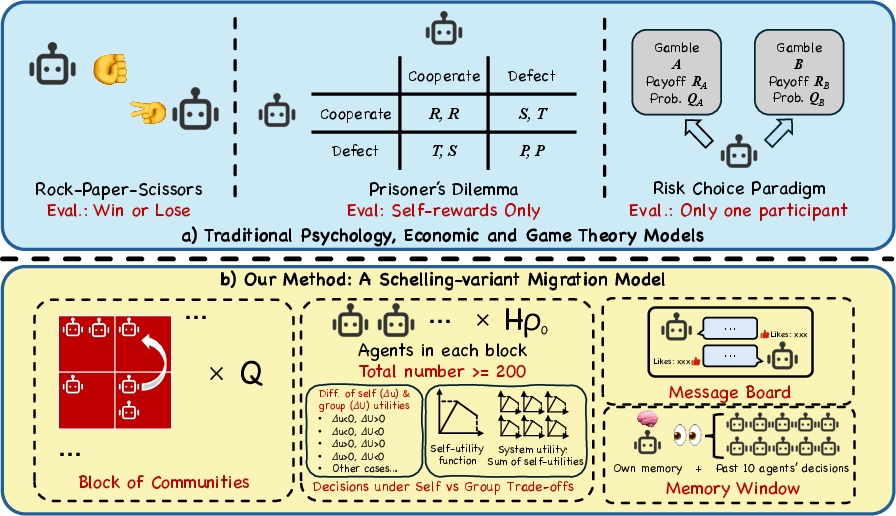
Figure 1: Through a Schelling-variant migration model, the method captures the emergence of diverse rationalities within a complex social environment.
The utility function is asymmetric around the optimal density, creating a social dilemma: agents are incentivized to make egoistic moves that increase personal utility but may prevent the system from reaching the global optimum. The experiment manipulates the level of social awareness in the agent prompts (GSD Levels 0–2) and the presence or absence of a message board to study the effects of social communication.
Quantitative and Qualitative Evaluation
The evaluation framework is mixed-methods. Quantitatively, macro-level outcomes are measured by the Price of Anarchy (PoA) and the Residential Gini Index (Gpop), while micro-level behaviors are classified in a 3x3 matrix based on the sign of changes in individual and system utility. Qualitatively, the authors employ a Grounded Theory-inspired coding pipeline, using an LLM-as-judge to analyze agent reasoning logs and message board content, extracting the cognitive underpinnings of observed behaviors.
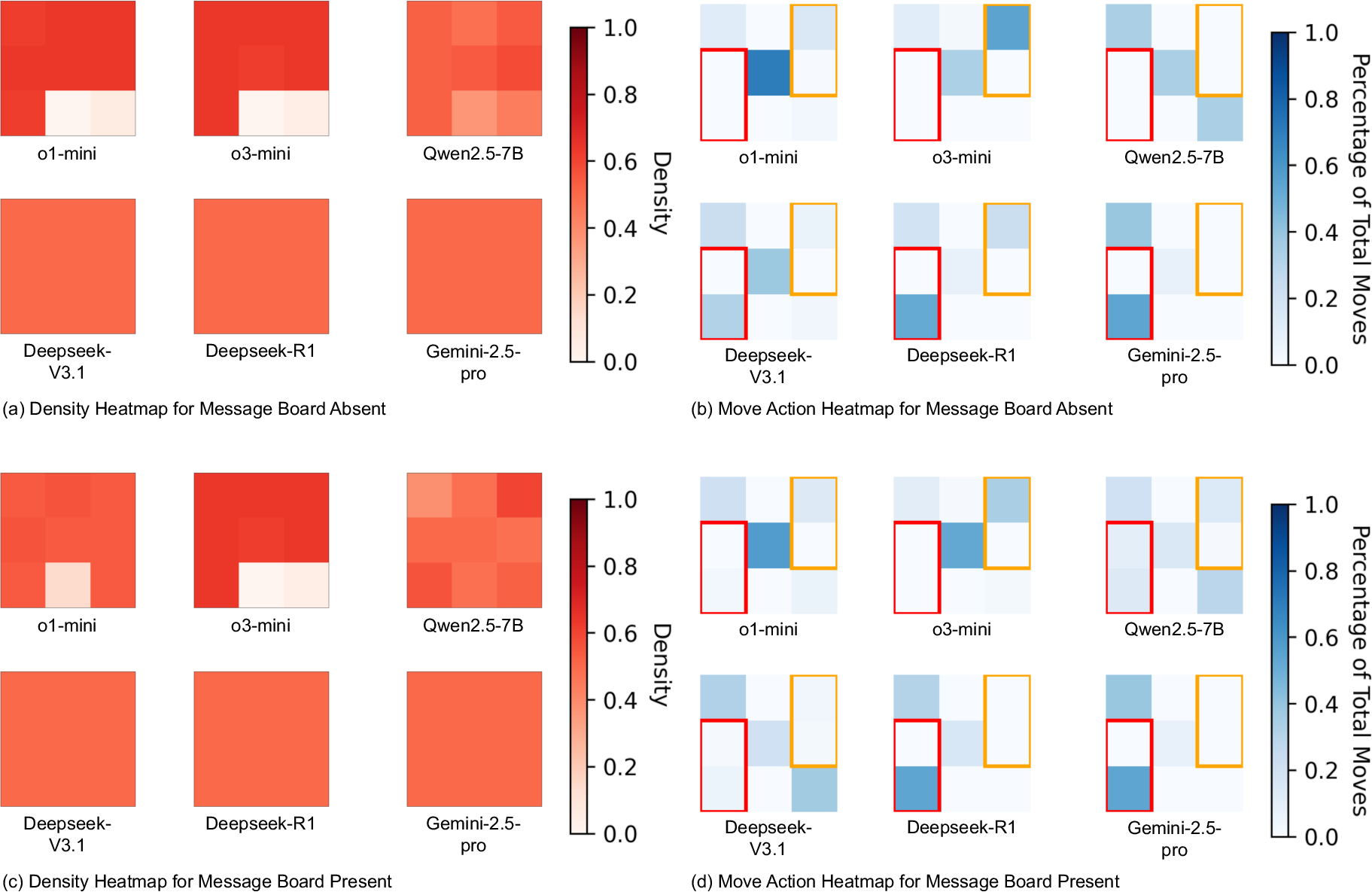
Figure 2: Visualization of convergence-state outcomes under the GSD Level 1 condition, showing final population density heatmaps and aggregated move action heatmaps for each model, with and without the message board.
Results: Bifurcation of Social Tendencies
Archetype 1: Adaptive Egoists
A subset of models (e.g., o1-mini, o3-mini, Qwen2.5-7B) are classified as "Adaptive Egoists." In the absence of social communication, these models default to self-interested behavior, as evidenced by low PoA (∼0.86), high Gpop (>0.21), and a high proportion of "Egoistic Actions" (up to 54.5%). Qualitative analysis reveals a cognitive architecture dominated by personal utility maximization and risk aversion, with minimal spontaneous altruism.
The introduction of the message board acts as a catalyst for pro-social behavior in these models. PoA increases (e.g., o1-mini: 0.9339), Gpop decreases, and the proportion of "Altruistic Actions" rises significantly (e.g., Qwen2.5-7B: 0.0% to 22.7%). The message board content shifts toward norm-setting and collective appeals, and agent reasoning incorporates social conformity and adherence to emergent norms.
Archetype 2: Altruistic Optimizers
A distinct class of models (e.g., Gemini-2.5-pro, Deepseek-R1, Deepseek-V3.1) are identified as "Altruistic Optimizers." These models consistently achieve system-optimal outcomes (PoA=1.0, Gpop=0.0) regardless of the presence of the message board. Their micro-level behavior is characterized by a high rate of "Altruistic Actions" (e.g., Gemini-2.5-pro: 53.8%), and qualitative analysis reveals a core logic of collective-centric motivation and explicit willingness to sacrifice personal utility for collective gain.
The message board in these societies functions primarily as a coordination mechanism, with public messages justifying altruistic sacrifices and reinforcing the maintenance of optimal states. The cognitive architecture is fundamentally different from the egoists, with system-level awareness and group welfare as the dominant decision drivers.
Implications for LLM-Driven Social Simulation
The findings have significant implications for the design and interpretation of LLM-driven ABM. The choice of LLM is not merely a technical decision about reasoning capability but a theoretical commitment to a particular model of social action. "Adaptive Egoists" are more suitable for simulating bounded rationality and norm formation in human societies, where sub-optimal equilibria and social influence are prevalent. "Altruistic Optimizers" are appropriate for modeling idealized pro-social actors or scenarios where collective welfare is paramount.
The results also challenge the sufficiency of small-scale, game-theoretic benchmarks for evaluating LLM social behavior. The emergence of strong reciprocity and norm-driven altruism in large-scale, multi-agent settings underscores the need for macro-level, society-scale evaluation frameworks.
Limitations and Future Directions
The study's limitations include the use of a simplified migration model and homogeneous agent populations. Future work should incorporate heterogeneous agent profiles, migration costs, and real-world demographic data to enhance ecological validity. Human-in-the-loop experiments are necessary to benchmark LLM agent behavior against actual human decision-making in analogous social dilemmas.
Conclusion
This work provides the first systematic evidence of intrinsic heterogeneity in the egoistic and altruistic tendencies of LLMs in large-scale agent societies. The identification of "Adaptive Egoists" and "Altruistic Optimizers" as stable behavioral archetypes has direct implications for the theoretical foundations and practical deployment of LLM-driven social simulations. Model selection must be guided by the alignment between the LLM's emergent social logic and the intended application domain, with explicit attention to the trade-offs between realism and idealization in simulating collective behavior.