- The paper presents a two-phase framework that synthesizes and refines solution trajectories for effective LLM domain adaptation.
- It achieves a 72.45% pass@1 accuracy on the Telemath benchmark, outperforming traditional methods and strong baseline models.
- The framework reduces energy consumption by 42% and latency by 60%, enhancing efficiency in edge and resource-constrained environments.
Data Trajectory Alignment for LLM Domain Adaptation
Introduction
The paper introduces Data Trajectory Alignment (DTA), a two-phase, model-agnostic data curation framework specifically designed for domain adaptation of LLMs in low-information-density domains like telecommunications mathematics. This framework emphasizes the alignment of the solution's process—encompassing the intermediate steps and presentation style—to the student's inductive biases. DTA's phases consist of an "Initializing" phase that synthesizes diverse candidates using strong teacher models, and a "DTA" phase that refines these solutions to align with the target model's strengths, applying signal-aware exemplar selection through agreement checks and reflection-based judging.
Methodology
Phase I - Initializing: This phase involves generating diverse, high-coverage candidates through an ensemble of strong teacher models. It synthesizes detailed solutions that act as the groundwork for the alignment process. The detailed solutions and domain knowledge points are extracted and summarized for generating novel training questions that integrate essential problem-solving skills.
Phase II - Data Trajectory Alignment (DTA): In this stage, the synthesized solutions are rewritten to align the intermediate steps and the presentation style with the student model's characteristics. This involves a peer-review-based filtering process to ensure correctness and the suitability of the training data. The rewritten solutions are then rigorously filtered and selected based on their informativeness and alignment with the desired reward metrics, as determined by a reflection-based judging system.
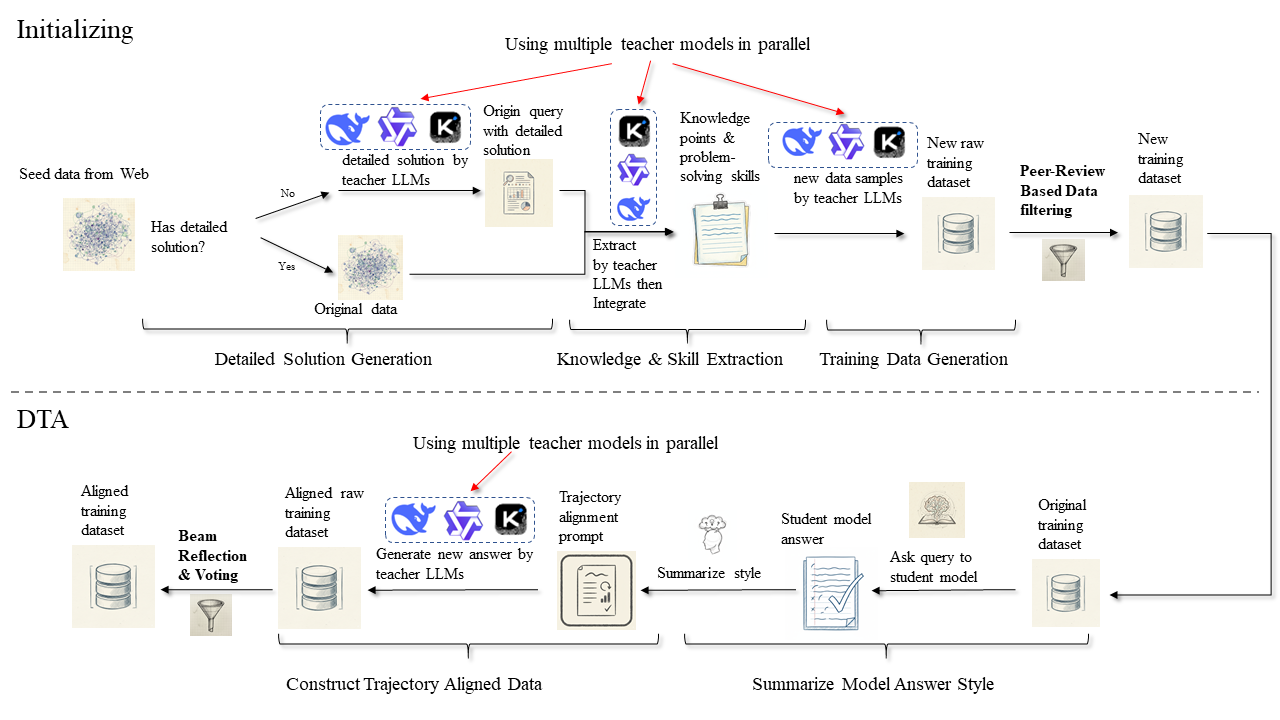
Figure 1: The working flow of the two-phase framework: initializing and DTA.
Results
The results on telecommunications mathematics demonstrated significant improvements with the application of DTA, achieving a pass@1 accuracy of 72.45% on the Telemath benchmark, surpassing both distilled-only training and a strong baseline model with explicit "thinking" capabilities by considerable margins. Notably, the data curation method was able to concentrate gains on logical-structural discourse markers rather than amplifying mere domain-specific nouns, indicating enhanced reasoning scaffolding.
System-Level Impact
Under edge-like inference conditions, the DTA framework proved highly efficient, reducing energy use per token by approximately 42% and end-to-end latency by 60% compared to the model with traditional "thinking-enabled" settings. This efficiency reflects DTA's capacity to improve inference without relying on expensive reasoning heuristics, presenting a practical advantage for mobile and edge deployments.
Practical and Theoretical Implications
Theoretically, the paper's approach of aligning how solutions are produced, rather than solely the solutions themselves, foregrounds an essential dimension in domain adaptation for LLMs—trajectory debt. By addressing this debt, DTA significantly enhances one-shot accuracy and robustness, which could be crucial for domains with strict resource constraints and formal correctness requirements, such as telecommunications.
Practically, the improved efficiency and accuracy presented by DTA offer a viable solution for deploying LLMs in resource-constrained environments without sacrificing performance or relying on computationally expensive inference-time adjustments.
Conclusion
Data Trajectory Alignment (DTA) provides an innovative approach to domain adaptation for LLMs by aligning the solution process trajectories with the student model's inductive biases. The framework demonstrates substantial accuracy gains and operational efficiencies in processing telecommunications mathematics, offering a promising avenue for deploying LLMs under constrained environments. Future research could enhance DTA by integrating verification-aware configurations and exploring broader domain applicability.