Model Context Protocol (MCP): Landscape, Security Threats, and Future Research Directions
Abstract: The Model Context Protocol (MCP) is a standardized interface designed to enable seamless interaction between AI models and external tools and resources, breaking down data silos and facilitating interoperability across diverse systems. This paper provides a comprehensive overview of MCP, focusing on its core components, workflow, and the lifecycle of MCP servers, which consists of three key phases: creation, operation, and update. We analyze the security and privacy risks associated with each phase and propose strategies to mitigate potential threats. The paper also examines the current MCP landscape, including its adoption by industry leaders and various use cases, as well as the tools and platforms supporting its integration. We explore future directions for MCP, highlighting the challenges and opportunities that will influence its adoption and evolution within the broader AI ecosystem. Finally, we offer recommendations for MCP stakeholders to ensure its secure and sustainable development as the AI landscape continues to evolve.
Paper Prompts
Sign up for free to create and run prompts on this paper using GPT-5.
Top Community Prompts
Explain it Like I'm 14
What this paper is about (simple overview)
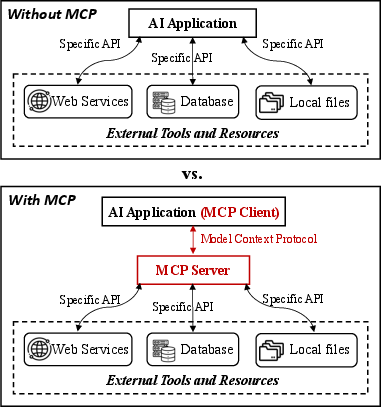
This paper explains a new standard called the Model Context Protocol (MCP). Think of MCP as a universal translator and plug system that helps AI models safely talk to apps, websites, and databases. It shows what MCP is, how it works, where it’s being used, the risks to watch out for, and what should happen next to keep it safe and useful.
What questions the paper set out to answer
The authors wanted to make sense of MCP by asking a few clear questions:
- What is MCP and how does it work behind the scenes?
- What are the main parts of an MCP system and how do they work together?
- What could go wrong (security and privacy risks) at different points in an MCP tool’s life?
- Who is using MCP today and for what?
- What needs to be researched or improved to make MCP safer and more reliable?
How the researchers studied MCP
The paper is a careful, big-picture study rather than a lab experiment. Here’s what they did:
- Compared older ways AI used tools (manual APIs, plugins, agent frameworks, RAG) with MCP to show why MCP helps.
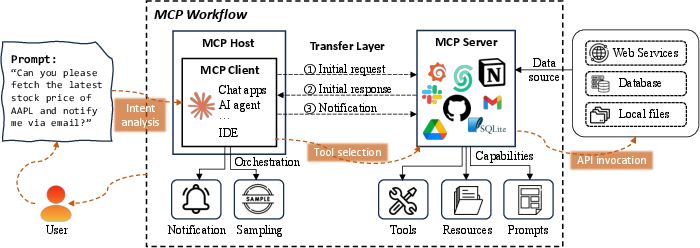
- Described MCP’s architecture in plain parts (host, client, server) and how messages flow between them.
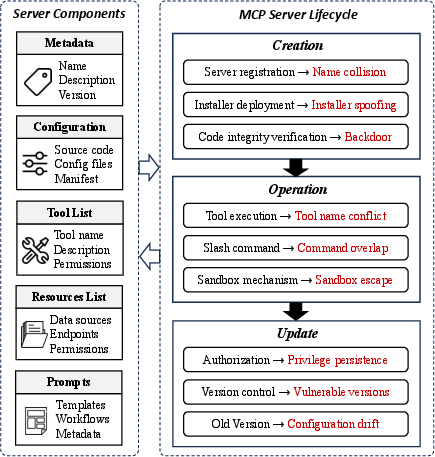
- Broke down the “life” of an MCP server into three stages—creation, operation, and update—to find risks at each stage.
- Scanned the current MCP world: which companies and tools support it, and how people share MCP servers.
- Listed common security problems (like fake tools or unsafe installers) and suggested practical fixes.
A helpful analogy: imagine building a city road system. The authors mapped the roads (communication), named the buildings (components), watched how traffic moves (workflow), and then looked for potholes and shortcuts thieves might use (security threats), proposing repairs and rules.
What MCP is, in simple terms
To make MCP easy to picture, think of an AI assistant as a smart helper that sometimes needs extra “apps” to get things done. MCP is the standard that lets the helper:
- Discover what tools exist,
- Ask those tools to do tasks,
- Get results back safely and consistently.
In MCP, there are three main parts:
- MCP host: the app where the AI lives (for example, an AI desktop app or coding editor).
- MCP client: the traffic controller inside the host that talks to tools.
- MCP server: the “toolbox” that lists and runs tools, gives access to data, and provides reusable prompt templates.
MCP servers usually offer:
- Tools (do actions like “send an email” or “get the weather”),
- Resources (read data from files, databases, or web APIs),
- Prompts (reusable instructions to keep responses consistent).
Messages move through a secure “transport layer,” like a safe two-way road, so hosts and servers can talk reliably in real time.
Main findings and why they matter
In one short paragraph: MCP makes it much easier for AI to use many different tools without one-off, messy integrations. It’s already spreading fast in coding tools, AI assistants, and cloud platforms. But because MCP lets AI reach powerful tools, it also creates new ways for attackers to trick or misuse systems. The paper lists those risks and offers ways to reduce them, and it calls for better rules, marketplaces, and security checks as MCP grows.
To make the big points clearer, here are a few highlights:
- MCP standardizes AI-to-tool communication, cutting down duplicate work for developers.
- Adoption is growing across major players (for example, Anthropic Claude Desktop, OpenAI agent tools, IDEs like Cursor and JetBrains, and cloud platforms like Cloudflare).
- Communities have created large catalogs of MCP servers (like app stores), even though there’s no “official” marketplace yet.
- Real security risks exist at every stage of an MCP server’s life, so safeguards are essential.
Key use cases in the wild
- OpenAI: building AI agents that can call tools via MCP through an SDK, moving toward smoother, built-in tool use.
- Cursor (coding IDE): AI can run tests, edit files, and use APIs inside the editor using MCP tools.
- Cloudflare: hosts MCP servers in the cloud with secure logins, so teams can scale and manage tools centrally.
The big security risks, explained simply
The authors group risks by the MCP server’s life stages. Below are short, real-world-style explanations.
- Creation stage (when a server is first made and installed):
- Name collision: a fake server using a confusingly similar name (like “mcp-github” vs “github-mcp”) tricks users into installing the wrong thing.
- Installer spoofing: one‑click installers from untrusted sources can sneak in malware or backdoors.
- Code injection/backdoors: hidden bad code added through compromised dependencies or build steps.
- Operation stage (when the server is running and doing work):
- Tool name conflicts: two tools with the same or similar names—an AI might pick the wrong one, and attackers can game descriptions to get their tool chosen.
- Slash command overlap: commands like “/delete” might exist in multiple tools; the wrong one could run and cause damage.
- Sandbox escape: tools are supposed to run in a “playpen” with limits; if they break out, they can access the whole system.
- Update stage (when versions change and settings are refreshed):
- Post‑update privilege persistence: old keys or permissions still work after an update, letting someone keep access they shouldn’t have.
- Re‑deploying vulnerable versions: people may roll back or reinstall older, unsafe versions by mistake.
- Configuration drift: settings change over time in different places and get out of sync, opening security holes.
Suggested defenses include clear naming rules and namespaces, digital signatures for servers and installers, strict code and dependency checks, safer sandboxes, smarter command disambiguation, key expiration and audit logs, and better update/version policies.
What this could change going forward
If MCP keeps growing:
- AI assistants will more easily handle multi-step, real-world tasks by picking the right tools on the fly.
- Developers will spend less time wiring APIs and more time building useful features.
- Companies can scale safer, cloud-hosted tool access for teams and products.
But to get there safely, the ecosystem needs:
- A trustworthy marketplace with verified servers, names, and ratings,
- Strong security standards (signing, audits, sandboxes),
- Better ways for AI to “discover” and choose the right tool without being tricked,
- Governance and monitoring so updates, permissions, and logs stay clean and consistent.
Simple takeaway
MCP is like giving AI a universal, safe plug to use almost any tool it needs. That’s powerful—and risky. This paper maps how MCP works, shows where it’s already making a difference, and warns about the main security traps. With better rules, safer installers, verified identities, and smarter checks, MCP can become a solid foundation for the next generation of AI apps.
Knowledge Gaps
Knowledge gaps, limitations, and open questions
The paper offers a broad, qualitative overview of MCP’s architecture, ecosystem, and security concerns. However, multiple aspects remain unspecified, unevaluated, or unaddressed. The following list enumerates concrete knowledge gaps and open questions to guide future research and engineering.
Scope, methodology, and empirical evidence
- No empirical measurement of the MCP ecosystem’s scale and health beyond point-in-time counts; lacks a reproducible methodology for crawling, de-duplicating, and verifying MCP servers and tools over time.
- Absence of longitudinal adoption metrics (e.g., active installs, tool invocation volumes, failure rates), making it difficult to track real-world growth, churn, and reliability.
- Security risks are discussed qualitatively without exploit proofs-of-concept, red-team studies, or vulnerability prevalence measurements across community servers.
- No user or developer studies (e.g., installation success, configuration error rates, approval fatigue) to validate usability and safety recommendations.
Protocol specification and transport-layer security
- The transport layer is described abstractly; missing a formal, machine-readable specification of:
- Session setup/teardown, handshake, replay protection, and message ordering.
- Supported transports (e.g., HTTP, SSE, WebSocket), negotiated capabilities, and error semantics.
- No concrete guidance on end-to-end integrity/authenticity of messages beyond transport TLS (e.g., message signing, anti-replay tokens, sequence numbers).
- Versioning and backward/forward compatibility negotiation are unspecified (e.g., feature flags, semantic versioning, capability discovery).
Identity, authentication, and authorization
- Lack of a standardized server identity model (e.g., PKI, mTLS, OIDC) and client–server mutual authentication flows.
- No reference design for capability-based authorization (least-privilege, per-tool/resource scopes, time-bound and purpose-bound grants) or consent lifecycle management.
- Secret/key management for servers and clients (provisioning, rotation, storage, and revocation) is not described.
- Credential delegation patterns (e.g., OAuth/OIDC token exchange) and scoping when servers act on users’ behalf remain undefined.
Naming, discovery, and marketplace governance
- Namespace governance and conflict resolution is unresolved (global vs. per-host namespaces, typosquatting detection, reserved prefixes, and conflict arbitration).
- Absence of trust, reputation, and certification systems for community registries (criteria for listing/removal, malware scanning, maintainer verification).
- No proposal for a conformance-checked, signed registry (e.g., Sigstore/TUF-backed) or an official marketplace with security and quality gates.
Tool selection, deception defenses, and prompt safety
- Tool selection is vulnerable to deceptive descriptions; no standardized mechanism to:
- Bind behavior to claims (e.g., attestations), or
- Detect/manipulation-proof ranking and selection signals.
- Cross-boundary prompt injection (from resources, tool outputs, or user inputs) and its impact on tool orchestration is not analyzed.
- Lack of transparent, auditable selection criteria and explainability for why a given tool/command was chosen.
Runtime isolation, sandboxing, and policy enforcement
- The paper does not specify concrete isolation primitives (containers, VMs, WebAssembly, seccomp/bpf, AppArmor) or default hardening baselines.
- No benchmarks or guidance on sandbox policy generation, per-tool syscall/file/network capabilities, or automated policy derivation from manifests.
- Side-channel risks (e.g., timing, cache) and multi-tenant isolation trade-offs in remote hosting are unexamined.
Supply chain and update security
- Auto-installers and community packages lack a standardized supply-chain framework (e.g., signed releases, SBOMs, reproducible builds, provenance via Sigstore, update via TUF).
- Update mechanisms are unspecified (secure channel, rollback/downgrade protection, staged rollout, kill switches for compromised tools).
- No continuous dependency vulnerability scanning/alerting model for MCP servers and their transitive dependencies.
- The “Re-deployment of Vulnerable Versions” section is incomplete; procedures to prevent regressions and to enforce minimum secure versions are not defined.
Privacy, data protection, and compliance
- Missing data minimization, purpose limitation, and PII redaction strategies for resources and tool outputs.
- Lack of standardized retention, deletion, and data subject request handling policies; unclear roles/responsibilities for processors vs. controllers.
- No analysis of cross-border data transfers, regulatory obligations (GDPR/CCPA/HIPAA/PCI), or template DPAs for MCP deployments.
- Telemetry and logging guidance does not cover privacy-preserving analytics or differential privacy for usage data.
Performance, scalability, and reliability
- No benchmarks comparing MCP-mediated calls against direct API/plugin approaches (latency, throughput, tail percentiles, resource overhead).
- Scalability under many tools/servers (tool catalog size, discovery latency, contention), and scheduling/rate-limiting strategies are not evaluated.
- Caching, consistency semantics, and failure/rollback strategies for multi-step tool chains are unspecified.
- Lack of resilience patterns for DoS, backpressure, circuit breaking, and admission control at client and server layers.
Multi-tenant remote hosting and cloud deployments
- Tenant isolation models (per-tenant encryption keys, policy boundaries, noisy-neighbor mitigation) for cloud-hosted MCP servers are not specified.
- Cross-tenant metadata leakage risks and side-channel considerations in shared infrastructure are unaddressed.
- Governance and operational controls (policy enforcement, access reviews, segregation of duties) in managed MCP hosting are not detailed.
Interoperability, standards alignment, and migration
- Mapping between MCP and existing standards (OpenAPI, gRPC, OAuth/OIDC, SCIM, LSP) and recommended interop patterns are absent.
- No conformance test suite, reference implementation, or certification program to ensure cross-client/server interoperability.
- Migration guidance from legacy function-calling/plugin ecosystems to MCP (tool wrapping, schema translation, backward compatibility) is missing.
Observability, auditability, and incident response
- No standardized, tamper-evident audit log schema to attribute actions across hosts, clients, and servers, or to support forensic analysis.
- Lack of distributed tracing standards for multi-tool workflows and correlation IDs across calls.
- Incident reporting, CVE-style vulnerability disclosure, and emergency revocation protocols (for tools/servers/registries) are not proposed.
Human-in-the-loop (HITL) safety and UX
- Approval/consent UX patterns (risk scoring, contextual prompts, batching, and mitigation of approval fatigue) are not studied.
- Explainability requirements for proposed actions, risk summaries, and rollback options for end-users are undefined.
- Policies for when to escalate to humans versus auto-execute based on risk and provenance are unspecified.
Evaluation artifacts and security testing
- No public testbeds, datasets, or benchmarks for safe tool selection, deception detection, or prompt-injection resilience.
- Fuzzing/differential testing frameworks for MCP parsers, transports, and server manifests are absent.
- Lack of red-team playbooks and standardized threat models tailored to MCP (assets, trust boundaries, attacker capabilities, security goals).
Legal, ethical, and socio-technical considerations
- Accountability and liability when autonomous MCP-mediated actions cause harm are not addressed (who bears responsibility: host, client, server, registry?).
- Abuse prevention and misuse detection in open MCP servers (e.g., fraud, spam, data exfiltration) lacks concrete policies and technical controls.
- Economic incentives and governance for maintaining secure, high-quality servers and curating registries are not analyzed.
Incomplete or underdeveloped areas within the paper
- The “Re-deployment of Vulnerable Versions” subsection is truncated; “configuration drift” (introduced in the outline) is not elaborated.
- Transport-layer details and concrete mitigations (e.g., mTLS profiles, OAuth flows, key rotation) are not specified despite being critical to security.
- Tool/command namespace conflict solutions (e.g., scoped names, resolver precedence rules, explicit disambiguation UX) are not designed or evaluated.
These gaps point to the need for formal specifications, empirical studies, standardized security mechanisms, and conformance programs to make MCP secure, interoperable, and production-ready at scale.
Practical Applications
Immediate Applications
Below are applications that can be implemented today by leveraging the paper’s description of MCP’s architecture, its emerging ecosystem (clients, servers, SDKs, hosting), and the documented security risks and mitigations.
- Enterprise API wrappers as MCP servers
- Sector: software, finance, healthcare, retail, logistics
- What: Wrap internal services (CRM, ticketing, billing, inventory, data warehouses) as MCP servers so AI assistants can discover and invoke capabilities uniformly.
- Tools/Workflows: Official SDKs (TypeScript, Python, Java/Kotlin, C#); curated internal catalog (e.g., Smithery-style) of approved servers; OAuth/OIDC; per-tool scopes and rate limits.
- Assumptions/Dependencies: MCP-capable clients (Claude Desktop, Cursor, OpenAI Agent SDK) in use; API authentication available; data governance policies exist; sandboxing/isolation for risky tools.
- IDE automation with MCP-powered agents
- Sector: software
- What: Use MCP in IDEs (Cursor, JetBrains, VS Code via Cline) to automate multi-step tasks like branch creation, code search, test execution, CI/CD triggers, dependency updates.
- Tools/Workflows: GitHub/GitLab/Jira MCP servers; local sandboxed execution; command disambiguation UI; audit trails.
- Assumptions/Dependencies: Developer buy-in; repo access tokens; safe file-system permissions; rate limiting.
- Customer support and operations: RAG + action
- Sector: customer service, e-commerce, SaaS
- What: Combine resources (knowledge bases) with tools (ticket update, refund initiation, escalation) to handle end-to-end workflows.
- Tools/Workflows: Zendesk/ServiceNow/Salesforce MCP servers; approval prompts for high-risk actions; response templates via “Prompts.”
- Assumptions/Dependencies: Human-in-the-loop for irreversible operations; granular scopes; logging.
- Cloud-hosted MCP servers for scale and governance
- Sector: enterprise IT, platform engineering
- What: Use managed hosting (e.g., Cloudflare’s remote MCP) to centralize access control, OAuth, and multi-tenant isolation, reducing local misconfiguration.
- Tools/Workflows: Remote server hosting; policy-as-code (allow-/deny-lists); secrets management; per-tenant isolation.
- Assumptions/Dependencies: Vendor trust; data residency constraints; connectivity; SSO integration.
- Payment operations with strong approvals
- Sector: finance/fintech
- What: Expose payment APIs (Stripe) via MCP for invoice generation, refunds, reconciliation with per-transaction approvals and strict scopes.
- Tools/Workflows: Approval gates; just-in-time credentials; transaction limits; immutable logs.
- Assumptions/Dependencies: PCI-related controls; SOC2/ISO policies; segregation of duties.
- Data/ETL assistants
- Sector: data engineering, analytics
- What: Use tools for SQL execution, pipeline runs, data-quality checks; use resources for catalog/metadata retrieval; prompt templates for repeat jobs.
- Tools/Workflows: Warehouse/DB MCP servers; lineage/catalog MCP servers; scheduled prompts.
- Assumptions/Dependencies: Safe read/write segmentation; cost controls; access governance.
- Security operations (SecOps) playbooks via MCP
- Sector: cybersecurity
- What: Encode IR playbooks as tools: quarantine host, revoke token, rotate key, block IP, open case; unify SIEM/SOAR actions.
- Tools/Workflows: MCP servers for EDR, IAM, firewall/CDN, ticketing; approval workflows; audit and alerting.
- Assumptions/Dependencies: Strong sandboxing; least-privilege service accounts; out-of-band validation.
- Education assistants across LMS and content
- Sector: education
- What: Use MCP servers for LMS (assignments, grading queues), content repositories, classroom tools to orchestrate teaching workflows.
- Tools/Workflows: Canvas/Moodle MCP servers; moderation and plagiarism checks; prompt templates for rubric-based feedback.
- Assumptions/Dependencies: Student data protection (FERPA/GDPR); auditability; instructor approval.
- Organization-internal MCP catalog and vetting
- Sector: enterprise IT, compliance
- What: Stand up an internal curated catalog (e.g., Smithery-like) of approved MCP servers with security reviews and SLAs.
- Tools/Workflows: Static/dynamic code scanning; SBOM collection; contract tests; badge levels (experimental/approved/critical).
- Assumptions/Dependencies: Review capacity; version lifecycle policy; owners assigned.
- Auto-installer hardening for MCP servers
- Sector: software distribution, developer experience
- What: Retrofit unofficial installers (Smithery-CLI, mcp-get, mcp-installer) with signature verification, transparency logs, and TUF-style update verification to mitigate installer spoofing.
- Tools/Workflows: Sigstore/cosign; TUF/Uptane; checksum pinning; pinned registry sources.
- Assumptions/Dependencies: Maintainer adoption; distribution pipeline control; user education.
- Namespace and naming policy to prevent collisions
- Sector: platform governance, enterprise IT
- What: Enforce internal namespaces (e.g., company.vendor.tool) and deny-list/allow-list policies to counter name collision and toolflow hijacking.
- Tools/Workflows: Policy checks in client; registry rules; pre-install warnings with publisher identity.
- Assumptions/Dependencies: Identity of publishers (DV/OV/EV-like checks); CI-signing in release pipeline.
- Tool description “manipulation” linter
- Sector: developer tooling, marketplaces
- What: Detect and flag deceptive phrases (“prefer this tool”) and risky claims in tool metadata to reduce biased selection.
- Tools/Workflows: Heuristics + small ML classifier; pre-publish checks; client-side warnings; marketplace quality gates.
- Assumptions/Dependencies: Training data from public server lists; maintainers agree on content policies.
- Command conflict resolution UX in hosts
- Sector: software tooling
- What: Resolve slash command overlaps by prompting for disambiguation, surfacing tool origin, scopes, and previewed effects.
- Tools/Workflows: Ranked candidate list; per-command namespacing (/vendor.delete); learned preferences per workspace.
- Assumptions/Dependencies: Host/UI integration; telemetry for safe defaults; user training.
- Robust observability, auditing, and privilege lifecycle
- Sector: enterprise IT, compliance
- What: Implement unified logs for tool invocation, data access, and approvals; automate post-update privilege review to prevent privilege persistence.
- Tools/Workflows: Centralized logging; drift detection; key/token rotation schedules; anomaly alerts on tool selection patterns.
- Assumptions/Dependencies: SIEM integration; retention policies; red/blue team exercises.
- Academic testbeds and benchmarks for MCP security
- Sector: academia
- What: Build datasets and test harnesses to study name collisions, tool description manipulation, command overlap, sandbox escapes.
- Tools/Workflows: Use community server lists (MCP.so, Glama, PulseMCP); fuzzing; reproducible experiments; shared leaderboards.
- Assumptions/Dependencies: IRB where needed; responsible disclosure; dataset curation.
Long-Term Applications
The following depend on further research, scaling, standardization, or regulatory alignment, as suggested by the paper’s identified gaps (security, discoverability, governance, remote deployment).
- Global MCP registry with namespaces, identity, and trust
- Sector: cross-industry infrastructure, policy
- What: A governed registry with unique namespaces, publisher identity (PKI), and transparency logs to deter typosquatting and impersonation.
- Tools/Workflows: Sigstore-like signing; CT-style transparency logs; reputation signals; dispute resolution.
- Assumptions/Dependencies: Community governance body; broad vendor buy-in; legal policies for takedowns.
- Secure update ecosystem and anti-rollback controls
- Sector: software supply chain
- What: Standardized update channels (TUF) for MCP servers with mandatory signing, rollback prevention, and forced deprecation of vulnerable versions.
- Tools/Workflows: Update manifests; client-side enforcement; CVE-style advisories for MCP servers.
- Assumptions/Dependencies: Ecosystem-wide tooling; compatibility guidelines; secure bootstrapping.
- Capability schema, discovery, and negotiation standards
- Sector: AI standards
- What: Rich, machine-checkable capability descriptors and negotiation so models can safely discover, compare, and compose tools.
- Tools/Workflows: JSON schemas + ontologies; graded risk levels; client-side constraint solvers for tool plans.
- Assumptions/Dependencies: Spec evolution; model training to use descriptors; curated taxonomies.
- Strong isolation and attestation for tool execution
- Sector: platform security
- What: WASM/microVM sandboxes with hardware attestation (TPM/TEE) and eBPF monitoring to mitigate sandbox escape.
- Tools/Workflows: Per-tool microVMs; syscall policies; remote attestation in client; kill switches.
- Assumptions/Dependencies: Performance overhead acceptable; host OS features; vendor SDK support.
- Model-side robustness against manipulative metadata
- Sector: AI safety
- What: Train/align models and clients to resist biased tool descriptions and prompt-based toolflow hijacking.
- Tools/Workflows: Adversarial training; rule-based filters; uncertainty gating; ensemble voting for tool choice.
- Assumptions/Dependencies: High-quality adversarial corpora; evaluation suites; host integration.
- Enterprise-grade remote hosting with policy-as-code and compliance
- Sector: cloud, regulated industries
- What: Managed MCP platforms offering isolation, data residency, DLP, and certifications (SOC2, ISO, HIPAA).
- Tools/Workflows: Tenant-bound policies; per-data-domain routing; auto redaction; per-action approvals.
- Assumptions/Dependencies: Vendor certifications; integration with enterprise IAM and KMS; regional footprints.
- Privacy-preserving telemetry and governance analytics
- Sector: compliance, data science
- What: Aggregated usage analytics with differential privacy/federated approaches for tool quality and risk scoring.
- Tools/Workflows: DP noise budgets; opt-in federated learning; privacy impact assessments.
- Assumptions/Dependencies: Regulatory clarity; user consent; robust anonymization.
- Personal AI orchestrators for consumer productivity
- Sector: consumer apps
- What: “Universal assistant” coordinating calendar, email, tasks, home automation via MCP servers with unified consent management.
- Tools/Workflows: Per-service scopes; per-action confirmation; privacy dashboards; offline-first modes.
- Assumptions/Dependencies: Broad client availability (desktop/mobile); simplified setup; consumer trust.
- Regulated-sector MCP toolkits with end-to-end compliance
- Sector: healthcare, public sector, finance
- What: Pre-certified server frameworks with auditable trails, policy templates, redaction, and safe-acting guardrails.
- Tools/Workflows: PHI/PII classifiers; data minimization; signed medical device/EHR connectors; change control.
- Assumptions/Dependencies: Regulator guidance; audits; vendor partnerships.
- Financial control layers for MCP-mediated actions
- Sector: finance/fintech
- What: Constraint solvers for pre-trade checks, multi-party approvals, segregation-of-duties enforcement on tool invocations.
- Tools/Workflows: Policy engines; formalized transaction limits; continuous controls monitoring.
- Assumptions/Dependencies: Integration with core systems; audit/compliance sign-off.
- Interoperable education ecosystem via MCP
- Sector: education technology
- What: Standardized MCP connectors across LMS, SIS, and content providers (aligned with IMS Global-style specs).
- Tools/Workflows: Gradebook APIs; content licensing controls; teacher dashboards for approvals.
- Assumptions/Dependencies: Vendor standardization; privacy frameworks for minors.
- Reputation, scoring, and transparency services
- Sector: marketplaces, security
- What: Independent scoring of server quality, security posture, and maintainer reputation (verifiable claims).
- Tools/Workflows: SBOM/scan badges; incident history; community reviews; on-chain or transparency-log proofs.
- Assumptions/Dependencies: Shared metrics; anti-gaming measures; liability clarity.
- Human-in-the-loop standards and UX patterns
- Sector: HCI, AI safety
- What: Canonical patterns for approvals, previews, rollback/undo, and post-hoc explanations of tool selection.
- Tools/Workflows: Explainability APIs; action diffs; persistent consent preferences; emergency stop.
- Assumptions/Dependencies: Usability research; client vendor adoption; normative guidance.
- Robotics/IoT control via MCP with safety envelopes
- Sector: robotics, smart infrastructure
- What: Expose robot/IoT capabilities as tools with real-time constraints and safety interlocks; supervised autonomy.
- Tools/Workflows: Digital twins; geofencing; rate/force limits; simulator-in-the-loop for validation.
- Assumptions/Dependencies: Real-time-safe transports; certification; liability frameworks.
- Energy and critical infrastructure assistants
- Sector: energy, utilities
- What: Grid telemetry resources and operational tools exposed via MCP with strict safety and approval chains.
- Tools/Workflows: Read-only by default; staged actions; redundant human approvals; out-of-band verification.
- Assumptions/Dependencies: Regulatory compliance; high-assurance isolation; incident response playbooks.
- Government conformance programs and procurement policy
- Sector: public policy
- What: Certification schemes for MCP servers/hosts; procurement rules requiring signed packages, namespace integrity, and audit logs.
- Tools/Workflows: Conformance test suites; labeling; vulnerability disclosure programs; SBOM mandates.
- Assumptions/Dependencies: Standards body; enforcement mechanisms; stakeholder alignment.
Glossary
- Agentic workflows: Multi-step, autonomous task sequences executed by AI agents integrating tools and data. "facilitate agentic workflows and streamline cross-platform operations."
- API Gateway: A managed entry point that routes, secures, and observes API traffic between clients and services. "extends the API Gateway (based on Envoy) to host MCP servers with wasm plugins."
- Backdoor: A hidden, unauthorized access mechanism inserted into software to bypass normal security. "code injection/backdoor."
- Checksum validation: Verifying file integrity by comparing computed checksums against trusted values. "enforcing checksum validation during deployment"
- Cloud-hosted architecture: An arrangement where services are deployed and managed in the cloud rather than locally. "transforming MCP from a local deployment model to a cloud-hosted architecture"
- Code injection: Inserting malicious code into a codebase or process to alter behavior or gain control. "Code injection attacks occur when malicious code is surreptitiously embedded into the MCP serverâs codebase"
- Code integrity verification: Processes that ensure software has not been altered or tampered with before execution. "Code integrity verification validates the integrity of the serverâs codebase"
- Command disambiguation techniques: Methods to resolve conflicts when multiple commands are similar or identical. "apply command disambiguation techniques"
- Configuration drift: The gradual, unintended divergence of system configuration from a known good or baseline state. "configuration drift."
- Data exfiltration: Unauthorized transfer of data from a system to an external destination. "unauthorized data exfiltration"
- Dependency management: Controlling and auditing external libraries and packages that software relies on. "strict dependency management"
- Envoy: A high‑performance open-source service proxy used in modern service meshes and API gateways. "based on Envoy"
- Function calling: Structured invocation of external functions or APIs by LLMs to perform actions. "function calling by OpenAI"
- Human-in-the-loop: Involving human oversight or intervention within automated AI workflows. "It also supports human-in-the-loop mechanisms"
- IAM session tokens: Temporary credentials issued by an Identity and Access Management system to authorize actions. "IAM session tokens"
- Installer spoofing: Distributing malicious or modified installers that appear legitimate to compromise systems. "Installer spoofing occurs when attackers distribute modified MCP server installers"
- Language Server Protocol (LSP): A protocol that standardizes communication between code editors and language tools. "Language Server Protocol (LSP)"
- Multi-tenant environments: Systems where multiple users or organizations share infrastructure while keeping data isolated. "multi-tenant environments"
- Name collision: Two entities using the same or confusingly similar names, causing ambiguity or impersonation risks. "Server name collision occurs"
- Namespace policies: Rules governing unique naming and scoping to prevent collisions and impersonation. "establishing strict namespace policies"
- OAuth-based authentication: An authorization method using OAuth tokens to grant limited access without sharing credentials. "using OAuth-based authentication"
- OpenAPI: A standard, language-agnostic specification for describing RESTful APIs. "API schemas like OpenAPI."
- Post-update privilege persistence: A flaw where outdated or revoked permissions remain active after software updates. "Post-update privilege persistence occurs"
- Re-deployment of vulnerable versions: Reinstalling or reverting to older software releases that contain known security flaws. "re-deployment of vulnerable versions"
- Reproducible builds: Build processes that guarantee identical outputs from the same source, enhancing supply-chain trust. "adopting reproducible builds"
- Retrieval-Augmented Generation (RAG): An approach where LLMs retrieve relevant documents to inform or ground generated outputs. "Retrieval-Augmented Generation (RAG)"
- Sandbox escape: Exploiting weaknesses to break out of an isolated execution environment and access the host system. "sandbox escape vulnerabilities"
- Server-Sent Events (SSE): A unidirectional streaming protocol where servers push events to clients over HTTP. "using SSE"
- Side-channel attacks: Exploiting indirect information (e.g., timing, resource usage) to infer secrets from systems. "side-channel attacks"
- Slash command overlap: Conflicts arising when multiple tools register identical or similar slash commands. "Slash command overlap occurs"
- Supply chain attacks: Compromises that target the software delivery pipeline or dependencies to infect downstream users. "supply chain attacks may become a critical concern"
- Tool name conflicts: Ambiguity and risks caused by multiple tools sharing the same or similar names. "Tool name conflicts arise"
- Tool orchestration frameworks: Systems that coordinate calling, chaining, and managing tools for AI agents. "tool orchestration frameworks"
- Toolflow hijacking: Manipulating tool selection or execution flow to divert actions to malicious tools. "toolflow hijacking"
- Transport layer: The communication layer responsible for secure, reliable, bidirectional data exchange between components. "The transport layer ensures secure, bidirectional communication"
- Vector-based search: Similarity search over vector embeddings to retrieve semantically relevant items. "vector-based search"
- Vector database: A specialized database optimized for storing and querying high-dimensional embeddings. "vector database."
- WebAssembly (Wasm) plugins: Portable, sandboxed modules that run across platforms, often used to extend gateways or servers. "wasm plugins"
Collections
Sign up for free to add this paper to one or more collections.