Cross-lingual Offensive Language Detection: A Systematic Review of Datasets, Transfer Approaches and Challenges
Abstract: The growing prevalence and rapid evolution of offensive language in social media amplify the complexities of detection, particularly highlighting the challenges in identifying such content across diverse languages. This survey presents a systematic and comprehensive exploration of Cross-Lingual Transfer Learning (CLTL) techniques in offensive language detection in social media. Our study stands as the first holistic overview to focus exclusively on the cross-lingual scenario in this domain. We analyse 67 relevant papers and categorise these studies across various dimensions, including the characteristics of multilingual datasets used, the cross-lingual resources employed, and the specific CLTL strategies implemented. According to "what to transfer", we also summarise three main CLTL transfer approaches: instance, feature, and parameter transfer. Additionally, we shed light on the current challenges and future research opportunities in this field. Furthermore, we have made our survey resources available online, including two comprehensive tables that provide accessible references to the multilingual datasets and CLTL methods used in the reviewed literature.
- Automatic detection of offensive language for urdu and roman urdu. IEEE Access 8 (2020), 91213–91226.
- Areej Al-Hassan and Hmood Al-Dossari. 2019. Detection of hate speech in social networks: a survey on multilingual corpus. In Proc. of COMIT, Vol. 10. 10–5121.
- Dataset construction for the detection of anti-social behaviour in online communication in Arabic. Procedia Computer Science 142 (2018), 174–181.
- Hate speech detection in the Indonesian language: A dataset and preliminary study. In Proc. of ICACSIS. 233–238.
- Building for tomorrow: Assessing the temporal persistence of text classifiers. Information Processing & Management 60, 2 (2023), 103200.
- Fatimah Alkomah and Xiaogang Ma. 2022. A literature review of textual hate speech detection methods and datasets. Information 13, 6 (2022), 273.
- Deep learning models for multilingual hate speech detection. arXiv preprint arXiv:2004.06465 (2020).
- A Deep Dive into Multilingual Hate Speech Classification. In Proc. of ECML PKDD, Yuxiao Dong, Georgiana Ifrim, Dunja Mladenić, Craig Saunders, and Sofie Van Hoecke (Eds.). Springer, Cham, 423–439.
- UrduThreat@FIRE2021: Shared Track on Abusive Threat Identification in Urdu. In Proc. of FIRE (Virtual Event, India). ACM, New York, NY, USA, 9–11.
- Hate Speech Detection is Not as Easy as You May Think: A Closer Look at Model Validation. In Proc. of ACM SIGIR (Paris, France). ACM, New York, NY, USA, 45–54.
- Cross-lingual hate speech detection based on multilingual domain-specific word embeddings. arXiv preprint arXiv:2104.14728 (2021).
- Hate speech detection is not as easy as you may think: A closer look at model validation (extended version). Information Systems 105 (2022), 101584.
- Resources for Multilingual Hate Speech Detection. In Proc. of the WOAH Workshop. ACL, Seattle, Washington (Hybrid), 122–130.
- Masaki Arata. 2019. Study on change of detection accuracy over time in cyberbullying detection. Ph. D. Dissertation. Master’s thesis, Kitami Institute of Technology, Department of Computer Science.
- Mikel Artetxe and Holger Schwenk. 2019. Massively Multilingual Sentence Embeddings for Zero-Shot Cross-Lingual Transfer and Beyond. Transactions of the ACL 7 (2019), 597–610.
- Model-Agnostic Meta-Learning for Multilingual Hate Speech Detection. IEEE Trans. on Computational Social Systems (2023), 1–10.
- Machine learning techniques for hate speech classification of twitter data: State-of-the-art, future challenges and research directions. Computer Science Review 38 (2020), 100311.
- Code-Switching Patterns Can Be an Effective Route to Improve Performance of Downstream NLP Applications: A Case Study of Humour, Sarcasm and Hate Speech Detection. In Proc. of ACL. ACL, Online, 1018–1023.
- SemEval-2019 Task 5: Multilingual Detection of Hate Speech Against Immigrants and Women in Twitter. In Proc. of the SemEval Workshop. ACL, Minneapolis, Minnesota, USA, 54–63.
- Developing a multilingual annotated corpus of misogyny and aggression. arXiv preprint arXiv:2003.07428 (2020).
- Cross-Lingual Transfer Learning for Hate Speech Detection. In Proc. of the LT-EDI Workshop. ACL, Kyiv, 15–25.
- Addressing the Challenges of Cross-Lingual Hate Speech Detection. arXiv preprint arXiv:2201.05922 (2022).
- Label modification and bootstrapping for zero-shot cross-lingual hate speech detection. Language Resources and Evaluation (2023), 1–32.
- A Dataset of Hindi-English Code-Mixed Social Media Text for Hate Speech Detection. In Proc. of PEOPLES Workshop. ACL, New Orleans, Louisiana, USA, 36–41.
- Overview of the evalita 2018 hate speech detection task. In Proc. of CEUR Workshop, Vol. 2263. CEUR, 1–9.
- Detecting Hateful and Offensive Speech in Arabic Social Media Using Transfer Learning. Applied Sciences 12, 24 (2022).
- Uwe Bretschneider and Ralf Peters. 2017. Detecting offensive statements towards foreigners in social media. (2017).
- Language models are few-shot learners. Proc. of NeurIPS 33 (2020), 1877–1901.
- Ben Burtenshaw and Mike Kestemont. 2021. A Dutch Dataset for Cross-lingual Multilabel Toxicity Detection. In Proc. of the BUCC Workshop. INCOMA Ltd., Online (Virtual Mode), 75–79.
- Dravidiancodemix: Sentiment analysis and offensive language identification dataset for dravidian languages in code-mixed text. Language Resources and Evaluation 56, 3 (2022), 765–806.
- Towards countering hate speech against journalists on social media. Online Social Networks and Media 17 (2020), 100071.
- AdaPrompt: Adaptive Model Training for Prompt-based NLP. In Findings of EMNLP. ACL, Abu Dhabi, United Arab Emirates, 6057–6068.
- Anusha Chhabra and Dinesh Kumar Vishwakarma. 2023. A literature survey on multimodal and multilingual automatic hate speech identification. Multimedia Systems (2023), 1–28.
- Multilingual and Multitarget Hate Speech Detection in Tweets. In Proc. of TALN-RECITAL. ATALA, Toulouse, France, 351–360.
- CONAN - COunter NArratives through Nichesourcing: a Multilingual Dataset of Responses to Fight Online Hate Speech. In Proc. of ACL. ACL, Florence, Italy, 2819–2829.
- Çağrı Çöltekin. 2020. A corpus of Turkish offensive language on social media. In Proc. of LREC. 6174–6184.
- Unsupervised Cross-lingual Representation Learning at Scale. In Proc. of ACL. ACL, Online, 8440–8451.
- Hybrid Emoji-Based Masked Language Models for Zero-Shot Abusive Language Detection. In Findings of EMNLP. ACL, Online, 943–949.
- Data Bootstrapping Approaches to Improve Low Resource Abusive Language Detection for Indic Languages. In Proc. of ACM HT (Barcelona, Spain). ACM, New York, NY, USA, 32–42.
- Automated Hate Speech Detection and the Problem of Offensive Language. In Proc. of ICWSM (Montreal, Canada). 512–515.
- Hate Speech Dataset from a White Supremacy Forum. In Proc. of the ALW Workshop. ACL, Brussels, Belgium, 11–20.
- Gretel Liz De la Peña Sarracén and Paolo Rosso. 2022. Unsupervised Embeddings with Graph Auto-Encoders for Multi-domain and Multilingual Hate Speech Detection. In Proc. of LREC. ELRA, Marseille, France, 2196–2204.
- Rogers de Pelle and Viviane Moreira. 2017. Offensive Comments in the Brazilian Web: a dataset and baseline results. In Anais do VI Brazilian Workshop on Social Network Analysis and Mining (São Paulo). SBC, Porto Alegre, RS, Brasil.
- Wubetu Barud Demilie and Ayodeji Olalekan Salau. 2022. Detection of fake news and hate speech for Ethiopian languages: a systematic review of the approaches. Journal of Big Data 9, 1 (2022), 66.
- COLD: A Benchmark for Chinese Offensive Language Detection. In Proc. of EMNLP. ACL, Abu Dhabi, United Arab Emirates, 11580–11599.
- Highly generalizable models for multilingual hate speech detection. arXiv preprint arXiv:2201.11294 (2022).
- BERT: Pre-training of Deep Bidirectional Transformers for Language Understanding. In Proc. of NAACL-HLT. ACL, Minneapolis, Minnesota, 4171–4186.
- Exploring linguistic features for extremist texts detection (on the material of Russian-speaking illegal texts). In Proc. of IEEE ISI. 188–190.
- Suman Dowlagar and Radhika Mamidi. 2021. A survey of recent neural network models on code-mixed indian hate speech data. In Proc. of FIRE. 67–74.
- Matthew S. Dryer and Martin Haspelmath (Eds.). 2013. WALS Online (v2020.3). Zenodo. https://doi.org/10.5281/zenodo.7385533
- Machine Learning and Affect Analysis against Cyber-Bullying. In Proc. of the Linguistic and Cognitive Approaches to Dialog Agents Symposium.
- Hate Speech Detection on Multilingual Twitter Using Convolutional Neural Networks. Revue d’Intelligence Artificielle 34, 1 (2020), 81–88.
- Peer to peer hate: Hate speech instigators and their targets. In Proc. of ICWSM, Vol. 12.
- Transfer language selection for zero-shot cross-lingual abusive language detection. Information Processing & Management 59, 4 (2022), 102981.
- Language-agnostic BERT Sentence Embedding. In Proc. of ACL. ACL, Dublin, Ireland, 878–891.
- Jointly Learning to Embed and Predict with Multiple Languages. In Proc. of ACL). ACL, Berlin, Germany, 2019–2028.
- Overview of the Evalita 2018 Task on Automatic Misogyny Identification (AMI). In EVALITA@CLiC-it.
- Overview of the Task on Automatic Misogyny Identification at IberEval 2018. In IberEval@SEPLN.
- Model-agnostic meta-learning for fast adaptation of deep networks. In Proc. of ICML. PMLR, 1126–1135.
- Using Cross Lingual Learning for Detecting Hate Speech in Portuguese. In Database and Expert Systems Applications, Christine Strauss, Gabriele Kotsis, A. Min Tjoa, and Ismail Khalil (Eds.). Springer, Cham, 170–175.
- Time of your hate: The challenge of time in hate speech detection on social media. Applied Sciences 10, 12 (2020), 4180.
- Rights for Peace. [n. d.]. What is Hate Speech? https://www.rightsforpeace.org/hate-speech. Accessed: 2023-10-24.
- Paula Fortuna. 2017. Automatic detection of hate speech in text: an overview of the topic and dataset annotation with hierarchical classes.
- Paula Fortuna and Sérgio Nunes. 2018. A Survey on Automatic Detection of Hate Speech in Text. 51, 4, Article 85 (jul 2018), 30 pages.
- A Hierarchically-Labeled Portuguese Hate Speech Dataset. In Proc. of the ALW Workshop. ACL, Florence, Italy, 94–104.
- Large scale crowdsourcing and characterization of twitter abusive behavior. In Proc. of ICWSM, Vol. 12.
- Cross-lingual Offensive Language Identification for Low Resource Languages: The Case of Marathi. In Proc. of RANLP. INCOMA Ltd., Held Online, 437–443.
- Lei Gao and Ruihong Huang. 2017. Detecting online hate speech using context aware models. arXiv preprint arXiv:1710.07395 (2017).
- Handling Bias in Toxic Speech Detection: A Survey. 55, 13s, Article 264 (jul 2023), 32 pages.
- XHate-999: Analyzing and Detecting Abusive Language Across Domains and Languages. In Proc. of COLING. ICCL, Barcelona, Spain (Online), 6350–6365.
- A Large Labeled Corpus for Online Harassment Research. In Proc. of ACM WebSci (Troy, New York, USA). ACM, New York, NY, USA, 229–233.
- Learning Word Vectors for 157 Languages. In Proc. of LREC.
- Multilingual Abusive Comment Detection at Scale for Indic Languages. Proc. of NeurIPS 35 (2022), 26176–26191.
- Modeling Profanity and Hate Speech in Social Media with Semantic Subspaces. In Proc. of the WOAH Workshop. ACL, Online, 6–16.
- Lawrence Han and Hao Tang. 2022. Designing of Prompts for Hate Speech Recognition with In-Context Learning. In Proc. of CSCI. IEEE, 319–320.
- Benchmarking multi-task learning for sentiment analysis and offensive language identification in under-resourced dravidian languages. arXiv preprint arXiv:2108.03867 (2021).
- KanCMD: Kannada CodeMixed Dataset for Sentiment Analysis and Offensive Language Detection. In Proc. of the PEOPLES Workshop. ACL, Barcelona, Spain (Online), 54–63.
- Offensive language identification in low-resourced code-mixed dravidian languages using pseudo-labeling. arXiv preprint arXiv:2108.12177 (2021).
- ToxiGen: A Large-Scale Machine-Generated Dataset for Adversarial and Implicit Hate Speech Detection. In Proc. of ACL. ACL, Dublin, Ireland, 3309–3326.
- Fatemah Husain and Ozlem Uzuner. 2021. A survey of offensive language detection for the Arabic language. ACM TALLIP 20, 1 (2021), 1–44.
- Fatemah Husain and Ozlem Uzuner. 2022. Transfer Learning Across Arabic Dialects for Offensive Language Detection. In Proc. of IALP. 196–205.
- Muhammad Okky Ibrohim and Indra Budi. 2019a. Translated vs non-translated method for multilingual hate speech identification in Twitter. International Journal on Advanced Science, Engineering and Information Technology 9, 4 (1 Jan. 2019), 1116–1123.
- Muhammad Okky Ibrohim and Indra Budi. 2019b. Multi-label Hate Speech and Abusive Language Detection in Indonesian Twitter. In Proc. of the ALW Workshop. ACL, Florence, Italy, 46–57.
- Md Saroar Jahan and Mourad Oussalah. 2023. A systematic review of Hate Speech automatic detection using Natural Language Processing. Neurocomputing (2023), 126232.
- KOLD: Korean Offensive Language Dataset. In Proc. of EMNLP. ACL, Abu Dhabi, United Arab Emirates, 10818–10833.
- SWSR: A Chinese dataset and lexicon for online sexism detection. Online Social Networks and Media 27 (2022), 100182.
- Aiqi Jiang and Arkaitz Zubiaga. 2021. Cross-Lingual Capsule Network for Hate Speech Detection in Social Media. In Proc. of ACM HT (Virtual Event, USA). ACM, New York, NY, USA, 217–223.
- Aiqi Jiang and Arkaitz Zubiaga. 2023. SexWEs: Domain-Aware Word Embeddings via Cross-Lingual Semantic Specialisation for Chinese Sexism Detection in Social Media. Proc. of ICWSM 17, 1 (Jun. 2023), 447–458.
- Is bert really robust? a strong baseline for natural language attack on text classification and entailment. In Proc. of AAAI, Vol. 34. 8018–8025.
- Mind Your Language: Abuse and Offense Detection for Code-Switched Languages. Proc. of AAAI 33, 01 (Jul. 2019), 9951–9952.
- Contextualizing hate speech classifiers with post-hoc explanation. arXiv preprint arXiv:2005.02439 (2020).
- Hate Speech Detection in Roman Urdu. ACM Transactions on Asian and Low-Resource Language Information Processing 20, 1, Article 9 (Mar. 2021).
- Confronting abusive language online: A survey from the ethical and human rights perspective. Artificial Intelligence Research 71 (2021), 431–478.
- Siamese neural networks for one-shot image recognition. In ICML deep learning workshop, Vol. 2. Lille.
- Akshi Kumar and Nitin Sachdeva. 2022. Multi-input integrative learning using deep neural networks and transfer learning for cyberbullying detection in real-time code-mix data. Multimedia systems 28, 6 (2022), 2027–2041.
- Evaluating aggression identification in social media. In Proc. of the TRAC Workshop. 1–5.
- Aggression-annotated Corpus of Hindi-English Code-mixed Data. In Proc. of LREC. ELRA, Miyazaki, Japan.
- Haspeede3 at evalita 2023: Overview of the political and religious hate speech detection task. In EVALITA.
- Unsupervised machine translation using monolingual corpora only. In Proc. of ICLR.
- Word translation without parallel data. In Proc. of ICLR.
- Exploring the Data Efficiency of Cross-Lingual Post-Training in Pretrained Language Models. Applied Sciences 11, 5 (2021).
- Dong-Hyun Lee et al. 2013. Pseudo-label: The simple and efficient semi-supervised learning method for deep neural networks. In ICML Workshop on challenges in representation learning, Vol. 3. Atlanta, 896.
- Multilingual Denoising Pre-training for Neural Machine Translation. Transactions of the ACL 8 (2020), 726–742.
- The FRENK datasets of socially unacceptable discourse in Slovene and English. In Proc. of TSD. Springer, 103–114.
- Scott M Lundberg and Su-In Lee. 2017. A Unified Approach to Interpreting Model Predictions. In Proc. of NeurIPS 30, I. Guyon, U. V. Luxburg, S. Bengio, H. Wallach, R. Fergus, S. Vishwanathan, and R. Garnett (Eds.). Curran Associates, Inc., 4765–4774.
- Overview of the HASOC Track at FIRE 2020: Hate Speech and Offensive Language Identification in Tamil, Malayalam, Hindi, English and German. In Proc. of FIRE (Hyderabad, India). ACM, New York, NY, USA, 29–32.
- Overview of the HASOC Track at FIRE 2019: Hate Speech and Offensive Content Identification in Indo-European Languages. In Proc. of FIRE (Kolkata, India). ACM, New York, NY, USA, 14–17.
- Exploring Stylometric and Emotion-Based Features for Multilingual Cross-Domain Hate Speech Detection. In Proc. of the WASSA Workshop. ACL, Online, 149–159.
- Hatexplain: A benchmark dataset for explainable hate speech detection. In Proc. of AAAI, Vol. 35. 14867–14875.
- Did you offend me? Classification of Offensive Tweets in Hinglish Language. In Proc. of the ALW Workshop. ACL, Brussels, Belgium, 138–148.
- Detecting Offensive Tweets in Hindi-English Code-Switched Language. In Proc. of the SocialNLP Workshop. ACL, Melbourne, Australia, 18–26.
- Tackling online abuse: A survey of automated abuse detection methods. arXiv preprint arXiv:1908.06024 (2019).
- Overview of the hasoc subtrack at fire 2021: Hate speech and offensive content identification in english and indo-aryan languages and conversational hate speech. In Proce. of FIRE. 1–3.
- Multilingual Auxiliary Tasks Training: Bridging the Gap between Languages for Zero-Shot Transfer of Hate Speech Detection Models. In Findings of AACL-IJCNLP. ACL, Online only, 347–363.
- Cross-Lingual Few-Shot Hate Speech and Offensive Language Detection Using Meta Learning. IEEE Access 10 (2022), 14880–14896.
- Abusive Language Detection on Arabic Social Media. In Proc. of the ALW Workshop. ACL, Vancouver, BC, Canada, 52–56.
- Overview of OSACT4 Arabic Offensive Language Detection Shared Task. In Proc. of the OSACT Workshop. ELRA, Marseille, France, 48–52.
- Arabic Offensive Language on Twitter: Analysis and Experiments. In Proc. of the WANLP Workshop. ACL, Kyiv, Ukraine (Virtual), 126–135.
- L-hsab: A levantine twitter dataset for hate speech and abusive language. In Proc. of the ALW Workshop. 111–118.
- Arianna Muti and Alberto Barrón-Cedeño. 2022. A Checkpoint on Multilingual Misogyny Identification. In Proc. of ACL SRW. ACL, Dublin, Ireland, 454–460.
- Debora Nozza. 2021. Exposing the limits of Zero-shot Cross-lingual Hate Speech Detection. In Proc. of ACL-IJCNLP. ACL, Online, 907–914.
- OpenAI. 2023. GPT-4 Technical Report. arXiv:2303.08774 [cs.CL]
- Multilingual and Multi-Aspect Hate Speech Analysis. In Proc. of EMNLP-IJCNLP. ACL, Hong Kong, China, 4675–4684.
- ERNIE-M: Enhanced Multilingual Representation by Aligning Cross-lingual Semantics with Monolingual Corpora. In Proc. of EMNLP. ACL, Online and Punta Cana, Dominican Republic, 27–38.
- The PRISMA 2020 statement: An updated guideline for reporting systematic reviews. International Journal of Surgery 88 (2021), 105906.
- Misogyny Detection in Twitter: a Multilingual and Cross-Domain Study. Information Processing & Management 57, 6 (2020), 102360.
- A joint learning approach with knowledge injection for zero-shot cross-lingual hate speech detection. Information Processing & Management 58, 4 (2021), 102544.
- Towards multidomain and multilingual abusive language detection: a survey. Personal and Ubiquitous Computing 27, 1 (2021), 17–43.
- Endang Wahyu Pamungkas and Viviana Patti. 2019. Cross-domain and Cross-lingual Abusive Language Detection: A Hybrid Approach with Deep Learning and a Multilingual Lexicon. In Proc. of ACL SRW. ACL, Florence, Italy, 363–370.
- Sinno Jialin Pan and Qiang Yang. 2010. A Survey on Transfer Learning. IEEE Trans. on Knowledge and Data Engineering 22, 10 (2010), 1345–1359.
- Kartikey Pant and Tanvi Dadu. 2020. Towards Code-switched Classification Exploiting Constituent Language Resources. In Proc. of AACL-IJCNLP SRW. ACL, Suzhou, China, 37–43.
- COVID-19 and cyberbullying: deep ensemble model to identify cyberbullying from code-switched languages during the pandemic. Multimedia Tools and Applications 82, 6 (2023), 8773–8789.
- SemEval-2021 Task 5: Toxic Spans Detection. In Proc. of the SemEval Workshop. ACL, Online, 59–69.
- Zero-shot Cross-lingual Content Filtering: Offensive Language and Hate Speech Detection. In Proc.of the EACL Hackashop. ACL, Online, 30–34.
- Investigating cross-lingual training for offensive language detection. PeerJ Computer Science 7 (2021), e559.
- Detecting and Monitoring Hate Speech in Twitter. Sensors 19, 21 (2019).
- Deep Contextualized Word Representations. In Proc. of NAACL-HLT. ACL, New Orleans, Louisiana, 2227–2237.
- Tung Minh Phung and Jan Cloos. 2022. An exploratory experiment on Hindi, Bengali hate-speech detection and transfer learning using neural networks. arXiv preprint arXiv:2201.01997 (2022).
- Cross-lingual learning for text processing: A survey. Expert Systems with Applications 165 (2021), 113765.
- Offensive Language Identification in Greek. In Proc. of LREC. ELRA, Marseille, France, 5113–5119.
- Overview of EXIST 2023: sEXism Identification in Social NeTworks. In Proc. of ECIR. Springer, 593–599.
- Respectful or Toxic? Using Zero-Shot Learning with Language Models to Detect Hate Speech. In Proc. of the WOAH workshop. ACL, Toronto, Canada, 60–68.
- Resources and benchmark corpora for hate speech detection: a systematic review. Language Resources and Evaluation 55 (2021), 477–523.
- Cyberbullying Detection–Technical Report 2/2018, Department of Computer Science AGH, University of Science and Technology. arXiv preprint arXiv:1808.00926 (2018).
- Results of the poleval 2019 shared task 6: First dataset and open shared task for automatic cyberbullying detection in polish twitter. (2019).
- Tharindu Ranasinghe and Marcos Zampieri. 2020. Multilingual Offensive Language Identification with Cross-lingual Embeddings. In Proc. of EMNLP. ACL, Online, 5838–5844.
- Tharindu Ranasinghe and Marcos Zampieri. 2021a. An Evaluation of Multilingual Offensive Language Identification Methods for the Languages of India. Information 12, 8 (2021).
- Tharindu Ranasinghe and Marcos Zampieri. 2021b. MUDES: Multilingual Detection of Offensive Spans. In Proc. of NAACL-HLT: Demonstrations. ACL, Online, 144–152.
- Tharindu Ranasinghe and Marcos Zampieri. 2021c. Multilingual Offensive Language Identification for Low-Resource Languages. ACM Transactions on Asian and Low-Resource Language Information Processing 21, 1, Article 4 (Nov. 2021), 13 pages.
- “Why Should I Trust You?”: Explaining the Predictions of Any Classifier. In Proc. of NAACL: Demonstrations. ACL, San Diego, California, 97–101.
- Bilingual Word Embeddings Rivaling. 2021. Llod-driven bilingual word embeddings rivaling cross-lingual transformers in quality of life concept detection from french online health communities. In Proc. of of SEMANTiCS, Vol. 53. IOS Press, 89.
- Hate-speech and offensive language detection in roman Urdu. In Proc. of EMNLP. 2512–2522.
- Detecting Hate Speech in Cross-Lingual and Multi-lingual Settings Using Language Agnostic Representations. In Proc. of CIARP, João Manuel R. S. Tavares, João Paulo Papa, and Manuel González Hidalgo (Eds.). Springer, Cham, 77–87.
- Overview of exist 2021: sexism identification in social networks. Procesamiento del Lenguaje Natural 67 (2021), 195–207.
- Overview of exist 2022: sexism identification in social networks. Procesamiento del Lenguaje Natural 69 (2022), 229–240.
- Hate speech detection in the bengali language: A dataset and its baseline evaluation. In Proc. of IJCACI. Springer, 457–468.
- Measuring the reliability of hate speech annotations: The case of the european refugee crisis. arXiv preprint arXiv:1701.08118 (2017).
- Data-Efficient Strategies for Expanding Hate Speech Detection into Under-Resourced Languages. In Proc. of EMNLP. ACL, Abu Dhabi, United Arab Emirates, 5674–5691.
- Multilingual HateCheck: Functional Tests for Multilingual Hate Speech Detection Models. In Proc. of the WOAH Workshop. ACL, Seattle, Washington (Hybrid), 154–169.
- Probing LLMs for hate speech detection: strengths and vulnerabilities. arXiv preprint arXiv:2310.12860 (2023).
- Training Multilingual and Adversarial Attack-Robust Models for Hate Detection on Social Media. Procedia Computer Science 213 (2022), 196–202.
- Offensive Content Detection via Synthetic Code-Switched Text. In Proc. of COLING. ICCL, Gyeongju, Republic of Korea, 6617–6624.
- Haspeede 2@ evalita2020: Overview of the evalita 2020 hate speech detection task. EVALITA (2020).
- An Italian Twitter Corpus of Hate Speech against Immigrants. In Proc. of LREC. ELRA, Miyazaki, Japan.
- Overview of the HASOC Subtrack at FIRE 2022: Hate Speech and Offensive Content Identification in English and Indo-Aryan Languages. In Proc. of FIRE (Kolkata, India). ACM, New York, NY, USA, 4–7.
- Anna Schmidt and Michael Wiegand. 2017. A survey on hate speech detection using natural language processing. In Proc. of the SocialNLP Workshop. 1–10.
- Automating News Comment Moderation with Limited Resources: Benchmarking in Croatian and Estonian. Journal for Language Technology and Computational Linguistics (2020).
- Cross-lingual offensive speech identification with transfer learning for low-resource languages. Computers and Electrical Engineering 101 (2022), 108005.
- Gudbjartur Ingi Sigurbergsson and Leon Derczynski. 2020. Offensive Language and Hate Speech Detection for Danish. In Proc. of LREC. ELRA, Marseille, France, 3498–3508.
- Offline bilingual word vectors, orthogonal transformations and the inverted softmax. In Proc. of ICLR.
- Hajung Sohn and Hyunju Lee. 2019. MC-BERT4HATE: Hate Speech Detection using Multi-channel BERT for Different Languages and Translations. In 2019 International Conference on Data Mining Workshops (ICDMW). 551–559.
- A Study of Multilingual Toxic Text Detection Approaches under Imbalanced Sample Distribution. Information 12, 5 (2021).
- Cleansing & expanding the HURTLEX(el) with a multidimensional categorization of offensive words. In Proc. of the WOAH Workshop. ACL, Seattle, Washington (Hybrid), 102–108.
- Cross-lingual zero-and few-shot hate speech detection utilising frozen transformer language models and AXEL. arXiv preprint arXiv:2004.13850 (2020).
- Overview of GermEval Task 2, 2019 shared task on the identification of offensive language. In Proc. of KONVENS. München [u.a.], 352 – 363.
- A corpus of english-hindi code-mixed tweets for sarcasm detection. arXiv preprint arXiv:1805.11869 (2018).
- Teodor Tiţa and Arkaitz Zubiaga. 2021. Cross-lingual Hate Speech Detection using Transformer Models. arXiv preprint arXiv:2111.00981 (2021).
- Llama: Open and efficient foundation language models. arXiv preprint arXiv:2302.13971 (2023).
- UNSPAHS. 2019. UN Strategy and Plan of Action on Hate Speech. https://www.un.org/en/genocideprevention/hate-speech-strategy.shtml. Accessed: 2023-10-24.
- Automatic detection and prevention of cyberbullying. In Proc. of HUSO. IARIA, 13–18.
- Neeraj Vashistha and Arkaitz Zubiaga. 2021. Online Multilingual Hate Speech Detection: Experimenting with Hindi and English Social Media. Information 12, 1 (2021).
- Bertie Vidgen and Leon Derczynski. 2020. Directions in abusive language training data, a systematic review: Garbage in, garbage out. Plos One 15, 12 (2020), e0243300.
- Learning from the worst: Dynamically generated datasets to improve online hate detection. arXiv preprint arXiv:2012.15761 (2020).
- Efficient Detection of Multilingual Hate Speech by Using Interactive Attention Network with Minimal Human Feedback. In Proc. of ACM WebSci (Virtual Event, United Kingdom). ACM, New York, NY, USA, 130–138.
- Dong Wang and Thomas Fang Zheng. 2015. Transfer learning for speech and language processing. In Proc. of APSIPA. IEEE, 1225–1237.
- Evaluating GPT-3 Generated Explanations for Hateful Content Moderation. In Proc. of IJCAI. 6255–6263.
- Zeerak Waseem and Dirk Hovy. 2016. Hateful Symbols or Hateful People? Predictive Features for Hate Speech Detection on Twitter. In Proc. of NAACL SRW. ACL, San Diego, California, 88–93.
- Finetuned language models are zero-shot learners. arXiv preprint arXiv:2109.01652 (2021).
- Overview of the germeval 2018 shared task on the identification of offensive language. (2018).
- Ex machina: Personal attacks seen at scale. In Proc. of WWW. 1391–1399.
- mT5: A Massively Multilingual Pre-trained Text-to-Text Transformer. In Proc. of NAACL-HLT. ACL, Online, 483–498.
- Peiling Yi and Arkaitz Zubiaga. 2023. Session-based cyberbullying detection in social media: A survey. Online Social Networks and Media 36 (2023), 100250.
- Wenjie Yin and Arkaitz Zubiaga. 2021. Towards generalisable hate speech detection: a review on obstacles and solutions. PeerJ Computer Science 7 (2021), e598.
- A multilingual offensive language detection method based on transfer learning from transformer fine-tuning model. Computer and Information Sciences 34, 8, Part B (2022), 6048–6056.
- SemEval-2019 Task 6: Identifying and Categorizing Offensive Language in Social Media (OffensEval). In Proc. of the SemEval Workshop, Jonathan May, Ekaterina Shutova, Aurelie Herbelot, Xiaodan Zhu, Marianna Apidianaki, and Saif M. Mohammad (Eds.). ACL, Minneapolis, Minnesota, USA, 75–86.
- SemEval-2020 Task 12: Multilingual Offensive Language Identification in Social Media (OffensEval 2020). In Proc. of the SemEval Workshop. ICCL, Barcelona (online), 1425–1447.
- Interpretable unified language checking. arXiv preprint arXiv:2304.03728 (2023).
- A survey of large language models. arXiv preprint arXiv:2303.18223 (2023).
- Cross-Cultural Transfer Learning for Chinese Offensive Language Detection. In Proc. of the C3NLP Workshop). ACL, Dubrovnik, Croatia, 8–15.
- Improving Zero-Shot Cross-Lingual Hate Speech Detection with Pseudo-Label Fine-Tuning of Transformer Language Models. Proc. of ICWSM 16, 1 (May 2022), 1435–1439.
Paper Prompts
Sign up for free to create and run prompts on this paper using GPT-5.
Top Community Prompts
Explain it Like I'm 14
Cross‑lingual Offensive Language Detection: A Teen‑Friendly Guide
What is this paper about?
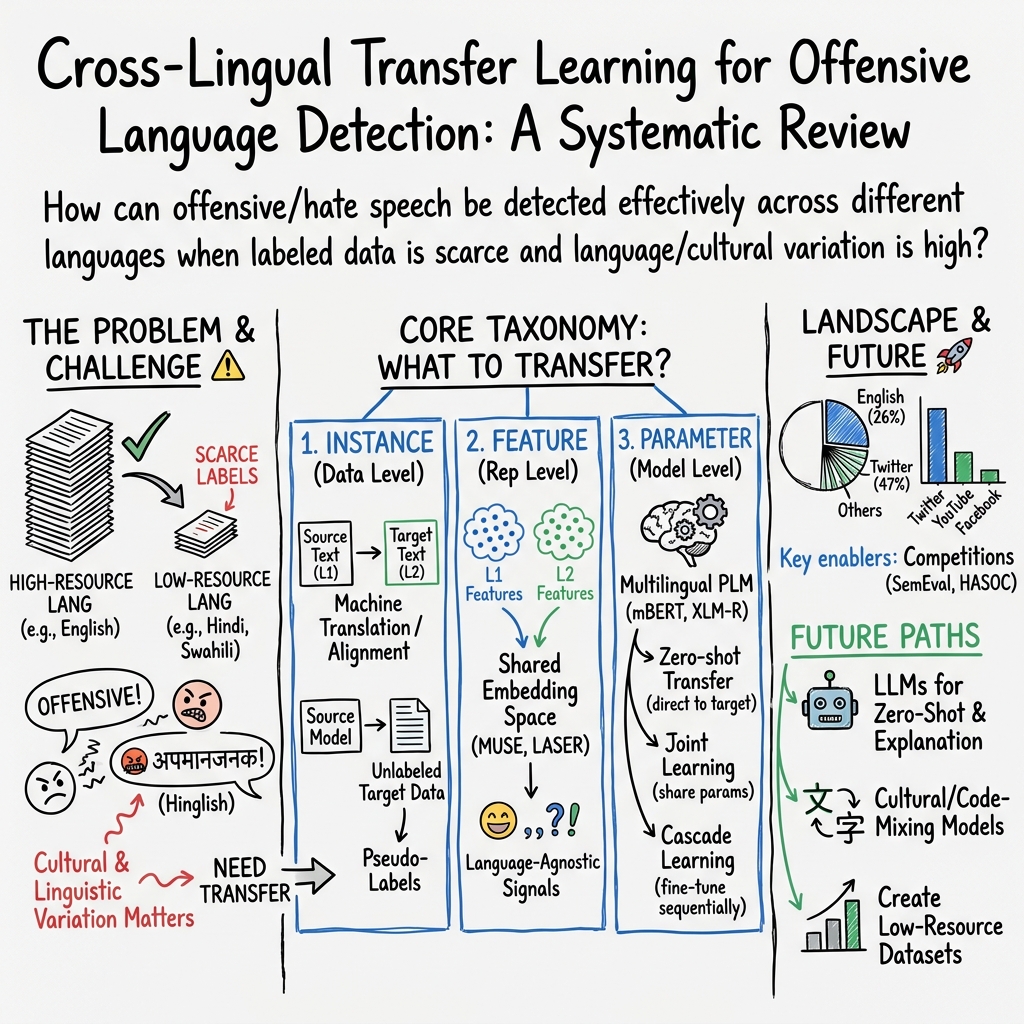
This paper is a big “map of the field” that looks at how computers can spot rude, harmful, or hateful messages on social media in many different languages—not just English. It reviews 67 research papers to explain what data people use, how they move knowledge from one language to another, what tools help, and what problems still need solving.
What questions were the authors trying to answer?
The authors set out to answer, in simple terms:
- What datasets and languages are used to detect offensive or hateful posts across the world?
- How can we “transfer” what machines learn in one language (like English) to help in another language (like Hindi or Arabic), especially when there isn’t much labeled data?
- Which strategies work best for cross‑language transfer, and what are their pros and cons?
- What are the biggest challenges (like slang, culture, and translation errors), and where should future research go?
How did they study it?
The authors did a systematic review—think of it like carefully collecting and organizing all the studies on this topic to see the big picture.
- They searched scholarly databases (like Google Scholar and the ACL Anthology) using many keyword combinations about hate/offense and multi‑language learning.
- They followed a structured process (called PRISMA) to include only relevant studies and ended up with 67 papers to analyze.
- They summarized:
- The datasets used (82 in total), including which languages and platforms they came from.
- The tools and resources that help cross languages (like translation systems, dictionaries, and multilingual models).
- The main transfer learning approaches.
Everyday analogy: Imagine you’re learning to bake cookies. You read lots of recipes from different countries, compare ingredients (datasets), cooking tools (resources like translation), and techniques (transfer approaches). Then you write a guide that tells others what works best when baking in different kitchens (languages).
Key ideas explained simply
Before the findings, here are a few important terms:
- Cross‑lingual: Using what we learned in one language to help in another. Like learning math in English and then solving problems in Spanish because the core ideas transfer.
- Multilingual: Involving many languages at the same time.
- Code‑mixing: When people mix languages in the same sentence (e.g., “Vamos to the park!”).
- Transfer learning: Teaching a model a skill once and reusing that skill in a new setting, with little extra training.
- Pre‑trained LLMs (PLMs): Very large language “brains” (like mBERT or XLM‑R) that have read lots of text and can be fine‑tuned for tasks like detecting hateful content.
The three main ways knowledge is transferred across languages
The paper groups cross‑language strategies into three easy‑to‑grasp types:
- Instance transfer (data-level)
- You move examples across languages—like translating English tweets into Spanish so a Spanish model can learn from them.
- Helpful when a target language has almost no labeled examples.
- Feature transfer (representation-level)
- You teach the model to see different languages in a shared “feature space,” so similar meanings end up close together.
- Analogy: A color wheel for languages—“red” in English and “rojo” in Spanish point to the same spot on the wheel.
- Parameter transfer (model-level)
- You reuse parts of a trained model (its “settings” or “weights”) in a new language.
- Analogy: If you’ve learned to ride a bike, switching to a similar bike takes little adjustment; you keep your balance skills (model parameters) and just fine‑tune.
These approaches can be mixed—for example, using translated data (instance transfer) with a multilingual model (parameter transfer).
What did they find, and why does it matter?
Here are the key takeaways, kept simple:
- A growing and global field:
- Research on cross‑lingual detection has grown fast since 2018.
- The review covers 67 papers and 82 datasets across 30+ languages.
- Data often comes from social media:
- Twitter is the most common source (almost half of all datasets), followed by YouTube and Facebook.
- Many datasets focus on “offensive language” or “hate speech,” but some target specific issues like sexism or racism.
- English dominates, but many languages are under‑served:
- English is heavily represented; many other languages (especially low‑resource ones) have far less labeled data.
- That’s why cross‑lingual transfer is so important: it helps build systems for languages with little data.
- Labels vary:
- Most datasets use simple labels like “offensive” vs. “not offensive,” but some use finer categories (target of attack, severity levels).
- This variety makes it harder to combine datasets across languages.
- Useful tools and resources:
- Multilingual dictionaries and parallel texts (the same sentence in two languages) help align meaning.
- Translation tools (e.g., Google Translate, DeepL) help create training data—but they can mess up slang, sarcasm, or cultural slurs.
- Multilingual models (like mBERT and XLM‑R) are powerful for parameter transfer.
- Challenges to watch out for:
- Translation errors and cultural differences: A phrase that’s clearly hateful in one language might be mild or meaningless in another.
- Code‑mixing: Mixed‑language posts are harder to analyze.
- Bias: If training data is unbalanced, models can unfairly flag certain groups or dialects.
- Small datasets: Many datasets are tiny, which makes it tough to train reliable models—especially for low‑resource languages.
- Practical contribution:
- The authors created online tables listing datasets and methods to help other researchers find and compare resources quickly.
Why it matters: Better cross‑lingual methods mean we can help keep online spaces safer in many languages—not just where there’s lots of data. That’s important for global platforms like YouTube, Instagram, and TikTok.
What’s the potential impact?
- Fairer and wider coverage: Cross‑lingual transfer can bring strong moderation tools to languages that are often overlooked, helping protect more people online.
- Faster responses to new trends: Harmful language evolves quickly. Transfer methods can adapt patterns learned in one language to others more rapidly.
- Better tools and standards: By comparing methods and datasets, researchers can build fairer, more reliable systems and set better guidelines.
- Future directions: The field needs better translations for slang/offense, more code‑mixing support, more balanced datasets across cultures, and careful attention to bias and ethics.
Short recap
- Purpose: Review how machines learn to detect offensive/hateful language across different languages.
- Method: A careful survey of 67 papers using a structured process.
- Big idea: Use what works in one language to help another (three main transfer types: instance, feature, parameter).
- Main findings: Lots of English data, heavy Twitter use, growing interest since 2018, strong multilingual models, and real challenges with culture, translation, and bias.
- Impact: Safer global social media through better, fairer, and more widely usable detection tools.
Knowledge Gaps
Unresolved gaps, limitations, and open questions
Below is a concise, actionable list of what remains missing, uncertain, or unexplored based on the survey’s own scope, evidence, and synthesis.
- Language coverage skew
- Over-reliance on Indo-European (especially English) and Arabic; scarce work on African, Southeast Asian, and Indigenous languages and dialects.
- Limited study of morphologically rich and non-Latin scripts (e.g., Amharic, Hausa, Thai), and how script/morphology affect cross-lingual transfer.
- Dataset scarcity and imbalance
- Few large, high-quality, labeled datasets for low-resource languages; most datasets are 103–105 in size and platform-limited.
- Minimal availability of intensity/degree labels and fine-grained target annotations across languages; label ontologies are inconsistent.
- Platform and domain diversity
- Heavy concentration on Twitter; limited evaluation across platforms (e.g., TikTok, WhatsApp, Telegram, VK, local forums) and community norms.
- Insufficient analysis of domain shift across platforms and genres in cross-lingual settings.
- Code-mixing and transliteration
- Sparse, standardized evaluation of code-mixed/text normalization and transliteration pipelines across language pairs/scripts.
- Lack of benchmarks and error analyses specifically designed for code-switching phenomena.
- Translation-dependent pipelines
- Inadequate assessment of translation errors, cultural nuance loss, and label noise introduced by MT-based data augmentation and label projection.
- No standard protocols for quality-control of machine translation/transliteration in offensive language contexts (e.g., slur preservation tests).
- Label schema alignment and ontology mapping
- No widely adopted cross-lingual ontology to reconcile binary vs. multi-label, target-vs.-type taxonomies across datasets and cultures.
- Unclear best practices for mapping heterogeneous labels to a shared cross-lingual schema without erasing culturally specific phenomena.
- Evaluation standardization and reproducibility
- Heterogeneous train/dev/test splits, metrics, and sampling strategies impede fair cross-paper comparisons or meta-analysis.
- Limited release of preprocessing scripts, training configurations, seeds, and model checkpoints; some datasets remain inaccessible.
- Benchmark design
- Absence of a community benchmark suite that jointly covers low-resource languages, code-mixing, multiple platforms, and unified label ontologies.
- Few longitudinal or temporal benchmarks to study drift and evolving slurs across languages.
- Transfer strategy comparability
- Limited head-to-head comparisons of instance-, feature-, and parameter-transfer approaches under controlled settings (same data/metrics).
- Lack of guidance on when to prefer each transfer level, and how to combine them effectively.
- Zero-/few-shot protocols
- No standardized zero-, few-shot, and active-learning protocols to quantify data efficiency across language pairs and families.
- Sparse study of negative transfer: when and why cross-lingual transfer harms performance, and mitigation strategies.
- Multilingual representation gaps
- Under-explored tokenization and subword choices for agglutinative/compounding languages and their impact on hate speech detection.
- Limited comparison of word-level vs. sentence-level multilingual representations tailored to this task.
- Pre-trained models and LLMs
- Little systematic evaluation of instruction-tuned or large multilingual models (post-2023) for cross-lingual hate/offense detection.
- Unclear best practices for adapter-based, prompt-based, or parameter-efficient tuning across diverse languages.
- Cultural and legal contextualization
- Insufficient modeling of culture-specific pragmatics, norms, and legal definitions of offense/hate; models often rely on English-centric cues.
- Lack of region-specific calibration and thresholding to align with local moderation policies and legal frameworks.
- Bias, fairness, and harms
- Sparse cross-lingual fairness evaluations (e.g., group-wise error rates by identity terms, dialects); no standardized fairness metrics for multilingual settings.
- Limited techniques to debias multilingual embeddings/models while preserving cross-lingual performance.
- Implicit abuse and pragmatics
- Insufficient treatment of implicit hate, sarcasm, coded language, and euphemisms that vary across cultures and languages.
- Few datasets or methods capturing context beyond a single message (e.g., conversation threads) in cross-lingual evaluation.
- Robustness and adversarial resilience
- Limited cross-lingual robustness tests for obfuscation (leetspeak), misspellings, adversarial paraphrases, and script-switching.
- No standardized stress-tests for multilingual/offensive language perturbations.
- Continual and life-long learning
- Little work on continual learning to track emerging slurs, memes, and shifting norms across languages without catastrophic forgetting.
- Few mechanisms for cross-lingual model updates that respect privacy and data-governance constraints.
- Data governance and ethics
- Minimal discussion of privacy, consent, and data sovereignty in cross-border dataset sharing and annotation.
- Limited guidance on ethical deployment and localized human-in-the-loop moderation for cross-lingual systems.
- Explainability and human factors
- Scarce research on cross-lingual explainability, user-facing rationales, and how explanations translate culturally across languages.
- Limited study of how annotator background and cultural context affect labels and model evaluation.
- Language-agnostic signals
- Underuse of shared, language-agnostic signals beyond emojis/punctuation (e.g., network features, user histories, temporal patterns) for cross-lingual transfer.
- Lack of ablations showing the marginal utility of language-agnostic features across languages.
- Cost-effective annotation
- Few investigations into cross-lingual active learning, weak supervision, or data programming to reduce labeling cost in low-resource languages.
- Under-explored crowdworker training and quality-control protocols tailored to culturally sensitive annotations.
- Calibration and threshold transfer
- Little attention to multilingual probability calibration and how thresholds generalize (or not) across languages and prevalence rates.
- No standard practice for per-language calibration to reduce over-/under-flagging.
- Error analysis by linguistic typology
- Limited systematic analyses connecting error patterns to linguistic features (e.g., morphology, word order, honorifics) or language distance.
- Few studies leveraging typological databases (e.g., WALS) to predict or mitigate transfer gaps.
- Downstream impact
- Lack of user-centric and societal impact studies evaluating false positives/negatives’ consequences across cultural contexts.
- Limited collaboration with moderators and local communities to validate model decisions and reduce harm.
Practical Applications
Immediate Applications
The following applications can be deployed now by leveraging the survey’s consolidated resources (datasets, tools, and methods) and the three transfer approaches (instance, feature, parameter transfer) it catalogues.
- Multilingual content moderation for social platforms (industry: software, social media, gaming, live streaming)
- What: Rapidly expand hate/offense detection to under-supported languages using zero-shot/few-shot fine-tuning of multilingual PLMs (e.g., mBERT, XLM-R), plus code-mixed preprocessing (transliteration) for chats.
- How: Parameter transfer (fine-tune XLM-R on source language, adapt to target with few labels); instance transfer (MT/back-translation to augment scarce target data); feature transfer (LASER/LabSE for semantic similarity).
- Tools/workflows: Moderation API with language-agnostic scoring; triage dashboards with severity and target-type labels; human-in-the-loop review queues.
- Assumptions/dependencies: Access to platform data and label taxonomies; calibration for per-language thresholds; bias audits; reliable MT/transliteration for slang and dialects; legal compliance per jurisdiction.
- Brand safety and ad placement filtering across languages (industry: advertising, marketing tech)
- What: Flag/avoid toxic user-generated content near ads in multilingual markets.
- How: Parameter transfer for cross-lingual classifiers; feature transfer to cluster and expand risk terms; lexicon-assisted explainability (HurtLex).
- Tools/workflows: Real-time page-level toxicity scoring; campaign-level safety rules by market; explanation snippets highlighting offensive spans.
- Assumptions: Coverage of local dialects; acceptable false-positive rate for brand safety; publisher integration.
- Customer support and trust & safety triage (industry: enterprise SaaS, customer experience)
- What: Filter abusive tickets/emails/chats and route for escalation; protect agents in global contact centers.
- How: Zero-shot/few-shot fine-tuning (parameter transfer); instance transfer for synthetic data augmentation; code-mixed normalization.
- Tools/workflows: Severity tagging, auto-responses, agent shield mode (redaction/blur).
- Assumptions: Data privacy, PII handling; domain adaptation for formal vs informal registers.
- Community moderation bots for multilingual spaces (industry/NGO: Discord/Telegram/Forums; daily life: creators, volunteer mods)
- What: Drop-in bots that detect hate/abuse across languages and code-mixed text.
- How: Lightweight XLM-R distilled variants; transliteration preprocessor; lexicon-backed rules for transparent moderation.
- Tools/workflows: Rule + ML hybrid pipelines; configurable thresholds; appeal logging.
- Assumptions: Compute and latency constraints; community norms and local policy alignment.
- Rapid dataset bootstrapping in low-resource languages (academia/industry: data science, annotation vendors)
- What: Jumpstart labeled corpora using transfer and active learning to minimize annotation cost.
- How: Instance transfer (MT of labeled source data; back-translation); parameter transfer (few-shot fine-tuning to seed high-uncertainty sampling); feature transfer for semantic sampling (LASER).
- Tools/workflows: Annotation studio with model-in-the-loop suggestions; code-mix-aware guidelines; quality control metrics.
- Assumptions: Access to bilingual annotators; MT quality checks to avoid label shift; annotation budget.
- Vendor/model benchmarking and procurement due diligence (industry/policy/academia)
- What: Evaluate moderation vendors’ cross-lingual performance using the survey’s dataset index and shared-task corpora.
- How: Assemble multilingual evaluation harness; report macro/micro-F1, robustness to code-mix, dialect shift, and translation artifacts.
- Tools/workflows: Continuous evaluation dashboard; red-teaming with lexicons and adversarial slang; bias and subgroup analyses (demographics/targets).
- Assumptions: License/access to datasets; legal/ethical approvals; standardized label taxonomies.
- Search, retrieval, and analytics for abusive content (industry/policy: risk intelligence, brand monitoring)
- What: Multilingual toxicity search and clustering to detect campaigns or trends.
- How: Feature transfer via sentence embeddings (LASER/LabSE) for cross-lingual semantic search; lexicon seeding for targeted themes (e.g., sexism, racism).
- Tools/workflows: Topic clustering, timeline spikes, geolinguistic maps; alerting.
- Assumptions: Access to public streams/APIs; careful handling of domain drift.
- Browser extensions/parenteral controls to mask harmful content (daily life)
- What: Client-side blur/redact of offensive text across languages on social sites and forums.
- How: Distilled multilingual PLMs; lexicon + ML hybrid for low-latency; on-device inference where feasible.
- Tools/workflows: User controls for sensitivity; reasons/explanations; allowlists.
- Assumptions: Performance on consumer hardware; false-positive UX impact.
- Multilingual lexicon expansion and quality control pipelines (academia/industry)
- What: Maintain/upkeep hate/offense lexicons across languages and dialects.
- How: Instance transfer (translation/back-translation); feature transfer (nearest-neighbor in multilingual embeddings) to propose candidates; human vetting.
- Tools/workflows: Versioned lexicon repositories; change logs; severity ratings.
- Assumptions: Cultural nuance review; avoiding overbroad terms.
- Elections and crisis monitoring across languages (policy/NGO/industry)
- What: Track surges in hateful narratives in multiple languages for early intervention.
- How: Cross-lingual classifiers; code-mix handling; target-type attribution (e.g., migrants, religion).
- Tools/workflows: Risk dashboards; escalation playbooks to platforms/partners.
- Assumptions: Data access and consent; legal guardrails; mitigation partnerships.
- Teaching and reproducibility support (academia)
- What: Course modules and labs on cross-lingual transfer using the survey’s GitHub tables (datasets + CLTL methods).
- How: Replicate parameter-transfer baselines; compare instance vs feature transfer on new languages.
- Tools/workflows: Starter notebooks; standardized evaluation sheets.
- Assumptions: Dataset licensing; compute availability.
Long-Term Applications
The following applications are promising but typically require further research, scaling, or infrastructure development to be reliable and equitable at global scale.
- Culture-aware severity calibration and harmonized taxonomies (industry/policy/academia)
- What: Align labels and severity across languages with culturally grounded guidelines to reduce over-/under-blocking.
- How: Cross-lingual annotation frameworks; hierarchical labels; adaptive thresholds per locale.
- Dependencies: Large, diverse, expert-annotated multilingual corpora; participatory design with local communities.
- Robust code-mixed and dialectal coverage (industry/academia)
- What: High-accuracy detection in heavy code-switching and regional dialects (incl. transliteration variance).
- How: Unsupervised/adversarial alignment; continual learning from live streams; subword/phonetic modeling.
- Dependencies: Streaming data infrastructure; privacy-preserving learning; reliable evaluation sets.
- Multimodal, cross-lingual moderation (industry)
- What: Jointly reason over text + images/memes/videos across languages.
- How: Vision–LLMs aligned with multilingual text encoders; contrastive training with meme datasets.
- Dependencies: Multimodal, multilingual datasets with fine-grained labels; safety-aligned training.
- Privacy-preserving, federated CLTL (industry/policy)
- What: Train/update cross-lingual moderation models without centralizing sensitive data.
- How: Federated learning; differential privacy; secure aggregation across regions.
- Dependencies: Platform coordination; regulatory alignment; robustness vs. privacy trade-offs.
- Model governance and regulatory audits across languages (policy/industry)
- What: Standardized, third-party audits of moderation quality, fairness, and errors in each language/market.
- How: Shared multilingual benchmarks; impact assessments; public reporting templates.
- Dependencies: Consensus on metrics; access to representative test data; legal frameworks.
- On-device or edge cross-lingual moderation (industry/daily life)
- What: Real-time, offline filtering in messaging apps or parental controls.
- How: Distillation, quantization, and sparse architectures for multilingual PLMs.
- Dependencies: Efficient model research; hardware capabilities; update channels for new slang.
- Early-warning systems for social conflict and targeted harassment (policy/NGO)
- What: Spatiotemporal monitoring of escalating hate narratives across languages.
- How: Cross-lingual event detection + toxicity scoring; graph-based campaign detection.
- Dependencies: Data-sharing agreements; false-positive risk management; response protocols.
- Continual learning pipelines for evolving slang and evasion (industry/academia)
- What: Keep models current against obfuscation and new slurs across languages.
- How: Self-training, weak supervision, and human-in-the-loop refresh cycles.
- Dependencies: Drift detection; annotation ops; safe deployment thresholds.
- Cross-lingual explainability and user-facing transparency (industry/policy)
- What: Provide localized, understandable rationales (e.g., highlighted spans, category/target) to users and moderators.
- How: Rationale extraction tied to multilingual lexicons; counterfactual explanations via translation-aware perturbations.
- Dependencies: Reliable rationale methods; UI/UX research; misinterpretation safeguards.
- Open, community-maintained multilingual corpus and lexicon hub (academia/NGO/industry)
- What: A sustained, centralized, versioned repository building on the survey’s index, covering more languages and domains.
- How: Data contribution standards; quality governance; ethical licensing.
- Dependencies: Funding and stewardship; contributor incentives; legal vetting.
- Cross-lingual counter-speech and assistance tools (industry/NGO)
- What: Generate or suggest context-aware, de-escalatory responses in users’ languages.
- How: Safety-aligned generative models with multilingual grounding; toxicity-aware retrieval augmentation.
- Dependencies: Guardrails to prevent misuse; evaluation of efficacy and harms; cultural tailoring.
Glossary
- Auto-encoder architecture: A neural model trained to reconstruct inputs via a compressed latent representation, used to learn language-agnostic features. "auto-encoder architecture"
- Code-mixed datasets: Corpora in which multiple languages are intermixed within the same content, often at token or sentence level. "code-mixed datasets"
- Code-mixing: The practice of alternating between languages within a single utterance or text. "code-mixed content"
- Cross-lingual word embeddings: Word vector spaces aligned across languages so that semantically similar words are close regardless of language. "Cross-lingual word embeddings are also created by utilising these multilingual resources."
- Cross-Lingual Transfer Learning (CLTL): Techniques that transfer knowledge from a resource-rich source language to improve performance in a resource-scarce target language. "Cross-Lingual Transfer Learning (CLTL) emerges as a promising direction"
- Feature Transfer: A transfer approach that shares or aligns representational features across languages. "Feature Transfer: Linguistic knowledge is shared or transferred"
- Few-shot learning: Adapting a model to a target language using only a small number of labeled examples. "few shots of "
- Fine-tuning: Further training a pre-trained model on task- or language-specific data to adapt it to a target setting. "fine-tune "
- HurtLex: A multilingual lexicon of offensive and hurtful terms used to support abusive language detection. "HurtLex."
- Instance Transfer: A transfer approach that moves data instances (e.g., texts or labels) across languages to aid training. "Instance Transfer: Instances are transferred on the data level"
- Language Agnostic BERT Sentence Embeddings (LabSE): Sentence-level multilingual embeddings designed to be language-agnostic. "Language Agnostic BERT Sentence Embeddings (LabSE)"
- Language Agnostic Sentence Representations (LASER): Multilingual sentence embeddings aimed at producing language-agnostic representations. "Language Agnostic Sentence Representations (LASER)"
- Language-agnostic resources: Signals (e.g., emojis, punctuation) not tied to a specific language that can support cross-lingual modeling. "Language-agnostic resources"
- Low-resource languages: Languages with limited labeled data or computational resources for NLP tasks. "low-resource languages"
- Machine transliteration tools: Systems that convert text from one script to another while preserving pronunciation. "machine transliteration tools"
- Machine translation tools: Systems that automatically translate text between languages. "Machine translation tools"
- mBART: A multilingual sequence-to-sequence pre-trained model often used for machine translation and generation. "mBART"
- mT5: A multilingual text-to-text Transformer pre-trained model for a variety of sequence tasks. "mT5"
- Multilingual BERT (mBERT): A version of BERT pre-trained on many languages, enabling cross-lingual transfer. "Multilingual BERT (mBERT)"
- Multilingual contextualised representations: Context-sensitive sentence-level embeddings aligned across languages. "Multilingual contextualised representations"
- Multilingual distributional representations: Word-level embeddings trained across languages that capture distributional semantics in a shared space. "Multilingual distributional representations"
- Multilingual Lexicons (word-aligned): Dictionaries mapping words or phrases across languages for direct translation or equivalence. "Multilingual Lexicons (word-aligned)"
- Multilingual PLMs: Pre-trained LLMs trained on multiple languages that enable zero-/few-shot cross-lingual transfer. "Multilingual PLMs"
- Multilingual representations: Language-independent vector representations shared across languages to facilitate transfer. "Multilingual representations, as language independent representations"
- Parallel Corpora (sentence-aligned): Collections of texts with aligned translations across languages at the sentence level. "Parallel Corpora (sentence-aligned)"
- Parameter Transfer: A transfer approach that reuses model parameters learned in one language for another. "Parameter Transfer: Parameter values are transferred"
- Pre-trained LLMs (PLMs): Models trained on large corpora to provide general-purpose language representations for downstream tasks. "Pre-trained LLMs (PLMs)"
- SOTA: An abbreviation for state-of-the-art, referring to the best-performing techniques at a given time. "a SOTA technique in NLP"
- XLM-RoBERTa (XLM-R): A strong multilingual Transformer model pre-trained on large-scale multilingual data. "XLM-RoBERTa (XLM-R)"
Collections
Sign up for free to add this paper to one or more collections.