Wasserstein Spaces: Geometry & Applications
This lightning talk introduces Wasserstein spaces, metric spaces of probability measures equipped with optimal transport distances. We explore their rich geometric structure—from geodesics and curvature to isometry rigidity and flexibility—revealing how the geometry of the underlying space shapes the infinite-dimensional Wasserstein geometry. We examine key properties including Riemannian-like structure, dimension theory, and stability results, and highlight applications spanning statistics, PDEs, and data science.Script
Imagine a universe where each point is itself an entire probability distribution, and distances measure the minimal cost of reshaping one distribution into another. This is the world of Wasserstein spaces, where optimal transport theory meets infinite-dimensional geometry to create structures with surprising rigidity, exotic symmetries, and powerful applications across mathematics and data science.
Let's begin by understanding what makes these spaces tick.
Building on this foundation, the p-Wasserstein distance quantifies how much it costs to optimally transport mass from one distribution to another. We minimize over all possible couplings, yielding a complete geodesic space where constant-speed paths arise naturally from displacement interpolation.
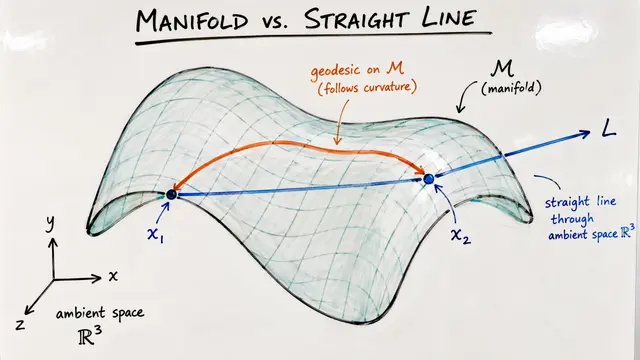
These geodesics are more than abstract objects. In the quadratic case, they reflect an infinite-dimensional Riemannian geometry where tangent spaces consist of vector fields and the metric encodes kinetic energy, bridging optimal transport with calculus of variations.
Now we explore how curvature of the base space sculpts Wasserstein geometry.
This dichotomy is striking. Euclidean base spaces allow wild, exotic isometries that split and remix measures in surprising ways, while strict negative curvature imposes absolute rigidity, forcing every symmetry of the Wasserstein space to descend faithfully from the base.
Despite their infinite dimensionality, Wasserstein spaces exhibit remarkable dimension-theoretic stability. The power-exponential parameter mirrors the dimension of the base, and for ultrametric spaces, explicit embeddings into sequence spaces reveal tractable algebraic structure, while universality results show these spaces can encode arbitrary finite geometries.
Let's examine the tension between rigidity and flexibility in isometry groups.
The structure of isometries is deeply geometric. Negative curvature locks down symmetries completely, while flat or product geometries with carefully chosen metrics unlock mass-splitting phenomena where single points can be transformed into genuine mixtures, revealing a rich landscape of intermediate behaviors.
These spaces also respect limits beautifully. Gromov-Hausdorff convergence lifts to the Wasserstein level, quotient constructions behave functorially, and higher-order iterations build a systematic hierarchy, making Wasserstein geometry a stable, well-behaved framework for infinite-dimensional analysis.
The reach of Wasserstein spaces extends far beyond pure geometry. They provide the natural setting for gradient flows of energy functionals, enable order-based statistical methods on distributional data, and furnish metrics for comparing stochastic processes, making them indispensable tools at the crossroads of analysis, probability, and modern data science.
Wasserstein spaces reveal how optimal transport transmutes the geometry of probability measures into a rich, infinite-dimensional landscape where curvature, rigidity, and dimension interplay in surprising ways. To dive deeper into this elegant fusion of geometry and probability, visit EmergentMind.com.