Symbolic Learning Enables Self-Evolving Agents
This presentation introduces a groundbreaking framework that shifts language agent research from engineering-centric to data-centric approaches through agent symbolic learning. We explore how treating language agents as symbolic networks with learnable prompts and tools enables autonomous self-optimization, examine the methodology inspired by neural network back-propagation adapted for natural language, and review experimental results demonstrating superior performance across standard benchmarks and complex agentic tasks like creative writing and software development.Script
What if language agents could learn and evolve themselves, without constant human engineering? This paper by Zhou and colleagues proposes a radical shift: treating agents as symbolic networks that optimize through natural language gradients, opening a pathway toward truly self-improving artificial intelligence.
Building on that vision, let's examine why current approaches fall short.
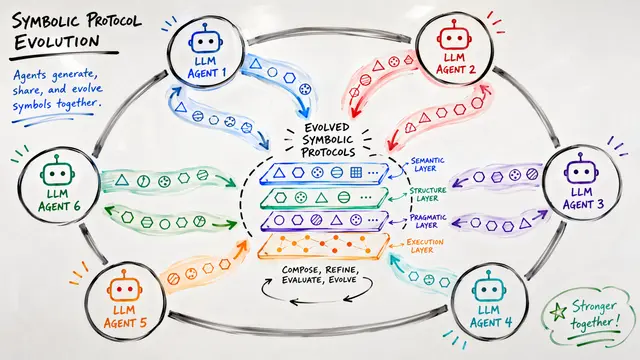
Following from that challenge, the authors identify a critical limitation: current language agents depend heavily on manual engineering of prompts and tools, which doesn't scale. Their solution introduces agent symbolic learning, a framework where agents optimize themselves using data, mirroring how neural networks learn but operating entirely in the symbolic domain of natural language.
Now let's explore how this symbolic learning actually works.
Connecting these ideas to familiar territory, the framework draws elegant parallels between neural networks and language agents. Where neural networks have computational graphs and numerical gradients, this approach has agent pipelines and language gradients—textual analyses that guide how prompts and tools should evolve.
Building on that architecture, the learning unfolds in 4 stages. The agent executes its pipeline while recording a trajectory, then a language loss function provides textual feedback. Language gradients propagate backward through each node, and finally symbolic optimizers use these gradients to update the agent's components—all happening in natural language rather than numerical space.
With the mechanics clear, let's see how this performs in practice.
The results validate this approach across diverse tasks. On standard benchmarks like HotPotQA, MATH, and HumanEval, agent symbolic learning consistently outperforms both traditional engineering-centric methods and other automated optimization approaches, demonstrating genuine learning rather than mere prompt tweaking.
Looking deeper at complex applications, this case study on creative writing reveals how the framework handles truly open-ended tasks. The agent doesn't just optimize for correctness but learns to produce coherent, high-quality creative text, showing that symbolic learning scales beyond rigid benchmark problems to tasks requiring nuanced judgment and creativity.
These findings point toward transformative possibilities. By enabling agents to learn autonomously from data, this framework makes sophisticated agent development scalable and opens research directions toward combining symbolic and neural optimization, potentially accelerating progress toward artificial general intelligence.
Agent symbolic learning transforms how we build intelligent systems—from manual engineering to autonomous evolution. Visit EmergentMind.com to explore this research and discover how self-improving agents are reshaping the path to AGI.