Large Language Models Can Self-Improve At Web Agent Tasks
This presentation explores groundbreaking research demonstrating how large language models can autonomously enhance their performance on complex web navigation tasks. By generating and learning from their own synthetic training data, these models achieve a remarkable 31% improvement in task completion rates on the challenging WebArena benchmark. The talk examines the methodology of self-improvement through different data mixtures, introduces novel evaluation metrics for measuring multi-dimensional progress, and discusses the implications for developing more capable AI agents without relying on expensive labeled datasets.Script
What if an AI agent could teach itself to navigate the web better, learning from its own attempts without any human-labeled examples? This paper reveals that large language models can do exactly that, achieving dramatic improvements on complex web tasks through self-improvement.
Let's start by understanding the problem these researchers set out to solve.
Building on this challenge, the core issue is that language models need extensive training data to handle multi-step web interactions, but creating those datasets is prohibitively expensive. The WebArena benchmark exposes just how difficult these tasks really are for current models.
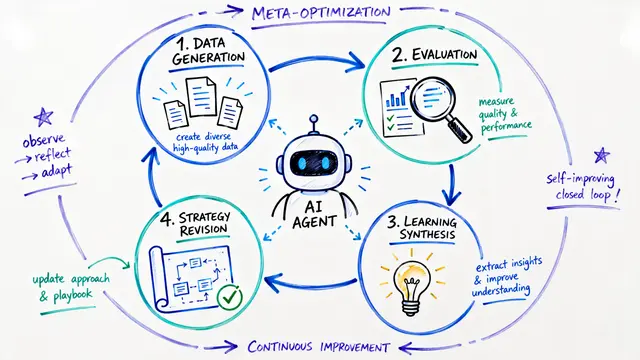
So how does self-improvement actually work? The model attempts tasks, generates action sequences, filters out poor attempts automatically, and then learns from its own successful trajectories. This clever approach sidesteps the need for expensive human annotation entirely.
The researchers tested 3 distinct strategies for creating synthetic training data. Mixture B, which combined both in-domain benchmark-like tasks and novel out-of-domain tasks, delivered the best results with a stunning 31% improvement in task completion rates.
Now, how do we properly evaluate these multi-dimensional improvements?
Traditional metrics only tell part of the story, so the authors introduced new evaluation methods. These metrics capture not just whether tasks succeed, but how many distinct capabilities the model acquires and how efficiently it navigates toward solutions.
What did the experiments reveal? While all approaches showed improvement, there were interesting trade-offs. Some models gained new capabilities but occasionally took invalid actions, and running multiple rounds of self-improvement yielded progressively smaller gains.
The authors were transparent about limitations. Self-improvement isn't a magic bullet; it works best in the first iteration, and models trained exclusively on out-of-domain data sometimes developed inefficient navigation patterns that achieved goals but took unnecessarily long paths.
This research has profound implications for building practical AI systems. By showing that models can bootstrap their own capabilities, it charts a path toward more capable autonomous agents without the crushing cost of human annotation, bringing us closer to AI that can truly assist with complex digital tasks.
Self-improvement through synthetic data represents a paradigm shift in training capable web agents, proving that language models can be their own best teachers. Visit EmergentMind.com to explore this research further and discover more cutting-edge AI breakthroughs.