AI-Powered Mathematical Discovery: Gemini Tackles Erdős Problems
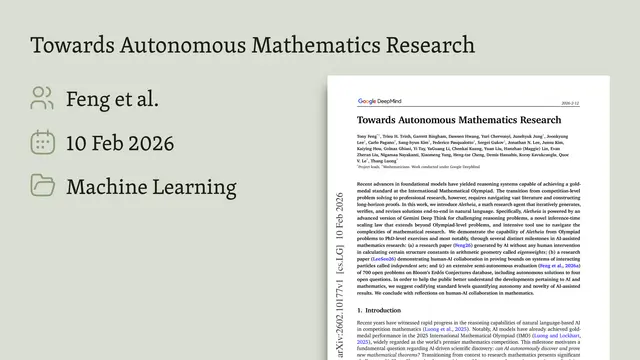
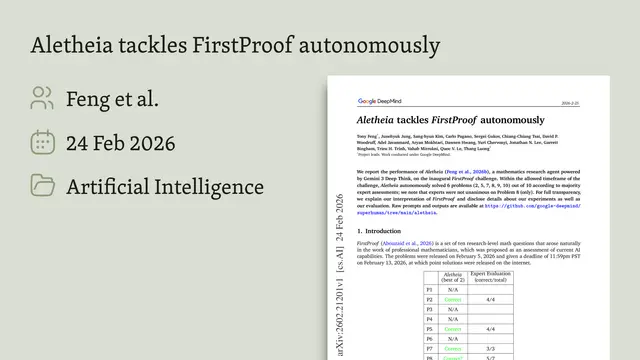
This lightning talk explores a groundbreaking case study where researchers deployed an AI mathematics research agent called Aletheia, built on Gemini Deep Think, to systematically tackle hundreds of open problems from the famous Erdős Problems database. The presentation reveals how this semi-autonomous approach successfully resolved several mathematical conjectures while highlighting critical challenges in verifying correctness, ensuring novelty, and managing the bottleneck of expert human review in AI-assisted mathematical discovery.Script
What if an AI could work through hundreds of unsolved mathematical problems in just one week? The researchers behind this study deployed Aletheia, an AI mathematics research agent built on Gemini Deep Think, to tackle 700 open problems from the legendary Erdős Problems database.
Building on this ambitious goal, the core challenge wasn't just mathematical difficulty. Many problems labeled as open were actually obscured by incomplete literature searches or ambiguous problem statements, creating a perfect testing ground for AI-assisted discovery.
Let's examine how the researchers designed their AI mathematics research agent.
The researchers designed a hybrid workflow that leverages AI for scale while preserving human expertise for critical decisions. This pipeline transformed 700 initial problems into 212 potentially correct responses, then down to just 27 candidates worthy of expert review.
This diagram illustrates the complete discovery pipeline, showing how AI generation feeds into automated verification, followed by staged human review. Notice how the system is designed to preserve precious expert time by using AI and junior mathematicians for initial filtering, ensuring domain experts only see the most promising candidates.
Now let's dive into what this systematic sweep actually discovered.
These results reveal a crucial insight about AI-generated mathematics. While the system produced technically sound reasoning in about one third of cases, the majority of even correct solutions failed to address the actual intended mathematical question due to misinterpretations or definitional issues.
The researchers categorized their successes into distinct types, revealing that AI can contribute in multiple ways beyond just novel problem solving. Interestingly, some of the most valuable contributions were in literature discovery, where the AI found existing solutions that had been overlooked, though this raised concerns about training data contamination.
Erdős-1051 stands out as a tentative milestone where an AI system genuinely resolved an open mathematical problem. This success not only demonstrated the potential of AI-assisted discovery but also catalyzed subsequent human-AI collaborative research, showing how AI breakthroughs can accelerate further mathematical progress.
However, this study also revealed significant obstacles that AI mathematical discovery must overcome.
These challenges reveal that the bottleneck in AI mathematics isn't just proof generation or even correctness checking. The most time-consuming and error-prone tasks involve understanding what problems actually mean and determining whether solutions are genuinely novel contributions to mathematical knowledge.
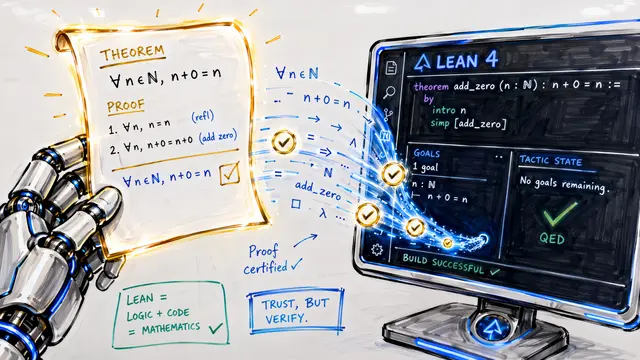
This comparison highlights a crucial insight from the study. While formal verification systems like Lean can ensure mathematical correctness, they cannot address the human-centric challenges of mathematical research: understanding what Erdős actually meant by a problem, finding whether someone already solved it, and ensuring the solution contributes meaningfully to mathematical knowledge.
The researchers identified a fundamental asymmetry in AI-assisted mathematics. While AI can generate hundreds of candidate solutions rapidly, the human expert attention needed to properly evaluate these candidates creates a new kind of bottleneck that requires careful system design to manage effectively.
Let's consider what these findings mean for the future of mathematical discovery.
This study suggests that AI-assisted mathematics will reshape how we think about mathematical progress. Rather than just solving hard problems, AI systems may prove most valuable in organizing and connecting existing mathematical knowledge, while human mathematicians focus on the creative and interpretive aspects of research.
The researchers emphasize important cautionary notes about AI-assisted mathematical discovery. The risk of subconscious plagiarism and the difficulty of comprehensive literature searches mean that novelty claims should be treated as upper bounds, subject to revision as more prior work is discovered.
Looking forward, the researchers outline critical areas for development. The mathematical community needs new tools and standards to handle the scale of AI-generated candidates while maintaining the rigor and attribution practices that define mathematical research.
Despite the challenges, this work points toward a transformative potential for AI in mathematics. By systematically tackling large databases of open problems, AI systems could help mathematicians discover connections and resolve questions that might otherwise remain buried in the literature for decades.
The study provides a practical blueprint for future AI-assisted mathematical research. The staged filtering approach and emphasis on human oversight offer a scalable model that other researchers can adapt for different mathematical domains and problem databases.
This case study represents more than just a technical achievement. It provides the mathematical community with the first systematic analysis of what happens when AI tackles hundreds of open problems simultaneously, revealing both the promise and the practical challenges of this new research paradigm.
The Erdős Problems case study shows us that the future of mathematical discovery lies not in replacing human mathematicians, but in creating intelligent systems that amplify human mathematical insight while respecting the deep challenges of novelty, interpretation, and attribution that define mathematical research. Visit EmergentMind.com to explore how AI is reshaping the landscape of mathematical discovery one theorem at a time.