Reinforced Generation of Combinatorial Structures: Ramsey Numbers
This presentation explores a breakthrough computational approach to one of mathematics' most stubborn problems: finding Ramsey numbers. Using AlphaEvolve, a large language model-powered meta-algorithm that evolves graph search heuristics, the researchers achieved new lower bounds for five classical Ramsey numbers—advances that had eluded decades of specialized human effort. The talk reveals how automated code-mutation agents can discover novel combinatorial search strategies, matching or surpassing hand-crafted algorithms across multiple parameter regimes, and what this means for the future of computational mathematics.Script
For most pairs of numbers beyond trivial cases, determining the exact Ramsey number is so difficult that we only know gaps between lower and upper bounds. Progress has required decades of specialized human ingenuity and custom search algorithms.
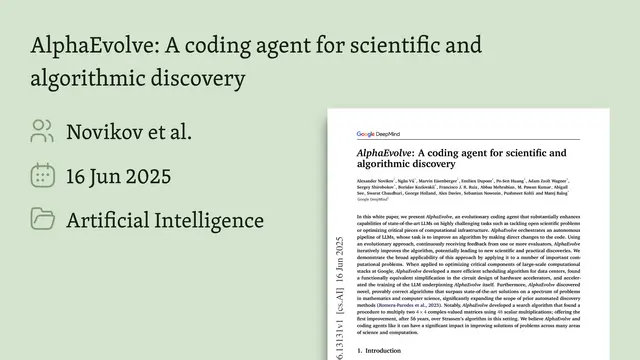
But what if instead of humans crafting search algorithms one by one, we could automate the discovery of those algorithms themselves? The authors introduce AlphaEvolve, a framework where large language models act as code-mutation agents, evolving entire search programs rather than just searching for graphs.
The mechanism is elegantly recursive.
AlphaEvolve treats the problem generically, letting the language model propose modifications to search code. Successful heuristics survive and spawn variations. The system discovered strategies ranging from Paley graph initialization to custom clique-counting accelerators—some never documented in prior literature.
The results speak through explicit constructions. Each new bound is certified by an actual graph that avoids the forbidden substructures. More remarkably, AlphaEvolve recapitulated decades of human-crafted bounds, often using entirely different algorithmic families.
This work reshapes the landscape of computational combinatorics. When the search space is intractable and analytical closed forms don't exist, language model agents can systematize what was previously piecemeal human exploration. The open question now is how far this automation can extend, and what formal conditions govern when machines can discover genuinely novel mathematical search strategies.
AlphaEvolve demonstrates that the future of hard mathematical problems may lie not in better search algorithms, but in algorithms that discover search algorithms. Visit EmergentMind.com to explore more breakthrough research and create your own video presentations.