Prompt Engineering a Prompt Engineer
This presentation explores PE2, a breakthrough methodology that transforms how large language models optimize their own prompts. By carefully designing a meta-prompt with explicit task descriptions, context specifications, and step-by-step reasoning templates, PE2 addresses fundamental limitations in automatic prompt engineering and achieves significant performance gains across mathematical reasoning and counterfactual evaluation tasks.Script
When you ask a language model to optimize prompts, what prompts do you give it to do that job well? The authors discovered that existing methods provide almost no guidance for this complex reasoning process, leaving the model to navigate prompt optimization nearly blind.
The researchers identified a fundamental gap. Current approaches hand the language model a prompt optimization task with barely any scaffolding, like asking an architect to design a building but only giving them the address.
So they built PE2, a methodology that engineers the meta-prompt itself with surgical precision.
PE2 introduces three components that transform the meta-prompt from a vague directive into a detailed reasoning framework. The two-step description makes expectations crystal clear. Context specification ensures the model understands how different prompt designs actually work. And the reasoning template walks the model through a series of questions for each example, forcing deeper reflection before proposing edits.
The empirical results tell a compelling story. On mathematical reasoning benchmarks, PE2 outperforms the widely used let's think step by step baseline by over 6% on MultiArith and 3% on GSM8K. Even more impressive, it beats other automatic prompt engineering approaches by nearly 7% on counterfactual evaluation tasks, demonstrating genuine reasoning capability rather than pattern matching.
What makes PE2 effective is how it actually improves prompts. The detailed meta-prompt enables the model to pinpoint exactly what's wrong with a current prompt, suggest precise fixes, and build coherent reasoning chains for tasks that require multiple steps of logic.
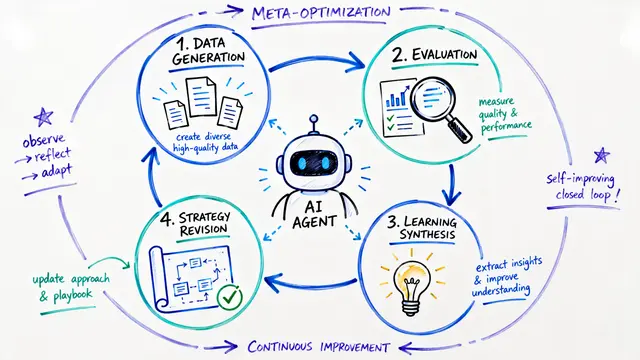
Like any research breakthrough, PE2 has boundaries. The authors acknowledge the danger that models might learn superficial shortcuts rather than genuine reasoning strategies. They also see enormous potential in having PE2 optimize its own meta-prompt recursively, creating a self-improving system.
This work reveals something fundamental about working with large language models. The prompts we use to guide them in meta-tasks are just as critical as the prompts for end tasks. When you give a model the right scaffolding to reason about prompt optimization, it can generate proposals that rival human prompt engineering.
The central insight is almost paradoxical. To build an automatic prompt engineer, you must first engineer the prompt that teaches the model how to engineer prompts. PE2 proves that investing design effort at this meta-level pays exponential dividends, turning vague optimization attempts into systematic improvement processes.
PE2 shows us that in the age of language models, the most powerful tool might be a well-designed instruction for designing instructions. Visit EmergentMind.com to explore more research like this and create your own AI-narrated presentations.