Learning recurrent dynamics in spiking networks
This lightning talk explores how spiking neural networks can learn and generate complex spatiotemporal activity patterns through a novel training approach. The presentation walks through the key challenge of coordinating individual neuron spikes to produce stable dynamics, introduces a recursive least squares algorithm that modifies recurrent connectivity, and demonstrates how these networks can learn arbitrary firing patterns while respecting biological constraints. The talk concludes by examining the implications for understanding brain functionality and mimicking biological computation.Script
Can a network of artificial spiking neurons learn to dance to any rhythm you give it? The brain coordinates billions of individual spikes into coherent patterns, and understanding how remains one of neuroscience's grand challenges.
Building on that question, let's examine why this coordination problem is so difficult.
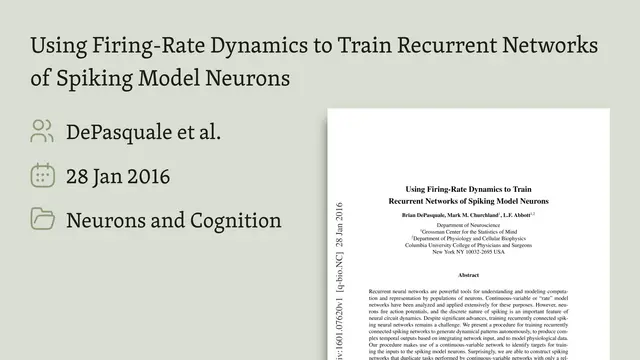
The authors identified a fundamental gap in our understanding. While researchers knew that rate-based networks could learn complex patterns, coordinating the precise timing of individual spikes in recurrent networks presented a much harder problem.
To solve this challenge, the researchers developed an elegant learning algorithm.
Their method uses Recursive Least Squares to adjust how neurons connect, training the network to match desired activity patterns. The algorithm respects biological realism by ensuring neurons remain strictly excitatory or inhibitory, just like in real brains.
Moving to the mechanics, training unfolds in two parallel streams. On one side, the network receives targets and stimulation to kick off activity, while on the other, the algorithm continuously refines synaptic weights by learning from both current performance and historical data.
So what can these trained networks actually do?
The results are striking. These spiking networks learned to produce virtually any pattern thrown at them, from chaotic dynamics to real biological recordings, revealing a computational capacity that mirrors the diversity we observe in actual brains.
Of course, the approach has boundaries. Network performance scales with size and diversity, and the learning rules, while effective, remain more abstract than the synaptic plasticity mechanisms found in real neurons.
This work bridges a critical gap between abstract computation and biological implementation. By showing that spiking networks can learn diverse dynamics while respecting neural constraints, the authors provide both a theoretical foundation and practical tools for understanding how brains compute.
Spiking networks can learn to orchestrate billions of discrete events into stable, meaningful patterns, revealing computational principles that bring us closer to understanding our own neural machinery. Visit EmergentMind.com to dive deeper into this research.