AI Meets Brain: Memory Systems Revolution
This presentation explores how cognitive neuroscience is revolutionizing AI agent design through brain-inspired memory systems. We'll journey from biological memory mechanisms to cutting-edge agent architectures, revealing how episodic and semantic memory principles can transform stateless language models into persistent, experience-driven autonomous agents capable of long-horizon reasoning and continuous learning.Script
Imagine an AI agent that could remember yesterday's conversation, learn from past mistakes, and build on previous experiences just like you do. Current language models are essentially digital amnesiacs, forgetting everything between sessions, but researchers are now bridging cognitive neuroscience and AI to create truly persistent, memory-enabled agents.
Building on this vision, we first need to understand the fundamental problem. Current AI agents face a critical limitation that prevents them from achieving human-like reasoning and continuity.
Let's explore how the brain solves this memory challenge and what AI can learn from it.
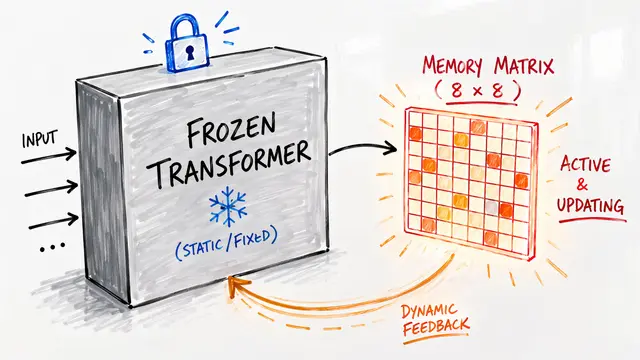
The contrast is striking when we compare biological and artificial memory systems. The brain uses dynamic, interconnected memory networks while current AI relies on rigid, separated storage mechanisms that lack the flexibility needed for continuous learning.
This diagram illustrates how memory transforms AI agents from reactive systems into proactive learners. Notice the feedback loop between memory, reflection, and planning that enables agents to build on past experiences and develop increasingly sophisticated behaviors over time.
The researchers propose a unified framework that bridges neuroscience and AI through systematic memory design.
This two-axis classification system moves beyond the simple short-term versus long-term dichotomy. The nature-based axis captures what type of information is stored, while the scope-based axis determines how broadly that memory can be applied across different agent interactions and sessions.
The nature-based classification draws directly from cognitive neuroscience, distinguishing between memory of specific experiences and abstract knowledge. This separation allows agents to both learn from particular interactions and extract generalizable principles.
The scope-based dimension addresses temporal persistence, determining whether memories serve immediate problem-solving or contribute to long-term agent development. Cross-trial memory is particularly crucial for building autonomous agents that improve over time.
Moving to implementation, the researchers identify four distinct storage formats, each with unique advantages. Text preserves interpretability, graphs enable structured reasoning, parameters offer speed, and latent vectors provide compressibility and trainability.
The framework treats memory as a dynamic system with a complete management lifecycle.
This closed-loop pipeline mirrors biological memory processes, where extraction converts experiences into storable formats, updating maintains relevance over time, retrieval activates relevant memories, and utilization applies them to new situations. The cyclical nature ensures memories evolve and improve through use.
Extraction strategies determine how interaction streams become usable memory records. Hierarchical approaches offer the most promise by creating multiple abstraction levels, while generative methods enable dynamic reconstruction similar to biological memory recall.
Retrieval strategies have evolved beyond simple similarity search to incorporate multiple factors that mirror human memory recall. Multi-factor approaches consider not just content similarity but also temporal factors and utility, leading to more contextually appropriate memory activation.
Utilization completes the memory cycle by applying retrieved memories to current tasks. The most sophisticated approaches go beyond simple concatenation to create optimized contexts that maximize the value of stored experiences.
The researchers also address how to evaluate and protect these memory systems.
Evaluation approaches split along the same lines as the memory taxonomy. Semantic-oriented tests focus on internal consistency and knowledge management, while episodic-oriented evaluations measure real-world task performance improvements through memory utilization.
Memory systems introduce new security vulnerabilities that require dedicated defenses. The researchers frame memory as an attack surface throughout the entire lifecycle, from formation to retrieval, requiring comprehensive security measures.
Looking ahead, several exciting research directions emerge from this framework.
The future points toward increasingly sophisticated memory architectures. Multimodal systems will handle rich sensory experiences while transferable skills will enable agents to share learned capabilities across different architectures and domains.
This survey reveals how cognitive neuroscience is reshaping AI agent design, moving us from stateless interactions toward persistent, experience-driven intelligence that learns and remembers like humans do. To dive deeper into this fascinating intersection of brain science and artificial intelligence, visit EmergentMind.com to explore more cutting-edge research.