Stuart-Landau Oscillators: From Bifurcation to Synchrony
This presentation explores the Stuart-Landau oscillator, the canonical mathematical model for understanding how systems transition into rhythmic behavior through Hopf bifurcation. We examine how these elegant complex-amplitude equations govern synchronization, clustering, and quenching phenomena in networks ranging from coupled lasers to neural ensembles, and reveal the deep mathematical structures—symmetries, singularities, and hierarchies—that organize collective dynamics from simple pairs to large populations.Script
A single equation governs how lasers lock, neurons fire in unison, and quantum systems settle into rhythmic steady states. The Stuart-Landau oscillator is the universal mathematical prototype for systems that cross the threshold into self-sustained oscillation, and it holds the key to understanding how networks of such oscillators organize into patterns far richer than any single rhythm.
The Stuart-Landau equation distills the essence of a Hopf bifurcation into a single complex-valued differential equation. The real parameter lambda determines whether oscillations grow or die, omega sets the rhythm, and the cubic term self-limits the amplitude to a stable circle once lambda crosses zero. This is the simplest possible model of a system that learns to oscillate.
When you couple these oscillators together, individual rhythms negotiate collective behavior.
Linear coupling pushes oscillators toward a common frequency through gradual entrainment, with exotic intermediate states like Bellerophon regimes where subgroups tick at quantized rates. But when you engineer coupling with rotational symmetry—making the equations invariant under specific phase rotations—you can force oscillators into precise integer frequency ratios, like 1 to 2 or 1 to 3, regardless of their natural mismatch. This symmetry-enforced high-order synchronization is a design principle for building reliable synthetic clocks and computation substrates.
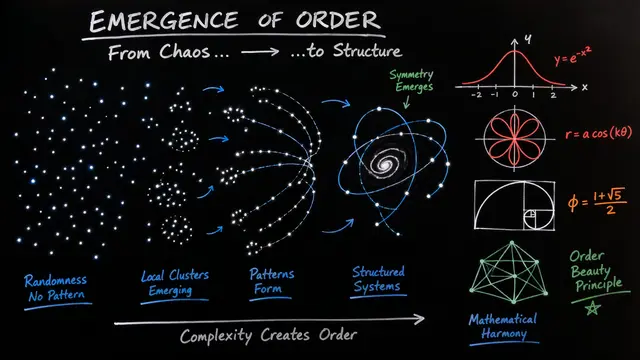
In large populations, oscillators don't just synchronize or stay random—they split into clusters, each humming at its own frequency. The birth and organization of these clusters is governed by a hierarchy of mathematical singularities, codimension-2 points where different cluster branches merge. One beautiful result is the one-third rule: for two clusters to coexist stably, each must contain at least a third of the population. This geometric constraint is universal, independent of network size, and emerges purely from the cubic symmetry of the normal form.
Coupling can also do the opposite of synchronization—it can extinguish oscillations entirely, even in parameter regimes where lone oscillators would cycle forever. This phenomenon, called amplitude death, occurs when repulsive coupling acts on orthogonal phase-space variables. The mathematics yields clean stability boundaries that don't depend on how many oscillators you have, and the mechanism maps onto real-world suppression events like the sudden electrical silence in the brain after a seizure.
From a single complex equation springs a universe of collective behavior: locking, clustering, quenching, and chaos. The Stuart-Landau oscillator remains the essential mathematical lens for understanding rhythmic coordination wherever it emerges. Visit EmergentMind.com to learn more and create your own videos.