In-Place Test-Time Training: Enabling Continual Adaptation in LLMs
This presentation explores In-Place Test-Time Training, a breakthrough framework that enables large language models to continuously adapt during inference without sacrificing efficiency or architectural compatibility. By repurposing existing MLP weights as trainable "fast weights" and introducing a next-token-prediction-aligned update objective, this approach overcomes the static train-then-deploy paradigm, achieving superior long-context reasoning and seamless integration with pre-trained models like Qwen and LLaMA.Script
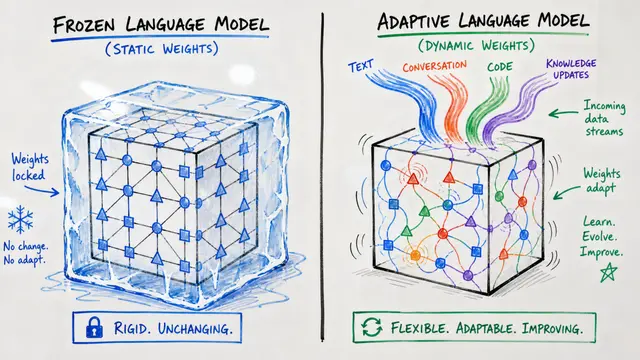
Large language models are frozen in time the moment training ends. They cannot adapt to new information streams, cannot update their understanding as contexts evolve, and struggle with tasks that stretch beyond their fixed context windows. This fundamental limitation has plagued the entire train-then-deploy paradigm, until now.
The root issue is architectural rigidity. Once a model is trained, its parameters are locked, forcing it to rely entirely on in-context learning for adaptation. But context windows have hard limits, and attention mechanisms become prohibitively expensive as sequences grow. Existing solutions either modify architectures in ways that break compatibility with valuable pre-trained models, or introduce such severe computational overhead that they are impractical for deployment.
The authors introduce a framework that sidesteps these barriers entirely.
The elegance lies in the execution. Instead of adding new layers or retraining from scratch, In-Place TTT simply designates the output projection of each MLP block as a trainable fast weight. The input projections stay frozen, anchoring the model to its pre-trained knowledge base. Updates happen in chunks rather than per token, preserving hardware parallelism, and critically, the update objective is designed to directly improve next-token prediction rather than merely reconstructing input features. This alignment is what makes the updates actually useful for language modeling.
The ablation studies reveal the precision engineering behind this approach. State size directly drives performance gains on the RULER benchmark with a 1.7 billion parameter model. Chunk size presents a classic efficiency trade-off, where intermediate values around 512 to 1024 tokens hit the sweet spot between update granularity and parallel execution. Perhaps most telling, both components of the LM-aligned value objective, the convolution and the projection, are independently necessary. Remove either one and performance degrades, confirming that the theoretical design translates directly into empirical necessity.
When the authors augmented pre-trained models like Qwen3-4B-Base with In-Place TTT, the improvements on long-context tasks were not incremental, they were decisive. Accuracy climbed as context length stretched to 64 thousand, 128 thousand, and even 256 thousand tokens, a regime where most models collapse. The method works across model families and sizes, and critically, it does so without destroying throughput or ballooning memory usage. This is not a research curiosity; it is a production-ready mechanism for continual adaptation.
In-Place Test-Time Training dismantles the false choice between static, efficient models and adaptive, impractical ones. By making adaptation a native inference-time capability rather than a post-deployment impossibility, it opens the door to language models that evolve with their contexts, learn from streaming data, and scale to document lengths that were previously out of reach. Visit EmergentMind.com to explore this paper further and create your own research video presentations.