FlashPortrait: From Flash to Film in Seconds
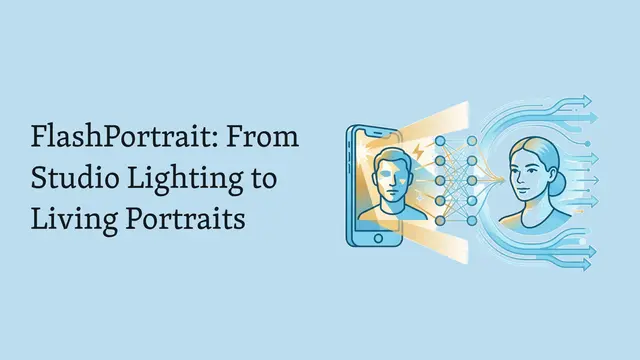
FlashPortrait encompasses two breakthrough approaches in portrait enhancement: first, a neural network that transforms harsh smartphone flash selfies into studio-quality portraits by learning low-frequency lighting residuals through an encoder-decoder architecture; second, a video diffusion transformer system that generates infinite-length, identity-preserving animated talking-head videos with up to 6× acceleration through normalized expression fusion and adaptive latent prediction. Together, these methods democratize professional-grade portrait processing for both still images and dynamic video content.Script
What if your harsh smartphone flash selfie could become a studio masterpiece in seconds, or better yet, transform into a lifelike animated portrait that talks and moves naturally for minutes on end? FlashPortrait makes both possible through breakthrough neural approaches to image and video enhancement.
Let's start by understanding what makes flash portraits so challenging to fix.
Building on this problem, smartphone flash creates four signature issues that degrade portrait quality. Specular highlights produce that telltale greasy look, hard shadows eliminate natural depth, uneven lighting amplifies every imperfection, and the overall result lacks the soft, flattering character of professional studio illumination.
Now here's how the first FlashPortrait approach solves this. An encoder-decoder network with VGG-16 backbone learns to predict the lighting difference between flash and studio portraits as a smooth, low-frequency residual, while skip connections ensure sharp facial features stay intact, delivering studio-quality results with over 96% pixel-level accuracy.
The key insight is training on the right target. By collecting synchronized flash and studio pairs, then using bilateral filtering to separate smooth illumination from skin texture, the network learns only what needs to change, the lighting itself, while data augmentation ensures robust generalization across poses and expressions.
But static enhancement is just the beginning; the modern FlashPortrait tackles infinite-length video.
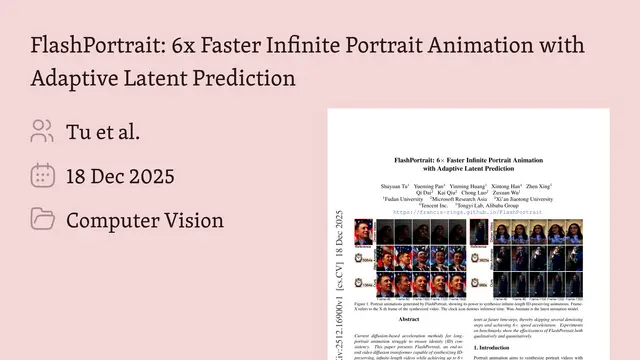
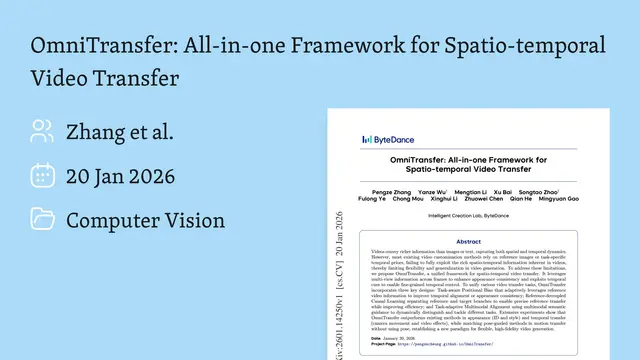
Taking this further, the video animation system extracts identity-agnostic expressions from any driving video, encodes your reference portrait through CLIP, then uses a video diffusion transformer to synthesize talking-head animations. A sliding-window approach with weighted blending scales this to sequences of any length without quality degradation.
Here's the breakthrough that makes infinite video work. Traditional diffusion methods accumulate identity drift as expression features inadvertently carry identity information, so the Normalized Facial Expression Block explicitly aligns the statistical distributions of the two feature streams before fusion, locking in the reference identity even across thousands of frames.
Speed matters for practical deployment. An adaptive latent predictor uses higher-order Taylor series to estimate intermediate denoising steps, dynamically adjusting skip size based on how much the face is moving, this achieves up to 6 times acceleration with almost imperceptible quality degradation.
The results speak for themselves. Over 92% of users prefer FlashPortrait animations across appearance, identity preservation, and expressiveness metrics, validated on multiple challenging datasets, and the system generalizes remarkably well despite being trained on a finite corpus of talking-head footage.
FlashPortrait demonstrates that neural networks can now master both the art of lighting correction and the challenge of infinite, identity-consistent video synthesis, bringing studio-grade portrait enhancement within reach of anyone with a smartphone. Visit EmergentMind.com to explore the technical details and see these methods in action.