Breaking the Modality Barrier
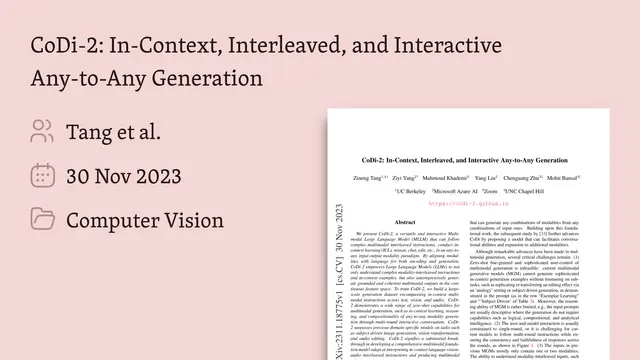
This presentation explores CoDi (Composable Diffusion), a revolutionary approach to multimodal AI that enables any-to-any generation across text, image, video, and audio. Rather than training separate models for every possible input-output combination, CoDi uses clever alignment techniques to compose modalities in a unified framework, achieving synchronized multimodal outputs while maintaining quality across individual modalities.Script
Imagine trying to build a system that can turn any type of media into any other type. Text to video, image to audio, or even combinations like text plus image generating synchronized video and sound. The challenge seems exponential, but the researchers behind this work found an elegant solution that sidesteps the complexity entirely.
Let's start by understanding why this problem has been so difficult to solve.
Previous approaches faced a fundamental scaling problem. With 4 modalities, you potentially need models for 16 different input-output combinations. Worse yet, finding training data for combinations like image to audio is nearly impossible, and chaining multiple models together creates synchronization nightmares.
The ideal solution would be a single model that maintains the quality of specialized systems while enabling seamless composition across modalities. This means generating perfectly synchronized video and audio from text, or creating images from audio descriptions that were never seen during training.
The authors' breakthrough was realizing they didn't need to solve every combination directly.
Instead of building one massive model, they built specialized diffusion models for each modality and then connected them through two key alignment mechanisms. This approach lets them maintain the strength of focused models while enabling powerful composition.
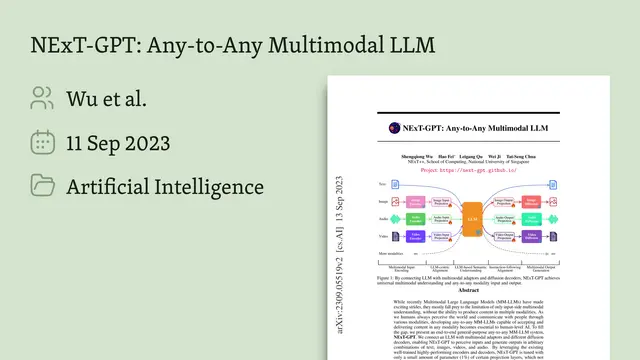
This overview shows the remarkable flexibility of their approach. Notice how any modality can serve as input and any combination can be generated as output. The colored arrows represent just a few examples of the exponential possibilities their system enables through composition rather than explicit training.
The first key innovation addresses how to handle multiple input types simultaneously.
Rather than training encoders for every possible modality pair, they use text as a universal hub. Starting with pre-trained CLIP for text-image alignment, they only need to train audio-text and video-text encoders. This reduces the complexity from quadratic to linear while enabling zero-shot combinations.
The mathematical elegance lies in simple weighted interpolation. Once all prompt encoders map to the same embedding space through text bridging, any combination of inputs can be blended with learnable weights, creating rich multi-modal conditioning that the system never explicitly trained on.
The second innovation enables synchronized multi-output generation.
For joint generation, each modality's diffusion process can attend to the latent states of other modalities through learned environment encoders. Critically, they freeze the original diffusion model weights and only train the cross-attention parameters, preserving the quality of individual modalities while enabling coordination.
The training follows a clever bridged sequence. First, they train image-text joint components, then freeze the text diffuser and train audio components using text-audio data. Finally, they train video components using audio-video data. This creates a chain of aligned latent spaces that enables composition.
Let's examine how they adapted diffusion models for each modality.
Each modality required thoughtful architectural choices. Video extends the image architecture with temporal modules and a novel latent shift technique for consistency. Audio cleverly reuses image architectures by treating spectrograms as single-channel images, while text uses 1D convolutions adapted for sequential data.
The training leverages massive existing datasets, with each modality pair drawing from appropriate sources. The beauty of the bridged approach is that they don't need every possible combination in their training data.
Now let's see how well this ambitious approach actually works in practice.
These examples demonstrate that CoDi maintains competitive quality for traditional single-modality tasks. The text-to-image generation rivals Stable Diffusion, the image captioning produces coherent descriptions, and notably, the audio-to-image generation creates visually sensible interpretations of sounds, showing the power of their cross-modal alignment.
Remarkably, CoDi doesn't sacrifice individual modality performance for its compositional abilities. It achieves competitive results across all single-modality benchmarks and even sets new standards in audio captioning, proving that the unified architecture enhances rather than compromises specialized capabilities.
The real magic emerges in multi-modal scenarios. The authors introduce coherence metrics showing that jointly generated outputs are more aligned than independently created content. This means their video and audio outputs are actually synchronized, not just co-occurring.
These examples showcase the system's versatility. Users can provide rich, multi-modal prompts and receive synchronized, multi-modal outputs that would require careful orchestration of multiple separate systems with traditional approaches.
Like any powerful technology, CoDi comes with important considerations and constraints.
The authors acknowledge that synchronized multimodal generation raises serious concerns about misinformation and deepfakes. Additionally, biases from training data can now propagate across multiple output modalities simultaneously, potentially amplifying harmful stereotypes in ways that single-modality systems cannot.
Finally, let's consider what this breakthrough means for the broader field.
CoDi represents a fundamental shift from building separate models for each task to creating composable systems that emerge capabilities through alignment. This paradigm could extend beyond these 4 modalities to include sensors, robotics, or other data types, making it a template for future multimodal AI development.
The researchers have shown us that the exponential complexity of multimodal AI can be tamed through elegant composition rather than brute force enumeration. CoDi proves that by aligning the right spaces, we can achieve remarkable emergent capabilities that exceed the sum of their parts. To dive deeper into this and other cutting-edge AI research, visit EmergentMind.com to explore the latest breakthroughs shaping our technological future.