Seeing the Unseen: How Optical Flaws Reveal Real Transients in Century-Old Sky Photos
This presentation explores a novel technique for validating fast optical transients in historical photographic plates by using coma aberration as a diagnostic tool. The author demonstrates how the characteristic comet-like distortions produced by telescope optics can discriminate genuine astronomical events from plate artifacts, revealing eleven mysterious transient detections clustered in space and time between 1949 and 1953. The work establishes a new morphological framework for archival transient searches and raises intriguing questions about the physical nature of these brief flashes of light captured on plates nearly a century old.Script
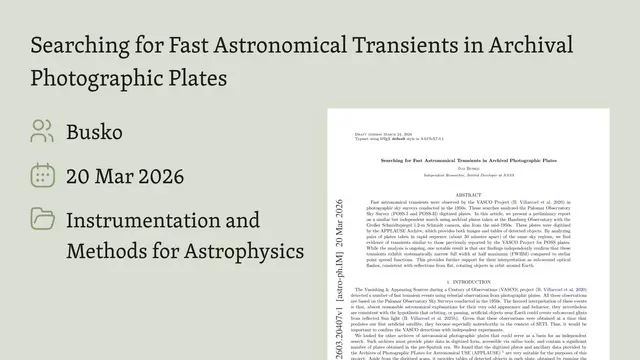
Century-old glass plates from the 1930s captured mysterious flashes of light that appear for one exposure and vanish the next. The challenge: how do you prove these are real astronomical events and not just emulsion defects or scratches on fragile plates nearly a hundred years old?
The solution lies in an optical imperfection called coma aberration. In non-Schmidt telescopes, stars far from the optical axis develop characteristic comet-like tails that always point away from the plate center. Real light entering the telescope inherits this signature; artifacts on the plate surface do not.
The author analyzed 532 plate pairs from Hamburg Observatory, applying strict morphological criteria: does the candidate show coma aligned with the plate center, do its wings and tails match nearby stars of similar brightness, and does it display the expected brightness-dependent distortion? Eleven transients passed every test.
The validated transients revealed something unexpected: seven clustered near one region of sky, four near another, and all eleven appeared between 1949 and 1953 despite plates covering 1934 to 1957. This clustering in both space and time demands explanation.
Some transients appear sharper than the stars around them, a paradox with a possible resolution: if these flashes lasted only seconds rather than the full 15-minute exposure, atmospheric turbulence would have less time to blur them. The coma remains because it is an optical property of the telescope itself.
The physical origin remains uncertain. The author has ruled out plate artifacts, asteroids, and meteors, leaving candidates like sunlight glints from tumbling space debris or atmospheric phenomena. Whatever these transients are, the coma morphology proves they are real light that entered the telescope. To explore more findings like these and create your own videos, visit EmergentMind.com.