Isotopic Evidence for a Cold and Distant Origin of the Interstellar Object 3I/ATLAS
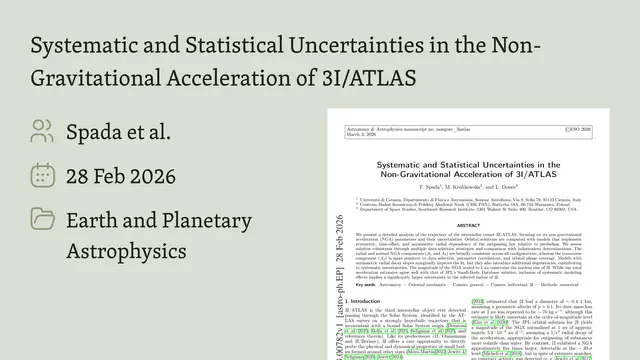
This presentation examines the extraordinary isotopic signatures found in interstellar object 3I/ATLAS using JWST and ALMA observations. The analysis reveals extreme deuterium-to-hydrogen and carbon-12-to-carbon-13 ratios that are dramatically different from any Solar System material, pointing to formation in a cold, metal-poor environment over 10 billion years ago in the early Milky Way. These findings provide the first direct compositional evidence of ancient planetary system formation under chemical conditions radically different from our own Solar System, offering a glimpse into the diversity of ice chemistry across galactic history.Script
A visitor from beyond our Solar System arrived in 2025, and its chemical fingerprint tells a story written 10 billion years ago. The interstellar object 3I/ATLAS carries isotopic ratios so extreme they can only have formed in the cold, metal-poor disk of the young Milky Way.
JWST and ALMA spectroscopy revealed deuterium enrichment in water ice more than an order of magnitude beyond anything we've seen in our own comets. The carbon isotope ratio is equally startling, indicating formation before the interstellar medium was enriched by dying stars.
While Solar System comets are water-rich, 3I/ATLAS is dominated by carbon monoxide and carbon dioxide. This hypervolatile-rich composition reflects formation conditions with unusually high carbon-to-oxygen ratios, unlike anything in our planetary neighborhood.
These chemical signatures point to a specific birthplace and time.
The extreme deuterium enrichment requires grain-surface chemistry at temperatures below 30 Kelvin under high ionization. The carbon isotope ratio can only be explained by accretion before asymptotic giant branch stars enriched the interstellar medium with carbon-13, placing formation at the dawn of the Milky Way disk over 10 billion years ago.
What makes 3I/ATLAS extraordinary is not just its age, but that it avoided thermal processing for billions of years, preserving a direct record of chemical conditions in the young Milky Way. It proves that planetary building blocks formed under wildly different conditions across the Galaxy, with complex organic precursors accessible long before our Solar System existed.
An icy traveler from the ancient Galaxy has delivered a message written in isotopes: planet formation began with chemistry we've never witnessed, in places and times far beyond our cosmic neighborhood. Visit EmergentMind.com to explore more research and create your own videos.