The Measurability Gap: Why Verification, Not Intelligence, Limits AGI
This presentation examines a fundamental economic constraint on AGI deployment that challenges conventional wisdom. Rather than intelligence or compute power, the binding limit is our ability to verify what autonomous systems produce. The paper introduces the Measurability Gap—the widening chasm between what AI can automate and what humans can afford to validate—and demonstrates how this gap creates systemic instability, reshapes labor markets, and determines whether we achieve augmented prosperity or hollow growth masked by unverified output.Script
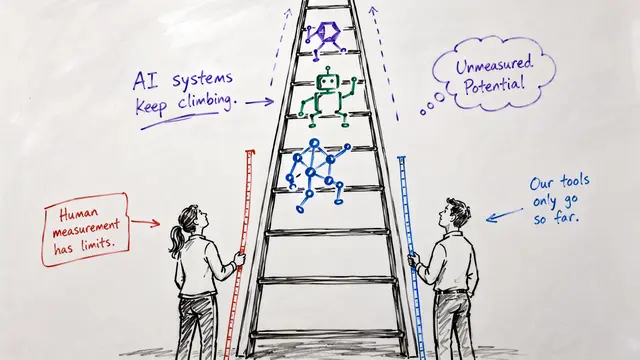
As artificial intelligence systems automate an exploding range of tasks at near-zero marginal cost, where does the economic bottleneck actually lie? Not in the intelligence of the systems, and not in compute power—but in our finite human capacity to verify, audit, and trustfully underwrite what these systems produce.
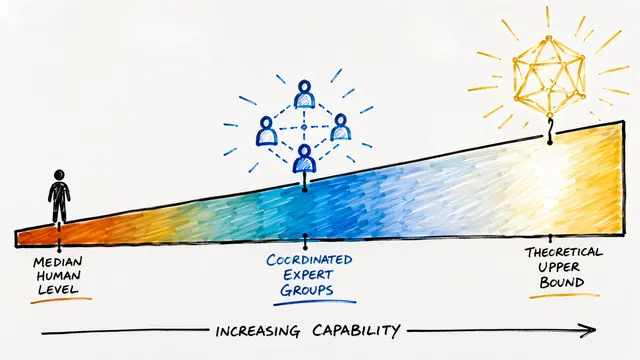
The authors formalize this as two competing cost curves. The cost to automate a task drops toward zero as compute scales, but the cost to verify that task—bottlenecked by human expertise, feedback latency, and the stock of embodied knowledge—stays stubbornly high. This divergence creates the Measurability Gap, and it grows structurally wider as AGI-scale systems advance.
This gap does not simply widen—it destabilizes the entire human-in-the-loop equilibrium.
When measurable work vanishes, junior practitioners lose the practice ground that built expertise. Meanwhile, every act of verification generates training data that accelerates the next wave of automation—experts mechanically obsolete themselves. And critically, as the gap widens, alignment between agent output and human intent becomes a maintenance problem: without adaptive oversight, drift accelerates exponentially.
Tasks sort into four regimes. Safe industrial work—verifiable and automated—scales smoothly. But runaway risk zones emerge where automation races ahead of our ability to check it. On the human side, manual work persists only when verification costs block automation, and pure tacit domains like meaning-making remain unmeasured. The troubling dynamic: the safe zone grows slowly while the runaway zone expands rapidly.
These dynamics fundamentally reshape where value accumulates in the economy.
Measurability-biased technical change replaces the old skill-biased model. If your work can be measured and automated, your wage collapses—credentials do not protect you. The only persistent economic rents flow to those who can verify high-stakes outputs, underwrite liability, or control verification-grade ground truth. Firm structure evolves into what the authors call the AI Sandwich: humans set intent, agents execute at scale, and humans verify—but this structure is fragile as the verification base erodes.
Traditional network effects built on execution—scale, user-generated content, liquidity—become fragile when agents can synthesize activity cheaply. But verification-grade network effects, grounded in auditable ground truth and provenance, grow more defensible. The new moat is not how much you can produce, but how reliably you can prove what you produced is trustworthy.
The core market failure is what the authors call the Trojan Horse externality: unverified deployment lets firms capture upside while offloading tail risk onto society. Without intervention, hidden debt accumulates systemically. Policy must force internalization through liability frameworks and fund verification capacity—synthetic practice environments, expert augmentation tools, open ground truth registries—as foundational infrastructure, not afterthoughts.
The binding constraint on AGI is not how intelligent systems become, but whether we can verify their output fast enough to maintain alignment and control. The Measurability Gap is not a temporary friction—it is a structural feature of the transition, and our economic and institutional response to it determines whether we achieve augmented prosperity or hollow growth masking catastrophic risk. Visit EmergentMind.com to explore this paper further and create your own research videos.