ByteRover: Agent-Native Memory Through LLM-Curated Hierarchical Context
ByteRover introduces a radical redesign of memory for large language model agents by embedding memory curation directly into the agent's reasoning loop. Rather than treating memory as an external database, ByteRover creates a hierarchical Context Tree that the agent itself maintains, annotates, and retrieves from. This agent-native architecture achieves 96.1% accuracy on long-horizon memory benchmarks while eliminating semantic drift, preserving provenance, and enabling crash-safe recovery—all without external vector databases.Script
Most memory systems for language model agents treat memory as a separate service, a black box that stores and retrieves information. This architectural split creates a hidden problem: the agent reasons in one semantic space while memory lives in another, leading to drift, lost context, and fragile recovery when things break.
ByteRover inverts this paradigm entirely. The agent doesn't query memory—it owns it. Every knowledge entry, every relationship, every piece of provenance is created and maintained by the agent itself as part of its reasoning process, giving it complete control over what it knows and why.
At the heart of this architecture is a hierarchical structure designed for how agents actually think.
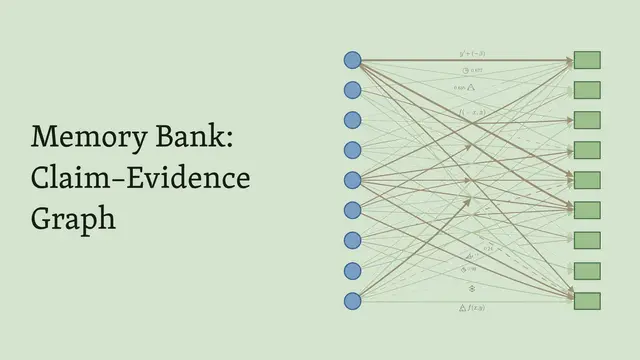
The Context Tree organizes knowledge as a file-based graph with explicit relationships and metadata. But it's alive—each entry tracks its own importance through access patterns, matures through validation tiers, and decays in relevance over time. This adaptive lifecycle means the agent always retrieves what matters most right now.
Efficiency comes from a 5-tier retrieval pipeline that escalates only when necessary. Most queries hit the cache or full-text search in milliseconds. The language model only engages for truly complex reasoning, keeping median latency below 2 seconds even with 23,000 entries in memory.
On LoCoMo, a challenging long-horizon memory benchmark, ByteRover achieves 96.1% accuracy. The gains are sharpest where structure matters most—multi-hop queries that require following chains of relationships, and temporal questions where knowing when something happened is as important as knowing what happened. The explicit relation graph and adaptive lifecycle make these hard problems tractable.
ByteRover proves that when agents own their memory, they don't just remember better—they reason better, because memory and reasoning finally speak the same language. Visit EmergentMind.com to explore this work further and create your own research video presentations.