Attack Success Rate: Measuring AI Vulnerability
This presentation explores Attack Success Rate (ASR), the fundamental metric for quantifying how often adversarial attacks succeed against AI systems. We examine how ASR is defined and measured across different domains—from speech recognition to large language models—and reveal why modern attacks achieve success rates above 90% even against state-of-the-art defenses. The talk demonstrates how ASR serves as both a vulnerability indicator and a critical benchmark for evaluating the security of deployed AI systems.Script
Imagine testing a bank vault by hiring professional safecrackers. If 95 out of 100 attempts succeed, you have a serious problem. In AI security, we face exactly this scenario—and Attack Success Rate tells us just how vulnerable our systems really are.
Let's start by understanding what we're actually measuring.
At its core, Attack Success Rate quantifies what fraction of adversarial manipulations actually work. It's computed as successful attacks divided by total attempts, typically expressed as a percentage. But here's the critical nuance: what counts as success depends entirely on the attacker's objective and the system being targeted.
The definition shifts dramatically across domains. For speech recognition, a targeted attack only succeeds if the system transcribes the exact phrase the attacker chose. In language models, success might mean triggering a backdoor or bypassing safety guardrails to generate harmful content.
Now let's examine how researchers actually measure and maximize ASR.
Attackers employ sophisticated optimization techniques to maximize their success rate. Some methods use iterative gradients to craft precise perturbations, while others exploit psychoacoustic properties to hide malicious changes. Advanced techniques even disentangle features or transform prompt structures to evade detection while maintaining high effectiveness.
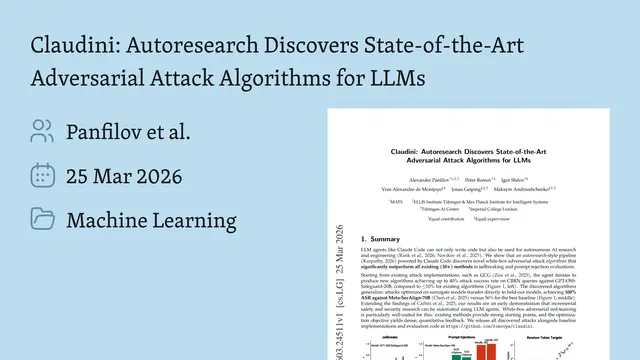
Here's where theory meets troubling reality. Modern attacks consistently achieve success rates between 85 and 98 percent, even against the latest generation of models with state-of-the-art safeguards. Some targeted attacks on vision systems achieve near-perfect success, demonstrating just how vulnerable our deployed systems remain.
But raw ASR doesn't tell the complete story.
Researchers have developed refined metrics to capture nuances that raw ASR misses. Attack Success Rate Difference isolates the true impact of backdoors by comparing poisoned and clean models. Non-detectable ASR only counts attacks that slip past anomaly detection, while First Attack Success Rate measures practical, single-shot effectiveness.
Despite intense research, defenses consistently fall short because attacks exploit fundamental vulnerabilities. They transfer across different model types, maintain normal-looking distributions to evade detection, and exploit the inherent biases in how models learn. Current alignment techniques simply cannot generalize fast enough to cover the expanding attack surface.
Attack Success Rate reveals an uncomfortable truth: our most advanced AI systems remain critically vulnerable to adversarial manipulation. Understanding and tracking this metric is essential for building genuinely robust AI. To explore the latest research on AI security and adversarial robustness, visit EmergentMind.com.