Gemini in the Lab: Accelerating Hard Science
An overview of how frontier LLMs like Gemini Deep Think are moving beyond simple coding help to actively solving open problems, refuting conjectures, and detecting complex proof flaws in theoretical research.Script
What happens when a researcher treats an AI not just as a search engine, but as a technical co-author capable of spotting fatal flaws in a proof or solving a decades-old geometry conjecture? Today we explore how Gemini is accelerating scientific discovery through elite-level collaboration.
While previous models were limited to basic drafting, this research demonstrates that Gemini can now tackle high-leverage tasks like finding counterexamples or deriving analytic expressions in physics and math. The researchers focused on whether these models can provide meaningful acceleration for experts in fields like cryptography and theoretical computer science.
To achieve these results, the authors developed a specific set of strategies they call the research playbook.
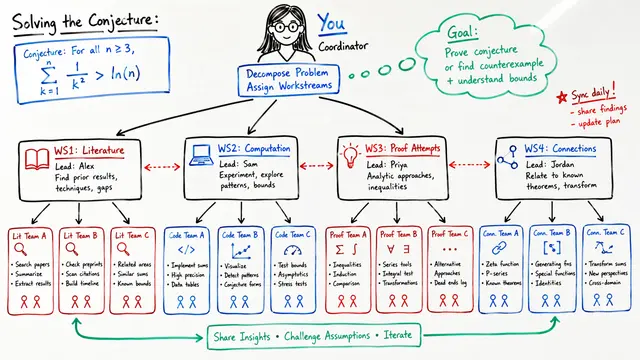
The researchers found success by moving beyond simple prompts to complex workflows, such as adversarial reviewer modes where the model critiqued its own hallucinations. They also used neuro-symbolic loops, where the AI writes code to test its own mathematical proposals and uses the execution errors to refine its next attempt.
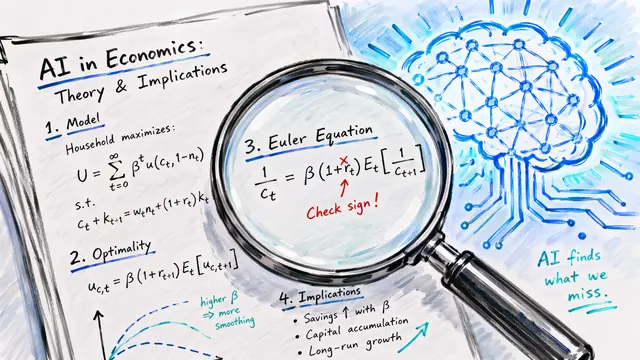
In one striking case study, the authors used Gemini as an adversarial reviewer to examine a cryptography paper. The AI successfully identified a fatal mismatch between the perfect consistency required by the definition and the statistical consistency actually achieved by the construction.
Moving to online algorithms, the researchers used Gemini to refute a conjecture about marginal gains. By generating and verifying an explicit counterexample using small-scale simulations, the model proved the proposed proof path was invalid.
The work also highlights Gemini's ability to cross-pollinate ideas from different fields. For a Steiner tree problem, the model suggested using the Kirszbraun Extension Theorem, a advanced geometric insight that resolved the Simplex is Best conjecture.
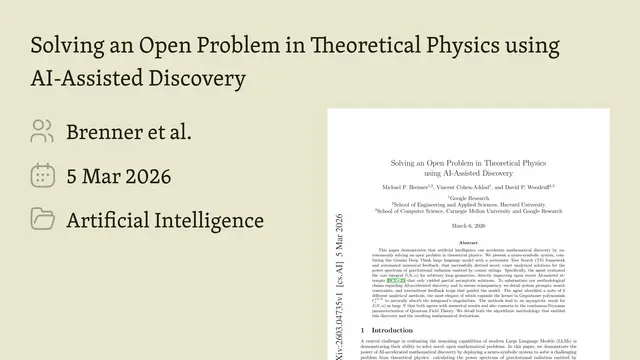
In the realm of physics, a neuro-symbolic derivation successfully evaluated difficult singular integrals for cosmic string spectra. The authors used a tree-search system to explore different derivation paths, with Gemini pruning 80 percent of the inefficient branches automatically.
Despite these successes, the authors emphasize that these models are still susceptible to hallucinations and noise. Correctness still requires standard mathematical verification and significant orchestration by human experts to stay on track.
The authors conclude that while AI is not autonomous yet, it is becoming a foundational collaborator for theoretical discovery. Go to EmergentMind.com to learn more.