Mapping Dark Matter with JWST
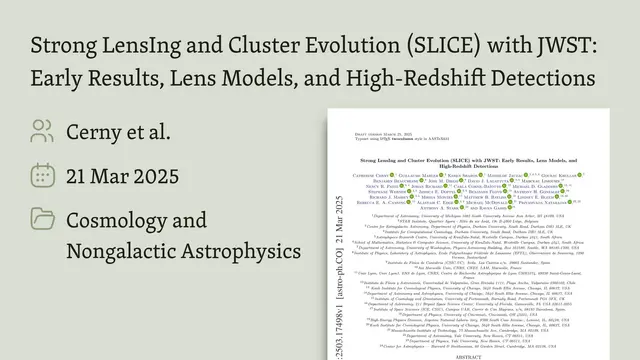
This lightning talk explores the first strong gravitational lensing model of galaxy cluster PSZ2 G118.46+39.32, combining JWST and HST observations to trace dark matter distribution. The researchers used 11 multiply-imaged systems and 60 lensing constraints to build a detailed mass model, revealing a bimodal cluster structure that provides insights into the merger state by comparing mass centroids with X-ray gas distributions.Script
Imagine trying to weigh something invisible that's scattered across millions of light years. Dark matter makes up most of the universe's mass, but we can only detect it through its gravitational effects on light itself.
Building on this challenge, the researchers focused on a specific galaxy cluster that acts like a cosmic magnifying glass. PSZ2 G118.46+39.32 sits at redshift 0.3967 and shows a distinctive two-part structure that makes it perfect for studying how dark matter behaves during cluster mergers.
Let's explore how gravitational lensing transforms distant galaxies into cosmic measuring tools.
The beauty of strong lensing lies in its directness - each multiply-imaged galaxy system provides geometric constraints on the mass distribution. The researchers used Lenstool with MCMC sampling to find the best-fit parametric model by minimizing the differences between observed and predicted image positions.
The combination of JWST and archival HST data proved transformative for this analysis. JWST's infrared sensitivity revealed lensed sources that were completely invisible to HST, dramatically increasing the number of constraints available for the mass model.
This stunning composite image showcases the power of multi-wavelength observations, with JWST NIRCam and HST data revealing the intricate web of gravitational lensing. Each colored system represents a different background galaxy that's been multiply-imaged by the cluster's gravity, while the circled clumps mark substructures within the lensed arcs that provide additional constraints on the mass distribution.
Now we'll see how the researchers transformed these observations into a detailed map of the cluster's mass.
The mass model treats the cluster as a sum of individual halos, each with its own parametric profile. The researchers selected cluster member galaxies using red sequence colors, then applied Faber-Jackson scaling relations to connect galaxy properties to their mass contributions.
The modeling process balanced rich observational constraints against fundamental limitations in the data. While the researchers had an impressive 90 total positional constraints, the lack of spectroscopic redshifts prevented them from achieving even tighter model precision.
Let's examine what this detailed mass model revealed about the cluster's structure and merger state.
The model achieved excellent agreement with observations, with sub-arcsecond precision in reproducing the lensed image positions. The mass measurements reveal that the eastern sub-cluster is slightly more massive than the western one, confirming the bimodal structure seen in the imaging.
The comparison between mass and gas centroids tells a compelling story about this cluster's evolutionary state. Unlike the famous Bullet Cluster where dark matter and gas are dramatically separated, PSZ2 G118.46+39.32 shows the components still closely aligned, suggesting we're witnessing the calm before the merger storm.
This work represents a significant advance in our ability to map dark matter in galaxy clusters. The combination of JWST's infrared sensitivity with proven lensing techniques opens new windows for studying the invisible universe at unprecedented detail.
The researchers have laid important groundwork that points toward even more precise measurements.
The authors clearly outline the path forward, with spectroscopic redshift measurements standing as the most critical next step. These observations would dramatically tighten the model constraints and enable even more precise mass measurements throughout the cluster.
Beyond this specific cluster, the work establishes a powerful template for how JWST can revolutionize gravitational lensing studies. The methodology developed here will enable systematic surveys of dark matter distribution across the universe's largest structures.
The technical execution demonstrates remarkable efficiency in extracting maximum information from the available observations. The researchers managed to constrain 45 model parameters using 90 observational constraints, achieving precision that rivals the best lensing models in the literature.
The model passes multiple validation tests that build confidence in its physical realism. Beyond simply reproducing the lensing observations, the resulting mass distribution shows the expected correlations with galaxy light and maintains physically reasonable scaling relationships across different mass scales.
Several methodological innovations distinguish this work from previous cluster lensing studies. The use of internal clumps within lensed arcs as additional constraints represents a particularly clever way to extract more information from the same observational data.
The researchers are refreshingly transparent about their model's limitations. The absence of spectroscopic redshifts represents the most significant constraint on achieving even higher precision, while the decision to exclude certain lensing features shows careful attention to model reliability over completeness.
This work beautifully demonstrates how JWST is transforming our ability to map the invisible universe through gravitational lensing. The researchers have created the most detailed mass model yet for PSZ2 G118.46+39.32, revealing a cluster caught in the calm moments before a major merger. To explore more cutting-edge research in astrophysics and cosmology, visit EmergentMind.com where invisible matter becomes visible through the lens of science.